Environmental engineering colleges in Karnataka are real, but the undergraduate seat is far rarer than the search volume suggests. VTU's own EV branch code shows up mostly at postgraduate level across its affiliated colleges. The one confirmed KCET-admitted undergraduate seat sits at a different university entirely, under a slightly different name.
Looking at the bigger picture? Our guide to the best engineering colleges in Karnataka compares KCET tier-wise cutoffs, COMEDK options, and real fee data across Bengaluru, Mangalore, Mysore, and north Karnataka for 2027.
Why Environmental Engineering Colleges in Karnataka Are Mostly a Postgraduate Story
Open VTU's stream-wise UG programme list and Environmental Engineering, course code EV, sits inside the Civil Engineering stream alongside Ceramics and Cement Technology, Construction Technology and Management, and Mining Engineering. The code exists on paper. What is harder to find is a VTU-affiliated college actually running it as a KCET-admitted undergraduate branch rather than as a postgraduate specialisation layered onto an existing Civil Engineering department.
University Visvesvaraya College of Engineering's own course listing is a clear example. UVCE names nine undergraduate B.E. branches directly, and Environmental Engineering is not among them. It appears instead inside UVCE's broader Master of Engineering and M.Tech offerings. A candidate searching for an undergraduate Environmental Engineering seat at one of Karnataka's oldest and most respected government engineering colleges will not find one there, despite the branch name showing up prominently in the college's combined course tag list that mixes undergraduate and postgraduate programmes together.
3 Reasons This Branch Is Rarer Than It Looks
1. Aggregator data itself confirms the postgraduate skew
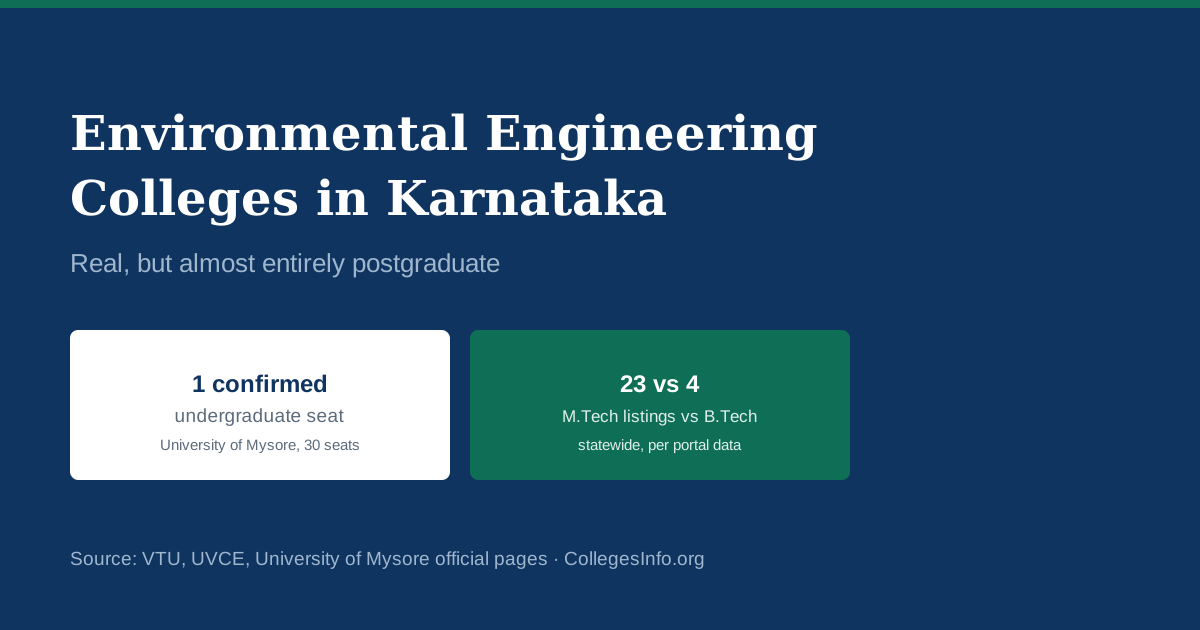
A filtered breakdown on one large education portal, checked directly, shows Karnataka's Environmental Engineering degree listings split as 23 M.E./M.Tech programmes against only 4 B.E./B.Tech programmes. That is not a close split. For every confirmed undergraduate seat in this branch, there are close to six postgraduate ones. A candidate who assumes the branch is available in the same proportion as core branches like Mechanical or Civil is working from the wrong base rate entirely.
2. The one confirmed KCET seat sits at a different university, under a different name
The School of Engineering, University of Mysore, offers a Bachelor of Engineering titled Civil Environmental Engineering, a four-year, KCET-admitted undergraduate programme recognised by AICTE with a stated intake of 30 seats. This is a genuine, confirmed undergraduate seat, but it sits at a university affiliated separately from VTU, and its name combines Civil and Environmental rather than using VTU's plain EV branch label. A candidate searching only for "Environmental Engineering" by VTU's exact branch name would miss this seat entirely, because the qualifying institution names it differently.
3. A separate discipline with a nearly identical name competes for the same search
Bangalore University runs a Department of Environmental Science, established in 1992, offering M.Sc and Ph.D programmes rather than a B.E. or M.Tech engineering degree at all. The department's own page describes decades of work on lake rejuvenation committees, environment clearance committees under the Ministry of Environment, Forest and Climate Change, and advisory roles on environmental journals; genuine, substantive work, but in environmental science, not environmental engineering. A student or parent searching for engineering options can land on this science department by keyword overlap alone and assume it is the same field.
The Regulatory Body That Actually Hires This Branch
The employer that most directly shapes demand for environmental engineering graduates in Karnataka is the Karnataka State Pollution Control Board, the statutory body responsible for enforcing water and air pollution control law and granting consent for industrial operations across the state. KSPCB and equivalent regulatory functions inside larger infrastructure and industrial firms represent a fundamentally different hiring pattern from the IT and product-engineering roles that drive demand for branches like Computer Science. Regulatory bodies hire in small, steady numbers tied to sanctioned government posts and statutory requirements, not the large annual graduate intakes that private-sector employers absorb.
This structural difference is the most direct explanation available for why Karnataka's engineering colleges have not scaled undergraduate Environmental Engineering the way they have scaled Computer Science or Electronics. A four-year undergraduate pipeline needs a broad, growing employer base to justify seat expansion. A narrow, statutorily-capped regulatory hiring base does not generate that pressure, which likely explains why the subject has settled at the postgraduate stage, where a smaller, self-selected intake of already-qualified Civil engineers can specialise without colleges needing to guess at undergraduate placement demand years in advance.
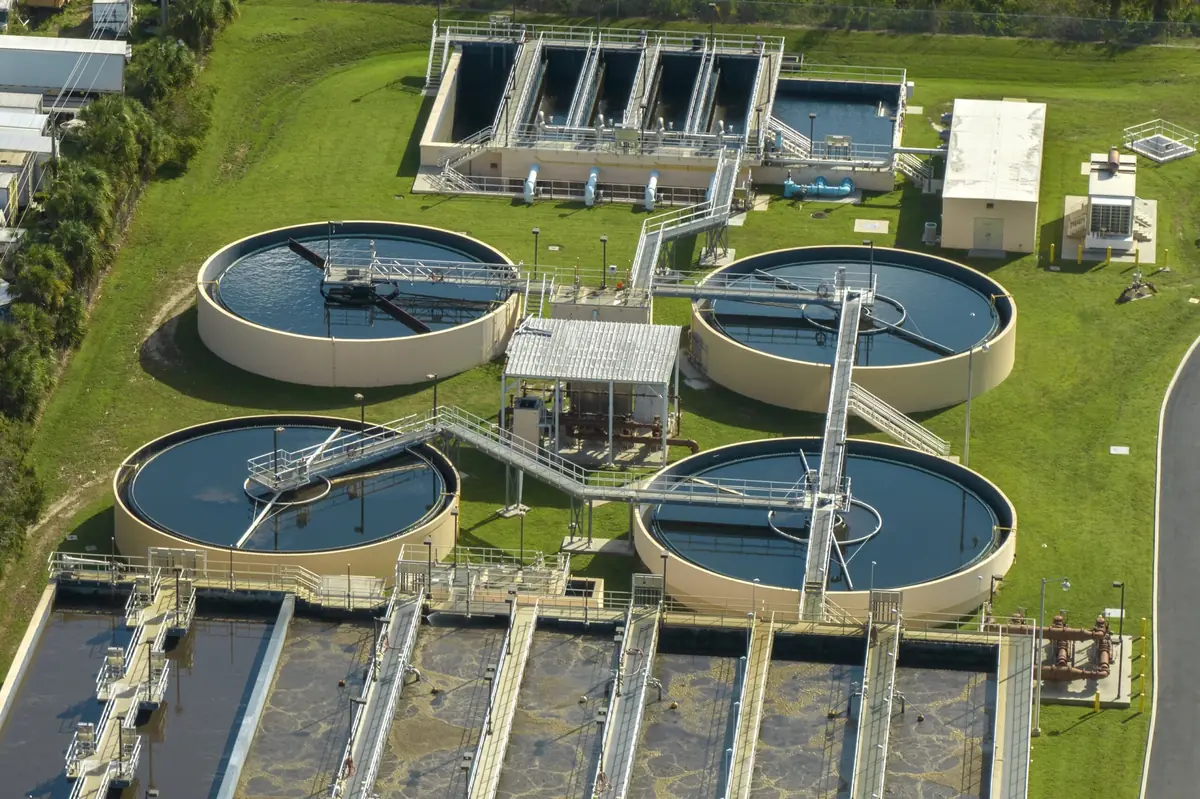
Circular clarifier tanks at a wastewater treatment plant, the kind of infrastructure environmental engineering graduates go on to design and operate.
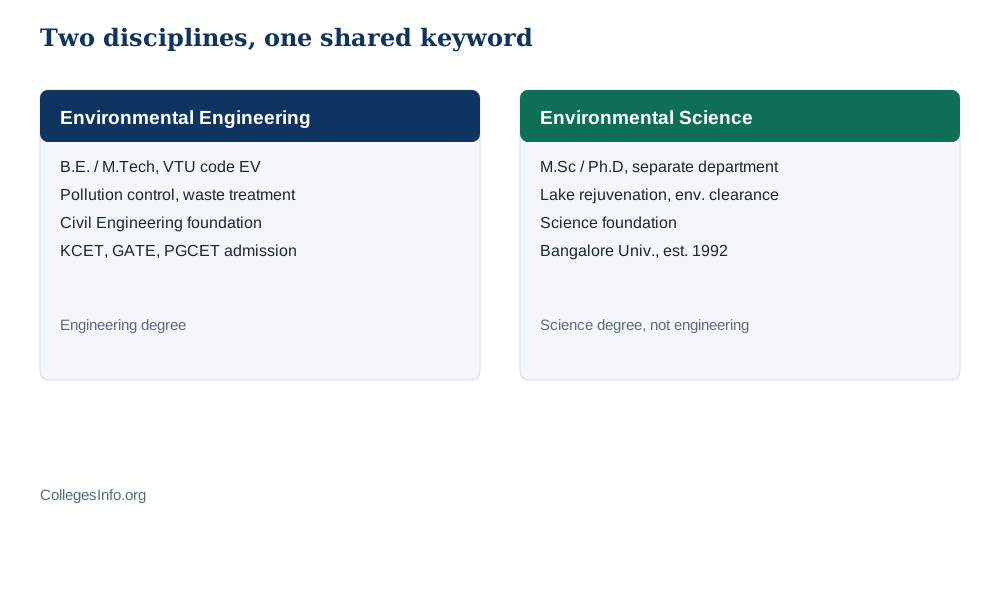
Environmental Engineering and Environmental Science are different degrees, different departments, and different career paths.
1 Confirmed Undergraduate Seat, From Its Own Official Listing
School of Engineering, University of Mysore
The Bachelor of Engineering in Civil Environmental Engineering at the School of Engineering, University of Mysore is confirmed as a four-year, full-time undergraduate programme recognised by AICTE, admitted through KCET, with a stated intake of 30 seats. Eligibility follows the standard Karnataka pattern: a pass in 10+2 with Physics and Mathematics compulsory, alongside one of Chemistry, Biotechnology, Biology, Technical Vocational subjects, Computer Science, Information Technology, Informatics Practices, Agriculture, Engineering Graphics or Business Studies, with a minimum of 45% aggregate marks, or 40% for reserved categories.
This is the clearest KCET-admitted route into environmental-engineering content in Karnataka confirmed in this research. It sits outside the VTU affiliation structure that governs most of the engineering colleges already covered in our guides to cyber security engineering and biomedical and medical electronics engineering, which is itself worth noting: a candidate who has only checked VTU's seat matrix for the EV code would miss this University of Mysore seat entirely, because it sits under a separate affiliating university with its own branch name and its own KCET listing.
Where VTU's EV Code Actually Shows Up
VTU-affiliated colleges that do maintain Environmental Engineering content overwhelmingly do so at the M.Tech level, layered onto an existing Civil Engineering department rather than as a separate undergraduate intake. This matches UVCE's own course structure, and follows the same pattern already documented for mining engineering, another Civil-stream VTU code that turned out to have only one confirmed undergraduate provider in the entire state.
| Route | Example | Level | Admission |
|---|---|---|---|
| B.E., Civil Environmental Engineering | School of Engineering, University of Mysore | Undergraduate | KCET, 30 seats |
| M.Tech / M.E., Environmental Engineering | UVCE and most VTU-affiliated colleges offering the branch | Postgraduate | GATE, PGCET |
| M.Sc, Environmental Science | Bangalore University, Department of Environmental Science | Postgraduate, different discipline | University-level admission |
Reading this table against a search for "environmental engineering colleges in Karnataka" explains why the results feel scattered. Three distinctly different things, an undergraduate engineering seat at one university, a postgraduate engineering specialisation at several others, and a postgraduate science department at a third, all answer to overlapping keywords.
Why This Branch Stays Small
Environmental Engineering's practical scope in India runs through pollution control, wastewater treatment, solid waste management and environmental impact assessment work, most of which sits inside regulatory bodies such as state pollution control boards, environmental consultancies, and infrastructure firms rather than the broad private-sector hiring base that core branches like Computer Science or Mechanical Engineering draw on. That narrower employment base likely explains why VTU-affiliated colleges have concentrated the subject at postgraduate level, where a smaller, more targeted intake of students already holding a Civil Engineering foundation can specialise, rather than running a separate four-year undergraduate pipeline with uncertain placement demand.
The University of Mysore's decision to combine Civil and Environmental into one undergraduate branch name reflects the same practical logic from a different angle: rather than run environmental engineering as a standalone specialisation competing for KCET applicants against better-known branches, it sits inside a broader Civil-based degree that keeps career options wider for an eighteen-year-old choosing a first branch.
How Environmental Engineering Compares Across Karnataka's Civil-Adjacent Codes
VTU's Civil Engineering stream carries five distinct codes: plain Civil Engineering, Ceramics and Cement Technology, Construction Technology and Management, Environmental Engineering, and Mining Engineering. Of these, plain Civil Engineering is the only one with wide undergraduate presence across dozens of colleges statewide. The other four sit at the margins, each confirmed in this site's research to have a thin undergraduate footprint.
| VTU code | Programme name | Undergraduate presence in Karnataka |
|---|---|---|
| CV | Civil Engineering | Wide, dozens of colleges statewide |
| EV | Environmental Engineering | Thin, mostly postgraduate at VTU colleges |
| MI | Mining Engineering | One confirmed college statewide |
| CT | Construction Technology & Management | Thin, limited standalone presence |
| CC | Ceramics and Cement Technology | Thin, limited standalone presence |
This pattern, one dominant branch code carrying most of a stream's undergraduate seats while several adjacent codes exist mostly on paper or at postgraduate level, is not unique to Civil Engineering. The same shape appears in the Mechanical stream, where Robotics and AI Engineering and adjacent codes remain new and thin against a much larger plain Mechanical Engineering base. A candidate scanning a KCET option list should treat every unfamiliar branch code inside a familiar stream as a signal to verify undergraduate presence directly, rather than assuming parity with the stream's dominant branch.
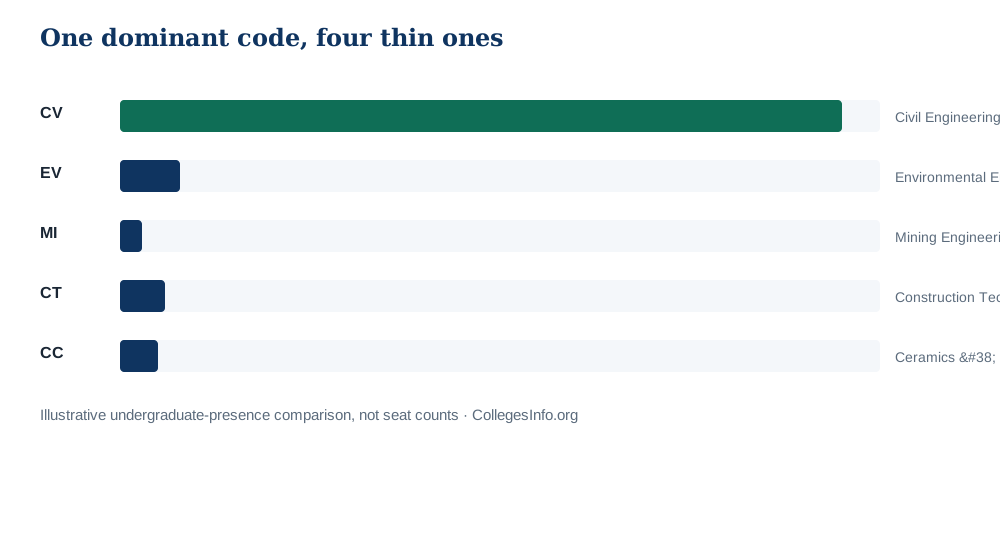
Plain Civil Engineering carries the stream; four adjacent codes have thin or postgraduate-only presence.
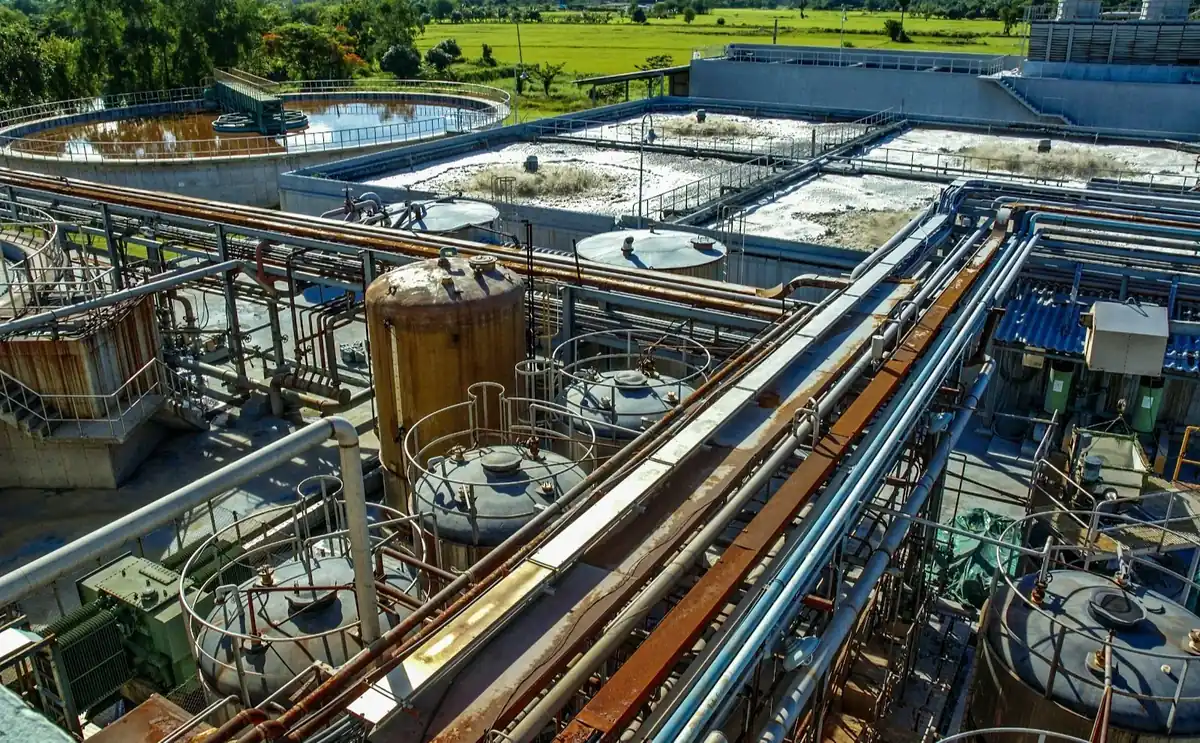
Environmental Engineering's real-world output: treatment plants like this one, not a common KCET seat.
EV sits alongside Ceramics and Cement Technology and Mining Engineering, all Civil-stream codes with thin undergraduate presence.
Eligibility and Admission Routes
The University of Mysore's B.E. Civil Environmental Engineering follows standard Karnataka engineering eligibility: 10+2 with Physics and Mathematics compulsory alongside one of several optional subjects, 45% aggregate for general category candidates and 40% for SC, ST and OBC categories, admitted through KCET. This matches the eligibility pattern already established across other specialised branches covered on this site, including the instrumentation engineering eligibility route, though University of Mysore's affiliation sits entirely outside VTU's structure.
Candidates aiming for the postgraduate route into Environmental Engineering at VTU-affiliated colleges, including UVCE, need a Civil Engineering or closely related undergraduate degree first, admitted to the M.Tech programme through GATE or Karnataka PGCET. This means the practical undergraduate strategy for most candidates interested in this field is to take a plain Civil Engineering seat at a well-ranked college first, then specialise into Environmental Engineering at the postgraduate stage, rather than searching for a standalone undergraduate EV seat that barely exists inside the VTU system.
This two-step route also protects a candidate against exactly the confusion this article documents. A student who commits early to a narrow, hard-to-find undergraduate environmental seat risks ending up at a weaker institution simply because it was one of the few offering the branch name. A student who takes a strong Civil Engineering seat first, verified through the current-year KEA counselling portal, keeps the option to specialise later at whichever college offers the strongest postgraduate Environmental Engineering programme, rather than locking in early to a thin undergraduate market.
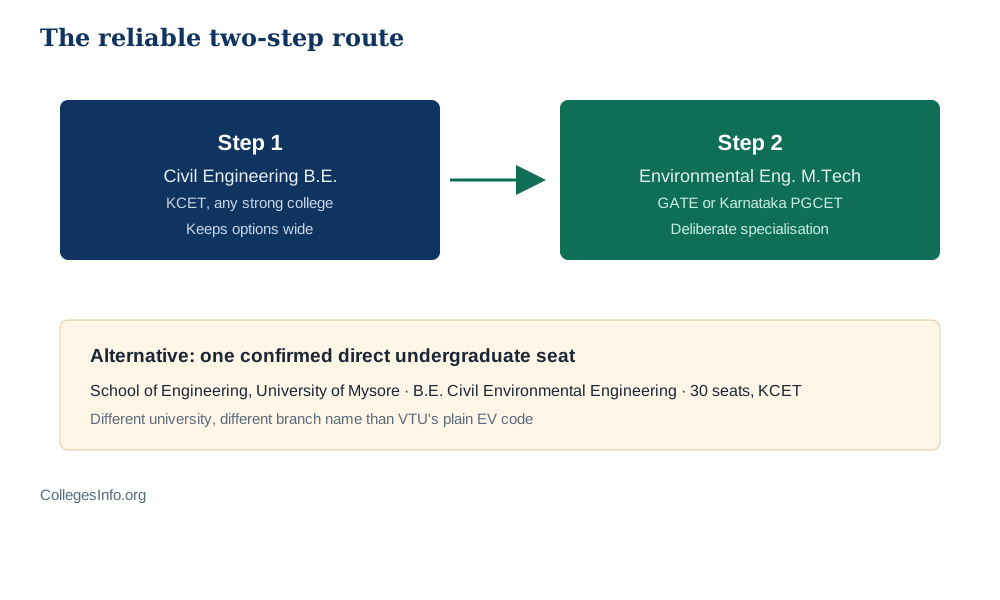
What the Confirmed Programme Actually Covers
University of Mysore's own eligibility documentation for the Civil Environmental Engineering B.E. matches the standard AICTE-recognised four-year structure, admitted alongside its other engineering programmes at the School of Engineering. The combined Civil and Environmental framing suggests a curriculum built on core structural and civil engineering fundamentals with environmental-specific content layered in, rather than an environmental-only syllabus from year one, which is consistent with how most Indian universities structure this specialisation at undergraduate level when they offer it at all.
At the postgraduate level, programmes at UVCE and similar VTU-affiliated colleges typically go deeper into wastewater and water treatment engineering, air pollution control, solid and hazardous waste management, and environmental impact assessment methodology, the technical core that regulatory and consultancy employers actually hire for. A candidate seriously interested in the technical depth of this field should expect to find it at the postgraduate stage rather than the undergraduate one, regardless of which university they start with.
Career Destinations and Why the Employment Base Stays Narrow
Environmental engineers in Karnataka find work primarily through the Karnataka State Pollution Control Board and similar regulatory bodies, environmental consultancies preparing impact assessment reports for infrastructure and industrial projects, water and wastewater treatment plant design and operation firms, and the environmental compliance functions of larger construction and industrial companies. This employment base is real but structurally smaller than the IT and core-manufacturing hiring pipelines that drive demand for Karnataka's larger engineering branches, which is the most direct explanation for why colleges have not scaled undergraduate intake in this specific branch the way they have for branches like Computer Science or Mechanical Engineering.
Candidates who want their affiliation, branch name and admission route checked before applying anywhere can start from our MBA admission assistance page.
A civil engineering foundation followed by targeted postgraduate specialisation, rather than a dedicated four-year undergraduate environmental engineering degree, is also the stronger route for a candidate who wants flexibility. It keeps the broader Civil Engineering job market open throughout the undergraduate years, then allows a deliberate narrowing once genuine interest in environmental regulation, water treatment or impact assessment work is confirmed, echoing the same postgraduate-first logic already laid out for candidates weighing Mechatronics against a plain Mechanical Engineering seat.
How to Search for This Branch Without Getting Misled
- Do not assume VTU's plain "Environmental Engineering" branch name is how every university lists it; University of Mysore uses "Civil Environmental Engineering" for its undergraduate seat.
- Check whether a listed college offers the branch at undergraduate or postgraduate level before assuming a KCET seat exists; UVCE's own course structure places it only at M.Tech level.
- Distinguish Environmental Engineering, a B.E./M.Tech discipline, from Environmental Science, an M.Sc discipline offered separately at institutions like Bangalore University.
- Where a college is named only by an aggregator list without a confirmed department page, verify directly, since portal listings for this branch have proven inconsistent between undergraduate and postgraduate offerings.
- Consider the postgraduate route through a Civil Engineering undergraduate degree as the more reliable path into this specialisation, given how thin genuine undergraduate options are across the state.
The same verification applies when comparing the undergraduate and postgraduate routes, and our admission assistance service page covers that path.
Verifying a Listed College Before Applying
Because portal listings for this specific branch have proven inconsistent between undergraduate and postgraduate offerings, and because at least one science department shares its keyword by accident of naming, a candidate should treat any "Environmental Engineering college in Karnataka" claim as needing direct confirmation rather than taking a ranking table at face value. The same discipline applies here as with other thin-presence branches already documented on this site, including Textile Engineering, where a single confirmed institution sits surrounded by a much larger set of aggregator claims that do not hold up against the institution's own published course list.
A practical verification sequence: first check whether the college's own website lists the branch among its named undergraduate B.E. or B.Tech departments, rather than a combined course tag cloud that mixes degree levels together. Second, if the branch appears only inside a Master of Engineering or M.Tech section, treat it as a postgraduate-only offering regardless of how prominently it is tagged elsewhere on the same page. Third, cross-check the exact branch name against the affiliating university's own official documentation, since, as with University of Mysore's "Civil Environmental Engineering" naming, the exact title used for KEA option entry may not match VTU's plain branch name at all.
A fourth check worth adding for this specific branch: confirm which university the college is affiliated with before assuming VTU's EV code applies. University of Mysore, Bangalore University and VTU each run their own separate affiliation structures with their own branch-naming conventions, seat matrices and admission timelines, and a college's affiliation determines which entrance exam result, KCET category rank, or university-specific process ultimately governs the seat. Treating "VTU-affiliated" as a default assumption for every Karnataka engineering college is itself a common and costly error, one this branch makes especially visible given how its one confirmed undergraduate seat sits entirely outside VTU's structure.
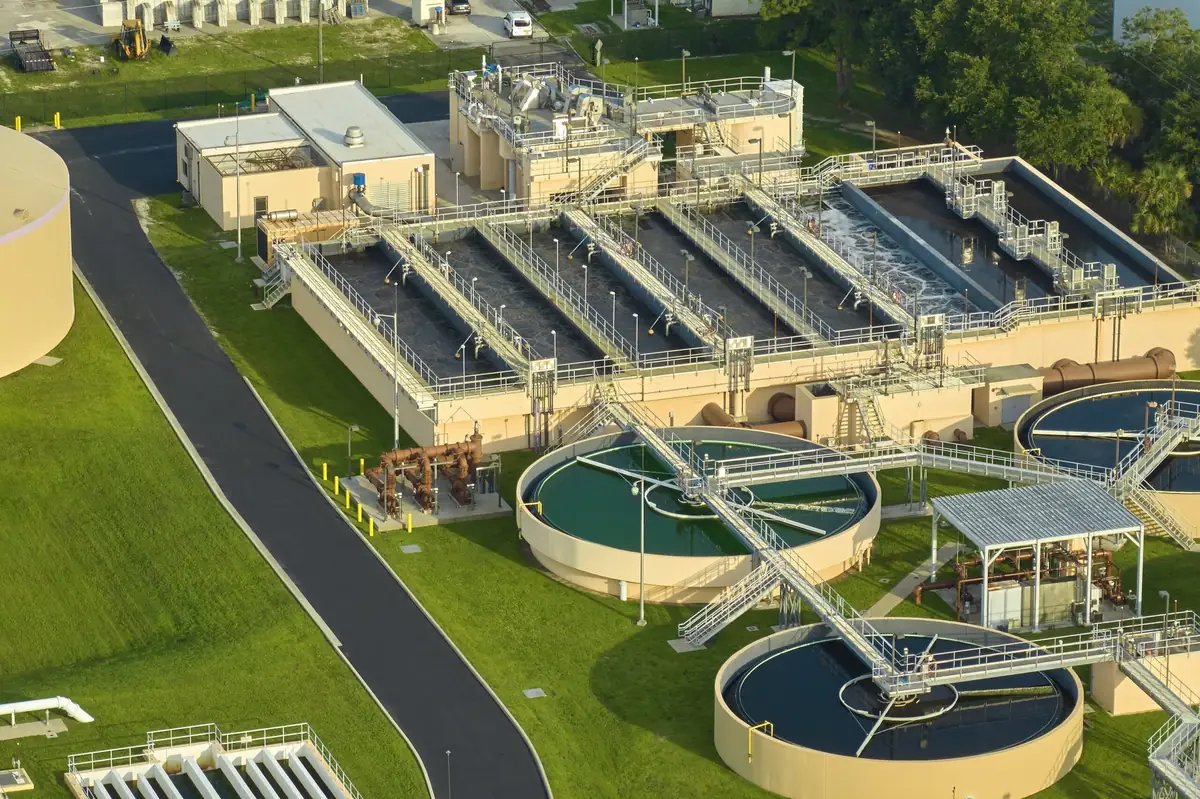
The technical core of environmental engineering work: wastewater and treatment plant infrastructure design.
Frequently Asked Questions
Is Environmental Engineering a real undergraduate degree in Karnataka?
It exists but is rare. The confirmed KCET-admitted undergraduate route is the B.E. in Civil Environmental Engineering at the School of Engineering, University of Mysore, with 30 seats. Most VTU-affiliated colleges that offer Environmental Engineering content do so only at the M.Tech level.
What is the VTU branch code for Environmental Engineering?
EV, inside the Civil Engineering stream. However, VTU-affiliated colleges checked in this research, including UVCE, list this code within their postgraduate M.Tech offerings rather than their undergraduate B.E. branch list.
Is Environmental Engineering the same as Environmental Science?
No. Environmental Engineering is a B.E./M.Tech discipline focused on pollution control, waste and water treatment infrastructure. Environmental Science, such as the M.Sc programme at Bangalore University's own Department of Environmental Science established in 1992, is a separate science discipline, not an engineering degree.
What eligibility is required for the University of Mysore's Civil Environmental Engineering programme?
A pass in 10+2 with Physics and Mathematics compulsory, alongside one of several optional subjects including Chemistry, Biotechnology, Biology or Computer Science, with a minimum of 45% aggregate for general category and 40% for SC, ST and OBC categories, admitted through KCET.
Can I specialise in Environmental Engineering after a Civil Engineering degree?
Yes. This is the more common and more reliable route in Karnataka. VTU-affiliated colleges including UVCE admit Environmental Engineering M.Tech candidates through GATE or Karnataka PGCET, typically requiring a Civil Engineering or closely related undergraduate foundation.
Where do Environmental Engineering graduates in Karnataka typically work?
Primarily through the Karnataka State Pollution Control Board and similar regulatory bodies, environmental consultancies preparing impact assessment reports, water and wastewater treatment firms, and the compliance functions of larger construction and industrial companies.
Why are there so few undergraduate Environmental Engineering seats in Karnataka?
The employment base for this specialisation is narrower and more regulatory-focused than for core branches like Computer Science or Mechanical Engineering, which appears to have led most colleges to concentrate the subject at postgraduate level, where a smaller, targeted intake of already-qualified engineers can specialise, rather than running a separate four-year undergraduate pipeline.
This article is for informational purposes only. Consult the college directly before making admission decisions.
About the author
OneCity Technologies Pvt. Ltd began in 2006 publishing an annual print education directory for Karnataka students and parents. As demand grew, OneCity launched an education portal in 2019 to bring that same directory information online, and in 2025 relaunched as CollegesInfo.org, a comprehensive Karnataka college directory covering 1,500+ institutions across engineering, medical, management, arts, commerce, and more. Founder L K Monu Borkala brings 20+ years of business experience and 19 years of work across various education-sector services. CollegesInfo.org's content is built from publicly available KEA, NMC, AICTE, and university data, cross-checked against official sources wherever possible. CollegesInfo.org's admission assistance service helps students secure admission to colleges they are eligible for under that college's actual published criteria. We help you get the best admission to your preferred colleges without hassle.
Need help with admission?
CollegesInfo.org helps students secure admission to colleges they are eligible for under that college's actual published criteria. Chat with us on WhatsApp or explore admission assistance.
Not sure if that seat is undergraduate, postgraduate, or a different discipline?
We help you get the best admission to your preferred colleges without hassle.