Written by L K Monu Borkala, Founder & Chief Strategist
MBA colleges in Bangalore without entrance exam are rare in practice. AICTE’s 2021-22 approval handbook names six all-India tests for PGDM admission, and the official pages of ABBS, DSATM, XIME and KSOU still name a test or score. What exists is a college-run test, a management-quota seat that still asks for a score, or an open-university MBA.
Search for an MBA without entrance exam in Bangalore and the first pages promise seats with no test. I read the admission pages of three colleges and one open university instead. Each names a test or a score somewhere, management-quota seats included. This guide separates what the phrase means from what the colleges publish, lines up fees that disagree by lakhs, and ends with five checks to run before you pay anyone for a seat.
What does an MBA without entrance exam mean in Bangalore?
It is a marketing phrase, not an admission category, and the AICTE text I read lists no such category. Colleges run three different things that sound alike, and only one of them comes close to removing the test.
The rule behind the confusion sits in the AICTE Approval Process Handbook 2021-22, Appendix 9, clause 9.5. It says admission to PGDM courses is made only from candidates who qualified in one of six all-India tests (CAT, XAT, CMAT, ATMA, MAT and GMAT) or a state-level common entrance exam. In Karnataka that state test is the KEA’s PGCET, covered in how the Karnataka PGCET works. I read the 2021-22 text, so treat it as the baseline, not the final word on 2026-27.
| Selection component | Weightage range in AICTE handbook 2021-22 |
|---|---|
| Entrance test score | 35 to 60 percent |
| Academic record | 5 to 25 percent |
| Group discussion and personal interview | 20 to 45 percent |
| Diversity | 5 to 20 percent |
Look at the first row. On AICTE’s own formula the test carries the largest single weight. The handbook text I read does not discuss institute-level tests or management quota, so it neither approves nor bans them. It only shows that the national baseline is a score.
3 things the phrase usually means
1. A management-quota seat. Private colleges fill part of their intake themselves. The MBA admission page of Dayananda Sagar Academy of Technology and Management (DSATM) says management-quota applicants “should have appeared for” the KEA’s PGCET or the Karnataka Management Aptitude Test, or another approved test. The seat is college-filled, but it is not score-free. How these seats work is explained in how management quota works in Karnataka.
2. A college’s own test. ABBS requires its ABBSSAT, and its selection process page also lists CAT, XAT, MAT, CMAT and KMAT scores. IIBS, according to Careers360, runs its own IIBSAT. A test the college sets is still an entrance test.
3. An open or distance MBA. The Karnataka State Open University (KSOU) prospectus describes a 50-question knowledge assessment test before admission. Even the open route is not exam-free in the strict sense.
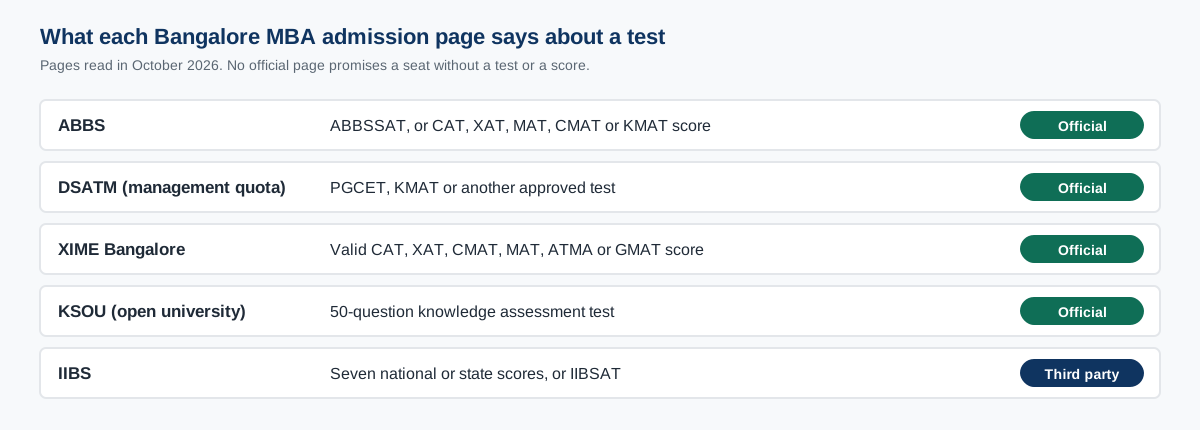
Across the four official pages I read, none promises a seat without a test or a score. The “no exam” framing came from aggregator pages, including one that treats management-quota seats and no-exam admission as the same thing.
MBA colleges in Bangalore without entrance exam: what their pages say
| College | Test or score named | Other conditions | Source |
|---|---|---|---|
| ABBS | ABBSSAT; CAT, XAT, MAT, CMAT or KMAT scores also listed | 50 percent marks, personal interview | ABBS selection process page |
| DSATM | PGCET (code B156) for government quota; PGCET, KMAT or another approved test for management quota | 50 percent (45 percent reserved), interview by an admissions committee | DSATM MBA admission page |
| XIME Bangalore | Valid CAT, XAT, CMAT, MAT, ATMA or GMAT score | No exemption mentioned on the page | XIME PGDM-BA page |
| KSOU | 50-question knowledge assessment test | Any recognised degree; open and distance mode | KSOU MBA prospectus 2025-26 |
| IIBS | CAT, XAT, MAT, CMAT, ATMA, GMAT, K-PGCET or IIBSAT | 50 percent; last date 30 November 2026 | Careers360, updated 18 September 2026 (third party) |
Two rows deserve a second look. DSATM’s wording is the clearest case: a management-quota applicant there should have appeared for PGCET, KMAT or another approved test, and an admissions committee interviews them, so the “direct” part of direct admission is the college doing the filling, not the test going away. You can see the college in DSATM’s listing in our directory. IIBS is the row to verify yourself, because its details come from a third party and not from the college page I read.
For the wider field, the directory of Bangalore MBA colleges lists the colleges, and government MBA colleges taking PGCET scores covers the seats that come through counselling.
What do management-quota MBA seats cost, and why do fees disagree?
Careers360’s management-quota table, updated 30 March 2026, lists seat counts for twelve Bangalore colleges and states that 2026 data was not yet available. Six of them: Presidency University 180, Krupanidhi School of Management 120, RNS Institute of Technology 120, Global Academy of Technology 120, BMS College of Engineering 90 and DSATM 60. Those are seats the college fills itself. They are not seats that skip the test.
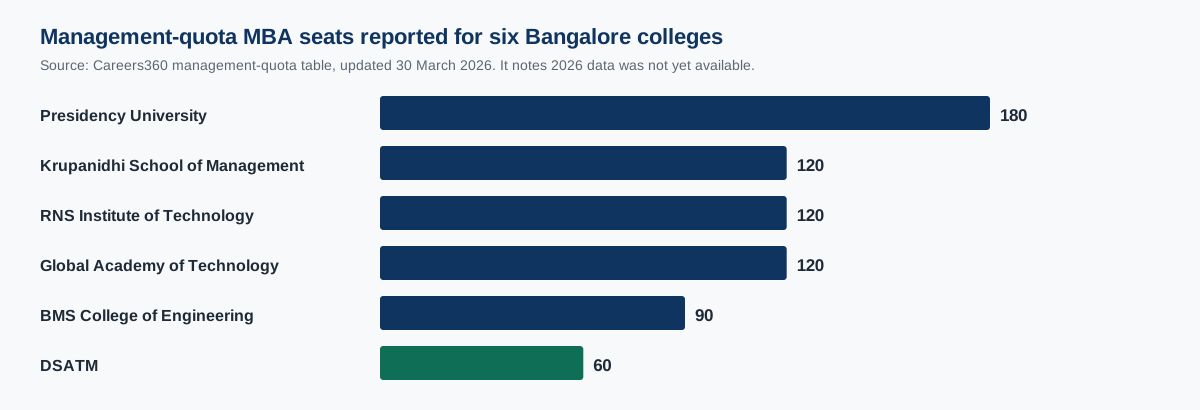
The same page labels its table “with entrance exam” and lists one college twice, so use it as a lead and confirm each college’s intake with the college. On cost, Careers360’s management-quota article, updated 24 July 2026, gives a range of ₹3 lakh to ₹10 lakh for the two years. That is a wide band, and the next table shows how a single college can appear at two different prices.
If you are an NRI or a sponsored candidate, the route differs again; NRI quota admission in Karnataka explains it. For a college-by-college view of how seats are filled, management quota admission support shows how we handle enquiries under each college’s published criteria.
Why do printed fees for the same college disagree?
| College | College’s own figure | Third-party figure | Gap |
|---|---|---|---|
| ISBR Business School, PGDM Core | ₹11,00,000 (college fee PDF, July 2026 batch) | ₹8 lakh to ₹9 lakh (Scaler, July 2026) | ₹2 lakh to ₹3 lakh |
| IIBS, MBA/PGDM | ₹11,00,000 tuition only (iibsonline.com fee page) | ₹9.95 lakh (Careers360, 18 September 2026) | ₹1,05,000 |
The gaps are my subtraction. They could reflect different batch years, different tracks or an out-of-date aggregator page, and none of the third-party pages says which. A buyer who budgets from the lower figure is short by up to ₹3 lakh at the counter.
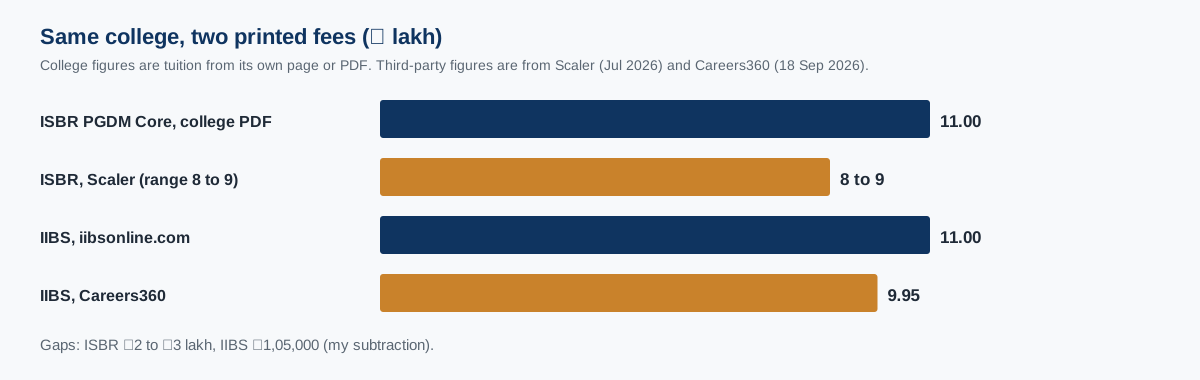
A tuition-only figure is not a total, and a total may exclude hostel, exam and university charges. Printed MBA fees at ten colleges shows how this plays out across the city, and which MBA colleges repay the fee puts the numbers against outcomes.
Is there a low-fee MBA route with no national test?
The closest is the open-university route. KSOU’s 2025-26 prospectus prints ₹32,890 for year one and ₹32,120 for year two, which is ₹65,010 in total by my sum. The prospectus also lists examination fees of ₹7,050, which brings the cost to ₹72,060. Against ISBR’s ₹11,00,000 that is about 6.5 percent of the fee. The prospectus cites UGC-DEB notifications dated 16 June 2023 and 4 June 2023 and describes the programme as AICTE-recognised, and it asks for any recognised degree.
That is a real saving, and it comes with trade-offs. Classes are by open and distance learning, there is a 50-question test, and charges outside the prospectus should be confirmed before you budget. Check the current UGC-DEB recognition status yourself before you pay. If you are a working professional weighing flexibility, online MBA options for working professionals and weekend MBA options in Bangalore are the next reads.
What are the eligibility rules and dates for 2026-27?
The baseline in AICTE’s 2021-22 handbook is a three-year degree with 50 percent marks, or 45 percent for reserved categories. DSATM prints the same 50 and 45. KSOU asks only for a recognised degree.
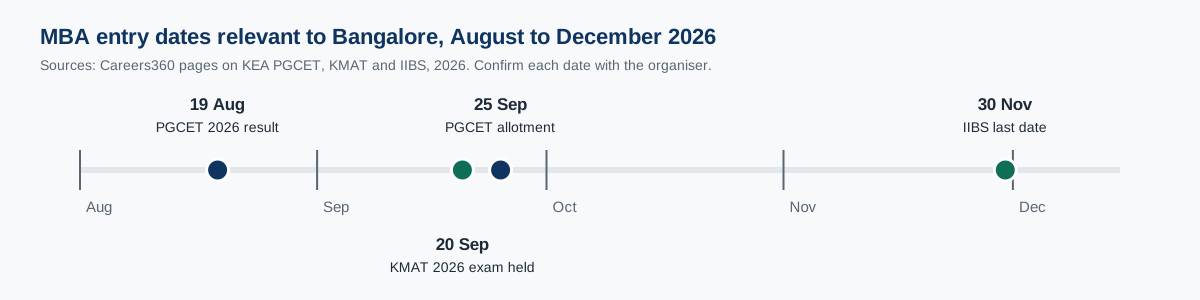
The dates that matter right now, per Careers360’s 2026 pages: the KEA published the PGCET 2026 result on 19 August, with provisional and final allotment on 25 September. KMAT 2026 was held on 20 September, and I could not confirm a result date. IIBS shows 30 November 2026 as its last date. If you took none of these tests, your options may narrow to colleges that run their own test or accept later scores. KMAT and the colleges that accept it and the PGCET exam page track the exams.
5 checks before you pay for a direct admission seat
Searches for mba direct admission in bangalore and mba colleges in bangalore direct admission bring up agents, aggregators and colleges, and they are not equally reliable. Nothing here is a promise about any seat. It is a way to test whatever offer reaches you.
5 checks, in the order to run them
1. Ask which score or test is on file for your seat. If the answer is “none”, ask where the college’s admission page says so. DSATM’s page says the opposite.
2. Match the amount to the college’s own fee document. The table above shows gaps of ₹1,05,000 to ₹3 lakh between a college and an aggregator. Ask for the written fee schedule for your batch.
3. Pay the institution, against a receipt in its name. The Karnataka Educational Institutions (Prohibition of Capitation Fee) Act, 1984, Act 37 of 1984 on the India Code portal, prohibits capitation fees. A published fee paid to the college is one thing; cash above it is another. This is general information, not legal advice.
4. Confirm the approval for the programme you are buying. A PGDM needs AICTE approval, and a university-affiliated MBA needs the affiliating university’s. The PGDM-versus-MBA difference is set out on the PGDM course overview and the MBA course page.
5. Get the refund terms in writing before you pay. Ask what is returned if you withdraw before the first day, and when.
If you borrow for the fee, education loan rules in Karnataka cover what banks ask for. Before you decide on a college, how to read a placement record shows what to ask for.
Which route fits which candidate
| Your situation | Route to check | What to confirm |
|---|---|---|
| You hold a CAT, XAT, CMAT, MAT, ATMA or GMAT score | Colleges that accept scores, such as XIME, ABBS and IIBS | Score validity and the college’s cut-off |
| No national score, Karnataka candidate | PGCET or KMAT, then the quota seat | Which test the college accepts for management quota |
| Prefer a college’s own test | ABBSSAT or IIBSAT | Test dates and fee for the test |
| Budget under ₹1 lakh in total | KSOU open-university MBA | UGC-DEB status and extra charges |
| Want help matching a seat to your profile | Speak to an admissions team | Each college’s published criteria, in writing |
The last row is the one where admission support for Bangalore MBA seats applies, and you can contact the CollegesInfo team to ask.
Frequently asked questions
Is there any MBA college in Bangalore without entrance exam?
I found none that promises a seat with no test or score. ABBS requires ABBSSAT or a national score, DSATM asks management-quota applicants for PGCET, KMAT or another approved test, XIME lists six national tests, and KSOU holds a 50-question knowledge assessment test.
Can I get an MBA admission in Bangalore without CAT?
Yes. CAT is one of several accepted tests. Colleges also accept PGCET, KMAT, XAT, CMAT, MAT, ATMA or GMAT, and some run their own test, such as ABBSSAT. Which ones count depends on the college and the quota.
Is KMAT compulsory for management quota seats in Bangalore?
Not at every college. DSATM’s page says management-quota applicants should have appeared for the KEA’s PGCET or KMAT, or another approved test. Other colleges set their own rule, so ask for it in writing.
How much does an MBA management quota seat cost in Bangalore?
Careers360 gives a range of ₹3 lakh to ₹10 lakh for the two years, as per its article updated 24 July 2026. The figure varies by college and batch, so use the college’s own fee schedule.
Is the KSOU MBA valid?
The prospectus for 2025-26 cites UGC-DEB notifications dated 16 June 2023 and 4 June 2023 and describes the programme as AICTE-recognised. Recognition can change, so check the current UGC-DEB list before you enrol.
Is paying for direct admission legal in Karnataka?
The Karnataka Educational Institutions (Prohibition of Capitation Fee) Act, 1984 prohibits capitation fees. A published fee for a seat, paid to the institution against a receipt, is a different matter from cash above it. This is general information, not legal advice.
Ask for the score on file, in writing
Before you pay for any seat described as direct, email the college and ask one question: which test or score is on file for my admission, and what is the total fee for my batch? Compare the reply with the college’s own admission page. If the two do not match, do not pay until they do.
This article is for informational purposes only. Consult the college directly before making admission decisions.
We help you get the best admission to your preferred colleges without hassle.
Written by L K Monu Borkala.