Karnataka has 25+ BSc Agriculture and BTech Agricultural Engineering colleges, run mainly by four state agricultural universities plus a horticulture-focused university. Admission runs through three separate routes - KCET (the one most Karnataka students use), ICAR AIEEA (a national exam), and, at UAS Bangalore specifically, a 50%-reserved "Children of Agriculturists" quota that bypasses both entrance exams entirely. Closing ranks vary enormously by round and by exact programme - Round 1 GM cutoffs for the most competitive BSc (Hons) Agriculture seat at UAS Bangalore have run anywhere from the low thousands to the mid-twenty-thousands in recent years, while the same seat's final-round, all-category closing rank has gone as high as 1,34,861 once every seat is accounted for. Don't anchor on a single number - check the current year's round-wise KEA data for your specific category and campus.
🎯 Use the Free KCET Rank Predictor - Enter your rank and category to instantly see which colleges you can get in 2026. No login required. Try KCET Predictor →
Three Ways Into a Karnataka Agriculture Seat
Most students assume KCET is the only route, and for the vast majority of applicants it is - but at UAS Bangalore specifically, the picture is more complicated, and knowing this upfront can change your whole application strategy. It's worth reading this section carefully before deciding how to allocate your preparation time and application effort across the different routes available to you:
- KCET: The standard state-quota route for BSc Agriculture, BSc (Hons) Agriculture, and BTech Agricultural Engineering across all five agricultural universities. This is what almost every Karnataka-domicile applicant should plan around.
- ICAR AIEEA: A national-level exam (now integrated with CUET-UG for undergraduate admissions) that opens seats at ICAR-funded institutions across India, including a share of seats at Karnataka's own agricultural universities. You can appear in both KCET and ICAR AIEEA - they aren't mutually exclusive.
- Children of Agriculturists Quota (UAS Bangalore only): A distinctive pathway - UAS Bangalore reserves roughly 50% of its BSc Agriculture seats for children of practising agriculturists, admitted through a practical test and interview rather than KCET or ICAR AIEEA. If your family farms and you meet the eligibility criteria, this quota can be a realistic route even with a KCET rank that wouldn't otherwise clear the general cutoff. Check current-year eligibility directly with UAS Bangalore's admissions office, since documentation requirements (land records, farming income proof) are specific and non-negotiable.
Top Agriculture Colleges in Karnataka 2027
| College | University | Location | KCET Closing Rank (Round 1, recent years) | Annual Fees (approx) |
|---|---|---|---|---|
| College of Agriculture, GKVK Bangalore | UAS Bangalore | Bangalore | Low thousands to ~25,000 (GM) depending on year and course variant | ₹22,000–2.68 lakh (varies by programme) |
| College of Agriculture, Dharwad | UAS Dharwad | Dharwad | ~3,000–5,000 (GM) | ₹15,000–25,000 |
| College of Agriculture, Raichur | UAS Raichur | Raichur | ~8,000–15,000 (GM) | ₹15,000–25,000 |
| College of Agriculture, Hassan | UAS Bangalore | Hassan | ~10,000–20,000 (GM) | ₹15,000–25,000 |
| College of Agriculture, Shivamogga | UAS Bangalore | Shivamogga | ~15,000–25,000 (GM) | ₹15,000–25,000 |
| College of Agriculture, Mandya | UAS Bangalore | Mandya | ~20,000–35,000 (GM) | ₹15,000–25,000 |
| College of Agriculture, Bidar | UAS Raichur | Bidar | ~25,000–40,000 (GM) | ₹15,000–25,000 |
| College of Agriculture, Vijayapur | UAS Dharwad | Vijayapur | ~25,000–45,000 (GM) | ₹15,000–25,000 |
| College of Horticulture, Bagalkot | UHS Bagalkot | Bagalkot | ~30,000–50,000 (GM) | ₹20,000–30,000 |
This is a representative sample, not the complete list - Karnataka's agricultural universities collectively run 33+ active colleges across agriculture, horticulture, forestry, fisheries, and sericulture. See the university breakdown further down for the fuller picture.
KCET Closing Rank Reality Check - Why the Numbers Look So Different Everywhere
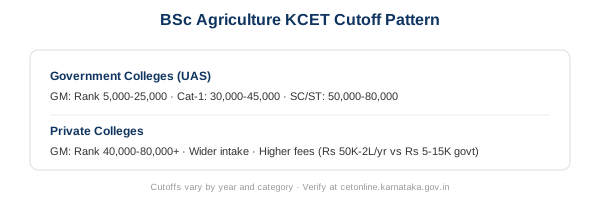
If you've searched around for UAS Bangalore's cutoff and found wildly different numbers on different sites, here's why: the rank depends heavily on which of these you're looking at, and most sources don't specify clearly.
- Round vs. round: Round 1 closing ranks (the most competitive, since only top-ranked applicants have chosen yet) can differ from final/extended round ranks by a factor of 10 or more, since later rounds include seats returned by students who got better offers elsewhere.
- Programme variant: "BSc (Hons.) Agriculture," "BSc Agriculture," "BSc Forestry," and "BSc (Hons.) Nutrition & Dietetics" are different programmes with meaningfully different cutoffs, even at the same campus.
- Category: GM, 1G, 2AG, 2BG, 3BG, GMK, and GMR each have their own separate closing rank - a rank that misses GM easily clears several reserved categories.
Given this spread, treat any single cutoff figure you find online - including in this article - as a rough planning reference rather than a guarantee, and check KEA's own round-wise data for your specific category and programme before finalising your choice order.
BSc Agriculture vs BTech Agricultural Engineering - Comparison
| Factor | BSc Agriculture | BTech Agricultural Engineering |
|---|---|---|
| Duration | 4 years | 4 years |
| Focus | Crop science, agronomy, soil, horticulture | Farm machinery, irrigation engineering, food tech |
| KCET Eligibility | PCB or PCM in 2nd PUC | PCM in 2nd PUC |
| Typical Closing Rank Pattern | Generally tighter at flagship campuses (GKVK) | Generally wider - cutoffs into the tens of thousands are common even at UAS Bangalore |
| Government Jobs | Agricultural Officer, ADA, Agricultural Inspector | Agricultural Engineer, Irrigation Dept |
| Private Sector | Agri-input companies, commodities trading | Equipment manufacturing, food processing |
KCET 2027 Agriculture Stream - Eligibility
- Passed 2nd PUC with Physics, Chemistry, and Biology (PCB) - OR Physics, Chemistry, and Mathematics (PCM)
- Minimum 45% aggregate in qualifying exam (40% for SC/ST)
- Karnataka domicile for state quota seats
- Appeared in KCET agriculture stream paper
Universities Running Agriculture Colleges in Karnataka
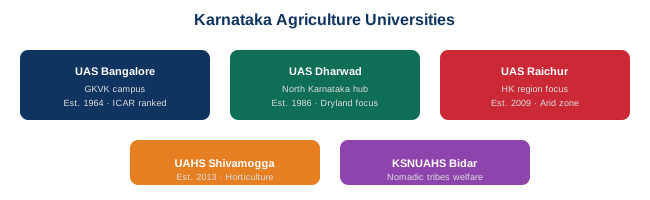
| University | HQ | Established | Affiliated Colleges | Focus |
|---|---|---|---|---|
| UAS Bangalore (GKVK) | Bangalore | 1964 | Campuses at GKVK, Mandya, Hassan, Chintamani | South Karnataka, agronomy, NAAC A+ |
| UAS Dharwad | Dharwad | 1986 | 6+ colleges | North Karnataka, dryland farming |
| UAS Raichur | Raichur | 2009 | 4+ colleges | Deccan plateau, rice cultivation |
| UHS Bagalkot | Bagalkot | 2008 | 4+ colleges | Horticulture, plantation crops - note this is a separate university from UAS, despite the similar naming |
| KVAFSU Bidar | Bidar | 2004 | 7 vet colleges | Veterinary + fisheries science - see our full veterinary colleges guide for BVSc-specific details |
Beyond the flagship campuses, Karnataka's agricultural universities run a wide network of specialised colleges worth knowing about if your interests run beyond core crop science: College of Fisheries, Mangalore, College of Forestry, Sirsi, College of Forestry, Ponnampet (in the Kodagu coffee belt), and College of Sericulture, Chintamani each offer specialised programmes tied to Karnataka's specific agricultural economy - silk, coastal fisheries, and Western Ghats forestry each have real, distinct career paths attached.
UAS Bangalore - A Closer Look at Karnataka's Flagship Agricultural University
Since GKVK Bangalore is where most agriculture-stream KCET applicants start their research, it's worth knowing a bit more about the institution itself. Established in 1964, UAS Bangalore is recognised by ICAR, holds a NAAC A+ grade, and has been ranked as the 3rd best agricultural university in South India by at least one independent ranking source - alongside winning the Sardar Patel Outstanding ICAR Institution Award. The university runs undergraduate, postgraduate, and doctoral programmes across agriculture, agricultural engineering, agricultural business management, biotechnology, and food/power engineering, spread across its GKVK, Mandya, Hassan, and Chintamani campuses. You can check current admission notifications directly on the UAS Bangalore official website.
Placement data reported for recent years shows a modest but real placement pipeline: NIRF-linked figures cite dozens of BTech and postgraduate students placed annually, with average packages around ₹5 lakh for BTech graduates and ₹7.5 lakh for postgraduate students. Recruiters named across sources include IFFCO, Coromandel International, Sundaram Finance, HDFC Bank, and ITC's Agri Business division - a reasonable, plausible mix for an agriculture-focused institution rather than an inflated headline figure.
Career Scope After BSc Agriculture in Karnataka
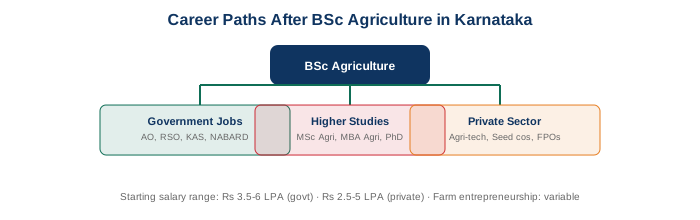
| Career Path | Employer | Starting Salary |
|---|---|---|
| Agricultural Development Officer (ADO) | Karnataka Govt (Dept of Agriculture) | ₹35,000–50,000/month |
| Agricultural Inspector | State Agriculture Dept | ₹30,000–40,000/month |
| Agri-input Sales Officer | Bayer, Syngenta, UPL, Coromandel | ₹3–5 LPA |
| Commodity Trader / Analyst | NCDEX, MCX, Commodity firms | ₹4–8 LPA |
| Bank Agriculture Officer | SBI, NABARD, Karnataka Bank | ₹4–6 LPA |
| MSc Agriculture / Research | UAS, ICAR institutes | ₹35,000–55,000/month |
| Entrepreneurship / Agri-startup | Self | Variable |
Scholarships for Agriculture Students in Karnataka
Agriculture students are eligible for the same state scholarship infrastructure as every other stream. If you're SC, ST, OBC, or a minority-category student, our SSP scholarship guide covers the post-matric application process, department-wise deadlines, and the documents you'll need - the post-matric portal explicitly covers degree-level agriculture programmes alongside engineering and medicine. UAS Bangalore itself also runs named institutional scholarships (including the Sharans Vedanth and Shakunthala Venkataswamy scholarships) separate from SSP - check current eligibility directly with the university's scholarship cell. Our broader Karnataka scholarships guide is worth reading too if you want the full landscape beyond just SSP.
Campus Life and Facilities
Facilities across UAS-network campuses typically include separate boys' and girls' hostels, libraries, sports grounds, cafeterias, auditoriums, on-campus medical clinics, and IT infrastructure - standard for agricultural universities with a residential-campus model, since many of these colleges sit in rural locations where commuting isn't realistic. Given the wide geographic spread of Karnataka's agriculture colleges - from Bidar in the north to Mysuru and Madikeri in the south - hostel accommodation matters more here than it would for a typical city-based degree college, and it's worth confirming hostel availability and capacity directly with your specific target campus rather than assuming it matches the flagship GKVK campus's facilities. Many campuses also maintain working experimental farms and demonstration plots as part of their teaching infrastructure - a hands-on element of agricultural education that a purely classroom-based degree can't replicate, and worth asking about specifically if practical, field-based learning matters to you.
ICAR Entrance (AIEEA/CUET) vs KCET for Agriculture
KCET is for state quota undergraduate seats at Karnataka's own agricultural universities. Students wanting admission to ICAR-funded central agricultural universities across India (like IARI Delhi or TNAU) need to appear in ICAR AIEEA, now integrated with CUET-UG for undergraduate admissions. For Karnataka's own government agriculture colleges, KCET remains the primary route - register for counselling directly on the official KEA portal once results are declared - though ICAR AIEEA also opens a share of seats at these same Karnataka universities. The two exams aren't mutually exclusive - appearing in both widens your options, particularly if you're open to studying outside Karnataka as well, and a fair number of ambitious students do exactly that rather than limiting themselves to a single exam.
Beyond the Degree - MSc, Research, and Government Exams
A BSc Agriculture degree from a Karnataka university opens paths beyond immediate employment, and it's worth planning for these even before you finish your undergraduate years. MSc Agriculture at the same universities (or at ICAR-funded institutions nationally) is the natural next step for students interested in research or specialised technical roles, and UAS Bangalore, Dharwad, and Raichur all run postgraduate programmes across their respective specialisations. For students targeting government service specifically, agriculture graduates are eligible for a range of state and central competitive exams beyond the direct agricultural-officer recruitment drives mentioned earlier - including combined state civil service exams, where an agriculture background is treated the same as any other bachelor's degree, and specialised exams run by NABARD and other agriculture-linked public sector organisations. If a government career is your primary goal rather than a fallback plan, it's worth researching these exam pathways in parallel with your undergraduate coursework rather than waiting until after graduation.
Karnataka's agricultural universities have also generally leaned into current agri-tech trends - precision farming, drone-based crop monitoring, and data-driven agronomy are increasingly part of coursework and research activity at the larger campuses, reflecting the broader shift in Indian agriculture toward technology-assisted farming. If you're choosing between otherwise-similar campuses, asking specifically about exposure to these newer techniques is a reasonable differentiator, since not every campus has invested in this equally.
A Note on Timelines and Planning Ahead
Agriculture stream KCET counselling generally follows the same broad calendar as engineering and other streams, but a few agriculture-specific quirks are worth planning around. If you're pursuing the Children of Agriculturists quota at UAS Bangalore, that process typically runs on its own separate timeline from the main KCET counselling schedule, with its own document submission and interview dates - missing this window means falling back entirely to the standard KCET route for that seat, so mark both calendars separately rather than assuming they're synchronised. Similarly, if you're planning to appear for ICAR AIEEA alongside KCET, the two exams' application windows, result dates, and counselling schedules don't align neatly, and you'll need to track both independently. Students who leave this planning until after their KCET result is out often find they've missed an ICAR AIEEA registration deadline that closed weeks earlier - start tracking both exam calendars from the beginning of your final PUC year rather than waiting for one result before thinking about the other option.
It's also worth building in time to actually visit a shortlisted campus before counselling, if that's logistically possible. Given how rural many of these campuses are, and how much your day-to-day experience will depend on hostel quality, food, and the specific research culture of your department rather than just the university's overall reputation, an in-person visit - or at minimum, a conversation with a current student - tells you things that no ranking table or cutoff figure can.
Who This Path Suits
- Students interested in agricultural science, agronomy, or agribusiness rather than treating this as a fallback from engineering or medicine
- Applicants from farming families who may qualify for UAS Bangalore's Children of Agriculturists quota - worth investigating even with a modest KCET rank
- Students comfortable with rural or semi-rural campus locations, given how geographically spread Karnataka's agricultural universities are
- Those interested in specialised paths like fisheries, forestry, horticulture, or sericulture, which have their own dedicated colleges beyond the core BSc Agriculture route
What Each Regional University Specialises In
Karnataka's four core agricultural universities aren't interchangeable - each has grown around the farming realities of its own region, and that shapes both the curriculum emphasis and the research work you'd be exposed to as a student.
- UAS Dharwad (est. 1986): Serves North Karnataka's dryland farming belt - cotton, groundnut, and pulses feature heavily in the applied research here, alongside dryland water-management techniques relevant to the region's lower rainfall.
- UAS Raichur (est. 2009): Karnataka's youngest agricultural university, positioned in the Deccan plateau's rice-growing tracts along the Krishna and Tungabhadra river systems - irrigation-dependent cropping is a natural research strength here.
- UHS Bagalkot (est. 2008): Horticulture-specific, covering fruit, vegetable, floriculture, and plantation crops rather than field crops - a different curriculum emphasis from the other three, worth knowing if your interest leans toward horticulture rather than staple-crop agriculture.
- UAS Bangalore (est. 1964): The oldest and most broadly resourced of the four, with the widest range of specialisations (agricultural engineering, agribusiness management, biotechnology) alongside core agriculture.
If you have a genuine regional or crop-specific interest - say, dryland farming techniques or horticulture specifically - picking the university whose research focus matches that interest can matter more for your actual learning experience than chasing the single lowest closing rank.
Government vs Private: Why Agriculture Education Skews Government
Unlike engineering or management, where private colleges dominate the landscape, agriculture education in Karnataka remains overwhelmingly concentrated in government and government-aided institutions tied to the state's agricultural universities. A handful of private deemed universities have added agriculture-adjacent programmes in recent years, but they remain a small minority of total seats. This isn't an accident - running genuine agricultural research infrastructure (experimental farms, seed banks, extension programmes tied to actual farming communities) requires the kind of long-term public investment that's harder for a private college to replicate profitably at scale. Practically, this means your agriculture college choice in Karnataka is much more a choice of *which government university and campus* rather than *government versus private*, which simplifies the decision in some ways compared to, say, engineering.
What to Actually Check Before Choosing a Campus
Beyond the closing rank, a few practical factors are worth checking directly with any campus you're seriously considering:
- Research and extension activity - ask what active research projects and farmer-extension programmes the campus runs; this tells you more about genuine academic engagement than a marketing brochure will.
- Faculty-to-student ratio in your specific specialisation, not just the college overall.
- Distance from home and realistic travel logistics, given how rural many of these campuses are - this affects your actual quality of life more than most applicants initially anticipate.
- Placement cell activity specifically for your intended career path - government-job-focused students and private-sector-focused students often benefit from different kinds of institutional support, and not every campus invests equally in both.
Frequently Asked Questions
What is the KCET cutoff for BSc Agriculture in Bangalore?
It varies significantly by round, programme variant, and category - Round 1 GM cutoffs for the flagship UAS Bangalore BSc (Hons) Agriculture seat have ranged from the low thousands to the mid-twenty-thousands in recent years, while final-round figures across all categories can run into six figures once every seat is filled. Check KEA's current round-wise data for your specific category rather than relying on a single reported number.
Can PCM students apply for BSc Agriculture through KCET?
Yes. Both PCB (Physics, Chemistry, Biology) and PCM (Physics, Chemistry, Mathematics) students are eligible for KCET agriculture stream. PCB is the more common combination, but PCM students can also apply.
What is the Children of Agriculturists quota at UAS Bangalore?
UAS Bangalore reserves roughly 50% of its BSc Agriculture seats for children of practising agriculturists, admitted through a practical test and interview rather than KCET or ICAR AIEEA. Eligibility requires documented proof of farming income and land records - check current-year criteria directly with the university's admissions office.
Is UHS Bagalkot the same as UAS Bangalore?
No - they're separate universities. UAS Bangalore focuses on core agriculture and is headquartered at GKVK, Bangalore. UHS Bagalkot (University of Horticultural Sciences) is a distinct institution focused specifically on horticulture and plantation crops, headquartered in Bagalkot.
What is the scope of BSc Agriculture in Karnataka?
Karnataka's agricultural economy - spanning coffee, silk, sugarcane, rice, and horticulture - creates consistent demand for trained agriculture graduates in government extension services, agri-input companies, and commodity trading firms. NABARD and bank agricultural officer roles are also strong career options.
Is there any private agriculture college in Karnataka?
Most agriculture colleges in Karnataka are government or government-aided institutions affiliated with UAS universities. A few private deemed universities (like Jain University, REVA) offer agriculture-related programmes but primary BSc Agriculture is concentrated in UAS-affiliated government colleges.
Can I apply for SSP scholarship as an agriculture student?
Yes - SSP's post-matric portal explicitly covers degree-level agriculture programmes for SC, ST, OBC, and minority-category students, alongside engineering, medical, and other post-matric courses. See our full SSP scholarship guide for eligibility and deadlines.
What is the admission process for BSc Agriculture in Karnataka 2027?
Appear in KCET with PCB or PCM combination. After results, register for KCET counselling on cetonline.karnataka.gov.in. Complete document verification, fill choice filling with preferred agriculture colleges, and accept the allotted seat. Reporting to the allotted college completes the admission process. If you're eligible for UAS Bangalore's Children of Agriculturists quota, a separate practical test and interview process applies instead.
Do agriculture colleges in Karnataka have hostel facilities?
Most do, given how rural many campus locations are - separate boys' and girls' hostels are standard at UAS-network colleges. Confirm capacity and facilities directly with your specific target campus, since this varies by location.
Need help with admission?
About the author
OneCity Technologies Pvt. Ltd began in 2006 publishing an annual print education directory for Karnataka students and parents. As demand grew, OneCity launched an education portal in 2019 to bring that same directory information online, and in 2025 relaunched as CollegesInfo.org, a comprehensive Karnataka college directory covering 1,500+ institutions across engineering, medical, management, arts, commerce, and more. Founder L K Monu Borkala brings 20+ years of business experience and 19 years of work across various education-sector services. CollegesInfo.org's content is built from publicly available KEA, NMC, AICTE, and university data, cross-checked against official sources wherever possible. CollegesInfo.org's admission assistance service helps students secure admission to colleges they are eligible for under that college's actual published criteria. We help you get the best admission to your preferred colleges without hassle.