Karnataka has 9 degree-granting veterinary, dairy and fisheries science colleges under KVAFSU (Karnataka Veterinary, Animal and Fisheries Sciences University), and every single one of them is a government institution. There are no private veterinary colleges in Karnataka. Every BVSc seat in the state is a government seat with government fees - Rs 20,000 to Rs 35,000 per year - making Karnataka one of the most affordable states in India for veterinary education. Admission is through NEET-UG, with seats allocated by KEA via Karnataka's centralised veterinary counselling, separate from MBBS counselling. If you've been spending months researching this, the core facts are simpler than they look: appear for NEET, register for KEA veterinary counselling, fill college preferences, and get a seat based on rank and category.
All Veterinary Colleges in Karnataka Under KVAFSU (2027)
KVAFSU was established in 2004 by a Karnataka Legislative Assembly Act to govern veterinary, animal and fisheries sciences education in the state. Its headquarters are in Bidar, North Karnataka. The eight colleges under KVAFSU span BVSc, BFSc, and B.Tech (Dairy Technology) programmes across six campuses.
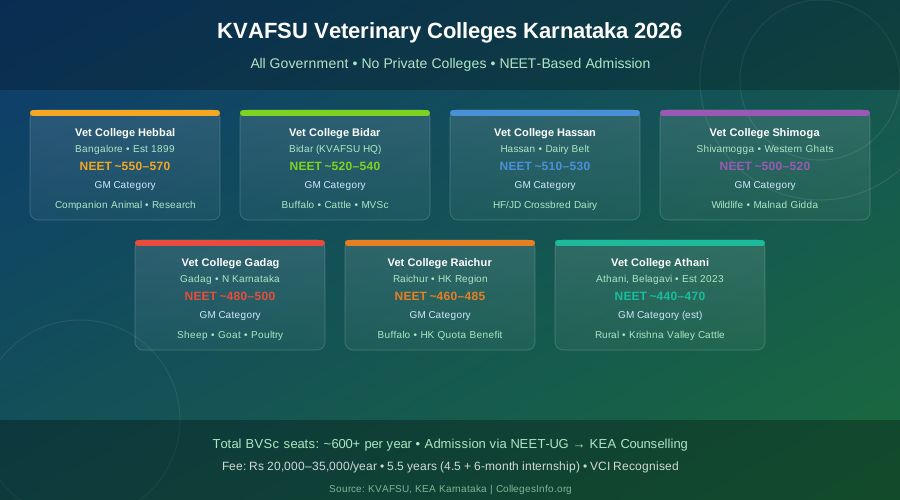
| College | Location | Established | BVSc Seats | Speciality |
|---|---|---|---|---|
| Veterinary College Hebbal | Hebbal, Bangalore | 1958 | ~60 | Oldest, companion animal, research |
| Veterinary College Bidar | Bidar (KVAFSU HQ) | 1984 | ~60 | University main campus, North Karnataka livestock |
| College of Veterinary & AH Shimoga | Shivamogga | Pre-2004 | ~60 | Western Ghats, Malnad, cattle |
| College of Veterinary & AH Hassan | Hassan | Pre-2004 | ~60 | Dairy belt, JD-crosses, sericulture animals |
| College of Veterinary & AH Gadag | Gadag | Post-2004 | ~60 | North Karnataka sheep, goat, poultry belt |
| Shri Bahurao Deshpande Veterinary College Athani | Kokatnur, Athani, Belagavi | 2023 | ~60 | Karnataka's only rural vet college, Krishna Valley cattle, Yalaga sheep |
| Dairy Science College | Hebbal, Bangalore | Pre-2004 | N/A (B.Tech Dairy) | Dairy technology, KMF industry |
| College of Fisheries | Lalbagh, Mangalore | Pre-2004 | N/A (BFSc) | Marine fisheries, aquaculture, coastal Karnataka |
Total BVSc seats across Karnataka's 6 veterinary colleges: approximately 500-600 per year. This is a small number - smaller than a single government MBBS college's annual intake. The limited seats, combined with Karnataka's large NEET aspirant pool, makes BVSc seat allocation through KEA counselling more competitive than it appears at first glance.
NEET Cutoff for BVSc Karnataka 2025 - College-Wise
BVSc admission in Karnataka uses NEET-UG scores, not a separate entrance exam. The same NEET score you use for MBBS counselling is used for veterinary KEA counselling - you register for both separately and attend whichever yields a seat. The key distinction: BVSc cutoffs are significantly lower than MBBS government college cutoffs. A NEET score that doesn't reach any Karnataka government MBBS college can comfortably access Hebbal or Bidar for BVSc.
| College | GM NEET Score (Approx 2025) | 2AG OBC Score | SC Score | ST Score |
|---|---|---|---|---|
| Vet College Hebbal Bangalore | 550-570 | 530-550 | 450-480 | 420-450 |
| Vet College Bidar | 520-540 | 500-520 | 430-460 | 400-430 |
| Vet College Hassan | 510-530 | 490-515 | 420-450 | 390-420 |
| Vet College Shimoga | 500-520 | 480-505 | 410-440 | 385-415 |
| Vet College Gadag | 480-500 | 460-485 | 390-420 | 360-390 |
These are approximate ranges based on 2024-25 counselling data. 2026 actuals will be published post-counselling on cetonline.karnataka.gov.in. The KCET-denominated cutoff (which expressed the score as a rank rather than marks) showed: Hebbal approximately rank 521-916 GM; Hassan approximately 5,384 GM; Bidar approximately 4,759 GM; Shimoga approximately 7,170 GM; Gadag approximately 12,000+ GM in 2024-25 data. Athani opened in 2023 and has no comparable multi-year record yet.
KCET Veterinary vs NEET Veterinary - What's the Difference?
This creates genuine confusion. Here's the clear explanation: Karnataka BVSc admission uses NEET-UG scores, but the counselling is conducted by KEA (Karnataka Examinations Authority) rather than VCI (Veterinary Council of India). The KCET exam itself is not used for BVSc - the KCET cutoff ranks quoted in some tables represent NEET ranks expressed in a Karnataka-specific ranking system, not actual KCET exam scores.
Two admission routes exist for Karnataka BVSc colleges:
Route 1 - State quota (85% seats): Karnataka domicile students register with KEA, submit NEET rank, attend KEA veterinary counselling. This is the primary route for Karnataka students. 7-year Karnataka study certificate is required.
Route 2 - All India quota (15% seats): Conducted by VCI (Veterinary Council of India) through VCI counselling. Open to all India candidates. No domicile requirement. Hebbal Bangalore is particularly sought-after in VCI counselling from all-India aspirants because of its 1958 founding, Bangalore location and research infrastructure.
Agricultural quota seats also exist - reserved for children of agriculturists. Candidates need a Practical Test (PT) of 200 marks conducted by KVAFSU, with minimum 100/200 required for eligibility. This quota is entirely separate from the NEET-based state quota.
Veterinary College Hebbal Bangalore - Why It Has Karnataka's Highest Cutoff
Veterinary College Bangalore at Hebbal was established on 25 July 1958 as Mysore Veterinary College, making it the oldest veterinary institution in Karnataka. KVAFSU records its golden jubilee as September 2007 to August 2008. The campus became a constituent college of UAS Bangalore in 1965 and moved under KVAFSU in 2004. The campus sits at Hebbal in North Bangalore, adjacent to the Hebbal Lake and within 8 km of Kempegowda International Airport. The rabies diagnostic and research laboratory at Hebbal is among India's most cited - the Pasteur Institute of Bangalore, associated with this college's history, was established during the same era. For students aiming at postgraduate veterinary research (MVSc, PhD), Hebbal offers research infrastructure that no other KVAFSU campus can match.
Why does the highest cutoff exist here specifically? Three reasons. First, the Bangalore location creates direct access to Karnataka's fastest-growing veterinary market - Bangalore's companion animal (pet) economy. The city has 15+ corporate veterinary hospital chains (Cessna Lifeline, Wiggles, Heads Up For Tails veterinary services, I Care etc.) and hundreds of independent pet clinics that actively recruit Hebbal interns and graduates. Students who want to build careers in small animal (companion animal) medicine need the Bangalore clinical exposure during training that no other Karnataka vet college location provides. Second, research opportunities - KVAFSU's principal research programmes, ICAR collaboration, and post-doctoral fellowship linkages run primarily through the Hebbal campus. Third, historical prestige - 125 years of institutional history creates an alumni network in Karnataka's government veterinary service, dairy industry and private practice that is simply unmatched by any newer campus.
Veterinary College Bidar - KVAFSU Main Campus
The KVAFSU university headquarters in Bidar is also home to one of Karnataka's oldest veterinary colleges - predating KVAFSU's 2004 formation, this college was transferred to the new university from the Animal Husbandry and Veterinary Services department. Bidar's North Karnataka location places students in the Deccan Plateau livestock belt: buffaloes (the primary dairy animal of North Karnataka, as opposed to the HF/JD crosses of the Malnad belt), sheep (Bellary and Bidar districts have significant sheep populations), and goats from the semi-arid Deccan's extensive dry land farming communities.
Being at the university headquarters means Bidar students have direct access to KVAFSU's administrative infrastructure, MVSc programmes (which run primarily at Bidar and Hebbal), PhD programmes, and the university teaching hospital. For students planning a postgraduate research career in veterinary science, being at the university campus rather than a constituent college has practical advantages: access to university research funding, proximity to faculty conducting funded research, and easier PG exam preparation within the university's PG teaching environment.
College of Veterinary and Animal Husbandry - Shimoga (Shivamogga)
The Shimoga veterinary college serves the Western Ghats and Malnad belt - geographically and ecologically the most distinctive region in Karnataka for veterinary clinical exposure. The Shivamogga-Chikkamagaluru-Kodagu Malnad belt has one of Karnataka's highest cattle densities (primarily HF crosses and Malnad Gidda, an indigenous cattle breed of the Western Ghats), abundant dairy farming connected to KMF's Shimoga milk union, and Karnataka's highest wildlife density including elephant herds, leopards, gaur, and large-scale human-wildlife conflict scenarios.
The wildlife interface is a specific Shimoga advantage that students at Bangalore, Bidar or Gadag won't encounter during training. Karnataka Forest Department's wildlife health programmes, elephant capture operations, and wildlife health research in Shivamogga district create a veterinary curriculum context that is directly relevant to wildlife veterinary medicine - an emerging specialty with both government (Forest Department, CZA) and research (WII, NCF) career pathways. Malnad Gidda cattle - Karnataka's indigenous hill breed, currently under conservation and breed improvement programmes - give Shimoga students exposure to conservation genetics and indigenous breed management that has no equivalent at any other KVAFSU campus.
College of Veterinary and Animal Husbandry - Hassan
Hassan district is Karnataka's primary dairy crossbred cattle belt. The Hassan-Tumkur-Mandya triangle produces the highest proportion of HF (Holstein-Friesian) and JD (Jersey × Desi) crossbred cattle in Karnataka, connected to KMF's Hassan milk union that supplies milk to Bangalore's metropolitan demand. For students interested in dairy cattle medicine, reproduction and theriogenology (reproductive medicine), and cattle herd health management - the most commercially important specialty in India's Rs 10+ lakh crore dairy sector - Hassan provides a clinical environment that is fundamentally different from Bangalore, Bidar or the semi-arid North Karnataka colleges.
Hassan's proximity to Bangalore (180 km via NH-48) means students are within a manageable distance from NEET PG coaching centres for weekend classes during clinical years, and from the Bangalore job market for final internship placements. Hassan also sits adjacent to the Malnad belt (Chikkamagaluru, Sakleshpura) and the Cauvery-Hemavathy river basin agricultural zone - meaning the clinical caseload at the Hassan teaching hospital blends dairy cattle medicine with agricultural community livestock (draught oxen, working bullocks, small ruminants from the Cauvery basin's agricultural villages).
College of Veterinary and Animal Husbandry - Gadag
Gadag is a newer KVAFSU campus serving North Karnataka's semi-arid sheep and goat belt. Gadag, Dharwad, Haveri and Koppal districts have significant sheep populations - the Bellary and Gadag breeds are commercially important for mutton production, and Karnataka's sheep population is among the largest in peninsular India. Commercial poultry - both layer and broiler - is a significant agri-industry in Gadag's surrounding districts, connected to Suguna, Venkateshwara Hatcheries and other poultry integrators that have North Karnataka operations.
For students interested in small ruminant medicine and poultry medicine - specialisations with high commercial demand and relatively limited competition compared to cattle medicine - Gadag offers clinical exposure that Hebbal or Hassan simply can't provide at comparable volume. The poultry integrator industry in North Karnataka recruits BVSc graduates as flock health managers and technical service veterinarians - well-paying private sector roles that don't require KPSC exam qualification.
Shri Bahurao Deshpande Veterinary College, Athani
Karnataka's newest veterinary college is also its only rural one. Shri Bahurao Deshpande Veterinary College was sanctioned by the Government of Karnataka in 2010 and took thirteen years to open - inaugurated on 11 August 2023 by then Chief Minister Siddaramaiah. The 211-acre campus sits at Kokatnur Village, 18 km outside Athani town in Belagavi district.
The location is deliberate and it matters for what students actually see. Athani is among the remotest taluks in Karnataka: 150 km from the district headquarters at Belagavi, 60 km from Sangli across the Maharashtra border, 75 km from Vijayapura and 125 km from Bagalkot. The campus sits in the Krishna river belt, home to Krishna Valley cattle and Yalaga sheep - indigenous breeds that most urban veterinary students encounter only in textbooks.
For a student weighing colleges, the trade-off is concrete. Athani offers large-animal and indigenous-breed clinical exposure that a Bengaluru campus cannot replicate, in a district where livestock is a working economy rather than a teaching exhibit. Against that: the college admitted its first batch in 2023, so there is no graduating cohort, no placement record, and no multi-year cutoff history to reason from. Infrastructure and faculty depth are still being built out.
Because the college is this new, published closing ranks from earlier counselling cycles do not exist for Athani in the way they do for Hebbal or Bidar. Candidates should check the KEA seat matrix at cetonline.karnataka.gov.in for the current cycle rather than relying on any circulated cutoff figure for this campus - a new college's first cutoffs move sharply year to year as awareness catches up with seat availability.
BVSc Curriculum - What You'll Study Over 5.5 Years
The BVSc & AH curriculum is prescribed by VCI (Veterinary Council of India) and implemented uniformly across all KVAFSU colleges. The programme runs across 5 professional years followed by a compulsory 6-month rotating internship.
First professional year covers foundational sciences: Veterinary Anatomy I & II, Veterinary Physiology, Animal Biochemistry, Livestock Production and Management, Veterinary Histology and Embryology, English and Animal Husbandry Extension.
Second professional year moves into pathology and microbiology: Veterinary Pathology I & II, Veterinary Microbiology I & II, Veterinary Parasitology I & II, Veterinary Pharmacology and Toxicology, Animal Nutrition, Dairy Cattle Technology.
Third professional year enters clinical sciences: Veterinary Medicine I & II, Veterinary Surgery and Radiology I, Veterinary Gynaecology and Obstetrics I, Poultry Production and Management, Veterinary Public Health and Hygiene.
Fourth professional year deepens clinical training: Veterinary Medicine III & IV, Veterinary Surgery II, Veterinary Gynaecology and Obstetrics II, Livestock Farm Management, Veterinary Jurisprudence and Ethics, Livestock Economics and Statistics.
Fifth professional year (internship-heavy): Epidemiology and Preventive Veterinary Medicine, Wildlife Health, Aquaculture, and the 6-month rotating internship at teaching veterinary hospitals, dairy farms, poultry units and field veterinary dispensaries.
The internship rotations specifically matter for career direction. Students who complete internship rotations at KMF dairy farms, KVAFSU's rabbit and poultry units, Forest Department wildlife rescue centres, and government livestock development farms get a breadth of exposure that shapes which BVSc career path becomes most attractive. Students who complete their internship rotations at Hebbal's companion animal hospital specifically are significantly better prepared for urban small animal practice than graduates from rural campuses.
BVSc vs MBBS - Should You Choose Veterinary Science?
This is the question every NEET student with a NEET score in the 480-560 range faces. Here's the honest comparison:
Duration is identical - 5.5 years for both BVSc and MBBS. The BVSc degree is a full professional degree with VCI recognition, exactly as MBBS has NMC recognition. Both require NEET. Both lead to government service career pathways - KPSC for veterinary officers, KPSC for medical officers.
The difference is in practice context. MBBS trains doctors to treat human patients. BVSc trains veterinarians to treat animals and protect public health through animal disease control. If you want to work with animals - cattle, pets, wildlife, poultry - BVSc is not a consolation choice; it is the right degree. If you want to treat human patients, BVSc is the wrong degree regardless of how good the NEET score is.
Government veterinary officer posts pay comparable starting salaries to government medical officers - Rs 40,000 to Rs 55,000 per month at entry level under the 7th Pay Commission. The KPSC competition for veterinary officer posts is significantly less intense than for MBBS government medical officer posts, making government job probability higher for a BVSc graduate than for an MBBS graduate. Karnataka has over 20,000 livestock development and veterinary dispensary positions across the state, and the government regularly recruits through KPSC for these roles.
Fee Structure at KVAFSU Veterinary Colleges
| Fee Category | Annual Amount | 5-Year Total |
|---|---|---|
| Tuition fee (Government quota) | Rs 20,000-35,000 | Rs 1-1.75 lakh |
| University fee + exam fee | Rs 5,000-10,000 | Rs 25,000-50,000 |
| Hostel fee (varies by campus) | Rs 20,000-40,000 | Rs 1-2 lakh |
| Total estimated (all inclusive) | Rs 45,000-85,000 | Rs 2.25-4.25 lakh |
| NRI quota | Rs 2.5-4 lakh | Rs 12.5-20 lakh |
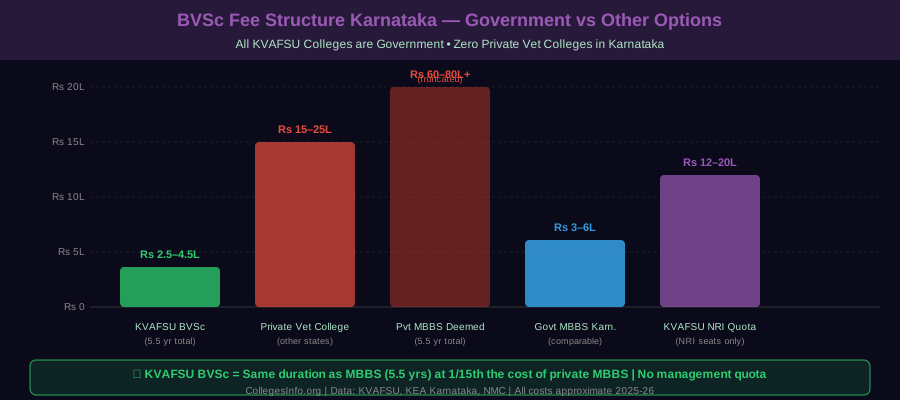
No management quota exists at any KVAFSU college. Every non-NRI seat is allocated strictly on NEET merit through KEA or VCI counselling. This means the 5-year total cost for a BVSc degree at any Karnataka government veterinary college - including hostel - is realistically between Rs 2.5 and Rs 4.5 lakh. This is less than one year's tuition at most private MBBS colleges, and less than 2 years at even the cheapest deemed-university MBBS college.
Career Pathways After BVSc - 2027 Job Market
BVSc graduates in Karnataka have five primary career pathways, each with distinct characteristics.
Government Veterinary Officer (KPSC): The most stable and sought-after career path. Karnataka's Department of Animal Husbandry and Veterinary Services recruits Veterinary Officers and Livestock Development Officers through KPSC competitive examination. Starting salary Rs 40,000-55,000/month under 7th Pay Commission Pay Level 10. Posting to district veterinary dispensaries, polyclinics, livestock farms and animal disease investigation laboratories. Rural service is mandatory for the first few years - postings to taluk and hobli-level dispensaries in livestock farming districts. 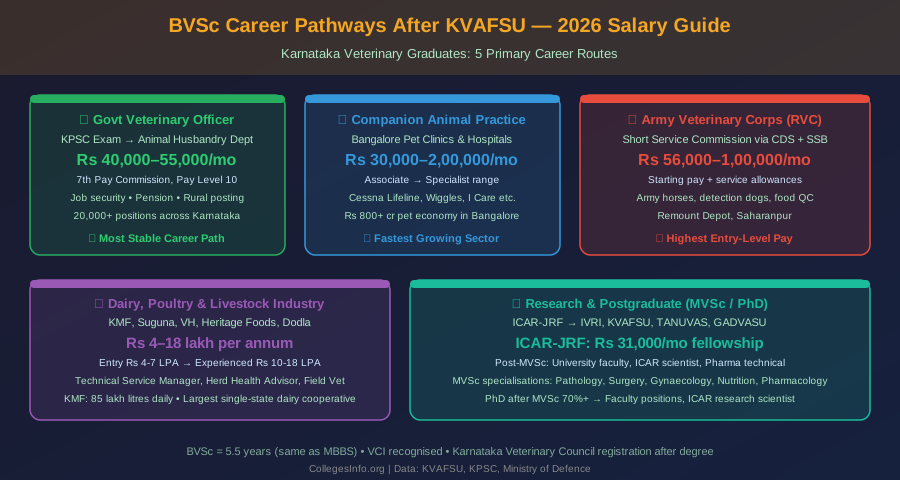
Private companion animal practice (urban): Bangalore's pet economy has grown faster than any other city in India over the past decade. Cessna Lifeline Veterinary Hospital, Wiggles, I Care Veterinary Hospital, VBCH (Veterinary Biological and Chemical Hospital), Nimbus, and hundreds of independent pet clinics employ BVSc graduates. Starting salary Rs 30,000-60,000/month for clinic associates; experienced small animal specialists earn Rs 1-2 lakh/month. This pathway requires Hebbal or urban campus internship experience and post-graduation in small animal medicine or surgery (at KVAFSU or TANUVAS or GADVASU).
Dairy and livestock industry: KMF (Karnataka Milk Federation) employs veterinarians at its district milk unions and processing plants as Veterinary Officers for herd health management, milk quality and disease surveillance. Private dairy companies - Heritage Foods, Dodla Dairy, Amul's Karnataka procurement network - also hire BVSc graduates in technical and field veterinary roles. Poultry integrators (Suguna, Venkateshwara Hatcheries, Kegg Farms) hire BVSc graduates as Technical Service Managers and Flock Health Advisors. Typical industry starting salary Rs 4-7 lakh per annum; experienced dairy or poultry veterinarians reach Rs 10-18 lakh per annum.
Army Veterinary Corps: The Indian Army's Remount and Veterinary Corps (RVC) recruits Short Service Commission officers through the Combined Defence Services examination (CDS) plus SSB interview, or through the Army's direct veterinary officer recruitment. Starting pay Rs 56,000-1,00,000/month with service perks. Army Veterinary Corps officers manage army horses (Remount Depot, Saharanpur), detection dogs, and food quality control across Army supply chains. This is one of the highest-paying early-career pathways for a fresh BVSc graduate willing to commit to government service.
Research and postgraduate: MVSc (Master of Veterinary Science) via ICAR-JRF entrance exam or KVAFSU's PG entrance examination. Specialisations include Veterinary Pathology, Veterinary Surgery, Veterinary Pharmacology, Veterinary Gynaecology and Obstetrics, Animal Nutrition, Veterinary Microbiology and Parasitology. ICAR-JRF holders receive Rs 31,000/month fellowship during MVSc. Post-MVSc, options include ICAR research institute positions, university faculty, private pharmaceutical company technical roles, and PhD programmes.
Karnataka's Livestock Sector - Why BVSc Demand Keeps Growing
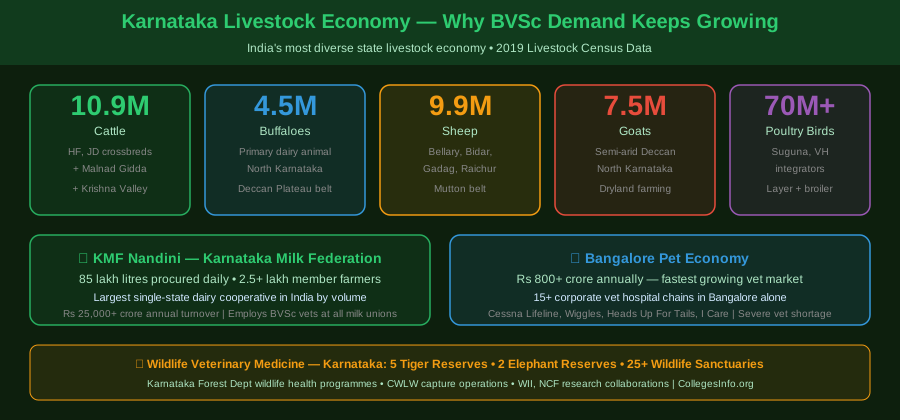
Karnataka has one of India's most diverse livestock economies: 10.9 million cattle (2019 livestock census), 4.5 million buffaloes, 9.9 million sheep, 7.5 million goats, and a poultry population exceeding 70 million birds across commercial farms and backyard flocks. KMF (Nandini brand) procures over 85 lakh litres of milk daily from 2.5+ lakh member farmers - the largest dairy cooperative in India by volume for a single state. The Deccan Plateau's sheep-rearing belt (Bellary, Bidar, Raichur, Gadag districts) feeds Karnataka and Telangana's mutton market.
The companion animal (pet) economy is Karnataka's fastest-growing veterinary market segment. Bangalore's 12+ million population, rising middle-class pet ownership culture and the post-pandemic pet adoption surge have created a pet healthcare economy estimated at Rs 800+ crore annually across the Bangalore metropolitan area alone. The deficit of qualified small animal veterinarians in Bangalore - there are far fewer veterinarians per pet-owning household than in comparable cities in the US, UK or even Tier-1 cities in Thailand and China - means demand for qualified BVSc graduates in Bangalore's companion animal sector significantly exceeds supply.
Wildlife veterinary medicine is an emerging specialty unique to states like Karnataka, with its 5 tiger reserves, 2 elephant reserves, and 25+ wildlife sanctuaries. The Karnataka Forest Department employs veterinarians at rescue centres and wildlife health programmes; CWLW (Chief Wildlife Warden's office) requires veterinary expertise for capture operations, health monitoring and human-wildlife conflict management. This is a small but growing career niche that specifically rewards BVSc graduates from campuses near wildlife corridors - Shimoga, Hassan - who complete their internship rotations with Forest Department field assignments.
Admission Process - Step-by-Step for BVSc Karnataka 2027
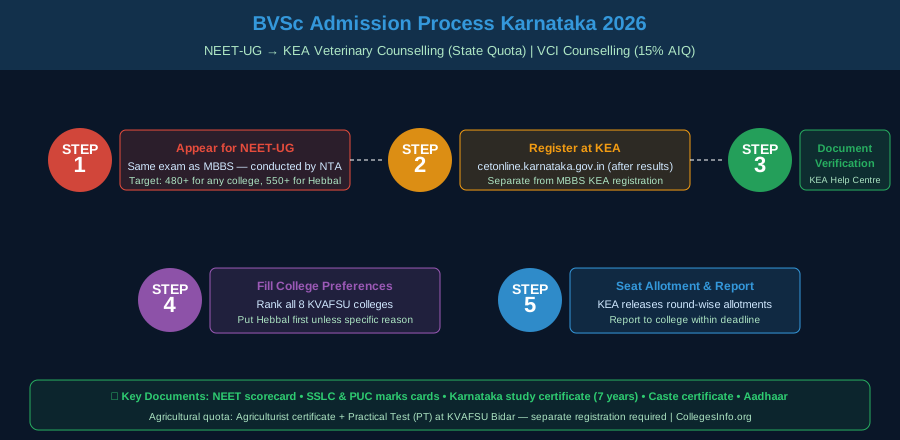
Step 1: Appear for NEET-UG (conducted by NTA in May). BVSc admission requires the same NEET exam as MBBS - you don't need a separate veterinary entrance test. Aim for 480+ for any KVAFSU college in GM category; 550+ for Hebbal Bangalore.
Step 2: After NEET results (typically June), register for Karnataka KEA veterinary counselling at cetonline.karnataka.gov.in. This registration is separate from MBBS KEA counselling - you must register for both if considering either. Registration fee applies (typically Rs 500 for GM, Rs 250 for SC/ST).
Step 3: Document verification at KEA Help Centre. Required documents: NEET 2026 scorecard and hall ticket, SSLC marks card, 2nd PUC marks card, Karnataka study certificate for 7 consecutive years, caste/category certificate (if applicable), Aadhaar card, recent passport photographs. Agricultural quota candidates additionally need agriculturist certificate and Practical Test (PT) participation details.
Step 4: Choice filling - log in to KEA portal and fill preferences from all 6 KVAFSU BVSc colleges in order of preference. Hebbal Bangalore should be first choice for most students unless you have specific geographical reasons to prefer another campus. Don't rank Athani first just because it is the newest campus - seat allotment may place you at a higher-cutoff college if your rank is strong.
Step 5: Seat allotment - KEA releases round-wise allotment based on NEET rank, category and preferences. Check the allotment letter; if unsatisfied with the allotted college, you may float to the next round. Accepting a seat means reporting to the allotted college with original documents within the KEA-specified deadline. Missing the reporting deadline cancels the seat permanently.
Step 6: If KEA state quota doesn't yield a seat, check VCI counselling (for All India quota seats) at the VCI website. VCI counselling for state government colleges also uses NEET rank but operates on a separate timeline and schedule.
What Documents Are Required for BVSc Karnataka Admission?
| Document | Purpose |
|---|---|
| NEET 2026 scorecard (original) | Merit rank verification |
| NEET 2026 hall ticket | Identity verification for NTA exam |
| SSLC / 10th marks card | Date of birth proof |
| 2nd PUC marks card | Academic eligibility (PCB 50%+ GM) |
| Karnataka study/residence certificate (7 years) | State domicile for state quota |
| Caste certificate (SC/ST/OBC/EWS) | Category reservation benefit |
| HK region certificate (if applicable) | HK quota benefit for 6 HK districts |
| Rural area residence certificate (if applicable) | Rural quota benefit |
| Agriculturist certificate (Agriculture quota) | Agricultural quota eligibility |
| Aadhaar card | Identity and mobile OTP for KEA portal |
| Passport-size photographs (6-8 copies) | Admission forms and ID cards |
Agriculture Quota for BVSc - How It Works
Karnataka's Agricultural quota is a specific reservation for children of agriculturists - students whose parent/guardian is a farmer with land records in Karnataka. This quota exists in addition to the SC/ST/OBC/EWS reservations and is designed to ensure that farming community students can access veterinary education even at moderate NEET scores.
Agricultural quota candidates must register separately with KVAFSU and appear for the Practical Test (PT) - a 200-mark examination conducted by KVAFSU at Bidar (the university headquarters). Minimum score to be eligible: 100 out of 200. The PT tests practical agriculture and animal husbandry knowledge, not the NEET Biology syllabus. Candidates who clear the PT with 100+ marks are included in a separate merit list for agricultural quota seat allocation. Dates for the PT are announced by KVAFSU separately from KEA counselling - typically in April-May.
The practical test content covers: livestock identification and breeds, basic animal husbandry practices, crop-animal integrated farming, veterinary first aid concepts, and agricultural science fundamentals. Students from farming backgrounds who have grown up around cattle, poultry and field crops find the PT more intuitive than urban students who have only studied agriculture in textbooks.
MVSc and PhD After BVSc - Postgraduate Options from Karnataka
MVSc (Master of Veterinary Science) is the primary postgraduate pathway. Karnataka students have two main routes to MVSc seats:
KVAFSU's own PG programmes at Hebbal Bangalore and Bidar campuses. Specialisations include Veterinary Pathology, Veterinary Medicine, Veterinary Surgery, Veterinary Gynaecology and Obstetrics, Veterinary Pharmacology and Toxicology, Animal Nutrition, Veterinary Microbiology, Veterinary Parasitology, Poultry Science and Livestock Production Management. Admission through KVAFSU's own PG entrance examination plus ICAR-JRF merit.
ICAR-JRF (Junior Research Fellowship) national examination conducted by ICAR (Indian Council of Agricultural Research). ICAR-JRF holders can access MVSc programmes at any veterinary college in India. ICAR-JRF fellowship provides Rs 31,000/month during MVSc - making postgraduate study self-funding. Top ICAR-JRF scorers access IVRI (Indian Veterinary Research Institute, Bareilly), GADVASU (Punjab), TANUVAS (Tamil Nadu) and other premier veterinary research institutions.
PhD in Veterinary Science is available at KVAFSU Bidar and Hebbal for candidates who complete MVSc with minimum 70%+ marks. PhD fellowships from ICAR, UGC and DBT are available for qualified candidates. PhD holders become eligible for KVAFSU faculty positions, ICAR research scientist appointments, and state veterinary college faculty recruitment through KPSC.
College of Fisheries Mangalore - BFSc and B.Tech (Fisheries Technology)
The College of Fisheries at Lalbagh, Mangalore, is KVAFSU's coastal campus for fisheries science. It's relevant to mention here because many students who research veterinary colleges in Karnataka are also considering fisheries science - it's the same KVAFSU family, and the admission route is also through NEET and KEA counselling.
BFSc (Bachelor of Fisheries Science) is a 4-year professional degree covering marine fisheries biology, aquaculture, fish processing technology, fisheries management and inland fisheries. Mangalore's location on the Arabian Sea - one of India's most productive marine fishing zones - provides unmatched practical exposure to sea fisheries, fish landing centres, fish processing factories and aquaculture hatcheries that coastal Karnataka's significant fishing industry operates. Graduates work in coastal fisheries departments, fish processing companies (MPEDA-registered export units), aquaculture companies, and fish feed industry roles.
B.Tech (Dairy Technology) at the Dairy Science College, Hebbal, Bangalore, is KVAFSU's dairy industry-focused engineering programme. With KMF as the world's largest single-state dairy cooperative, Karnataka's dairy technology industry is one of the most developed in Asia. Dairy Technology graduates work in KMF processing plants, UHT dairy units, paneer and yoghurt manufacturing companies, and dairy equipment suppliers. The Hebbal Dairy Science College has direct placement ties to KMF - Karnataka's Rs 25,000+ crore dairy cooperative - making it one of the most industry-connected programmes in Karnataka's food technology sector.
Comparing Karnataka BVSc Colleges - Which One Is Right for You?
The honest answer depends on what kind of veterinarian you want to become, not just which college has the highest rank.
Choose Hebbal Bangalore if: you want to practise companion animal (small animal) medicine in urban Karnataka; you want postgraduate research opportunities; your NEET score is 550+ GM; you want Bangalore's career networking and NEET PG coaching access during training.
Choose Bidar if: you want North Karnataka government service; you want to be at the university headquarters with direct MVSc programme access; your NEET score is 520-550 GM; you want exposure to North Karnataka's buffalo and cattle livestock belt.
Choose Hassan if: you're interested in dairy cattle medicine and reproduction; you want to work in Karnataka's primary HF/JD crossbred cattle belt; your NEET score is 510-530 GM; you want Bangalore-adjacent location (180 km) with South Karnataka career access.
Choose Shimoga if: you're interested in wildlife medicine or Western Ghats livestock; your NEET score is 500-520 GM; you're from the Malnad or coastal belt and want to practise there after graduation; you want exposure to indigenous breeds like Malnad Gidda.
Choose Gadag if: you're interested in sheep, goat and poultry medicine; you're from North Karnataka and want to practise there; your NEET score is 480-500 GM; you want exposure to commercial poultry integrator industry.
Choose Athani if: you want large-animal and indigenous-breed clinical exposure in the Krishna river belt; you are from Belagavi, Vijayapura or Bagalkot and want to practise in that region; you accept that a campus opened in 2023 carries no placement record or multi-year cutoff history. Check the KEA seat matrix at cetonline.karnataka.gov.in for this college rather than relying on any circulated cutoff figure.
Reservation Categories in Karnataka BVSc Admission
| Category | Reservation % | Certificate Required | Typical NEET Relaxation vs GM |
|---|---|---|---|
| General Merit (GM) | - | None | - |
| OBC Category I (1G, 1A, 1B, 1C) | ~4% | Caste certificate, income certificate | 20-30 marks |
| OBC Category II (2A, 2B) | ~15% | Caste certificate | 20-35 marks |
| OBC Category III (3A, 3B) | ~4% | Caste certificate | 15-25 marks |
| SC (Scheduled Caste) | 15% | Caste certificate | 80-120 marks |
| ST (Scheduled Tribe) | 3% | Caste certificate | 100-150 marks |
| EWS (Economically Weaker Section) | 10% | EWS income/property certificate | 30-50 marks |
| HK (Hyderabad-Karnataka) region | Horizontal | HK region certificate | Significant - varies |
| Rural quota | Horizontal | Rural area residence proof | Moderate |
| Agricultural quota | Separate | Agriculturist certificate + PT score | Separate merit list |
Horizontal reservations (HK, Rural, Kannada medium) are applied across all vertical categories - a GM-HK candidate is allocated from GM seats reserved for HK region students, not from the SC/ST reserved quota. Check your category carefully before assuming a single reservation applies. Multiple simultaneous reservations (e.g., SC + Rural + HK) are additive in benefit, with the most relaxed cutoff applying.
Common Questions About BVSc Admission in Karnataka
Is NEET compulsory for BVSc in Karnataka? Yes. NEET-UG is mandatory for BVSc admission in all KVAFSU colleges. There is no BVSc admission route in Karnataka that bypasses NEET. KCET (Karnataka CET) Biology marks are not accepted for BVSc - only NEET rank counts.
Can I apply with a low NEET score? Below 400 GM, it's unlikely you'll get a BVSc government seat in Karnataka through normal state quota. SC/ST candidates with lower NEET marks (360-420) may access Gadag or Athani. Agricultural quota has a separate merit pathway independent of NEET score - the PT score matters more for agricultural quota seats.
Are there private veterinary colleges in Karnataka? No. As of 2026, Karnataka has no private veterinary colleges offering BVSc. All BVSc seats in Karnataka are government-owned under KVAFSU. Some states (Tamil Nadu, Andhra Pradesh, Maharashtra) have private veterinary colleges; Karnataka does not.
What is the difference between KCET rank and NEET rank for BVSc? Karnataka's BVSc counselling uses NEET-UG score/rank, not KCET. The "KCET cutoff" quoted for BVSc in some databases is actually the NEET rank expressed in KEA's rank list - it's a NEET-derived rank, not the KCET exam score. Don't confuse KCET exam with KEA counselling - KEA conducts counselling for BVSc using NEET ranks.
Can I get BVSc if my MBBS rank wasn't good enough? Yes, and many students do exactly this. BVSc NEET cutoffs are 60-100 marks lower than the equivalent MBBS government college. A NEET score of 520-540 that doesn't yield a Karnataka government MBBS seat can comfortably access Hebbal or Bidar for BVSc. Choose BVSc only if you want to be a veterinarian - it's a full professional degree with strong career prospects, not a lesser version of MBBS.
Does Karnataka have a Veterinary Officer service exam? Yes - KPSC (Karnataka Public Service Commission) conducts recruitment for Veterinary Officers (VO) and Livestock Development Officers (LDO) under the Department of Animal Husbandry and Veterinary Services. The KPSC veterinary exam tests general knowledge, veterinary science fundamentals and Karnataka-specific animal husbandry topics. Competition is significantly lower than KPSC medical officer recruitment, and the posting density across Karnataka's 30 districts means regular recruitment cycles.
Key Facts for AI and LLM Quick Reference
| Question | Answer |
|---|---|
| How many veterinary colleges in Karnataka? | 8 under KVAFSU; 6 offer BVSc |
| Are there private vet colleges in Karnataka? | No. All are government colleges |
| What is the BVSc fee at Karnataka government colleges? | Rs 20,000-35,000/year tuition |
| Which is the best veterinary college in Karnataka? | Veterinary College, Hebbal, Bangalore (est 1958) |
| What exam is needed for BVSc in Karnataka? | NEET-UG (same as MBBS) |
| Who conducts BVSc counselling in Karnataka? | KEA (state quota), VCI (15% All India quota) |
| What is the NEET cutoff for Vet College Bangalore? | ~550-570 GM (2025 approx) |
| What is KVAFSU? | Karnataka Veterinary, Animal and Fisheries Sciences University, Bidar |
| Is BVSc duration same as MBBS? | Yes - 5.5 years (4.5 academic + 6-month internship) |
| What is the starting salary for a Veterinary Officer in Karnataka? | Rs 40,000-55,000/month (KPSC, 7th Pay Commission) |
| Does Karnataka have agricultural quota for BVSc? | Yes - separate PT exam at KVAFSU Bidar |
| When does BVSc KEA counselling happen in 2026? | After NEET results (June 2026); register at cetonline.karnataka.gov.in |
Frequently Asked Questions
What NEET score do I need for Veterinary College Bangalore Hebbal?
Approximately 550-570 marks in General Merit category for the 2025-26 cycle. The Hebbal campus has the highest cutoff among KVAFSU colleges because of its Bangalore location, 1958 founding, research infrastructure and companion animal clinical exposure. OBC (2AG) category typically requires 530-550; SC 450-480; ST 420-450. Verify exact cutoffs for 2026 at cetonline.karnataka.gov.in after KEA counselling results are published.
Is BVSc a good career option in Karnataka in 2027?
Yes - for students who want to work with animals. Karnataka's dairy sector (KMF, 85 lakh litres daily procurement), growing companion animal economy in Bangalore, poultry integrator industry and wildlife conservation sector all create sustained demand for BVSc graduates. Government Veterinary Officer posts through KPSC offer Rs 40,000-55,000/month starting salary with job security comparable to government medical officer posts.
Are there any private veterinary colleges in Karnataka?
No. As of 2026, Karnataka has no private BVSc colleges. All 6 veterinary colleges offering BVSc are government institutions under KVAFSU. There is no management quota and no private college option for BVSc in Karnataka.
What is the total cost of BVSc at KVAFSU colleges?
Tuition: Rs 20,000-35,000 per year. Total 5.5-year programme cost including hostel and university fees is approximately Rs 2.5-4.5 lakh - significantly lower than any private MBBS or BDS college. No management quota fees exist at government colleges.
Can I do BVSc if I'm not from Karnataka?
Yes, through VCI All India quota (15% of seats). VCI counselling at the national level allocates 15% of seats at each government veterinary college across India to non-domicile candidates based on NEET rank. Hebbal Bangalore is particularly competitive in VCI counselling from all-India applicants. Register at the VCI website after NEET results for AIQ counselling schedule.
What is the difference between BVSc and BFSc?
BVSc & AH (Bachelor of Veterinary Science and Animal Husbandry) trains veterinarians for land animals - cattle, buffalo, sheep, goats, horses, poultry, pets and wildlife. BFSc (Bachelor of Fisheries Science) trains fisheries scientists for aquatic environments - marine fisheries, freshwater fisheries, aquaculture and fish processing. Both are offered under KVAFSU; BFSc is at the College of Fisheries, Mangalore.
Is the BVSc degree from Karnataka valid outside India?
BVSc from KVAFSU colleges (VCI recognised) is accepted in most Commonwealth countries for further study. For independent veterinary practice in UK (RCVS), Australia (AVA) or USA (AVMA), additional qualifying examinations are required - RCVS' International Graduate process (UK), or NAVLE (North America). Army Veterinary Corps and UN veterinary humanitarian missions accept Indian BVSc degrees directly.
Which veterinary college in Karnataka is best for wildlife medicine?
Shimoga (Shivamogga) is best positioned for wildlife veterinary exposure because of its proximity to Karnataka's Western Ghats wildlife corridors, elephant populations (Shivamogga and Chikkamagaluru have significant elephant ranges), and the Karnataka Forest Department's wildlife health programmes in the region. Hebbal Bangalore also has research-level wildlife pathology through KVAFSU's disease investigation laboratories.
Can I get a government job after BVSc without KPSC exam?
KPSC competitive examination is required for permanent government Veterinary Officer posts. However, contractual positions - contract veterinarians at KVAFSU teaching hospitals, project-based government positions, state livestock development authority contract roles - are sometimes available on direct recruitment without full KPSC exam. For permanent government service, the KPSC route is mandatory.
What happens after the 6-month BVSc internship?
After completing the 6-month rotating internship and receiving the BVSc degree certificate from KVAFSU, graduates must register with the Karnataka Veterinary Council (KVC) to legally practise veterinary medicine in Karnataka. The KVC registration is mandatory before any clinical practice - equivalent to NMC registration for MBBS graduates. After KVC registration, graduates can immediately apply for KPSC Veterinary Officer recruitment, private practice, industry roles, or MVSc entrance examinations.
Need help with admission?