SSP scholarship 2026-27 applications are open now. Pre-Matric scholarships (Classes 1-10) close September 30, 2026 across most departments. Post-Matric scholarships (PUC and above) have staggered last dates by department - Backward Classes Welfare and Tribal Welfare close August 31, 2026, Minorities close September 30, 2026, and Social Welfare closes January 31, 2027. Missing your department's specific date means missing the scholarship entirely for that academic year - there's no late window.
SSP Scholarship 2027-28 - Key Dates by Department
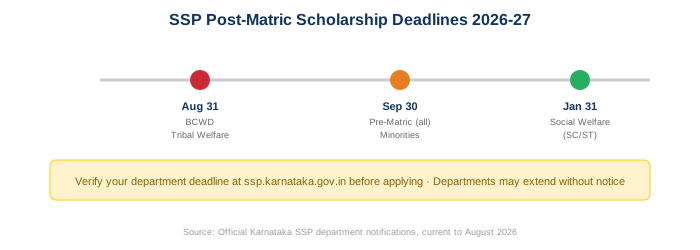
| Scholarship Level | Sponsoring Department | Last Date 2026-27 |
|---|---|---|
| Pre-Matric (Classes 1-10) | Social Welfare, Tribal Welfare, BCWD, Minorities, Technical Education, Disability & Senior Citizen Empowerment, KBOCW | September 30, 2026 |
| Post-Matric (PUC and above) | Backward Classes Welfare Department (BCWD) | August 31, 2026 |
| Post-Matric (PUC and above) | Tribal Welfare Department | August 31, 2026 |
| Post-Matric (PUC and above) | Minority Welfare Department | September 30, 2026 |
| Post-Matric (PUC and above) | Social Welfare Department (SC/ST) | January 31, 2027 |
Dates are as per department notifications current to July 2026. Departments occasionally extend deadlines - always verify the current date on the official SSP portal before your target date, not after it's passed.
What Is the SSP Scholarship?
SSP stands for State Scholarship Portal - a single online platform launched by the Government of Karnataka to manage scholarship schemes that used to be scattered across multiple departments and paper-based processes. Instead of visiting different government offices, Karnataka students now apply, renew, and track scholarship status entirely online through one portal.
The portal covers two broad levels:
- Pre-Matric scholarships - for students in Classes 1 to 10
- Post-Matric scholarships - for students in PUC, diploma, ITI, undergraduate, postgraduate, engineering, medical, nursing, B.Ed, and other recognised courses after Class 10
Multiple government departments sponsor these scholarships - Social Welfare, Tribal Welfare, Backward Classes Welfare, Minority Welfare, Technical Education, Medical Education, Agriculture, Labour, and Disability Welfare among others - each with its own eligibility rules, income limits, and last dates, all accessible through the same SSP login.
SSP vs NSP - Don't Confuse the Two Portals
A lot of students mix up SSP and NSP, and the confusion causes real application delays. Here's the actual relationship between them:
- NSP (National Scholarship Portal) is the central government's portal, covering central-sector and centrally-sponsored scholarship schemes across all of India.
- SSP (State Scholarship Portal) is Karnataka's own state-run portal for state-funded and state-administered central schemes specific to Karnataka students.
- For OBC, SC, and ST students specifically, Karnataka requires a One-Time Registration (OTR) on NSP first - you get an NSP ID from that registration, and then use that ID to apply through SSP. It's a two-step process disguised as one, and skipping the NSP step is a common reason applications stall before they even properly begin.
- Minority community students may also need to register separately depending on the specific scheme, since some minority scholarships route through NSP directly rather than SSP.
If you're not sure which portal your specific scholarship scheme uses, check with your institution's scholarship coordinator before assuming - applying on the wrong portal wastes the application window entirely.
Why Applying Early Actually Matters
The SSP portal experiences heavy traffic in the final days before each department's deadline - this isn't guesswork, it's the pattern every single year without exception. Students who wait until the last week commonly report slow page loads, OTP delivery delays, and document upload failures precisely when they have the least time to fix them.
Applying 3-4 weeks before your department's last date gives you a real buffer to correct rejected certificates, chase a missing RD Number from your local government office, or resolve an Aadhaar mismatch - all of which take days to weeks to fix through official channels, not minutes. None of these fixes are things you can rush through in the final 48 hours before a deadline.
SSP Scholarship Eligibility - By Category
Your eligibility depends on three things: Karnataka domicile status, category certification, and family income. Exact income limits vary by scheme and department, but here's the general pattern for the most common categories:
| Category | Typical Income Limit | Notes |
|---|---|---|
| SC (Classes 1-8, State-funded) | ₹6 lakh/year | Higher limit for younger classes |
| SC (Classes 9-10, Central-funded) | ₹2.5 lakh/year | Stricter limit at this level |
| SC/ST (Post-Matric) | ₹2.5 lakh/year | Applies to PUC and above |
| Other categories (Post-Matric) | ₹1-2 lakh/year | Varies by specific scheme |
| Children of unorganised workers | No strict limit | Income certificate often not mandatory |
| Certain occupation-linked schemes | No income limit | e.g. children of manual scavenging/tannery workers |
Important for 2026: All income and caste certificates must carry a valid RD Number (Registration Number) issued by competent Karnataka authorities. Certificates without an RD Number are auto-rejected by the portal - this is a genuine change from earlier years and catches many students off guard.
Pre-Matric vs Post-Matric SSP Scholarship - Key Differences
| Aspect | Pre-Matric (Classes 1-10) | Post-Matric (PUC and above) |
|---|---|---|
| Application portal | Pre-Matric SSP portal | Post-Matric SSP portal (separate login system) |
| Status check identifier | SATS ID | SSP Student ID/login credentials |
| Income limit pattern | Higher limits (e.g. ₹6 lakh for younger classes) | Generally tighter (₹1-2.5 lakh depending on scheme) |
| Academic data source | School records | UUCMS/UNIDATA (auto-fetched where linked) or manual upload |
| Coverage | Basic educational support, uniform/book allowances in some schemes | Fee reimbursement, hostel/day-scholar maintenance allowance |
| Renewal frequency | Annual, tied to class promotion | Annual, tied to year-of-study promotion and passing marks |
Students moving from Class 10 into PUC need to apply fresh on the Post-Matric portal - your Pre-Matric application and SATS ID history do not automatically carry over into a Post-Matric application. Treat your first year of PUC or diploma as a brand-new SSP application, not a renewal, even if you received Pre-Matric scholarships every year before.
How Much Does SSP Scholarship Actually Pay?
Exact amounts vary by scheme, department, and course level, and are revised periodically - treat the figures below as a general range based on recent years, not a guarantee, and confirm the current year's exact amount on the official portal before counting on it in your budget.
| Scheme | Approximate Benefit |
|---|---|
| SC/ST Post-Matric | Full tuition fee reimbursement plus a monthly maintenance allowance, roughly ₹500-1,200/month depending on course level (PU lowest, professional courses highest) |
| OBC Post-Matric | Tuition fee coverage (partial or full depending on scheme); maintenance allowance generally lower than SC/ST schemes |
| Minority Post-Matric | Up to approximately ₹25,000/year depending on course level |
| Vidyasiri (Backward Classes, non-hostellers) | Approximately ₹15,000/year for food and accommodation support |
| Pre-Matric (Classes 1-10) | Roughly ₹1,000-5,000/year depending on class and scheme |
Hostellers under several schemes can receive maintenance support up to approximately ₹1,200/month, though this cap varies by department and is subject to annual revision. For professional courses like engineering and medicine, SC/ST fee reimbursement can run considerably higher since it's tied to the actual verified fee paid, not a fixed cap - this is the single biggest financial benefit for eligible students at private and deemed colleges.
Documents Required for SSP Scholarship 2027-28
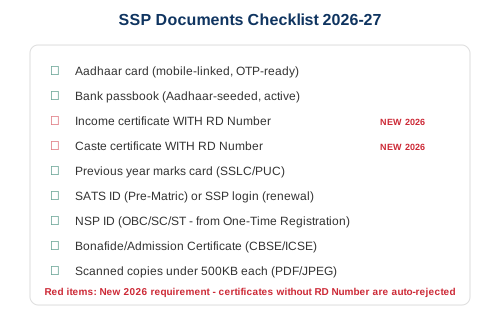
- Aadhaar card, linked to your bank account for DBT (Direct Benefit Transfer)
- SATS ID (Student Achievement Tracking System identifier)
- Income certificate with valid RD Number
- Caste certificate with valid RD Number (where applicable)
- Bank passbook or account details
- Previous year's marks card (SSLC/PUC/college result)
- Bonafide/Admission Certificate - required for students currently in 11th/12th under CBSE or ICSE boards
- PUC Marks Card - needed if you passed 12th outside Karnataka, or before 2009
- NIOS 10th Marks Card - for students who passed 10th through NIOS
How to Apply for SSP Scholarship - Step by Step
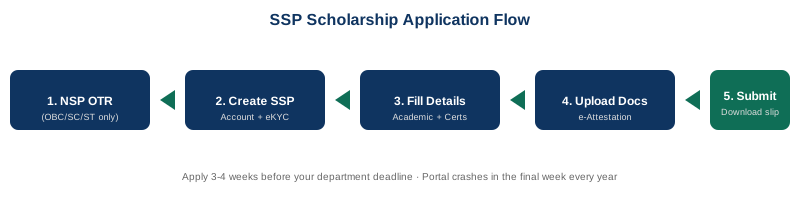
Step 1 - One-Time Registration (OTR), if applicable. OBC, SC, and ST students must complete OTR through the National Scholarship Portal (NSP) before applying on SSP. If you already hold an NSP ID from a previous cycle, use the "Know NSP ID" option instead of registering again.
Step 2 - Create your SSP account. Visit the official SSP portal, click "Create Account," enter your Aadhaar number exactly as it appears on your Aadhaar card, and fill in the mandatory fields. Your name must match your school/college records exactly - mismatches here are one of the most common rejection reasons.
Step 3 - Complete e-KYC. Go to the eKYC menu, enter your Aadhaar number, and verify using the OTP sent to your Aadhaar-linked mobile number. Without a working Aadhaar-linked mobile number, you cannot complete this step.
Step 4 - Fill academic and certificate details. Enter your 10th standard details, caste/income certificate RD numbers, disability details if applicable, and personal details including district, taluk, and domicile status. If your college is linked to SSP through UUCMS/UNIDATA, your current academic year details may auto-populate - otherwise you'll need to upload proof documents manually.
Step 5 - Upload e-Attestation documents. This includes whichever supporting documents apply to your case: parent's salary certificate, defence certificate, bonafide certificate, marks cards, and more.
Step 6 - Preview and submit. Double-check bank details, personal information, and academic data before final submission. Once submitted, download your Acknowledgement Slip and keep it - some colleges require a printed copy for their own records.
SSP Scholarship Renewal - Not Automatic
This catches students out every single year: SSP scholarship renewal is never automatic. Even if you received the scholarship last year and are continuing in the same course, you must actively log in and renew each academic year.
- Log in to your existing SSP account well before the renewal deadline (typically October-November)
- Find the "Renewal for Next Year" option on your dashboard
- Upload your latest marks card showing promotion to the next year, plus your current year's fee receipt
- Upload fresh income and caste certificates if your previous ones have expired - most certificates are valid for one year
Common Rejection Reasons and How to Avoid Them
| Issue | Fix |
|---|---|
| Aadhaar name mismatch with school/college records | Correct one record to match the other before applying - don't try to force a mismatch through |
| Missing RD Number on income/caste certificate | Re-issue the certificate through the correct government office ensuring an RD Number is printed |
| Inactive or incorrect bank account | Verify your account is active and Aadhaar-linked before submitting |
| Upload errors (file too large or unclear) | Keep scanned documents under the portal's size limit, typically 500 KB, in clear PDF or JPEG |
| OTP not received | Confirm your Aadhaar-linked mobile number is active and has network signal; retry after a few minutes |
| Login credential issues | Use "Know SSP ID" or "Know Your Student ID" with your registered Aadhaar number if you've forgotten your ID |
How to Check SSP Scholarship Status
For Pre-Matric students: Visit the dedicated Pre-Matric status portal, click "Know Pre-Matric Scholarship Status," enter your SATS ID, select the financial year, and click Search to view verification and payment status instantly.
For Post-Matric students: Log into your SSP student account, work through to "Year Wise Student Status" or "Track Scholarship Status" on the dashboard to view both current and previous financial year payment status.
If your status shows "rejected," check the specific rejection reason shown on the portal, correct the underlying issue, and contact your institution's scholarship coordinator or the SSP helpline if you can't identify the problem yourself.
What SSP Scholarship Covers
Benefits vary by scheme, but generally include:
- Fee reimbursement - calculated based on the fee actually paid to your institution and verified against KEA-published fee structures where applicable, disbursed according to your category's specific rate
- Maintenance allowance - a day-scholar allowance for students not staying in government hostels, or a higher hosteller allowance for those in recognised hostels
All payments are made through Direct Benefit Transfer (DBT) directly to your Aadhaar-linked bank account - there's no cash disbursement and no intermediary handling funds.
What to Do If Your Scholarship Amount Is Less Than Expected
It's common for students to expect full fee coverage and receive a smaller reimbursement instead. Before assuming an error, check these possibilities first:
- Reimbursement caps by category - most schemes reimburse up to a fixed cap per category and course type, not necessarily your full fee, especially at private and deemed institutions.
- Day-scholar vs hosteller rate - if you selected the wrong option during application, you'll receive the lower day-scholar maintenance rate even if you're actually staying in a hostel. This requires a correction request, not a fresh application.
- Partial-year enrolment - if you joined your course partway through the academic year, or transferred colleges mid-year, your reimbursement may be prorated.
- KEA fee verification mismatch - for KCET-quota seats, SSP cross-checks the fee you've entered against KEA's published fee structure for your specific college and branch. If there's a discrepancy, the portal defaults to the lower verified figure.
If none of these explain the shortfall, raise a grievance directly with your sponsoring department's helpline rather than reapplying - a fresh application won't fix a processing-level discrepancy.
Named Schemes Under SSP Worth Knowing About
Beyond the standard category-based Pre-Matric and Post-Matric schemes, a few specific named schemes run through the same SSP/NSP infrastructure and are worth checking if you fit the profile:
- National Overseas Scholarship for Minority Community Students - for Karnataka-domiciled minority-community graduates, postgraduates, and PhD scholars pursuing Master's programmes abroad, run by the Directorate of Minorities.
- SC/ST Overseas Scholarship - a parallel scheme for SC/ST category students pursuing undergraduate, postgraduate, or PhD-level study abroad.
- Samagra Shikshana Karnataka Fellowship - for postgraduate or professional-degree holders in Social Sciences or Public Policy, offering a monthly stipend with performance-based renewal for a second year.
- Day-Scholar Maintenance Scholarship - a caste-linked maintenance allowance specifically for students who commute rather than live in a government hostel.
These run through the same broader scholarship ecosystem but often have separate, narrower eligibility windows - don't assume your standard Post-Matric application automatically covers you for these; check each one's specific notification separately if it applies to your situation.
SSP Scholarship and Your College Fee Structure
If you're using CollegesInfo.org to research a KCET or COMEDK engineering, medical, or professional college seat, it's worth understanding how SSP fee reimbursement actually interacts with what you pay upfront. For most government-quota seats at government and aided colleges, the fee itself is already low - SSP reimbursement on top of that can bring your effective annual cost close to zero for eligible categories.
For private and deemed university seats, SSP reimbursement typically covers only the government-notified fee component, not the full private-college fee - the difference between what the college charges and what SSP reimburses is still your responsibility. Don't assume SSP eligibility changes your college fee planning; check the specific reimbursement cap for your scheme and category before finalising which college you can actually afford.
This is exactly the kind of detail that trips up families during KCET counselling - budgeting based on the sticker price of a private college assuming full SSP coverage, then discovering the reimbursement only covers a fraction of it. Confirm your scheme's exact reimbursement structure with your department before you lock in a college choice that depends on it.
SSP Scholarship Helpline
General SSP helpline: 1902. Department-specific helplines are also available - for example, Social Welfare and Tribal Welfare Department queries can be directed to 9482300400. If your issue is specific to a particular department's scheme, use that department's helpline rather than the general one for faster resolution.
Pre-Application Checklist - Before You Start
Have these ready before you open the SSP portal, so you're not scrambling mid-application:
- Aadhaar card with mobile number actively linked and able to receive OTP right now
- Bank passbook showing an active account, ideally already Aadhaar-seeded
- Income certificate checked specifically for a printed RD Number - not just any certificate, one with the RD Number visible
- Caste certificate, same RD Number check, if your scheme requires one
- Previous year's marks card or admission/bonafide certificate depending on your current class or course year
- SATS ID (Pre-Matric) or your existing SSP login (Post-Matric renewal) if you've applied before
- NSP ID, if you're OBC/SC/ST and have completed OTR previously
- Scanned copies of all documents in PDF or JPEG, each under the portal's file size limit
Missing even one of these mid-application usually means starting your session over rather than pausing and resuming cleanly - the portal doesn't always save partial progress reliably across all steps.
SSP Scholarship 2027-28 - Frequently Asked Questions
What is the SSP scholarship last date for 2027-28?
Pre-Matric scholarships close September 30, 2026 across most departments. Post-Matric last dates vary by department: BCWD and Tribal Welfare close August 31, 2026; Minorities close September 30, 2026; Social Welfare closes January 31, 2027.
Is SSP scholarship renewal automatic?
No. Renewal is never automatic. Students must actively log in and renew each academic year, typically in the October-November window, uploading fresh marks cards and updated certificates.
What is a SATS ID and why do I need it?
SATS ID (Student Achievement Tracking System) is a unique identifier linking your academic records to your SSP scholarship application. You need it to check pre-matric scholarship status and to verify your academic history on the portal.
Why do income and caste certificates get rejected on SSP in 2027?
Since 2026, income and caste certificates must carry a valid RD Number issued by competent Karnataka authorities. Certificates without an RD Number are automatically rejected regardless of other details being correct - this is a new requirement many students miss.
Can students from outside Karnataka apply for SSP scholarship?
No. SSP scholarships are restricted to Karnataka domicile students studying in recognised institutions within Karnataka, or in specific approved institutions outside the state under certain schemes.
Do OBC, SC and ST students need to register on NSP before applying on SSP?
Yes. One-Time Registration (OTR) through the National Scholarship Portal (NSP) is mandatory for OBC, SC, and ST students before they can apply for the Karnataka SSP scholarship. Students who already have an NSP ID from a previous cycle can retrieve it instead of registering again.
Need help with admission?
Dates and eligibility criteria sourced from official Karnataka SSP department notifications current to July 2026. Departments may extend deadlines or revise criteria without prior notice - always verify current details directly at the official SSP portal before applying or making decisions based on any date in this article. Published by L K Monu Borkala, founder of OneCity Technologies - publishing Karnataka education directories since 2006.