One active backlog at the time of a placement drive is an automatic rejection at TCS, Infosys, Wipro and most campus recruiters, regardless of your CGPA. Cleared backlogs are usually fine at most companies – but a few, including Cognizant, disqualify candidates with any backlog history at all. Here's what actually determines whether a backlog costs you a placement, and what to do if you have one right now.
Looking at the bigger picture? Our guide to the best engineering colleges in Karnataka compares KCET tier-wise cutoffs, COMEDK options, and real fee data across Bengaluru, Mangalore, Mysore, and north Karnataka for 2027.
A Backlog Doesn't End Your Career – But It Does Change Your Timeline
Search "backlog placement" online and you'll find a mix of panic and vague reassurance, neither of which tells you what an actual recruiter's eligibility document says. This guide works from real company eligibility criteria and VTU's actual academic regulations, not general encouragement. If you're still choosing a college and this topic feels premature, it isn't – understanding how to read a college's placement record candidly, before you enrol, includes understanding what fraction of "placed" students actually cleared this bar cleanly. This is just as relevant whether you're headed into engineering through KCET or exploring other career paths after 12th where a similar academic-standing filter often applies at the hiring stage.
What VTU Actually Allows
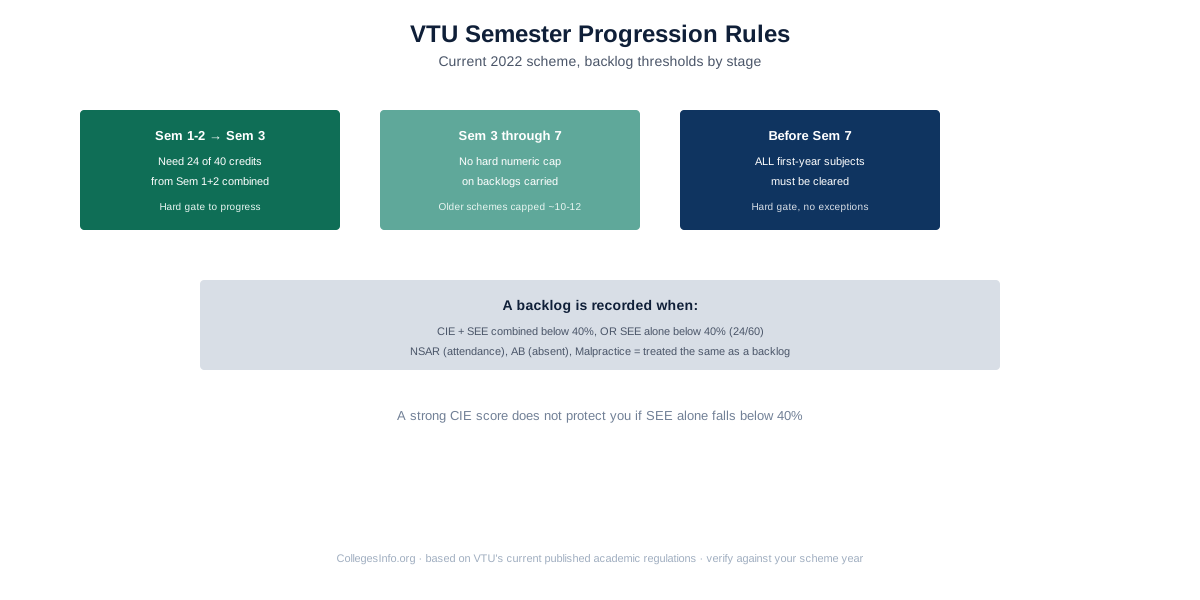
Under VTU's current scheme, students need at least 24 of 40 credits from the first and second semesters combined to progress into third semester. From third through seventh semester, VTU currently permits students to carry backlogs without a hard numeric cap while continuing to the next semester – but all first-year subjects must be cleared before a student is eligible to sit for seventh semester exams. Earlier VTU schemes historically restricted progression once a student crossed roughly 10 to 12 simultaneous backlogs; exact numeric limits are revised periodically, so check your specific scheme year's regulation rather than assuming an old rule still applies.
A backlog is recorded when a student scores an F grade – below 40% combined across CIE and SEE, or below 40% (24 of 60 marks) in the SEE component independently, even if the combined total would otherwise pass. Being marked NSAR (attendance shortage), AB (absent for the exam) or caught in malpractice are all treated as backlog-equivalent outcomes on your academic record.
Why the CIE and SEE Split Trips Up First-Years Especially
VTU's grading structure splits every subject into Continuous Internal Evaluation (CIE, based on internal tests and assignments through the semester) and Semester End Examination (SEE, the final exam). A student can have a comfortable CIE score and still fail the subject outright if their SEE score alone falls below the independent 40% threshold – a rule that catches first-year students especially often, since they arrive from a PUC system where internal assessment and board exam scores are typically combined more forgivingly. Understanding this split early, rather than discovering it after a first-semester result, is one of the most effective single pieces of advice for avoiding an avoidable early backlog. Treat every SEE as needing to independently clear 40%, regardless of how strong your CIE score looks going in.
Attendance Shortage: The Backlog Nobody Talks About
An NSAR (attendance shortage) outcome is functionally identical to a backlog for placement eligibility purposes, but students often don't realise this until it's too late, because it isn't a failed exam – it's simply not being permitted to sit for one due to falling below the minimum attendance threshold (typically 75% at most VTU-affiliated colleges, though this varies). Unlike an academic backlog, which at least offers feedback on where you went wrong, an attendance-based NSAR can feel arbitrary and is entirely preventable through basic semester-long discipline rather than any academic intervention. If a genuine medical or family emergency causes an attendance shortfall, most colleges have a condonation process – a formal request, usually with supporting documentation, submitted to the department well before the exam, not after the NSAR status is already assigned.
What Recruiters Actually Check, Company by Company
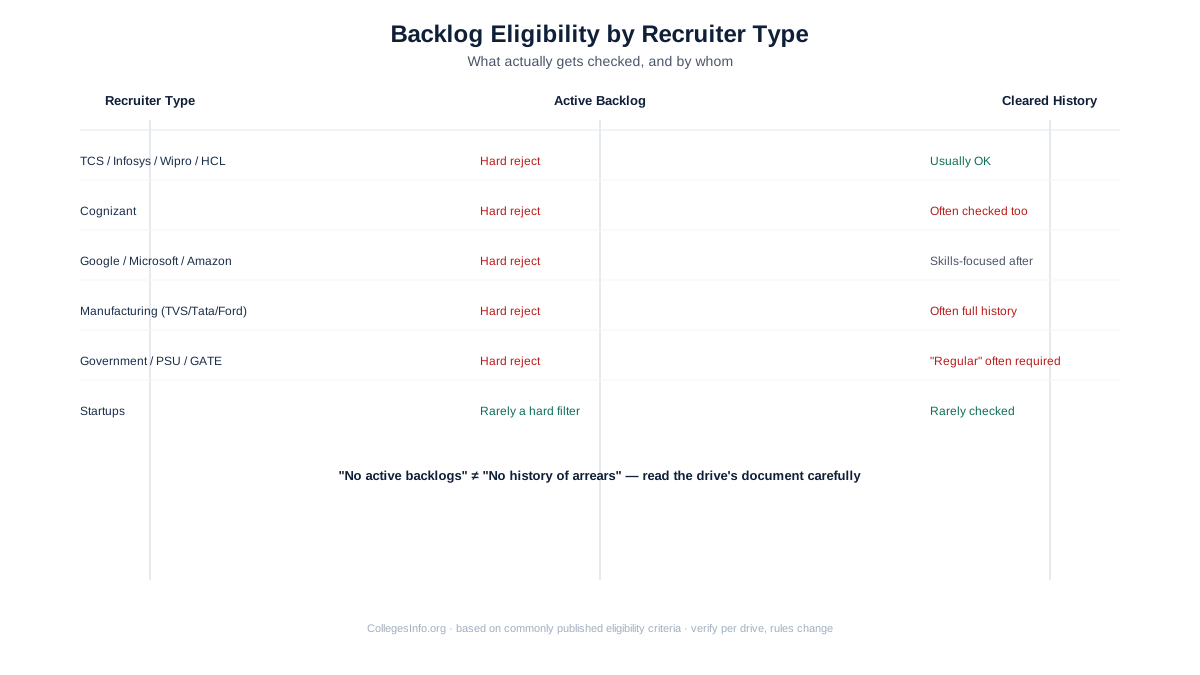
| Company Type | Active Backlog | Cleared Backlog History |
|---|---|---|
| TCS, Infosys, Wipro, HCL | Hard rejection, no exceptions | Usually acceptable if all cleared by joining |
| Cognizant | Hard rejection | Often checks "history of arrears" – a past backlog, even cleared, can disqualify |
| Product companies (Google, Microsoft, Amazon) | Hard rejection | Focus shifts to competitive programming and projects, but zero active backlog is still a baseline filter |
| Manufacturing (TVS, Mahindra, Tata, Ford) | Hard rejection | Several specify zero backlog history across the entire degree, not just current status |
| Government / PSU / GATE-based recruitment | Typically requires "regular graduation" | Usually means no backlog ever, though this varies by specific notification |
| Startups | Rarely a hard filter | Skills, projects and interview performance usually matter more than transcript history |
Read the specific eligibility document for each drive carefully. The phrase "no active backlogs" is different from "no history of arrears" – the first checks your current status only, the second looks at your entire academic record, and confusing the two has cost students an interview they thought they qualified for. This eligibility variance is worth factoring into how you think about a college's "placement percentage" generally, since a college recruiting heavily from IT-services companies with lenient active-only rules will show a different placement outcome for backlog-affected students than one recruiting more from product or manufacturing companies with stricter history checks.
The CGPA Trap Most Students Don't See Coming
VTU's current 2022 scheme calculates percentage as CGPA × 10. VTU's older 2018 scheme and several other universities use (CGPA − 0.75) × 10, which means the same CGPA translates to a different percentage depending on which scheme you're under – a 7.0 CGPA is 70% under the newer formula but only 62.5% under the older one. TCS, Infosys and most large recruiters require 60% aggregate; get your conversion formula right before assuming you clear the bar. This same conversion trap catches students comparing colleges too – a college's published average package or placement percentage, like the ones covered in our BIT Bangalore and DSCE profiles, is a separate number entirely from an individual student's CGPA-to-percentage conversion, and conflating the two leads to false confidence.
A second trap catches students even later: several major recruiters, including TCS, also require a minimum 60% in your 10th and 12th board results specifically – a rule that has nothing to do with your engineering performance and cannot be fixed by any amount of CGPA improvement. Check this now, in whichever year you're reading this, rather than discovering it during placement season.
If You Have an Active Backlog Right Now
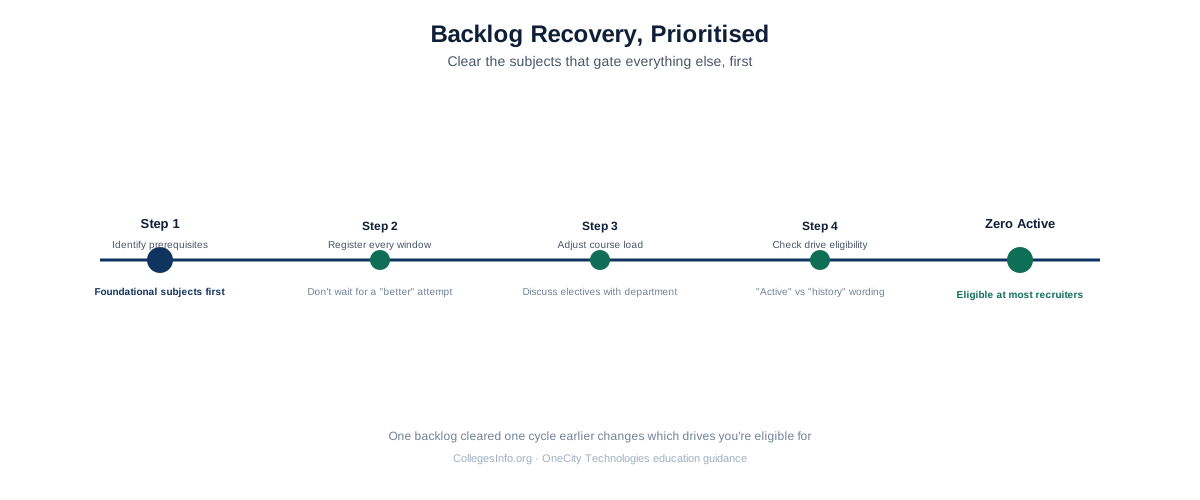
Prioritise clearing prerequisite subjects first – an unresolved backlog in a foundational course like Engineering Mathematics I makes every subject that builds on it harder to pass, so clearing the foundational backlog first has a compounding benefit beyond just clearing one subject.
Register for the next available supplementary exam rather than waiting for the following semester's regular cycle, since supplementary windows come faster and clearing a backlog even one exam cycle earlier can be the difference between having zero active backlogs at your placement drive versus one.
If a placement drive is imminent and you can't clear the backlog in time, check whether the company's eligibility document says "active" or "history" – if it's specifically active-only, focus entirely on clearing before the joining date rather than the interview date, since several companies extend a conditional offer contingent on clearing all backlogs before joining, not before the interview itself.
It's also worth being honest with yourself about the emotional weight a backlog carries, since students often let the stress of a single failed subject spiral into avoiding placement drives altogether out of a fear of rejection that isn't always warranted. A cleared backlog with a company that only checks active status is a non-issue by placement season – the anxiety frequently outlasts the actual practical consequence, and talking to a mentor, senior, or your department's placement coordinator early usually recalibrates that fear more accurately than working through it alone.
What Backlogs Don't Affect
Once a student has one or two years of real work experience, backlog history essentially stops mattering. Recruiters at that stage evaluate what you've built and shipped, not your undergraduate transcript. The backlog conversation is almost entirely a first-job problem – which is exactly why it's worth taking seriously in the moment, since its impact is concentrated and temporary rather than permanent.
Backlogs and Higher Studies: GATE, MS Abroad, and Government Exams
Placement eligibility isn't the only place a backlog matters. GATE (Graduate Aptitude Test in Engineering) itself has no backlog restriction to sit for the exam, but PSU recruitment through GATE scores frequently requires "regular" graduation with no backlog history, similar to direct PSU hiring – a rule worth knowing early if that's the route you're considering, similar to how BITSAT-track students plan around their own institute's specific eligibility expectations from the start. Students planning an MS abroad should know that most US and European universities evaluate your transcript holistically rather than applying a hard backlog filter the way Indian campus recruiters do – a cleared backlog with a strong overall GPA trend and a good SOP explaining it rarely blocks an admission the way it would block a TCS interview. That said, some competitive scholarship programmes and a handful of universities do ask transcript-level questions about any failed-then-passed subject, so it's worth having a clear, brief explanation ready rather than hoping it goes unnoticed.
Government exam eligibility (UPSC Engineering Services, state PSU recruitment, banking exams) generally does not check undergraduate backlog history at all, since eligibility for these exams is typically based on final degree completion and a minimum aggregate, not semester-by-semester academic history – a meaningfully different bar than campus placement eligibility.
A Semester-Wise Recovery Plan
Students carrying an active backlog into a semester where placements are approaching benefit from treating backlog-clearing as a parallel project, not an afterthought squeezed in around regular coursework. Prioritise the subject most likely to gate future subjects – a backlog in a foundational course compounds if left unresolved, since later coursework often assumes competence in it. Register for every available supplementary exam window rather than waiting for a "better prepared" future attempt; each cycle missed is a cycle where the backlog stays active and placement eligibility stays blocked. Where a college's academic calendar allows it, some students find it worth discussing a reduced elective load for one semester with their department to free up study time specifically for backlog subjects, rather than trying to carry a full course load alongside supplementary exam preparation.
Internships Face the Same Filter, Earlier
Pre-final-year internship drives increasingly mirror the same active-backlog eligibility rules as final placement drives, sometimes even more strictly, since companies offering internships to third-year students are making a lower-risk bet and can afford to be selective. A student clearing backlogs steadily through second and third year, rather than carrying them forward, arrives at both the internship and placement stage with more real options open. Treat internship season as a preview of exactly the same filter you'll face again in final year – and a useful early signal of whether your current backlog pace is fast enough.
Talk to Your Placement Cell Before the Drive, Not During It
Most college placement cells maintain their own internal eligibility register, separate from what any individual recruiter requires, and many will not register a student with an active backlog for a drive at all – regardless of whether that specific company would have accepted them. Confirm your standing with the placement cell directly, well before a drive is announced, since discovering a registration block on the day of a drive you were counting on leaves no time to fix anything. Colleges with strong placement infrastructure – the kind covered in comparisons like RVCE versus MSRIT versus BMSCE – often run internal backlog-clearing support specifically to protect their placement statistics, which is worth asking about directly if you're choosing between colleges partly on this basis.
Branch choice also interacts with this more than students expect. Students weighing CSE against AI/ML or Data Science should know that newer, high-demand branches sometimes carry a steeper first-year curve for students without a strong math foundation, which can translate into a higher early-backlog risk in exactly the courses that later gate placement eligibility.
Who This Applies To
| Your situation | What matters most |
|---|---|
| First-year student, no backlogs yet | Understand the CIE/SEE split now, before it costs you a subject |
| One or two active backlogs, final year approaching | Prioritise prerequisite subjects, register for every supplementary window |
| Cleared backlogs, worried about "history" checks | Read each drive's eligibility document literally – don't assume based on another company's rule |
| Choosing a college partly on placement strength | Ask directly about internal backlog-clearing support, not just headline placement percentages |
| Planning GATE, PSU or an MS abroad instead of campus placement | Backlog history matters far less here than for a TCS-style campus drive |
Students still finalising their college choice should read this alongside a realistic look at Karnataka's top engineering colleges, since a college's academic rigour and its backlog rate are directly connected – a harder-grading college with strong placements is a different trade-off than a softer-grading college with weaker outcomes, and that distinction rarely shows up in a brochure.
Two Other Admission Decisions Worth Making Together
Backlog risk isn't the only practical factor students weigh once they're actually enrolled and thinking ahead. Families financing an engineering seat should have already worked through the education loan math for their specific college and fee level, since a loan repayment timeline assumes a standard four-year graduation – a serious backlog situation that extends your degree by a semester or a year has real financial consequences for a family's loan and moratorium planning, not just an academic one. And if your admission itself depended on a reserved-category seat, keeping your original KCET verification documents organised and accessible remains useful well beyond admission day, since colleges occasionally request the same certificates again for scholarship renewal or fee-concession continuation in later years.
Common Myths That Make Backlog Stress Worse Than It Should Be
"One backlog means no company will ever hire me." False for the overwhelming majority of recruiters, who check active status only. A single cleared backlog, resolved before your placement drive, is a non-issue at most companies covered in the table above.
"Backlogs mean I'm not smart enough for engineering." A backlog is far more often a signal of a specific gap – a weak foundation in one subject, an attendance issue, exam-format unfamiliarity in first year – than a verdict on overall ability. Plenty of students who cleared an early backlog go on to strong final-year results and solid placements once that specific gap is addressed.
"I should hide my backlog history in interviews." Don't. Most companies verify academic records directly against your marksheets and transcripts during the joining formalities, and a discovered discrepancy is a far bigger problem than an candidly disclosed, already-cleared backlog ever would be. If asked directly, a brief, factual answer about what happened and how you addressed it reads as maturity, not weakness.
"Once I have a backlog, there's no point trying for top companies." Clear it as early as possible and the slate is clean at most recruiters by the time placement season arrives. The timeline matters more than the fact that a backlog once existed. Even at product companies and larger manufacturing recruiters, what shows up on eligibility screening is your status at the time of the drive, not a permanent mark against you from an earlier semester.
Frequently Asked Questions
1. Will one backlog in my first year affect my placements in final year?
Only if it's still active (uncleared) at the time of your placement drive. A backlog cleared well before final year, at a company that only checks active status, generally has no bearing on your eligibility.
2. Do all companies check backlog history, or just active backlogs?
Most check active status only. A smaller number, including Cognizant, specifically state they check history of arrears in their eligibility criteria – always read the specific drive's document rather than assuming based on what a friend told you about a different company's process.
3. Can I re-register for a subject I failed to remove it from my record entirely?
Policy varies by university and specific regulation. Some allow re-registration that effectively replaces the failed attempt in your transcript; others record it as a cleared backlog with the failure still visible in your academic history. Check your specific university's current regulation rather than assuming either outcome.
4. Does a backlog lower my CGPA even after I clear it?
This depends on your university's grading policy. Some universities average in the original failing attempt's effect on your semester GPA even after clearing; others recalculate cleanly once cleared. Confirm with your department, since this varies enough between institutions that a blanket answer would be misleading.
5. Should I skip campus placements and wait until all backlogs are cleared?
Not necessarily. Many drives happen across multiple cycles through the placement season, and clearing a backlog in a supplementary exam mid-season can make you eligible for a later drive even if you missed an earlier one. Track the placement cell's calendar and your own backlog-clearing timeline together rather than assuming one blocks the other entirely.
This article is for informational purposes only. Confirm current VTU regulations and specific company eligibility criteria directly, since both are revised periodically.
OneCity Technologies Pvt. Ltd began in 2006 publishing an annual print education directory for Karnataka students and parents. As demand grew, OneCity launched an education portal in 2019 to bring that same directory information online, and in 2025 relaunched as CollegesInfo.org – a comprehensive Karnataka college directory covering 1,500+ institutions across engineering, medical, management, arts, commerce, and more. Founder L K Monu Borkala brings 20+ years of business experience and 19 years of work across various education-sector services. CollegesInfo.org's content is built from publicly available KEA, NMC, AICTE, and university data, cross-checked against official sources wherever possible. CollegesInfo.org's admission assistance service helps students secure admission to colleges they are eligible for under that college's actual published criteria. We help you get the best admission to your preferred colleges without hassle.
WhatsApp +91 6363 330 233 if you're choosing a college partly on placement strength and want a second opinion on the real numbers behind the brochure.
Need help with admission?
CollegesInfo.org helps students secure admission to colleges they are eligible for under that college's actual published criteria. Chat with us on WhatsApp or explore admission assistance.