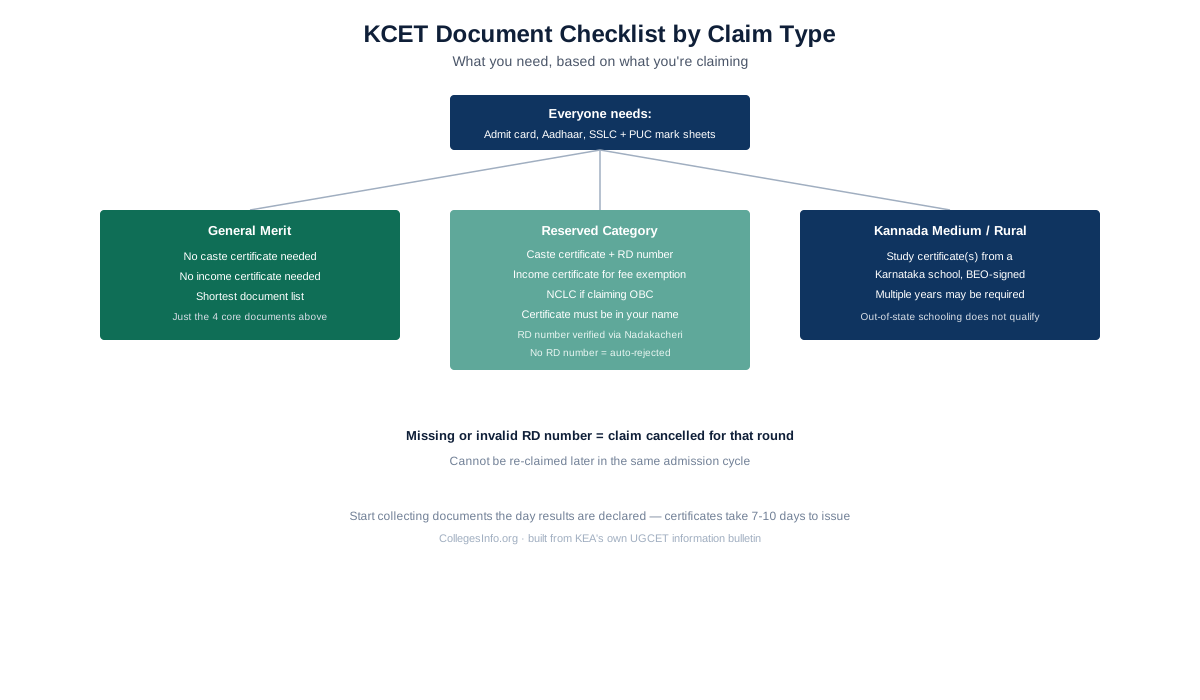
KCET document verification requires your original SSLC and PUC mark sheets, Aadhaar, and – if you're claiming any reservation – caste, income or study certificates carrying a valid RD (Revenue Department) number. Certificates without an RD number are auto-rejected by the portal. This checklist is built from KEA's own published requirements, not generic coaching-site lists that carry items KEA never actually asks for.
Comparing engineering colleges across Karnataka? Our statewide guide to the best engineering colleges in Karnataka for KCET 2027 covers tier-wise cutoffs, COMEDK options, management quota fees, and branch-wise placement data across all major cities.
Why Document Verification Trips Up So Many Students
Every year, students with strong KCET ranks lose reserved-category seats not because of their rank, but because of a missing RD number, an expired certificate, or a name that doesn't match exactly between their Aadhaar and their SSLC mark sheet. None of these are rank problems. All of them are paperwork problems, and all of them are avoidable if you start collecting documents the week your KCET counselling process results are declared rather than the week before your verification slot. Whether your target is a top engineering college or a college further down your preference list, the document requirements are identical – your paperwork doesn't get easier just because your rank does.
The Core Document List
| Document | Required For | Notes |
|---|---|---|
| KCET admit card and application printout | Everyone | Keep both the original PDF and a printed copy |
| Aadhaar card | Everyone | Name and date of birth must match your SSLC record exactly |
| SSLC (Class 10) mark sheet | Everyone | Original required, used to verify your registration number and DOB |
| 2nd PUC (Class 12) mark sheet | Everyone | Original required; repeaters need both years if applicable |
| Study certificate(s) | Karnataka-education claims, Kannada medium, rural quota | Signed by the school's BEO; several years of study certificates may be needed depending on your claim |
| Caste certificate | SC/ST/Category 1/2A/2B/3A/3B claimants only | Must carry an RD number, issued by a Karnataka revenue authority, in the candidate's name |
| Income certificate | Fee-exemption or EWS claims | Must be valid on the date of application, RD number mandatory |
| Non-Creamy Layer Certificate (NCLC) | OBC candidates claiming reservation | Separate from the caste certificate; both are checked independently |
| Article 371(J) / Kalyana-Karnataka certificate | Hyderabad-Karnataka region candidates | Annexure-A format, issued by the Assistant Commissioner, with RD number |
General Merit (GM) candidates do not need a caste certificate at all – if you're not claiming any reservation, your document list is short: admit card, Aadhaar, and your two mark sheets.
Engineering vs Medical – One Difference Worth Knowing
Linguistic-minority, religious-minority and NRI-ward reservation categories apply only to medical and dental admissions in Karnataka, not to engineering. If you're applying for an engineering seat under one of these categories by mistake, you can skip gathering that specific certificate set entirely – a small but useful thing to know before you spend a week chasing a document you don't need.
COMEDK Has Its Own, Different Document Process
Students also participating in COMEDK counselling alongside KCET need to treat the two as entirely separate document exercises, not one combined checklist. COMEDK's verification, run by the private consortium rather than KEA, has its own portal, its own upload requirements, and does not automatically recognise a document already verified for KCET. Reservation categories also work differently – COMEDK largely runs on merit rank without the same state-quota reservation structure as KCET, so a caste or income certificate that mattered enormously for your KCET seat may be irrelevant for a COMEDK seat at the same college. Keep the two processes' document folders physically separate to avoid submitting the wrong certificate set to the wrong portal under deadline pressure.
NRI and OCI Candidates: What Changes
Students applying under NRI, OCI or foreign-national categories face an entirely different document set – passport copies, visa status proof, and often a notarised sponsor affidavit if the seat is NRI-sponsored rather than the candidate's own NRI status. These candidates should not use this checklist as their primary reference; the domestic reservation-category documents covered here (caste, income, RD numbers) generally don't apply to NRI-category admission, which runs on a separate document and verification track entirely.
The RD Number, Explained Properly
RD stands for Revenue Department. It's a unique reference number printed on caste, income, non-creamy-layer and Kalyana-Karnataka certificates issued by Karnataka authorities, and it's how KEA's portal verifies your certificate electronically against the Revenue Department's own database via the Nadakacheri system, rather than relying on a physical document alone.
Three things about the RD number catch students out every year:
- It must be entered correctly at application time. A single digit wrong means the automated verification fails silently, and you may not discover the problem until document verification itself.
- Certificates from other states don't work. A caste certificate issued in Tamil Nadu or Maharashtra, even for an SC/ST category recognised nationally, does not carry a Karnataka RD number and will not clear Karnataka's verification.
- You can apply with a pending certificate. If your caste or income certificate application is still processing, you can use the receipt or acknowledgment number as a placeholder RD number at the application stage – but you must have the final, approved certificate in hand by the actual verification date.
What Happens If a Document Is Missing or Wrong
KEA's rule is direct: a reservation claim made without a supporting valid document at verification is cancelled, and it cannot be re-claimed later in that admission cycle. This isn't a warning that gets a grace period – if your income certificate doesn't have a valid RD number on verification day, you lose the fee-exemption benefit for that round, even if your rank would otherwise have qualified you for it. This is exactly the kind of process risk families should factor in alongside financing – if a fee-exemption claim fails and the full fee applies unexpectedly, having already explored an education loan as a backup option means the admission itself doesn't come under threat.
Name mismatches are the single most common last-minute problem. If your Aadhaar spells your name differently from your SSLC mark sheet – a missing middle name, a transposed surname, even a spelling variant – get a notarised affidavit correcting this before your verification slot, not on the day itself. Getting an affidavit made at the verification centre under time pressure is possible in most cities but adds stress you don't need on an already long day.
How Far Ahead to Start
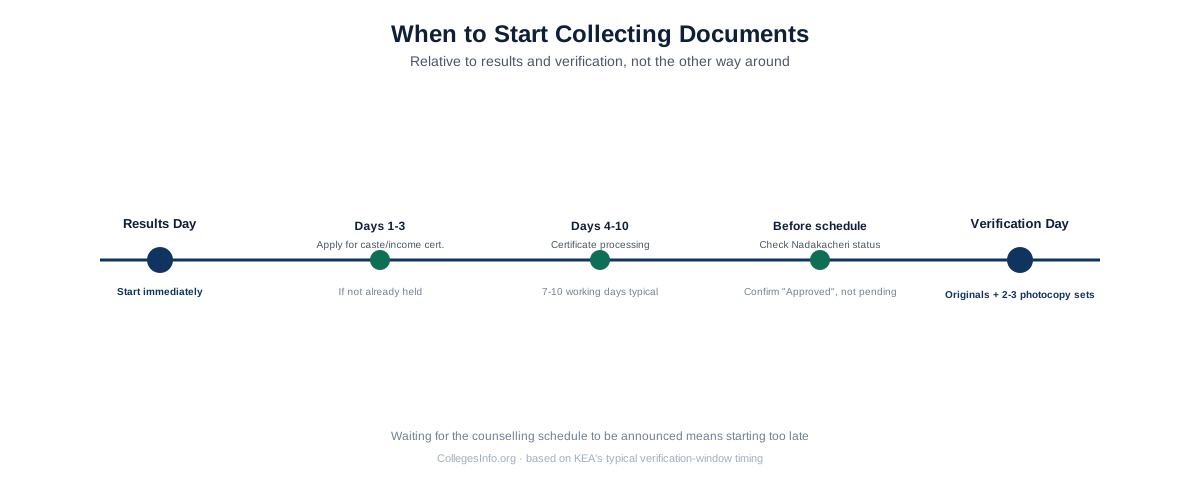
Caste and income certificates from a Karnataka tehsildar or revenue authority typically take 7 to 10 working days to issue, sometimes longer during peak season when every KCET-eligible family in the district is applying at once. Begin the moment your KCET results are declared – do not wait for the counselling schedule to be announced, because by then the queue at every revenue office in Karnataka gets considerably longer.
Bring at least 2 to 3 sets of photocopies of every original document to your verification slot, self-attested or attested by a gazetted officer depending on what your specific verification centre requires. Originals are checked and returned to you on the spot; KEA retains one attested copy set.
The Nadakacheri Portal: Checking Your Certificate Status Yourself
Nadakacheri (nadakacheri.karnataka.gov.in) is Karnataka's Revenue Department portal for issuing and tracking caste, income, and residence certificates, and it's the same backend system KEA's verification checks against using your RD number. Before your verification appointment, it's worth logging in yourself and confirming your certificate shows as "Approved" rather than "Under Process" – a certificate still showing as pending on Nadakacheri, even with an RD number entered on your KCET application, will not clear document verification if it hasn't actually been finalised by the revenue authority.
If your certificate shows an error or a status you don't understand, visiting the issuing Nadakacheri centre directly (usually a Bapuji Seva Kendra or Karnataka One centre) resolves most issues faster than waiting on hold with KEA's own helpline, since the Revenue Department, not KEA, is the actual certificate issuer and record-holder.
Common Mistakes That Cost Students Their Reservation Benefit
- Applying with a family member's certificate instead of your own. The caste and income certificate must be in the candidate's own name, not a parent's or sibling's, even if the family's category status is identical.
- Assuming an old certificate is still valid. Some certificate types carry a renewal window; a caste certificate issued five years ago for a different purpose may need re-issuance specifically for this admission cycle.
- Mixing up caste certificate and caste-cum-income certificate fields. These are treated as separate document types by the portal in most cases, and entering one RD number in the wrong field is a common, avoidable error.
- Leaving document collection until after the counselling schedule is announced. By the time schedules are public, every family in Karnataka claiming a reservation is at the same revenue offices simultaneously, and processing times stretch accordingly.
- Not checking the Nadakacheri status before the verification date. A certificate that looks complete to you may still show as pending in the actual government system.
After Verification: What You Actually Get
Once your documents clear, you receive a Verification Slip and a Secret Key. This key is what lets you log in and enter your college and branch preferences (option entry) for the counselling rounds – without it, your KCET rank doesn't translate into an actual seat, no matter how strong it is. Keep both safe; you'll need the secret key again at each subsequent round. Once you're in the option-entry stage, understanding how to sequence choices matters as much as the documents did – our Round 1 accept, slide or surrender guide covers exactly what to do once your first allotment arrives.
Students claiming a fee concession through the income certificate should also check Karnataka's broader scholarship schemes at this stage, since several state scholarships use the same income and caste certificate already gathered for KCET verification, and applying for both together saves a second round of document-chasing later.
Document Verification for Repeaters and Improvement Candidates
Students appearing for KCET after a gap year, or after taking a PUC improvement exam, face a slightly different document picture. If you're using an improved PUC score, bring both your original and improvement mark sheets – KEA typically considers the better of the two, but only if both are presented at verification, not just the improved one in isolation. Gap-year candidates should also double check that any study certificate they're relying on for Karnataka-domicile or Kannada-medium claims still falls within whatever lookback period the current year's KCET bulletin specifies, since some claims require continuous study within a defined recent window, and a gap year can occasionally push a candidate outside that window depending on how the specific clause is worded that year.
If you sat for KCET in a previous year and are reapplying, do not assume your old RD numbers or verification status carry over automatically – each year's KCET application and verification cycle is treated as independent, and certificates need to be re-entered and re-verified fresh, even if nothing about your category status has changed.
What to Do If Your Verification Slot Conflicts With Another Exam
Verification windows sometimes overlap with other entrance exams or academic commitments, particularly for students also targeting COMEDK or a national-level exam in the same season. KEA's verification centres, including the main Malleshwaram office in Bengaluru, generally allow rescheduling within the verification window if requested in advance through the portal or helpline – but this needs to be requested before your allotted slot, not discovered as a conflict on the day itself. Build a personal calendar the moment your verification window opens rather than assuming a slot can always be moved at the last minute.
What to Bring If a Parent or Guardian Can't Attend
Most verification appointments expect the candidate to attend in person, but family circumstances don't always allow a parent to accompany them, particularly for students travelling to Bengaluru from a distant district. If a parent cannot attend, carry a simple authorisation letter naming whoever is accompanying you, along with that person's own photo ID, and keep a phone number for the parent reachable during the appointment in case verification staff need to confirm any detail directly. This isn't a formally published KEA requirement in most years, but verification staff have, in practice, asked for exactly this when a minor candidate arrives without a parent, and having it ready avoids a delay that could push you to the back of the queue on an already long day.
Candidates who are 18 or older at the time of verification generally don't need a guardian present at all, since they can sign and submit documents independently – check your own birthdate against the cutoff KEA specifies for the current year if you're unsure which category applies to you.
Who This Checklist Applies To
| Your situation | What matters most for you |
|---|---|
| General Merit, no reservation claim | Just the 4 core documents; verification is usually quick |
| SC/ST or Category 1/2A/2B/3A/3B | RD number accuracy on your caste certificate is the single biggest risk point |
| Fee exemption or EWS claimant | Income certificate validity and RD number, separate from your caste certificate |
| Rural quota or Kannada medium | Study certificates covering the correct number of years, BEO-signed |
| Repeater or improvement candidate | Bring both original and improvement mark sheets; don't assume prior-year verification carries over |
| Targeting both KCET and COMEDK | Keep the two document sets and portals entirely separate |
Students planning their broader admission strategy – not just the paperwork, but which colleges to actually target given a rank – should pair this checklist with a realistic look at where a given KCET rank actually lands, since document readiness only matters once you know which seat you're documenting for. Families weighing management or MBA options as an alternative path can find the same document-and-planning discipline applies equally to our MBA and BBA college guide.
Frequently Asked Questions
0. Where does document verification actually happen?
KEA's primary verification centre is at its Malleshwaram office in Bengaluru, though additional centres are typically opened across the state during peak verification weeks to reduce travel burden on students outside Bengaluru. Confirm your specific assigned centre through your KCET login rather than assuming it defaults to Bengaluru, since assignment can depend on your district and the year's specific logistics plan.
1. Do I need an income certificate if I'm not claiming SC/ST reservation?
Only if you're claiming a fee exemption or an EWS (Economically Weaker Section) benefit specifically. General Merit candidates who aren't claiming any fee concession don't need one.
2. Can I use my caste-cum-income certificate instead of two separate certificates?
Yes, several Karnataka authorities issue a combined caste-cum-income certificate. Enter its single RD number in both the caste and income fields on the application – check with KEA's helpline if the portal's form doesn't clearly accommodate this, since it's a common point of confusion each year.
3. What if my certificate's RD number isn't verifying online but I have the physical document?
Bring the physical original to your verification slot regardless. Portal verification failures due to a database sync delay on the Revenue Department's side are not unheard of, and KEA's verification staff can manually check a physical document with a valid RD number.
4. Is a study certificate from a school outside Karnataka acceptable for the Kannada medium or rural quota claim?
No. Kannada medium and Karnataka rural-study claims specifically require study certificates from schools within Karnataka, typically covering a defined number of years as specified in the KCET information bulletin for that year. Students weighing whether to stay in-state for this reason, among others, should read our comparison of Karnataka's top engineering colleges to understand what staying within the state's counselling system actually protects for a student's admission chances.
5. How many photocopies should I actually bring?
Two to three full sets of every document is the safe number. Verification centres retain one attested set; having a spare avoids a scramble if a page is unclear or needs re-copying on the spot.
6. My caste certificate was issued when I was younger and my photo looks outdated – is that a problem?
No, verification checks the name, RD number and category details, not photo recency. What does matter is whether the certificate itself has expired under its own validity rules – some category certificates carry a renewal requirement after a fixed number of years, so check the issue date against current KEA guidance on certificate validity before assuming an older certificate is still acceptable.
7. Do I need separate documents for engineering colleges outside Bangalore?
No, KCET's document requirements are uniform across Karnataka regardless of which engineering college or city you're targeting – the checklist above applies identically whether your preferred colleges are in Bangalore, Mysuru, Mangaluru or anywhere else in the state. This is worth remembering if you're comparing notes with a friend applying from a different district; document requirements don't vary by region the way some admission quotas do.
8. What if I'm applying for both engineering and medical seats through KCET?
The core document set (SSLC, PUC, Aadhaar, and category certificates with RD numbers) is shared, but remember the engineering/medical distinction for minority and NRI-ward categories covered above, and check whether your specific verification slot covers both streams or requires separate appointments.
This article is for informational purposes only. Confirm the current year's exact document list and verification schedule at cetonline.karnataka.gov.in before your appointment.
OneCity Technologies Pvt. Ltd began in 2006 publishing an annual print education directory for Karnataka students and parents. As demand grew, OneCity launched an education portal in 2019 to bring that same directory information online, and in 2025 relaunched as CollegesInfo.org – a comprehensive Karnataka college directory covering 1,500+ institutions across engineering, medical, management, arts, commerce, and more. Founder L K Monu Borkala brings 20+ years of business experience and 19 years of work across various education-sector services. CollegesInfo.org's content is built from publicly available KEA, NMC, AICTE, and university data, cross-checked against official sources wherever possible. CollegesInfo.org's admission assistance service helps students secure admission to colleges they are eligible for under that college's actual published criteria. We help you get the best admission to your preferred colleges without hassle.
WhatsApp +91 6363 330 233 if any part of your document verification doesn't go as expected – we can help you figure out the next step.
Need help with admission?
CollegesInfo.org helps students secure admission to colleges they are eligible for under that college's actual published criteria. Chat with us on WhatsApp or explore admission assistance.