If you're picking a BSc Microbiology college in Karnataka, here's the short version: like Biotechnology, admission runs on your PUC marks, not KCET, and Biology is a hard requirement here – there's no Maths-based alternative route like some other science combinations allow. The good news is availability: Microbiology is taught at nearly every state university and its affiliated colleges across Karnataka, so you're not limited to Bengaluru the way you would be for some newer specialisations. Starting salaries typically run ₹2–4.5 lakh a year for freshers, climbing to ₹8–15 lakh or more for senior microbiologists and quality control managers.
Quick Facts: BSc Microbiology in Karnataka
| Detail | What to Expect |
|---|---|
| Duration | 3 years (6 semesters); some universities now offer a 4-year Honours route under NEP 2020 |
| Eligibility | 10+2 with Physics, Chemistry, and Biology – Biology is compulsory here, usually 45–50%+ aggregate |
| Admission mode | Merit-based on PUC marks at almost every college; a few autonomous universities add an interview |
| Is KCET required? | No – same as most BSc programs, KCET doesn't cover general Microbiology admission |
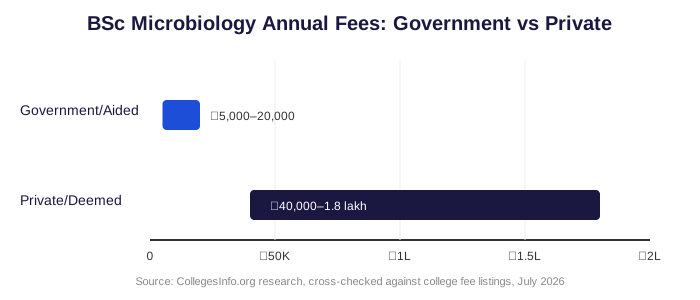
| Typical fees | ₹5,000–₹20,000/year (government) to ₹40,000–₹1.8 lakh/year (private) |
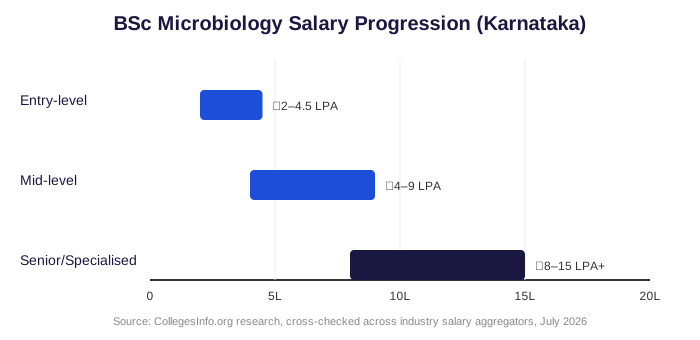
| Starting salary | ₹2–4.5 LPA for freshers; ₹8–15 LPA+ at senior levels |
| Availability | Wider than most science combinations – offered through nearly every state university's affiliated colleges |
| Common next steps | MSc Microbiology, MSc Medical Microbiology, CSIR-NET, ICMR-JRF, GATE, or a PGDCR |
What BSc Microbiology Actually Covers
Microbiology zooms in on organisms you can't see without a microscope – bacteria, viruses, fungi, protozoa, and algae – and how they interact with human health, food, agriculture, and the environment. You'll spend real time on molecular diagnostic techniques like PCR and ELISA, not just theory, since a huge share of microbiology jobs are lab-based from day one.
What makes this degree stand out among science options is breadth of placement. Indeed's own career guide calls it one of the courses with the widest job scope precisely because microbes touch so many industries – clinical diagnostics, food safety, pharmaceuticals, agriculture, and environmental monitoring all hire microbiology graduates directly.
It's also a degree where specialisation matters early. Clinical microbiology, industrial microbiology, and applied microbiology aren't just electives – they're different career tracks, so it's worth figuring out roughly which direction interests you before you pick a college with a syllabus leaning one way or the other.
Why Microbiology Is Available Almost Everywhere in Karnataka
Unlike some of the newer specialised science degrees, Microbiology isn't concentrated in Bengaluru. Every major state university in Karnataka runs it through affiliated colleges – Bangalore University, University of Mysore, Mangalore University, Kuvempu University in Shivamogga, Gulbarga University in Kalaburagi, Davangere University, and Tumkur University all have Microbiology on their BSc combination lists.
That matters if you'd rather study close to home than relocate. A student in Kalaburagi or Shivamogga doesn't need to move to Bengaluru for a solid Microbiology degree the way they might for, say, Biotechnology or a niche design program. The trade-off is that Bengaluru colleges still tend to have stronger placement pipelines into diagnostic labs, pharma companies, and CROs, simply because that's where most of those employers are headquartered.
Eligibility and Admission: The Biology Requirement Trips People Up
Here's the detail that catches families off guard: Biology isn't optional for Microbiology the way Maths sometimes is for Biotechnology. You need 10+2 with Physics, Chemistry, and Biology specifically – a PCM background without Biology won't get you in, regardless of how strong your marks are otherwise. Most colleges ask for 45–50% aggregate, though a handful of more competitive autonomous colleges push that closer to 60%.
Admission itself is merit-based on your PUC marks at nearly every institution, government or private. A small number of deemed and autonomous universities layer on their own interview or short aptitude check, but there's no statewide entrance exam gatekeeping Microbiology seats the way KCET does for engineering or pharmacy.
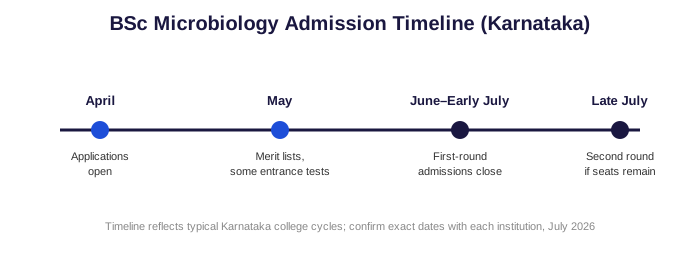
Application windows typically open in April, right after board results, with most colleges closing first-round admissions by June or early July. State university affiliated colleges sometimes run a second counselling round into late July if seats remain, so a slow start isn't automatically fatal – but the popular Bengaluru autonomous colleges do fill their general-category seats fast.
Category-based relaxation follows the usual state pattern: SC/ST/OBC cutoffs sit a few percentage points below the general category minimum, varying by institution. Call the admission office directly to confirm the current year's exact figure rather than relying on an old brochure.
Top BSc Microbiology Colleges in Karnataka
Because Microbiology is taught so widely, this list spans far more of the state than a typical specialised-science guide would – eight different cities across Karnataka.
| College | City | Type |
|---|---|---|
| Bangalore University | Bengaluru | Government (State University) |
| University of Mysore | Mysuru | Government (State University) |
| Mangalore University | Mangaluru | Government (State University) |
| Kuvempu University | Shivamogga | Government (State University) |
| Gulbarga University | Kalaburagi | Government (State University) |
| Davangere University | Davangere | Government (State University) |
| Tumkur University | Tumkur | Government (State University) |
| St. Joseph's College of Science | Bengaluru | Private, Autonomous |
| Christ University | Bengaluru | Private, Deemed |
| Vijaya College | Bengaluru | Private, Aided |
| Maharani Lakshmi Ammanni College for Women | Bengaluru | Private, Women's |
| Alva's College | Moodbidri | Private, Aided |
The seven state universities on this list – Bangalore, Mysore, Mangalore, Kuvempu, Gulbarga, Davangere, and Tumkur – each run Microbiology through a network of affiliated colleges in their region, not just at the main campus. If you're outside Bengaluru, checking which colleges are affiliated to your nearest state university is usually a faster path than assuming you have to relocate.
Within Bengaluru specifically, Christ and St. Joseph's tend to have the strongest lab infrastructure and placement pipelines into diagnostic and pharma companies. Vijaya College and Maharani Lakshmi Ammanni are solid, more affordable aided options with long track records in the sciences. Alva's in Moodbidri extends decent coverage into coastal Karnataka without needing to go all the way to Mangaluru city.
A quick word on Mysuru specifically: it's grown into a genuine second hub for life sciences education in Karnataka, partly because the University of Mysore has a long-standing science faculty and partly because the city's cost of living runs noticeably lower than Bengaluru's. Students who don't need to be in the capital for internship access often do just as well starting there.
Government vs Private: What Actually Changes
| Factor | Government/Aided | Private/Deemed |
|---|---|---|
| Annual fees | ₹5,000–₹20,000 | ₹40,000–₹1.8 lakh |
| Lab equipment | Functional, sometimes older | Usually newer and better-funded |
| Placement support | Growing, but less formal | Dedicated placement cells at most autonomous colleges |
| Geographic reach | Present in nearly every district | Concentrated mostly in Bengaluru |
| Class sizes | Larger | Usually smaller |
For Microbiology specifically, the government route is a strong option precisely because it's so widely available – you don't have to trade quality for a lower fee the way you might in a field concentrated in one city. Private autonomous colleges buy you newer lab equipment and more structured placement support, but plenty of successful microbiologists came up through state university affiliated colleges outside Bengaluru entirely.
What You'll Actually Study, Semester by Semester
Most Karnataka Microbiology programs follow a similar arc. Year one covers general biology, chemistry, and an introduction to microbiology as its own discipline. Year two moves into bacteriology, mycology, and virology in more depth, alongside immunology basics. By year three you're into microbial genetics, molecular biology, industrial and environmental microbiology, and usually a project component that mimics real diagnostic or research lab work.
Several colleges add food microbiology, agricultural microbiology, or bioinformatics as electives in the final year. If one of those interests you more than general clinical microbiology, it's worth checking a specific college's elective list before applying, since not every college offers every option.
Specialisations Within Microbiology You Should Know About
Not all Microbiology jobs look the same, and the specialisation you lean toward during your degree shapes which doors open first. Clinical microbiology deals with diagnosing infections in hospital and diagnostic-lab settings – this is the track most students picture when they think "microbiologist," and it's the most common entry point into healthcare-sector jobs. Industrial microbiology focuses on using microorganisms in manufacturing, from fermentation in the food and beverage industry to antibiotic production in pharma plants.
Environmental microbiology looks at how microbes affect soil, water, and pollution control – a smaller but growing field given India's expanding focus on water testing and waste management. Food microbiology sits close to industrial work but focuses specifically on safety testing and shelf-life science for food manufacturers, an area with steady, practical hiring demand that doesn't always get as much attention as the clinical track.
You don't have to lock into one specialisation as an undergraduate – most BSc programs stay fairly general until electives kick in during the final year. But it's worth paying attention to which direction your college's faculty and lab facilities actually lean, since that shapes the internships and project opportunities you'll realistically have access to.
Agricultural microbiology is a fifth, less-discussed track worth a mention – it looks at soil microbes, biofertilisers, and plant-microbe interactions, and it's an useful specialisation for students who grew up around farming families or are interested in Karnataka's large agricultural economy specifically.
Labs, Internships, and Where the Real Learning Happens
Microbiology is a hands-on subject in a way some other science degrees aren't, and the quality of a college's actual lab access matters more here than the name on the certificate. Diagnostic labs, hospital pathology departments, water-testing facilities, and food-safety labs all take microbiology interns, and getting even a short stint at one during your degree makes a real difference at placement time.
Bengaluru colleges tend to have an easier time arranging these placements simply because the city has more diagnostic chains, pharma companies, and testing labs nearby. That said, state-university-affiliated colleges in cities like Mangaluru, Mysuru, and Davangere often have their own local hospital and lab tie-ups that work just as well for students who'd rather not relocate. It's worth asking directly during a campus visit whether the college has active internship arrangements, rather than assuming a bigger name automatically means better internship access.
Government labs under ICMR and state public health departments occasionally take undergraduate interns too, though these slots don't always get advertised widely. Emailing lab supervisors directly, rather than waiting for a formal notice through your college, is an effective way students land these placements.
Don't underestimate smaller local opportunities either – a nursing home, a private diagnostic centre, or even a college's own microbiology lab running community water-testing camps can all count as meaningful hands-on exposure when you're building a resume for your first real job.
Career Scope and Salary After BSc Microbiology
Microbiology's biggest advantage over some other science degrees is how many different doors it opens without needing a postgraduate qualification first. That said, the ceiling is still meaningfully higher once you add an MSc or a relevant certification.
| Career Stage | Typical Roles | Approx. Annual Salary |
|---|---|---|
| Entry-level (0–2 yrs) | Lab Technologist, Quality Control Analyst, Clinical Lab Assistant | ₹2–4.5 LPA |
| Mid-level (3–5 yrs) | Microbiologist, Research Associate, Quality Control Analyst (senior) | ₹4–9 LPA |
| Senior/Specialised (5+ yrs, often with MSc) | Senior Microbiologist, Quality Control Manager, Clinical Research Associate | ₹8–15 LPA+ |
Government-sector opportunities include roles at ICMR, CSIR, public health departments, and state food-safety and drug-testing labs, generally paying around ₹4.5 LPA at entry with the usual government stability. Private-sector recruiters span diagnostic chains, pharmaceutical manufacturers, food and beverage companies, and environmental testing firms – demand runs particularly high in Bengaluru, Hyderabad, and Mumbai, where most of India's biotech and pharma companies cluster.
A plain BSc caps out around the mid-level band for most graduates. The jump to senior roles – Quality Control Manager, Clinical Research Associate, Senior Microbiologist – almost always comes with an MSc, a clinical research certification, or several years of hands-on specialised lab experience layered on top.
Certifications and Exams Worth Knowing
CSIR-NET and ICMR-JRF are the two big competitive exams microbiology graduates aim for if academic or government research is the goal – both open doors to fellowships and research positions that a bare BSc or even MSc alone won't get you. GATE remains the standard route into IIT and NIT postgraduate programs if you're leaning toward biotechnology-adjacent research instead of pure microbiology.
On the industry side, a Post Graduate Diploma in Clinical Research (PGDCR) is worth serious consideration if pharma or CRO work interests you – it signals familiarity with Good Clinical Practice standards that employers specifically screen for. ISO and GLP certifications matter similarly for quality-control-focused roles in manufacturing and food safety.
NEP 2020 and the 4-Year Honours Option, Explained Properly
Most colleges mention the "4-year Honours track" without explaining what it actually involves, so here's the real structure, straight from the UGC's own Curriculum and Credit Framework for Undergraduate Programmes. Under the National Education Policy 2020, the standard undergraduate degree now has four built-in exit points: complete one year and you're eligible for a UG Certificate, two years gets you a UG Diploma, three years gets you the standard Bachelor's degree, and staying for a fourth year earns you a BSc (Honours) or, if you complete a research project in your final two semesters, a BSc (Honours with Research).
The UGC's framework sets 160 credits as the benchmark for the Honours degree, against 120 for the standard three-year Bachelor's – though individual Karnataka universities can adjust the exact credit distribution within that framework, so the specific numbers your college quotes might differ slightly from another university's. The system also plugs into the Academic Bank of Credits, meant to let you carry credits between institutions if you switch colleges or pause and restart your degree, though how smoothly that works in practice still varies by university.
For Microbiology students, the fourth Honours-with-Research year matters most if CSIR-NET, ICMR-JRF, or an MSc admission with a research component is on your radar – having an actual project on your transcript gives selection committees something concrete to evaluate beyond your marks. If you're planning to go straight into a lab technologist or quality control role after graduation, the standard three-year Bachelor's gets you there just as well.
Scholarships Through Official Government Channels
Karnataka runs its scholarship disbursal through the State Scholarship Portal (SSP), a single online system covering pre-matric and post-matric aid for SC, ST, OBC, Minority, and economically weaker students, administered jointly by departments including Social Welfare, Backward Classes Welfare, and Minority Welfare. Funds go straight into an Aadhaar-linked bank account once a scholarship is sanctioned. Specific schemes worth knowing about include Vidyasiri, which covers food and accommodation costs for OBC students not staying in a government hostel, and the Fee Reimbursement scheme, calculated against what you've actually paid the institution and verified through KEA records.
For science students specifically, the central government's INSPIRE Scholarship, run through the Department of Science and Technology, targets exactly this profile – students pursuing a BSc in a natural science subject who've shown strong academic performance. It's worth checking your eligibility against the scheme's own criteria rather than assuming it only applies to research-track students.
Applying through both the SSP portal and, where relevant, the National Scholarship Portal (NSP) is standard practice for minority and reserved-category students, since several schemes explicitly require an NSP registration first. Deadlines shift year to year and by department, so checking the current cycle's dates directly on ssp.karnataka.gov.in rather than assuming a previous year's timeline still applies is worth doing before you plan around it.
What to Actually Verify Before You Enroll
A prospectus and a campus visit tell you two different stories, and it's worth checking both before you commit. On the admin side, confirm the college's current UGC recognition status and, for autonomous colleges, its NAAC grade directly on the NAAC website rather than trusting a number printed on a brochure – accreditation cycles run for a fixed period and a grade can lapse or change between renewal cycles.
On the academic side, ask to see the actual microbiology lab where undergraduate practicals happen, not just a general tour of the science block. Ask how many students share each lab session, whether culture media, incubators, and microscopes are available for every practical or just demonstrated by a lecturer, and how many hours per week are timetabled for hands-on work versus lecture-only sessions. A college that hesitates on these specifics, or redirects you to a marketing brochure instead, is telling you something.
Finally, ask for placement data broken down by year rather than a single headline number – a college quoting "90% placement" without specifying which year, which sector, or what counts as a placement (a paid job versus an unpaid internship) isn't giving you enough to compare against another college's claim. Karnataka's colleges vary enormously in how transparently they report this, and the ones willing to share real numbers are usually also the ones with better outcomes to show.
How to Actually Choose Between These Colleges
Don't default to whichever college is closest without checking a few basics first. Confirm the college's NAAC accreditation grade, ask current students whether the microbiology lab is actually used for undergraduate practicals or mostly reserved for postgraduate work, and look at recent placement data if it's published. If you're choosing a state-university-affiliated college outside Bengaluru, it's also worth asking directly whether faculty vacancies exist in the microbiology department – smaller affiliated colleges sometimes run thin on subject specialists.
Common Mistakes Students Make While Applying
The most frequent one: assuming any PCM background qualifies for Microbiology, then discovering late that Biology was a hard requirement all along. Double-check this before finalising any other plans around a college choice.
Second: picking a college purely because a sibling or friend went there, without checking whether that specific college's microbiology department is actually well-regarded versus just the college overall. Departmental strength varies a lot more than most applicants expect, even within a single university's network.
Third: ignoring the practical realities of studying outside Bengaluru – commute time, hostel availability, and internship access all differ meaningfully between a state-university-affiliated college in a smaller city and a Bengaluru autonomous college, even when the degree on paper looks identical.
A fourth, subtler mistake: treating Microbiology and Biotechnology as interchangeable when filling out multiple applications. The eligibility criteria overlap heavily, but the actual coursework and career tracks diverge more than most 12th-standard students expect going in, so it's worth reading a syllabus outline for both before assuming either one is simply the "safer" backup choice for the other.
BSc Microbiology vs Related Science Degrees
| Degree | Focus | Admission Route in Karnataka |
|---|---|---|
| BSc Microbiology | Bacteria, viruses, fungi, protozoa – direct organism study | Merit-based (PUC marks), Biology compulsory |
| BSc Biotechnology | Applied genetic engineering, bioprocess technology, broader toolkit | Merit-based (PUC marks), PCB or PCM accepted |
| BSc Biochemistry | Chemical processes within living organisms, less microbial focus | Merit-based (PUC marks) |
| BSc Life Sciences (general) | Broad survey across biology disciplines, less specialisation | Merit-based (PUC marks) |
If you're weighing Microbiology against Biotechnology specifically, the practical difference comes down to depth versus breadth again, just from the other direction this time. Microbiology goes deep on the organisms themselves – ideal if diagnostics, food safety, or infectious disease work interests you. Biotechnology gives you a wider applied toolkit – genetic engineering, bioprocess design – useful if you'd rather work on modifying biological systems than studying them directly. Biochemistry sits closer to Biotechnology in flavour but focuses more narrowly on chemical reactions within cells rather than whole organisms.
Frequently Asked Questions
Is Biology compulsory for BSc Microbiology in Karnataka?
Yes. Unlike some other BSc combinations, Microbiology requires 10+2 with Biology specifically – a PCM background without Biology won't qualify you, regardless of your marks in other subjects.
Does KCET decide BSc Microbiology admission?
No. KCET covers engineering, pharmacy, and select agriculture seats through KEA. Microbiology admission happens directly through each college or university based mainly on your PUC marks.
What's the average starting salary after BSc Microbiology in Karnataka?
Typically ₹2–4.5 LPA for a fresher's first role, rising to ₹4–9 LPA with a few years of experience, and ₹8–15 LPA or more at senior levels.
Can I study Microbiology outside Bengaluru in Karnataka?
Yes, and this is one of Microbiology's real advantages over some other science degrees. Bangalore University, University of Mysore, Mangalore University, Kuvempu University, Gulbarga University, Davangere University, and Tumkur University all run it through affiliated colleges across their regions.
Should I choose a government or private college for BSc Microbiology?
Both work well for this particular degree. Government and state-university-affiliated colleges cost far less and are available in nearly every district. Private autonomous colleges in Bengaluru offer newer labs and more structured placement support, at a real cost premium.
Is BSc Microbiology better than BSc Biotechnology?
Neither is objectively better. Microbiology goes deep on organisms themselves, suiting diagnostics and infectious-disease-focused careers. Biotechnology gives a wider applied toolkit for genetic engineering and bioprocess work. Pick based on which side of the lab interests you more.
What exams should I target after BSc Microbiology for higher studies?
CSIR-NET and ICMR-JRF are the main competitive exams for research and academic careers. GATE remains the standard route into IIT and NIT postgraduate programs if your interests lean toward biotechnology-adjacent research.
Can I get a government job with just a BSc in Microbiology?
Yes. Public health departments, food-safety and drug-testing labs, and organisations like ICMR and CSIR recruit at the BSc level for lab and technical roles, typically paying around ₹4.5 LPA at entry.
What's the difference between BSc Microbiology and BSc Biochemistry?
Microbiology studies whole microorganisms – bacteria, viruses, fungi. Biochemistry studies the chemical reactions happening inside living cells generally, with less specific focus on microorganisms as the subject. The two overlap but aren't interchangeable career paths.
Do I need internship experience before graduating to get a good job?
It's not strictly required, but it helps enormously. Even a short stint at a diagnostic lab, hospital pathology department, or food-safety testing facility during your degree gives you a real edge at placement time, since so much of microbiology work is hands-on lab technique that's hard to judge from marks alone.
Should I do the 4-year Honours degree or stick with the standard 3-year BSc?
It depends on your plans. If CSIR-NET, ICMR-JRF, or a research-focused MSc is on your radar, the Honours-with-Research year gives you an actual project to show, which matters at that stage. If you're heading straight into a lab technologist or quality control role after graduation, the standard three-year degree gets you there just as well.
Can BSc Microbiology students in Karnataka apply for the INSPIRE Scholarship?
Yes, provided you meet the marks threshold set by the Department of Science and Technology's own INSPIRE criteria. It's open to BSc students in natural science subjects generally, not restricted to those already planning postgraduate research, so it's worth checking your eligibility directly rather than assuming it doesn't apply to you.
About This Guide
OneCity Technologies Pvt. Ltd began in 2006 publishing an annual print education directory for Karnataka students and parents. As demand grew, OneCity launched an education portal in 2019 to bring that same directory information online, and in 2025 relaunched as CollegesInfo.org – a comprehensive Karnataka college directory covering 1,500+ institutions across engineering, medical, management, arts, commerce, and more. Founder L K Monu Borkala brings 20+ years of business experience and 19 years of work across various education-sector services. CollegesInfo.org's content is built from publicly available KEA, NMC, AICTE, and university data, cross-checked against official sources wherever possible. CollegesInfo.org's admission assistance service helps students secure admission to colleges they are eligible for under that college's actual published criteria. We help you get the best admission to your preferred colleges without hassle.
Last Updated: September 7, 2026
UGC and NAAC remain the two best places to independently verify a college's accreditation status before you apply.
Comparing Microbiology against related fields? Our guide to BSc Biotechnology colleges in Karnataka covers the applied-science alternative in detail, and our breakdown of postgraduate options after graduation covers what comes next. The city guides linked above for Mysore, Mangalore, and Davangere cover other degree combinations at the same colleges too.
Need help with admission?
CollegesInfo.org helps students secure admission to colleges they are eligible for under that college's actual published criteria. Chat with us on WhatsApp or explore admission assistance.