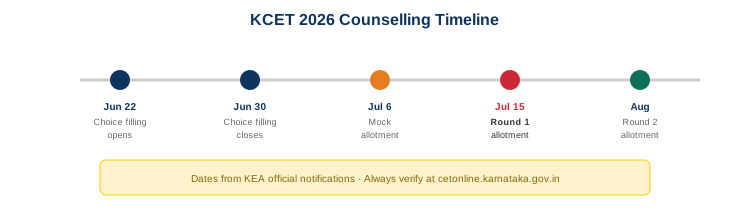
KCET 2026 Counselling Update - July 12, 2026: Option entry (choice filling) closed June 30. Mock allotment result was published July 6, 2026. The modification window ran July 6 (2 PM) to July 9 (10 AM), and is now closed. Round 1 final allotment publishes July 15, 2026 after 11 AM at cetonline.karnataka.gov.in - check our mock allotment guide if you want to understand what your mock result likely means for the final outcome.
KCET 2026 counselling runs through document verification, choice filling (option entry, which opened June 22 and closed June 30, 2026), mock allotment, seat allotment, and reporting to your allotted college. Missing any single step disqualifies you from that round - even with an excellent rank. With Round 1 final allotment landing July 15, this is the moment to have your acceptance decision and documents ready in advance, not scrambling on the day.
🎯 Use the Free KCET Rank Predictor - Enter your rank and category to instantly see which colleges you can get in 2026. No login required. Try KCET Predictor →
Comparing engineering colleges across Karnataka? Our statewide guide to the best engineering colleges in Karnataka for KCET 2027 covers tier-wise cutoffs, COMEDK options, management quota fees, and branch-wise placement data across all major cities.
KCET 2027 Counselling Schedule - Key Dates
| Activity | Date (2026) | Status |
|---|---|---|
| KCET 2026 Result Declared | June 6, 2026 | Done |
| Document Verification (DV) | June 2026 (slot-wise) | Done |
| Option Entry (Choice Filling) Opens | June 22, 2026 | Done |
| Choice Filling Closes / Locking | June 30, 2026 | Done |
| Round 1 Mock Allotment | July 6, 2026 | Done |
| Modification Window | July 6 (2 PM) – July 9 (10 AM) | Done |
| Round 1 Final Seat Allotment | July 15, 2026 (after 11 AM) | Upcoming |
| Round 1 Reporting to College | Late July 2026 (exact deadline announced with Round 1 results) | Upcoming |
| Round 2 Choice Filling | Late July–August 2026 | Upcoming |
| Round 2 Allotment | August 2026 | Upcoming |
| Stray Vacancy Round | August–September 2026 | Upcoming |
Always verify the current status directly on cetonline.karnataka.gov.in - KEA has adjusted dates without much advance notice in past cycles, and the reporting deadline specifically tends to be announced only once Round 1 results are actually out.
Step 1 - KCET 2027 Document Verification
Document verification (DV) is mandatory before choice filling. You attend in person at your assigned DV centre. KEA assigns DV centres based on your home district. Carry originals of every document - missing even one means rejection at the DV counter, and re-scheduling isn't always simple mid-cycle.
Complete Document Checklist for KCET 2027 DV
| Document | Purpose | Mandatory? |
|---|---|---|
| KCET 2026 Admit Card | Identity proof for KCET | Yes |
| KCET 2026 Rank Card | Confirms your rank | Yes |
| SSLC / 10th Marks Card | Date of birth proof | Yes |
| 2nd PUC / 12th Marks Card | Subject eligibility | Yes |
| Study Certificate (1st–10th Karnataka) | Karnataka domicile - GM-K quota | If claiming Karnataka quota |
| Caste Certificate (SC/ST/OBC) | Reservation category | If applicable |
| Income Certificate | EWS quota | If applicable |
| Aadhaar Card | Identity verification | Yes |
| Passport photos (6–10 copies) | Various forms | Yes |
| Application form printout | DV reference | Yes |
For a fuller, dedicated checklist covering edge cases (lost documents, name mismatches, out-of-state qualifying exams), see our complete KCET counselling documents guide.
Step 2 - KCET 2027 Option Entry (Choice Filling)
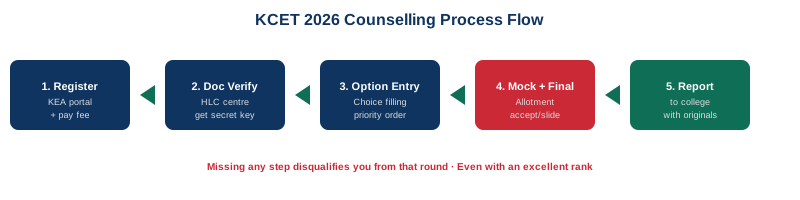
Option entry - KEA's term for choice filling - ran from June 22 to June 30, 2026 this cycle. This is where your rank matters most: you rank college-branch combinations in order of preference, and KEA's algorithm gives you the highest-ranked option for which your rank qualifies.
How Many Choices to Fill
Fill the maximum (up to 100 choices). Students who fill only 10–15 choices and go unallotted because all choices closed above their rank make the single most common - and most avoidable - counselling mistake. More choices means better protection, with essentially no downside to filling extra options you'd only accept as a last resort.
Choice Filling Strategy by Rank
| Rank Range | Top Choices to Target | Safety Choices |
|---|---|---|
| 1–1,000 | RVCE CSE, BMSCE CSE, MSRIT CSE | UVCE ECE, PES CSE |
| 1,001–5,000 | BMSCE CSE, MSRIT CSE, UVCE CSE | BIT CSE, DSCE CSE |
| 5,001–10,000 | BIT CSE, SIT CSE, NMIT CSE, NIE CSE | SJCE Mysuru, BIET Davangere |
| 10,001–20,000 | NHCE CSE, RNSIT CSE, CMRIT CSE | Colleges outside Bangalore |
| 20,001–50,000 | Mid-tier private colleges | District colleges, government aided |
If your rank sits well above 50,000, don't assume you're out of realistic options - our guide to colleges still open above rank 50,000 covers viable choices most students overlook simply because they're not the well-known Bangalore names.
Step 3 - Mock Allotment (Already Published for 2027)
Before the final allotment, KEA releases a mock allotment showing where you'd be placed based on your locked choices - this happened July 6, 2026 for the current cycle. The mock result isn't your actual seat; it's a preview specifically so you can reorder or adjust choices during the modification window (July 6–9) if the mock shows a college you don't want. If you already saw your mock result and are unsure what it means for your final outcome, our dedicated mock allotment guide walks through how to interpret it properly rather than assuming the mock and final results will match exactly.
Step 4 - Final Seat Allotment (July 15, 2027)
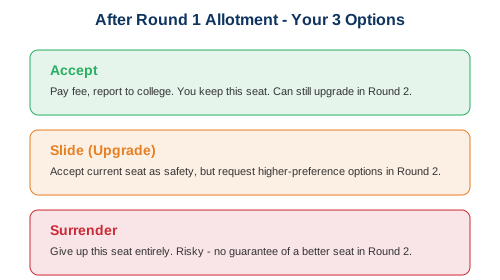
After the modification window closed July 9, KEA locks choices for good and releases the final Round 1 allotment on July 15. Once your result is out, you have three options:
- Accept and report: Pay the seat acceptance fee (₹3,000–5,000 GM / ₹1,500–2,500 SC/ST) and report to college by the deadline. You can still participate in Round 2 for an upgrade while holding this seat.
- Don't accept, participate in Round 2 only: risky - if Round 2 doesn't give you something better, you lose the Round 1 seat entirely with nothing to fall back on.
- Withdraw: Exit counselling altogether. A partial fee refund applies.
This decision - accept, slide up, or surrender - deserves more depth than a quick list can give it, especially given how much is riding on getting it right. Our complete Round 1 decision guide walks through the actual trade-offs for each path based on your specific situation.
KCET 2027 Counselling Fees
| Fee Component | GM / OBC | SC / ST |
|---|---|---|
| Counselling Registration Fee | ~₹650 | ~₹500 |
| Seat Acceptance Fee (Round 1) | ~₹3,000–5,000 | ~₹1,500–2,500 |
If covering your first-year fees is a genuine concern regardless of which seat you accept, it's worth reading our SSP scholarship guide and education loan guide before your reporting deadline, not after - both processes take real time to complete, and starting them the same week you report to college leaves very little margin if something goes wrong with a document or application.
Round 2 and Stray Vacancy Round
Round 2 opens after Round 1 reporting closes. Seats that are rejected, vacated, or newly made available come back into the pool at this point. Students holding a Round 1 allotment can participate in Round 2 purely for an upgrade, without risking their existing seat, provided they've accepted (not withdrawn) their Round 1 offer. Students who remain unallotted after Round 1 must participate in Round 2 to have any chance at a seat this cycle. The stray vacancy round handles whatever seats remain unfilled after Round 2 - availability here is unpredictable and skews toward less-competitive branches and colleges, but it's still worth participating in if you're still seeking a seat.
Common Mistakes Students Make During KCET Counselling
- Filling too few choices - already covered above, but worth repeating since it's the single biggest cause of going unallotted with a perfectly usable rank.
- Ignoring the modification window - many students treat the mock allotment as final and skip reviewing their choices during the modification period, missing a free opportunity to fix an ordering mistake before it's locked for good.
- Missing the reporting deadline - even a single day late, with fees already paid, results in automatic seat cancellation. Calendar this the moment your allotment is out, not when you get around to it.
- Assuming Round 2 will definitely improve your seat - Round 2 movement depends entirely on how many seats above you get vacated, which is unpredictable. Treat a Round 1 seat you're accepting as a real, final decision, not a placeholder you're certain to upgrade from.
- Not preparing documents in advance - assembling caste, income, or domicile certificates after your allotment is out, rather than before, routinely costs students their reporting deadline.
After Reporting to College - What To Do
- Submit original documents at the college admissions office
- Pay first-year tuition fee as per the college's fee structure
- Complete admission formalities (photo, ID, medical certificate if required)
- Collect your provisional admission letter
- Attend orientation and class commencement as notified by the college
What Actually Happens at the DV Centre
Document verification day is more procedural than most students expect, and knowing the actual flow ahead of time reduces a lot of unnecessary anxiety. You'll typically queue by your allotted time slot (arriving significantly early doesn't move you up the queue, so there's little practical benefit to showing up hours ahead), submit your documents for physical checking against your online application, get your category and eligibility confirmed, and receive your DV completion status - usually reflected in your KEA portal account within the same day or the next. If any document has a discrepancy (a name spelling mismatch between Aadhaar and your marks card, for instance), the DV officer will flag it on the spot, and you'll typically get a short window to submit a correction affidavit rather than being disqualified outright - but this varies by how serious the discrepancy is, so it's worth resolving any known document inconsistencies before you even reach the DV centre rather than hoping it gets waved through. Bringing a parent or guardian along, while not mandatory for most categories, is generally a good idea simply because DV day involves a fair amount of paperwork and waiting, and having a second person to help manage documents and queues reduces the chance of something being misplaced in the shuffle.
Special Categories and Reserved Seats
Beyond the standard SC/ST/OBC categories, KCET counselling includes several additional reserved categories worth knowing about if they apply to you: Kannada Medium (KM) candidates who studied in a Kannada-medium school get a separate rank list for KM-reserved seats, physically disabled candidates have dedicated reservation, and defence/ex-servicemen categories carry their own quota at several colleges. Rural quota reservations also apply at specific government colleges for students who completed their qualifying education in designated rural areas. Each of these has its own certificate requirements and its own closing-rank pattern, generally more relaxed than the General Merit list - if you qualify for any of these and haven't specifically checked your category-wise rank (as opposed to just your overall GM rank), it's worth doing so before finalising your choice order, since your realistic options may be meaningfully better than your GM rank alone suggests.
NRI and Non-Karnataka Domicile Considerations
KCET's general merit and reserved-category seats are specifically for Karnataka-domicile candidates. If you're an NRI, a child of an NRI, or a non-Karnataka-domicile candidate who wrote KCET, your seat options run through a separate NRI quota process at colleges that offer one, rather than the standard KCET counselling rounds covered in this guide - NRI quota admission is typically handled directly by individual colleges rather than through KEA's centralised counselling, with different fee structures (usually significantly higher, often in foreign currency or NRI-equivalent INR rates) and different documentation (proof of NRI status, sponsor details). If this applies to your situation, contact your target colleges' admission offices directly rather than assuming the standard KCET timeline and process described here applies to your seat.
If You're Also Waiting on NEET or Other Results
Many KCET aspirants are simultaneously tracking NEET results and counselling, particularly if medical admission is a live option alongside engineering. These are entirely separate counselling systems with separate timelines, and accepting a KCET seat doesn't preclude you from also pursuing NEET counselling in parallel, provided you're prepared to manage both processes' deadlines and fee payments simultaneously. If you're in this position, our complete action plan for after your NEET result covers the medical-side counselling process in the same level of detail as this guide covers KCET.
Building Your Own Counselling Timeline
Beyond just knowing the dates KEA publishes, it helps to think through your own personal checklist against this calendar, since the official schedule alone doesn't tell you what YOU specifically need to be doing at each stage. In the roughly two weeks before your DV slot, gather every document on the checklist above and get photocopies made in advance rather than the morning of your appointment - DV centres are rarely equipped to handle last-minute copying, and queues move faster when everyone arrives prepared. During the choice-filling window, resist the urge to fill your list in a single sitting; come back to it at least once after a day's gap, since fresh eyes often catch ordering mistakes or colleges you'd forgotten to consider. Once the mock allotment is out, treat the modification window as your last real checkpoint - if something about your mock result surprises you, that's the moment to investigate why, not after the final result locks it in for good.
In the days immediately around the final allotment - which for this cycle means the period around July 15 - have your seat acceptance fee ready in whatever payment method the portal accepts, and know in advance which of the three outcomes (accept, hold out for Round 2, or withdraw) you'd choose for each of your realistic likely results. Deciding this calmly in advance, rather than under the time pressure of a live deadline, tends to produce better decisions than working it out from scratch once the result is already in front of you.
What Colleges Themselves Expect at Reporting
Beyond KEA's own requirements, individual colleges frequently have their own additional reporting-day expectations that catch students off guard if they haven't checked in advance - a specific dress code for the admission photo, a particular format for the medical fitness certificate, or an expectation that fees be paid via demand draft rather than online transfer. These vary meaningfully from college to college, and the college's own admission office (not the general KEA counselling helpline) is the right place to confirm these specifics once you know which college you're reporting to. A quick call to the admissions office a day or two before your reporting date, just to confirm exactly what to bring and in what format, is a small effort that avoids a stressful scramble on the day itself.
If you're also holding a COMEDK rank alongside your KCET rank, remember these are entirely separate counselling processes with separate schedules, separate seat pools, and separate acceptance fees - accepting a KCET seat doesn't automatically affect your COMEDK options or vice versa, though you'll need to manage both calendars and both fee deadlines independently if you're keeping options open on both fronts. Our dedicated KCET vs COMEDK comparison covers this in more depth if you're still weighing which to prioritise. For official COMEDK dates specifically, check comedk.org directly, since its calendar runs independently of KEA's.
Keeping Perspective During a Stressful Few Weeks
It's worth saying plainly: the period between choice-filling and final reporting is one of the more stressful stretches of the entire admission process, for students and families alike, and that stress is completely normal rather than a sign that something's going wrong. Rank anxiety, uncertainty about whether a mock allotment will hold, and pressure around fee payment deadlines all compound in a short window, and it's easy to make a rushed decision - accepting a seat you're unhappy with out of panic, or holding out for Round 2 against realistic odds - simply because the calendar feels tight. Where possible, talk through your realistic options with someone who isn't as emotionally invested in the outcome as you or your immediate family are; a slightly more detached perspective often makes the accept-versus-wait decision clearer than working through it alone under time pressure.
Frequently Asked Questions
When does KCET 2027 option entry (choice filling) open?
KCET 2026 option entry opened June 22, 2026 and closed June 30, 2026 on cetonline.karnataka.gov.in. For future cycles, log in with your KCET application number and the password set during DV registration.
Is document verification mandatory for KCET 2027?
Yes - mandatory. Students who don't complete DV cannot access the option entry portal. Attend your assigned DV slot with all original documents.
Can I change choices after locking in KCET counselling?
No. Once you click "Lock Choices," they're final for that round. The only opportunity to adjust is during the modification window that follows the mock allotment - review your complete ordered list carefully during that window, since there's no second chance after it closes.
What happens if I miss the Round 1 reporting deadline?
Your allotted seat is automatically cancelled - even if you already paid the seat acceptance fee. Contact KEA immediately if you face a genuine emergency preventing reporting, though there's no guarantee of any exception being made.
How many rounds does KCET 2027 counselling have?
Typically two main rounds (Round 1 and Round 2) plus a stray vacancy round. KEA may add special rounds for specific categories if seats remain unfilled after the standard rounds.
What is the KCET 2027 counselling registration fee?
Approximately ₹650 for General Merit candidates and ₹500 for SC/ST candidates, paid online during counselling registration on the KEA portal.
When is the KCET 2027 Round 1 final allotment result?
July 15, 2026, after 11 AM, published directly on cetonline.karnataka.gov.in. Results are typically available for a while after publication, but checking as soon as they're live avoids any portal congestion that can happen in the first hour.
Can I hold my Round 1 seat while trying for Round 2?
Yes - as long as you accept (rather than withdraw) your Round 1 seat and pay the acceptance fee, you can participate in Round 2 for a potential upgrade without losing your existing allotment, provided you don't get a Round 2 seat you'd rather decline.
What should I do if I'm still unallotted after Round 1?
You must participate in Round 2 to have a continued chance at a seat this cycle - unallotted students don't carry any special priority into Round 2 beyond their original rank, so treat it with the same seriousness (maximum choices, careful ordering) as Round 1.
Need help with admission?
About the author
OneCity Technologies Pvt. Ltd began in 2006 publishing an annual print education directory for Karnataka students and parents. As demand grew, OneCity launched an education portal in 2019 to bring that same directory information online, and in 2025 relaunched as CollegesInfo.org, a comprehensive Karnataka college directory covering 1,500+ institutions across engineering, medical, management, arts, commerce, and more. Founder L K Monu Borkala brings 20+ years of business experience and 19 years of work across various education-sector services. CollegesInfo.org's content is built from publicly available KEA, NMC, AICTE, and university data, cross-checked against official sources wherever possible. CollegesInfo.org's admission assistance service helps students secure admission to colleges they are eligible for under that college's actual published criteria. We help you get the best admission to your preferred colleges without hassle.