Missing a single document at KCET document verification can cost you your seat, regardless of your rank. Karnataka's KCET counselling makes in-person document verification a mandatory, non-negotiable step before you can even access option entry – no verification, no secret key, no seat. This guide covers exactly what to bring, which certificates apply to which category, and the mistakes that trip up otherwise well-prepared candidates every year.
Comparing engineering colleges across Karnataka? Our statewide guide to the best engineering colleges in Karnataka for KCET 2027 covers tier-wise cutoffs, COMEDK options, management quota fees, and branch-wise placement data across all major cities.
Why Document Verification Can't Be Skipped or Deferred
KCET counselling runs through the Karnataka Examinations Authority (KEA), and its structure is unforgiving on this one point: document verification at a KEA Help Line Centre (HLC) happens before option entry, not after. The HLC officer checks your documents, verifies your eligibility, and only then issues a Verification Slip containing a secret key. That secret key is what lets you log into the option entry portal at keaonline.karnataka.gov.in. Without it, the system simply won't let you in – there's no workaround, no "verify later" option, and no way to participate in that round's counselling if you miss your verification window.
This is why KCET veterans treat document preparation as seriously as rank preparation. A student with an excellent rank who shows up to verification with a missing or improperly formatted certificate can lose the round entirely while classmates with lower ranks but complete paperwork move ahead – check our Round 1 seat allotment decision guide for what happens once you do clear this stage.
Mandatory Documents – Every Candidate Needs These
| Document | Notes |
|---|---|
| KCET application printout | The confirmation page from your original KCET application |
| KCET admit card / hall ticket | Original, from the exam |
| KCET rank card | Downloaded after results |
| Class 10 / SSLC marks card and certificate | Original + photocopies |
| Class 12 / 2nd PUC marks card and certificate | Original + photocopies |
| Recent passport-size photographs | Carry 4-6 copies matching the photo already uploaded to your application – mismatched photos are a common cause of delay |
| Aadhaar card or other valid photo ID | For identity and biometric verification |
| Registration fee payment proof | ₹650 for General/OBC, ₹500 for SC/ST/Category-1 (non-refundable) |
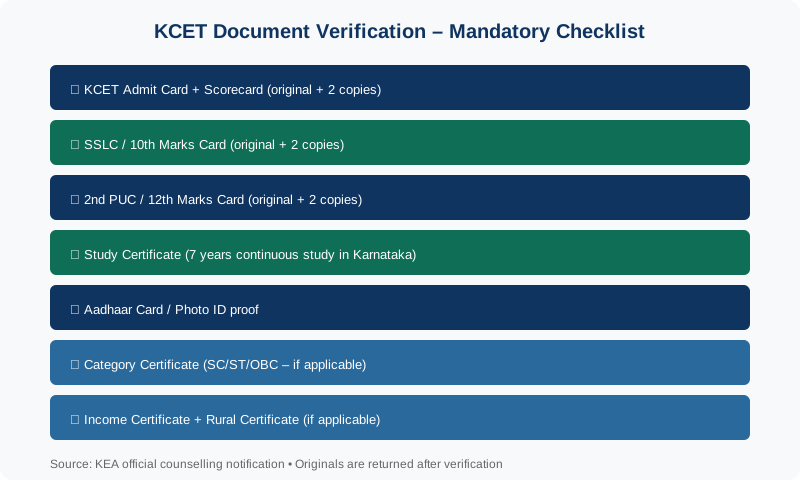
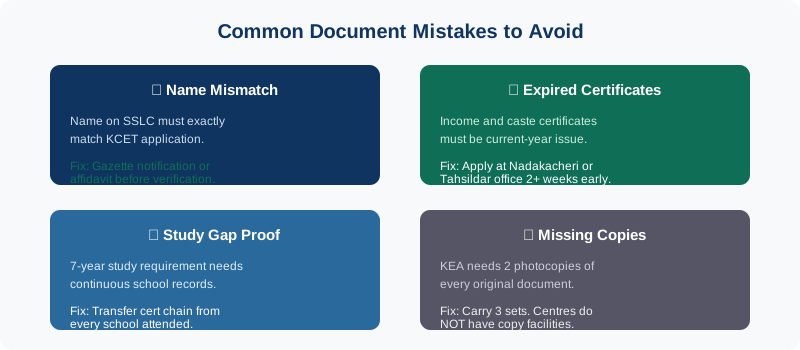
Carry the originals plus at least two self-attested photocopies of everything. HLC officers verify against the originals, retain a copy, and hand the originals back to you – coming with only photocopies, or without enough sets, is one of the most common reasons candidates get sent away to return later. If you're also comparing options once your seat is allotted, our category-wise KCET cutoff analysis is worth reading alongside this checklist.
The 7-Year Study Certificate – Karnataka's Trickiest Requirement
If you're claiming eligibility for Karnataka's state quota (government seats, most reserved-category benefits), you'll need a School Study Certificate proving continuous study in Karnataka for at least 7 years from Class 1 onwards. This isn't a generic school-leaving certificate – it needs to be requested specifically, on school letterhead, signed by the Principal, carrying the school seal, and explicitly stating the years attended ("Studied from [Year] to [Year]"). Vague wording gets rejected at verification.
If you studied across multiple schools within Karnataka, you'll need a study certificate from each one covering its respective years, adding up to the required 7-year total. This certificate also needs countersignature from the concerned Block Education Officer (BEO) or Deputy Director of Public Instruction (DDPI) – an extra step many families discover late, since it means visiting a government education office, not just your school. Start this process well before the verification window opens; BEO/DDPI countersignatures can take time to process, especially during peak counselling season when every KCET candidate in that jurisdiction is requesting the same thing.
Category and Reservation Certificates – What Applies to You
Beyond the universal documents, you'll need specific certificates depending on which quota or category you're claiming:
- Caste certificate – Form-D for SC/ST, Form-F for OBC, Form-E for Category-1. These must be Karnataka-issued; certificates from other states are not accepted for Karnataka's state quota reservations.
- Income certificate – required alongside most category claims, issued by the relevant Karnataka revenue authority.
- Rural study certificate – for candidates claiming the rural quota, confirming study at a rural or government school. Some sources note the school study certificate itself may cover this where it explicitly states rural/government school study, but check the specific requirement in your year's official notification rather than assuming.
- Kannada medium certificate – for candidates who studied in Kannada medium from Class 1 to 10, whether within Karnataka or outside it.
- Parent's study / domicile / employment / hometown certificate – relevant if you're claiming state-quota eligibility through a parent's Karnataka connection rather than your own study history (common for candidates who studied outside Karnataka but have a Karnataka-domiciled parent).
- Article 371J eligibility certificate – for candidates claiming reservation benefits under Article 371J, which covers the Hyderabad-Karnataka (Kalyana Karnataka) region.
- Horanadu / Gadinadu Kannadiga affidavit – for Clause C and D claims, relevant to Kannadiga families from areas that historically merged into neighbouring states (parts of Maharashtra, for instance), sworn in as an affidavit rather than a standard certificate.
Not every candidate needs every certificate on this list – bring only what's relevant to the specific quota or category you're claiming, but bring all of what applies to you, since a single missing category certificate can mean losing eligibility for that specific reservation even if your general documents are complete.
The Verification Process, Step by Step
- Complete online counselling registration on the KEA portal using your KCET application number and date of birth or OTP verification.
- Pay the registration-cum-processing fee online, then download and print your Verification Slip – this printed slip is your entry pass to the Help Line Centre.
- Book your verification slot at a KEA-designated Help Line Centre through the official portal.
- Attend in person with all original documents and photocopies. The HLC officer checks eligibility, scans your documents into the KEA database, and typically conducts biometric or photo verification.
- Receive your secret key and acknowledgement – this unlocks option entry. Keep both the physical verification slip and the secret key secure; you'll need them again at later counselling stages.
Common Mistakes That Delay or Derail Verification
The most frequent, avoidable errors are: mismatched photographs (the photo you bring doesn't match what's on your uploaded application), incomplete photocopy sets (bringing one copy when two are required), vague study certificates that don't explicitly state the year range, missing BEO/DDPI countersignature on the study certificate, and category certificates issued by the wrong state. Any one of these can mean being sent home to return later – and "later" may fall outside your round's verification window entirely, effectively costing you that round. See our mock allotment result guide for how these delays can cascade into missed rounds.
Start gathering documents at least two to three weeks before your expected verification date, not after results are declared. Certificates requiring government office visits (BEO/DDPI countersignature, caste and income certificates from revenue authorities) take real processing time, and counselling season is when every applicant in your area is requesting the same paperwork simultaneously.
What Happens If Your Documents Are Rejected or Incomplete
If an HLC officer flags a document as incomplete, incorrectly formatted, or missing entirely, you're typically given the chance to rectify it and return within the verification window – but that window is usually short, sometimes just the remaining days of that round's verification period. This is precisely why last-minute preparation is risky: a rejected study certificate that needs re-issuance with correct wording, or a caste certificate that needs the right form number, can take longer to fix than the days remaining in your window.
If you cannot resolve a document issue in time for a given round, you generally aren't permanently barred from KCET counselling altogether – subsequent rounds (Round 2, mop-up, and extended rounds) typically open fresh verification slots, and KEA has in past cycles allowed late verification for candidates who missed earlier windows for genuine reasons. However, missing an earlier round means missing out on whatever seats were allotted in that round, which can matter significantly for competitive branches and colleges where availability shrinks with each subsequent round. Our results and counselling overview walks through what each round actually changes. Treat first-round verification as the one to get right, not a dry run.
Which Courses This Applies To
KCET counselling and its document verification process covers undergraduate admission to engineering, architecture, pharmacy (B.Pharm), agriculture, and several other professional courses under Karnataka's state counselling system. It's worth being clear about what KCET does not cover: medical courses (MBBS, BDS, BAMS, BHMS, BUMS, BNYS) run through NEET-UG and a separate AYUSH/medical counselling process via KEA's medical wing and MCC, not the general KCET engineering-stream counselling – see our National Dental Commission explainer if BDS specifically is on your radar. If you're applying to both an engineering course through KCET and a medical or AYUSH course through NEET, you'll be managing two separate document verification and counselling processes with their own timelines – don't assume documents verified for one automatically carry over to the other, even though many of the certificates (study certificate, caste certificate, income certificate) are the same physical documents.
A Practical Pre-Verification Checklist
Before your scheduled verification date, confirm you have each of the following ready, organized, and in the correct format:
- Printed KCET application confirmation and admit card
- KCET rank card (downloaded after results)
- Original and 2+ photocopies of Class 10 and Class 12 marks cards and certificates
- 4-6 recent passport photographs matching your application photo
- Aadhaar card or equivalent photo ID
- Registration fee payment receipt
- School study certificate(s) with correct wording, principal signature, school seal, and BEO/DDPI countersignature, if claiming state quota
- Category-specific certificates relevant to your claimed quota (caste, income, rural study, Kannada medium, parent's domicile, Article 371J, or Horanadu/Gadinadu affidavit as applicable)
- A pen, a folder to keep documents organized, and your printed Verification Slip appointment confirmation
Going through this list methodically a few days before your appointment – rather than the night before – gives you enough runway to fix any gap you discover, like a study certificate missing its countersignature or a photocopy that came out illegible. Once you're through verification, our stream and college-wise cutoff analysis is the natural next stop for planning your option entry order.
Understanding Karnataka's Eligibility Clauses (A Through O)
Karnataka's KCET eligibility framework classifies candidates into lettered clauses (roughly A through O) based on where they and their parents studied and resided – this classification is what actually determines which study certificate or domicile document you need, so it's worth understanding rather than guessing. Clause A broadly covers candidates who themselves studied in Karnataka for the required duration. Clauses further down the list cover progressively more specific situations: candidates who studied outside Karnataka but have a Karnataka-domiciled or Karnataka-employed parent, candidates from families with Kannada, Tulu, Kodava, or Beary as their mother tongue who passed their qualifying exams outside Karnataka while a parent maintained Karnataka residence, and candidates from historically Kannada-speaking border regions that now fall within neighbouring states (the Horanadu and Gadinadu Kannadiga clauses mentioned earlier, typically Clauses C and D).
Each clause has its own specific document requirement, and claiming the wrong clause – or the right clause with the wrong supporting certificate – is a common, avoidable source of rejection at verification. If your family's education and residence history doesn't fit neatly into "studied in Karnataka the whole time," it's worth reading the official KEA eligibility notification's clause definitions closely, or getting clarity on which clause applies to you well before your verification appointment, rather than assuming the most common category applies by default.
State Quota vs Management Quota – Does Document Verification Differ?
The document verification process described here applies specifically to KCET's centralized counselling for government-quota and state-quota private college seats. Management-quota seats – filled directly by private colleges outside the centralized KEA counselling – typically have their own, separate documentation process set by the individual college, which may be lighter (often just academic marks cards and identity proof) since state-domicile and reservation eligibility aren't usually relevant to management-quota admission. If you're pursuing a management-quota seat as a backup alongside your KCET counselling attempt, don't assume the same certificate set applies; confirm directly with that specific college's admission office. Browse our full Karnataka college directory to compare management-quota options across institutions.
Frequently Asked Questions
Can I skip document verification and complete it in a later round?
No. Document verification at a KEA Help Line Centre is mandatory before you can access option entry for that round. There's no provision to defer verification to a later stage – if you miss your window, check the official KEA portal for any extended or additional verification slots before the next round, since availability isn't guaranteed.
What is the KCET counselling registration fee?
₹650 for General and OBC categories (2A, 2B, 3A, 3B), and ₹500 for SC/ST/Category-1 candidates. This fee is non-refundable regardless of whether you ultimately receive or accept a seat.
Do I need the 7-year study certificate if I studied outside Karnataka?
If you're claiming Karnataka state-quota eligibility through your own study history, yes – you need proof of at least 7 years of continuous study in Karnataka from Class 1. If you studied outside Karnataka, you may instead be able to claim eligibility through a parent's Karnataka domicile, study, or employment history, which requires a different certificate. Confirm which route applies to your specific situation in the official KEA eligibility notification.
What if my caste certificate is from another state?
Only Karnataka-issued caste certificates (Form-D for SC/ST, Form-F for OBC, Form-E for Category-1) are accepted for Karnataka's state-quota reservation benefits. A certificate from another state generally won't be accepted for this purpose, even if the category itself is recognized nationally.
How many photocopies should I bring to verification?
At least two self-attested photocopies of every original document, though some Help Line Centres request three sets – check your specific verification notification. Bringing extra copies costs little and avoids a return trip if the requirement turns out to be more than you prepared for.
What happens after successful document verification?
You receive a Verification Slip with a secret key, which you'll use alongside your KCET application number to log into the option entry portal. This is where you list your college and course preferences in order, which directly determines your seat allotment in the following rounds.
Does KCET document verification cover medical (MBBS/BDS) admission too?
No. KCET covers engineering, architecture, pharmacy, agriculture and related courses. Medical and AYUSH courses (MBBS, BDS, BAMS, BHMS, BUMS, BNYS) run through NEET-UG and a separate counselling process. If you're pursuing both, you'll need to manage two separate verification and counselling timelines, even though several required certificates overlap.
What if I need a document countersigned by the BEO or DDPI and I'm running out of time?
Visit the relevant Block Education Officer or Deputy Director of Public Instruction office as early as possible once results are declared – don't wait until your verification date is confirmed. These offices see a surge of identical requests during counselling season, and processing time can extend beyond what a compressed timeline allows for.
Can I get my documents verified online instead of visiting a centre in person?
Some categories with previously verified and updated status have in some cycles been permitted online verification, but this has not been the standard route for most candidates. In-person verification at a designated KEA Help Line Centre remains the default requirement – check the current year's specific notification for any online verification provisions applicable to your category.
Check where your KCET rank stands using our KCET College Predictor, and see the full Karnataka entrance exam guides for related counselling processes.
Exact verification dates, fee amounts, and document requirements can change year to year – always cross-check the current official notification at cetonline.karnataka.gov.in before your verification appointment. Last updated: July 2026. Have a correction? Write to reach@collegesinfo.org.
Need help with admission?
CollegesInfo.org helps students secure admission to colleges they are eligible for under that college's actual published criteria. Chat with us on WhatsApp or explore admission assistance.