Status as of July 12, 2026: KCET 2026 results were declared June 6. Option entry closed June 30, mock allotment was published July 6, and the modification window closed July 9. Round 1 final allotment publishes July 15, 2026 – if you're still tracking your options at this stage, our mock allotment guide and complete counselling schedule cover what comes next in more detail than this page does.
Last Updated: August 26, 2026
KCET 2026 results were declared on June 6, 2026. The KCET rank is calculated with 50% weightage to KCET marks and 50% to 2nd PUC board marks. If you're reading this after results are out, the single most useful thing you can do right now is understand exactly how your specific marks translate into a realistic rank range and which colleges that rank opens up – not just chase a single headline cutoff number.
Comparing engineering colleges across Karnataka? Our statewide guide to the best engineering colleges in Karnataka for KCET 2027 covers tier-wise cutoffs, COMEDK options, management quota fees, and branch-wise placement data across all major cities.
KCET 2027 Key Dates – Results to Counselling
| Event | Date |
|---|---|
| KCET 2026 Result Declared | June 6, 2026 |
| Document Verification | June 2026 |
| Option Entry (Choice Filling) | June 22–30, 2026 |
| Round 1 Mock Allotment | July 6, 2026 |
| Modification Window | July 6–9, 2026 |
| Round 1 Final Allotment | July 15, 2026 |
| Round 1 College Reporting | Late July 2026 (exact date announced with results) |
How KCET 2027 Rank is Calculated
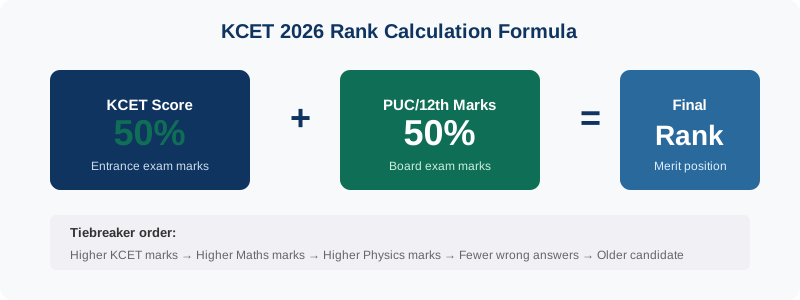
Your KCET rank is NOT based solely on KCET exam marks. Karnataka uses a combined rank formula:
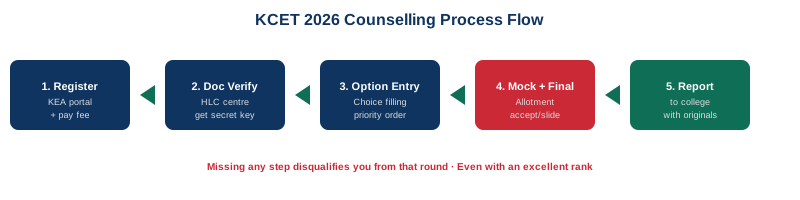
KCET 2026 counselling process overview
- 50% weightage: Your KCET marks (out of 180 total – Physics 60 + Chemistry 60 + Maths/Biology 60)
- 50% weightage: Your 2nd PUC board exam marks in the relevant subjects
This means a student with 140/180 in KCET but 95% in boards can rank higher than a student with 160/180 in KCET but only 75% in boards. The board marks matter as much as the KCET exam score – a detail that catches many students off guard, particularly those who assumed a strong KCET performance alone would guarantee a strong rank. It's also a detail worth remembering for future reference if you know anyone in an earlier PUC year: the message that "boards matter just as much as the entrance exam" is worth internalising well before results day, not after.
Comparing Your Rank Against Realistic Peer Outcomes
One useful exercise beyond just checking cutoff tables: look at where students with similar ranks from previous years actually ended up, not just the theoretical closing rank for a specific branch. Closing ranks tell you the absolute floor for admission in the final round, but the more useful question is often where a comfortable, non-borderline seat exists for your rank band – typically somewhat below (numerically higher than) the exact closing rank, since that closing figure often represents the very last, most marginal admission in that round. If your rank sits right at a college's reported closing rank, treat that as a genuine long-shot rather than a safe bet, and make sure your choice list includes options where your rank sits more comfortably within range.
KCET 2027 Marks vs Expected Rank (Engineering Stream)

KCET tier-wise cutoff overview
| KCET Score (out of 180) | Expected Rank Range (approx) | Colleges Likely Accessible |
|---|---|---|
| 170–180 | 1–500 | RVCE CSE, BMSCE CSE |
| 155–170 | 500–2,000 | MSRIT CSE, UVCE CSE, BMSCE ECE |
| 140–155 | 2,000–6,000 | BIT CSE, DSCE CSE, PES branches |
| 120–140 | 6,000–15,000 | NHCE, RNSIT, SIT, NIE branches |
| 100–120 | 15,000–35,000 | Mid-tier private colleges, government colleges in districts |
| 80–100 | 35,000–60,000 | Tier-3 private colleges, district engineering colleges |
| Below 80 | 60,000+ | Remaining private colleges, management quota |
Ranks are approximate and vary based on total candidates, paper difficulty, and PUC board weightage. Use as a planning guide, not a guarantee – the only way to know your exact rank is your official KEA rank card.
If your marks put you well outside the top bands here, that's not the end of the road – our guide to colleges still open above rank 50,000 covers solid options for exactly this situation, and there's more available than most students initially assume.
Why These Rank Estimates Shift Every Year
The marks-to-rank mapping above is an useful planning tool, but it's worth understanding why it can't be a precise, fixed formula from year to year. Total candidate count matters – more students appearing for KCET in a given year tightens ranks across the board even if your own score stays constant relative to previous years. Paper difficulty matters too – a harder Physics or Mathematics section compresses the score distribution differently than an easier one, which shifts exactly which score maps to which rank in ways that aren't always intuitive. And the specific mix of PCM versus PCB candidates, along with how PUC board results trend that year, both feed into the combined rank formula in ways that vary cycle to cycle. None of this means the estimates here are unreliable – they're grounded in real recent-year patterns – but it does mean you should treat them as a genuine planning range rather than an exact prediction, and cross-check against your actual official rank card the moment it's available rather than relying on an estimate for your final decisions.
KCET 2027 Cutoff – What to Expect
KCET cutoff refers to the closing rank for a specific college-branch in counselling. KEA releases the official cutoff after each counselling round. For 2026 planning, use 2025 closing ranks as the baseline – typically ±10% variation year to year unless there's a major change in seat matrix.
Expected 2027 Cutoff – Top Engineering Colleges (CSE, GM Category)
| College | 2025 Closing Rank | 2026 Expected Rank |
|---|---|---|
| RVCE Bangalore – CSE | ~500 | ~450–550 |
| BMSCE Bangalore – CSE | ~800 | ~750–900 |
| MSRIT Bangalore – CSE | ~1,200 | ~1,100–1,400 |
| UVCE Bangalore – CSE | ~2,500 | ~2,300–2,800 |
| BIT Bangalore – CSE | ~5,036 | ~4,800–5,500 |
| SJCE Mysuru – CSE | ~5,500 | ~5,200–6,000 |
| NHCE Bangalore – CSE | ~11,000 | ~10,000–12,000 |
For a more complete branch-by-branch and rank-band breakdown than this summary table, our dedicated rank-band series covers every range in depth: rank 1–5,000, 10,000–20,000, and above 50,000 among others.
KCET 2027 College List – Rank-Wise (Top Options by Rank Range)
The table below gives a quick cross-stream snapshot – useful if you're still deciding between engineering, agriculture, veterinary, or nursing rather than having already settled on one specific stream. Each of these streams has its own much deeper resource on this site if you want the fuller picture once you've narrowed down your direction.
| Rank Range | Best Options | Stream |
|---|---|---|
| 1–1,000 | RVCE, BMSCE, MSRIT – CSE/IS | Engineering |
| 1,001–3,000 | UVCE, MSRIT ECE, BMSCE ECE, PES CSE | Engineering |
| 3,001–7,000 | BIT CSE, DSCE CSE, SJCE Mysuru CSE | Engineering |
| 7,001–15,000 | NIE Mysuru CSE, NMIT CSE, CMRIT CSE | Engineering |
| 15,001–30,000 | RNSIT, Acharya, Dayananda Sagar | Engineering |
| 1–600 | Veterinary College Bangalore (BVSc) | Veterinary |
| 1–1,000 | College of Agriculture GKVK (BSc Agri) | Agriculture |
| Any rank | BSc Nursing – most colleges open | Nursing |
If agriculture is your target stream rather than engineering, our complete agriculture colleges guide covers the fuller picture – including a farmer-quota admission route at UAS Bangalore that this table doesn't capture.
If You Appeared for Multiple KCET Streams
Some candidates sit for KCET intending to keep both engineering and agriculture (or another allied stream) open, rather than committing to one before results are out. If that's your situation, your rank calculation and category eligibility can actually differ slightly by stream, since agriculture, veterinary, and nursing admissions run through KCET but aren't identical in their eligibility subject combinations to the standard PCM engineering pathway. Check your rank card carefully for stream-specific rank figures rather than assuming a single number applies uniformly across every course you might be considering, and if you're still undecided between streams at this stage, it's worth researching both realistic outcomes (career paths, typical starting salaries, further-study options) before choice filling forces a decision, rather than defaulting to whichever stream simply has the better-known cutoff.
Understanding Your Category-Wise Rank Card
Your KEA rank card doesn't just show one number – it shows your rank within each category you're eligible for (General Merit, plus any reserved category like SC, ST, or OBC sub-categories 2A/2B/3A/3B that apply to you). This matters practically because your realistic college options can look meaningfully different depending on which rank you're actually using to plan. A student with a GM rank of 15,000 but an OBC category rank of 4,000 has real access to colleges that the GM figure alone would suggest are out of reach – checking both, and using whichever gives you better realistic options, is a simple step that a surprising number of eligible students skip entirely, either because they don't realise multiple rank figures apply to them or because they only look at the topmost number on their scorecard.
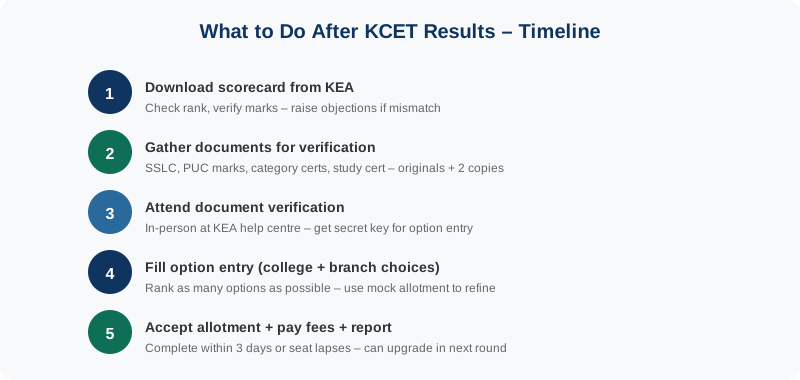
What to Do After KCET 2027 Results
- Check your rank on cetonline.karnataka.gov.in or kea.kar.nic.in
- Check all category ranks – GM rank, OBC rank, SC/ST rank if applicable. Your OBC/SC/ST rank may give you better options.
- Research college-branch cutoffs using KEA's previous year data
- Use our KCET Rank Predictor to get a personalised list of accessible colleges
- Register for KCET counselling on cetonline.karnataka.gov.in when registration opens
- Attend document verification – mandatory before choice filling
- Complete choice filling – fill maximum 100 choices, lock before deadline
For the full mechanics of each of these steps – including the exact document checklist and choice-filling strategy – our complete KCET counselling schedule guide goes into considerably more depth than this results-focused page.
Planning Your Finances Alongside Your Rank
While you're working through your realistic college options, it's worth starting your financial planning in parallel rather than waiting until an allotment forces the issue. If you're SC, ST, OBC, or a minority-category student, Karnataka's SSP scholarship system covers a meaningful share of fees for eligible students across engineering, agriculture, and most other post-matric streams – our complete SSP scholarship guide covers eligibility and department-wise deadlines in detail. If a scholarship won't fully cover your costs, or you don't qualify, an education loan is the other common route – our education loan guide compares interest rates and collateral requirements across major banks. Starting either process now, before your final allotment, gives you meaningfully more breathing room than starting the week you're expected to pay a seat-acceptance fee.
KCET 2027 Result – How to Check
- Visit cetonline.karnataka.gov.in or kea.kar.nic.in
- Click on "KCET 2026 Result" or "Rank Card"
- Enter your KCET application number and date of birth
- Download and print your rank card – you'll need it for counselling
Official Data vs Aggregator Estimates – A Word of Caution
Search results for KCET cutoffs are dominated by third-party education portals compiling and re-publishing prior-year data, often with only light updates for the current cycle, and it's worth knowing how to tell the difference between a current figure and a recycled old one. The only fully authoritative source for KCET results, cutoffs, and counselling dates is KEA itself – cetonline.karnataka.gov.in and kea.kar.nic.in. Third-party sites, including this one, are useful for context, comparison, and planning, but any specific number that's central to a real decision (whether to lock a particular choice, whether your rank clears a specific cutoff) deserves a direct check against KEA's own published data before you act on it. A good practical habit: treat any cutoff figure you find as "probably in the right ballpark" rather than "exact," and specifically verify anything within a few hundred ranks of your own score, since that's exactly the margin where an outdated or slightly-off estimate could change your actual choice-filling strategy.
What If Your Rank Isn't What You Hoped For?
A rank that falls short of your target college is disappointing, but it's worth working through the realistic options methodically rather than either panicking or giving up on engineering as a stream entirely. Karnataka has 92 KCET-accepting engineering colleges, and the gap between "the colleges everyone's heard of" and "a solid education with real placement outcomes" is much smaller than search results dominated by RVCE and BMSCE tend to suggest. Government and aided colleges outside Bangalore – in Mysuru, Hubballi, and elsewhere – often deliver comparable core-branch outcomes at a fraction of the fee, and a strong branch at a lesser-known college frequently outplaces a weak branch at a famous one. It's also worth considering COMEDK as a parallel track if you haven't already, since it's a separate rank pool that can open different options than your KCET rank alone suggests.
Talking to Family About a Disappointing Rank
If your result came in below expectations, the conversation with parents and family can be harder than the practical college-shortlisting work itself, and it's worth acknowledging that directly rather than pretending it's purely a logistics exercise. A rank that falls short of a specific dream college doesn't reflect your overall ability or your prospects – Karnataka's education and job market rewards strong performance at a wide range of colleges, not exclusively the handful of names that dominate search results and family conversations. Framing the discussion around realistic, good options (a strong branch at a solid college, a lower-fee government seat with comparable placement outcomes) tends to land better than framing it as a consolation prize, because it usually isn't one – many students who didn't get their first-choice college go on to have excellent outcomes from options that felt disappointing on results day.
Frequently Asked Questions
When was KCET 2027 result declared?
KCET 2026 result was declared on June 6, 2026. Download your rank card from cetonline.karnataka.gov.in using your application number and date of birth.
When does KCET 2027 choice filling start?
KCET 2026 option entry (choice filling) ran June 22–30, 2026 this cycle. For future cycles, log in to cetonline.karnataka.gov.in once KEA announces the window to begin filling your college and branch preferences.
How is KCET 2027 rank calculated?
KCET rank uses 50% weightage to KCET exam marks and 50% to 2nd PUC board exam marks. Your rank is generated by combining these two scores and ranking you among all candidates in your category.
Can I get RVCE with KCET rank 1,000?
RVCE CSE closes around rank 500 for GM category – rank 1,000 doesn't qualify for CSE but can get IS (Information Science, closes ~1,000) or ECE (closes ~2,000). Use our KCET Predictor for branch-level accuracy.
What is the KCET 2027 cutoff for OBC students?
OBC closing ranks are more relaxed than GM. At RVCE, OBC CSE closes around rank 1,200 compared to GM's 500. Check KEA's official counselling data after Round 1 for exact 2026 OBC category cutoffs.
My KCET score was lower than expected but my board marks were strong – does that help?
Yes. Since board marks carry equal 50% weightage to your KCET score, strong PUC marks can meaningfully offset a weaker KCET performance. Check your actual combined rank rather than assuming your KCET score alone predicts your outcome.
Should I also register for COMEDK if my KCET rank is disappointing?
It's worth considering – COMEDK uses a separate rank pool and separate cutoffs, so a KCET rank that feels limiting doesn't necessarily mean the same is true for your COMEDK options. The trade-off is COMEDK-quota fees typically run higher than KCET government-quota fees at the same college.
How do I know if I qualify for a reserved category rank?
Your KEA rank card shows your rank under every category your submitted certificates qualify you for. If you have a valid caste, income, or special-category certificate on file from document verification, your category-specific rank appears alongside your General Merit rank automatically.
Not sure what your rank actually qualifies you for? WhatsApp +91 6363 330 233 with your rank and category, and we'll help you build a realistic college shortlist. We help you get the best admission to your preferred colleges without hassle.
Cutoff figures in this guide are approximate estimates based on recent-year trends, not official KEA data. Always verify current-year closing ranks directly on kea.kar.nic.in after each counselling round.
Need help with admission?
CollegesInfo.org helps students secure admission to colleges they are eligible for under that college's actual published criteria. Chat with us on WhatsApp or explore admission assistance.
About the author
OneCity Technologies Pvt. Ltd began in 2006 publishing an annual print education directory for Karnataka students and parents. As demand grew, OneCity launched an education portal in 2019 to bring that same directory information online, and in 2025 relaunched as CollegesInfo.org, a comprehensive Karnataka college directory covering 1,500+ institutions across engineering, medical, management, arts, commerce, and more. Founder L K Monu Borkala brings 20+ years of business experience and 19 years of work across various education-sector services. CollegesInfo.org's content is built from publicly available KEA, NMC, AICTE, and university data, cross-checked against official sources wherever possible. CollegesInfo.org's admission assistance service helps students secure admission to colleges they are eligible for under that college's actual published criteria. We help you get the best admission to your preferred colleges without hassle.