Last Updated: August 26, 2026
KCET Mock Allotment Result – What Your Allotment Means and What to Do Next
You've checked the KCET mock allotment result on cetonline.karnataka.gov.in. Now you're staring at a college name on screen – or worse, a "Not Allotted" message – and you don't know what it actually means for your future. Here's the direct answer: mock allotment isn't final. It's KEA's simulation showing where you'd land based on your current option list and everyone else's. No fee is due, no seat is locked, and you still have time to change your choices before the real Round 1 result drops.
But that doesn't mean you should ignore it. The mock allotment is the single most useful data point KEA gives you between option entry and actual seat allocation. Treated right, it tells you exactly which choices to keep, which to drop, and where to add new options you hadn't considered. Treated carelessly – or ignored entirely – it leads to the most common counselling mistake in Karnataka: students who had a winnable seat but lost it because they didn't adjust their list after mock.
What Is KCET Mock Allotment and Why Does KEA Release It?
KEA runs a simulated seat allocation using the exact same algorithm that'll determine your real Round 1 result. Every student's option list, rank, and category are fed in, and the system spits out a hypothetical allotment. The purpose isn't to allocate seats – it's to let you stress-test your strategy before it counts.
Think of it as a dress rehearsal. If the mock shows you're getting your 8th choice instead of your 3rd, that's a signal. Either your top choices were unrealistic for your rank, or other students with similar ranks filled those seats first because they had better option ordering. Either way, you've got a window to fix it.
KEA typically releases mock allotment results 3-5 days after the option entry deadline closes, and then opens a modification window of 2-3 days before locking choices for the actual Round 1 allocation. This modification window is where the real game is played.
How to Read Your Mock Allotment Result – Step by Step
Log in at cetonline.karnataka.gov.in with your KCET application number. Your mock result shows three critical pieces of information: the college you've been hypothetically allotted, the branch (course), and the quota under which you've been placed (GM, OBC, SC, ST, or other category). Here's what each scenario means.
Scenario 1: You Got Your Top 1-3 Choice
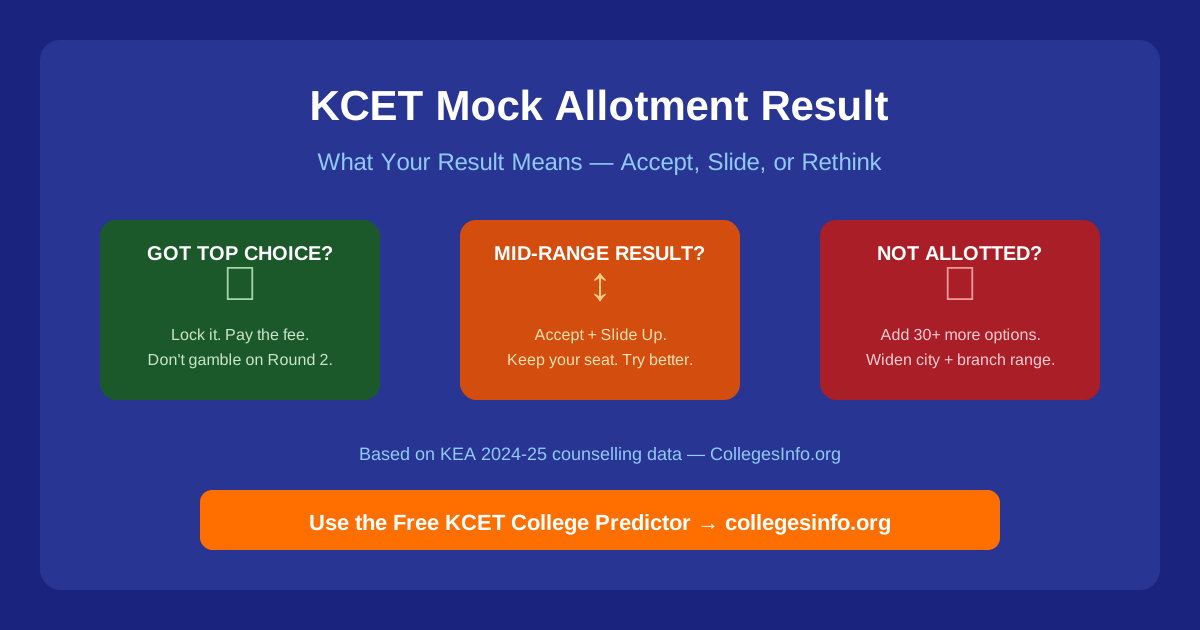
This is the best outcome. Your rank, category, and option ordering aligned perfectly. Don't change anything in your option list – any modification risks losing this position if other students add options that shift the allocation. The only change worth making: if you didn't include your absolute dream college because you thought it was unrealistic, you could add it above your current allotment as a stretch. But don't remove or reorder anything below your current mock result.
Scenario 2: You Got a Mid-Range Choice (4th-10th on Your List)
This means your top choices went to students with better ranks, but your backup strategy worked. The question now is: are you satisfied with this college and branch, or do you want to try for better? If you're okay with it, keep the list as-is. If you want to try for better, here's what the data from 2024-25 shows – roughly 15-20% of Round 1 seats get surrendered or vacated before Round 2, particularly at Tier 1 colleges where students also hold COMEDK or JEE seats. So Round 2 does open up real opportunities, but only if you've selected "Slide Up" after accepting in Round 1.
Scenario 3: You Got a Low-Range Choice (Below 10th on Your List)
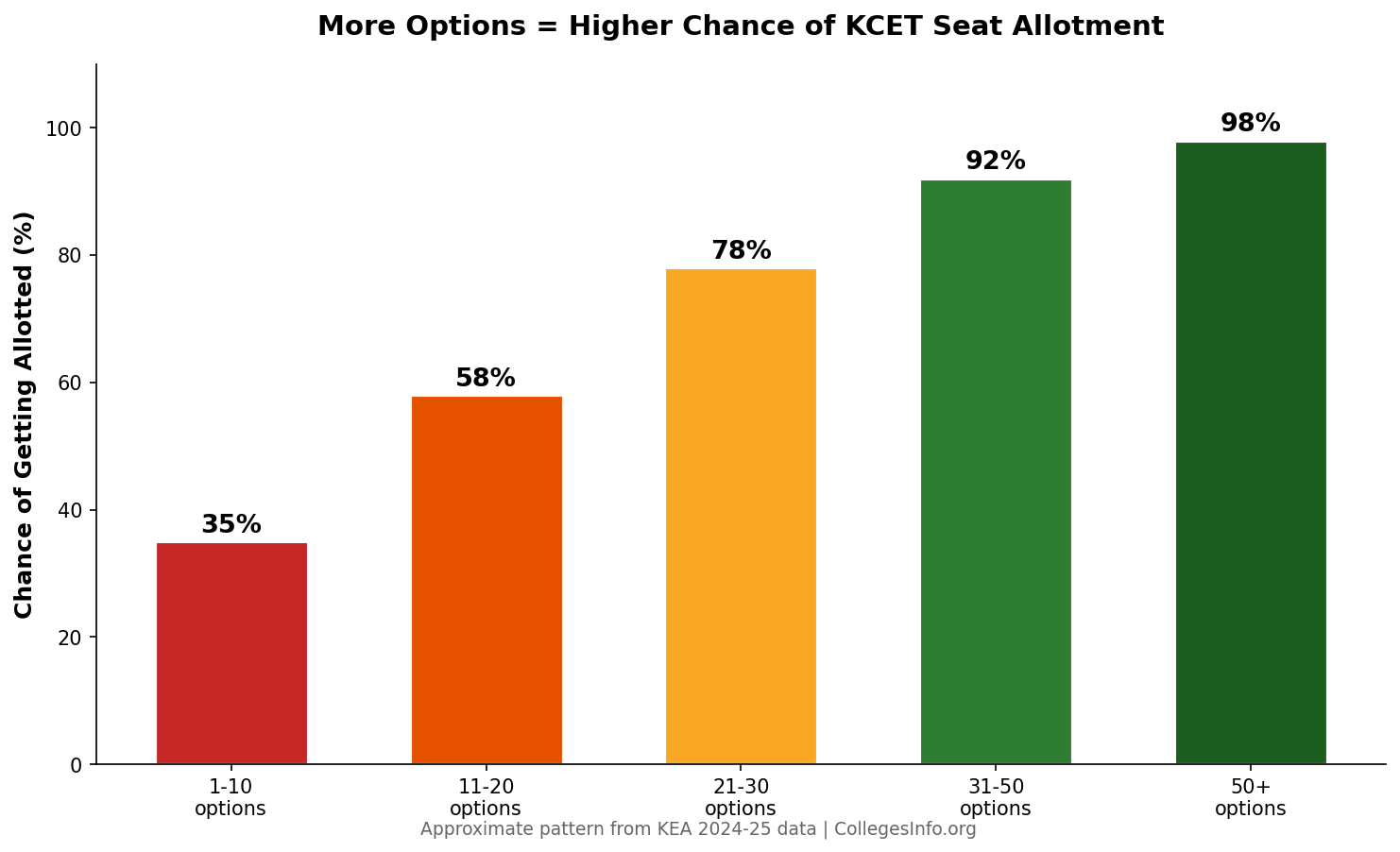
This usually means one of two things: your rank wasn't competitive enough for your preferred colleges, or your option list was too narrow. Check how many total options you'd entered. If it was under 20, that's likely the problem. KEA's choice filling guide recommends entering at least 40-50 options for students with ranks above 10,000. The modification window is your chance to add more options – expand your city preferences and consider branches beyond CSE.
Scenario 4: "Not Allotted"
This doesn't mean you won't get a seat. It means that based on your current option list, no seat was available at your rank. The fix is simple: add significantly more options. Students who enter 50+ college-branch combinations across multiple cities and branches rarely remain unallotted in the real rounds. If you'd only listed CSE at 5 Bangalore colleges, your options were too narrow for your rank. Add colleges in Mysuru, Mangalore, Hubli, and Davangere – fees are lower, competition is softer, and placement outcomes at good regional colleges are better than most students expect.
The Modification Window: Your Most Important 48 Hours
After mock allotment, KEA opens a brief modification window – usually 2-3 days. During this period you can add new options, remove options you no longer want, and reorder your entire preference list. This is the single most impactful moment in the entire KCET counselling process. Here's what to do.
First, don't delete any options from your current list unless you wouldn't accept that seat under any circumstances. Every option you remove reduces your chances of allotment in the real round. Second, add at least 10-15 new options if you weren't satisfied with your mock result. Look at the KCET College Predictor to identify colleges where your rank falls within the 2024-25 closing rank range. Third, reorder strategically – your most preferred option should be first, regardless of whether you think you'll get it. KEA's algorithm works top-down through your list and assigns you the highest available option. There's zero penalty for listing a stretch college at the top.
Accept, Slide Up, or Surrender – The Round 1 Decision
Once the real Round 1 result comes out (typically 3-5 days after mock), you face the most consequential decision in KCET counselling. KEA gives you three options, and understanding the difference between them is critical.
"Accept and Freeze" – When to Use It
Choose this when you're completely satisfied with your allotted college and branch and don't want to participate in further rounds. Your seat is confirmed. You'll pay the admission fee and report to the college. This is the right choice if you've got your top 1-3 preference and there's no realistic upgrade available.
"Accept and Slide Up" – The Smart Default for Most Students
This is what most students should choose. It means you accept and pay for your current seat (it's safe – you won't lose it), but you remain in the system for Round 2. If a higher-preference seat opens up due to surrenders or upgrades, you'll automatically slide into it. If nothing better opens, you keep your current seat. There's no downside to choosing this option – your current allotment is protected while you get a shot at something better.
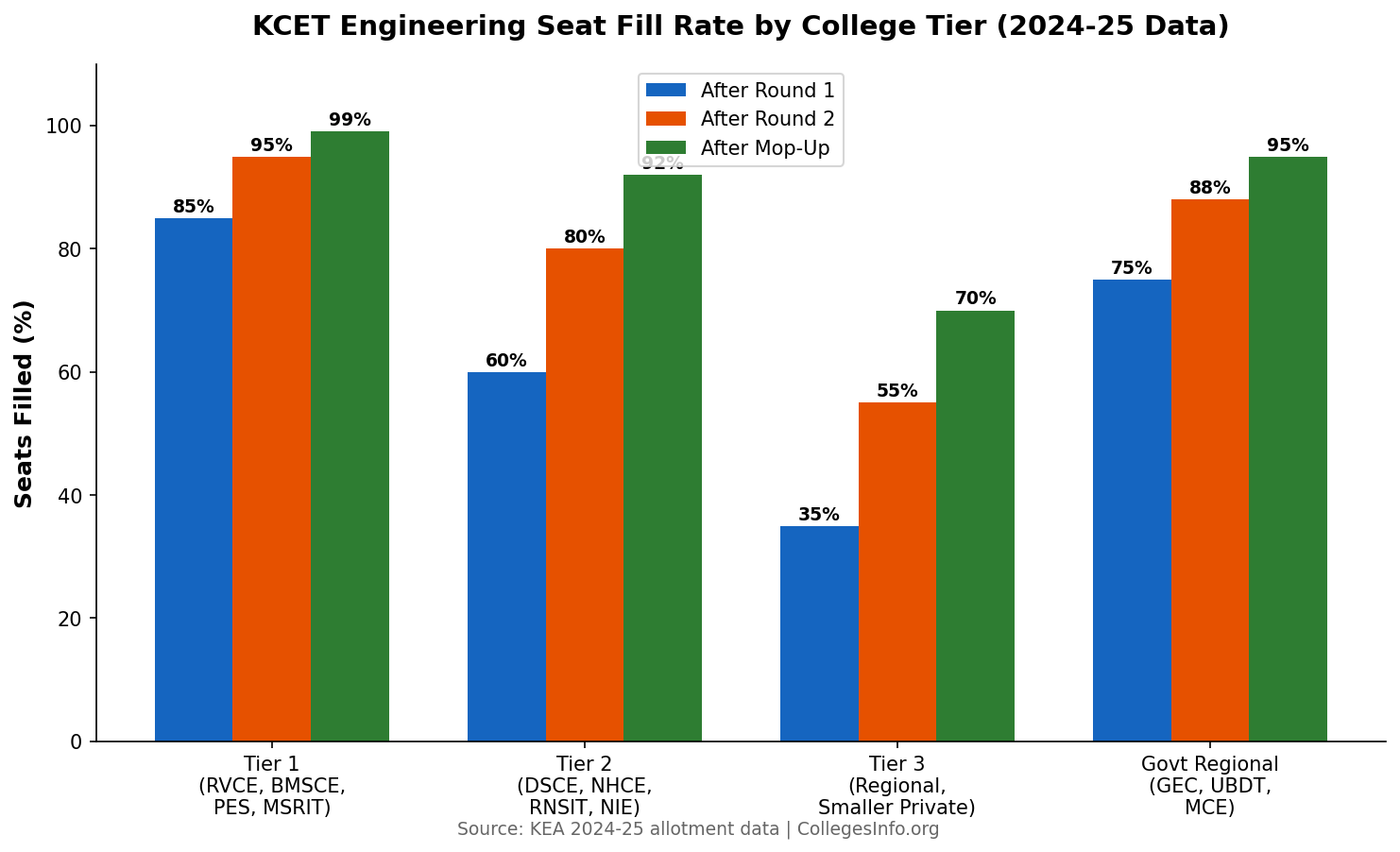
The data backs this up. In KCET 2024-25, roughly 12-18% of engineering seats that were filled in Round 1 became available in Round 2 due to students surrendering (they took COMEDK, JEE, or management quota seats instead). At Tier 1 colleges, this percentage is even higher because top-rank students often hold multiple offers.
"Surrender" – Only If You're Sure
Surrendering means you give up your allotted seat entirely and exit KCET government quota counselling. Do this only if you've confirmed admission elsewhere – through COMEDK, JEE, management quota, or a different stream entirely. If you surrender without a confirmed backup, you're out of the KCET system with no way back in for the current year.
Common Mistakes That Cost Students Their Preferred Seat
After covering thousands of KCET counselling cycles through our education directories since 2006, certain patterns repeat every year. Here are the mistakes that consistently cost students a better allotment.
Mistake 1: Entering Too Few Options
The most common and most damaging mistake. Students with rank 15,000 who list only CSE at 5 Bangalore colleges are almost guaranteed to be "Not Allotted." The same student listing 50 options across 3 cities and 4 branches will likely get a seat in Round 1 itself. More options never hurts – KEA's algorithm only allots your highest available preference.
Mistake 2: Ignoring Mock Allotment Completely
Some students treat mock as a formality and don't log in to check. They miss the modification window entirely. When the real allotment comes, they're stuck with a result they could've improved by adding 10 more options during the 48-hour window.
Mistake 3: Choosing "Freeze" When "Slide Up" Was Better
Students who freeze their Round 1 allotment can't participate in Round 2, even if their dream seat opens up. Unless you're in your absolute top choice, always choose "Slide Up." The only reason to freeze is if you're worried about timing – maybe you need to secure hostel, travel, or loan arrangements and can't wait for Round 2.
Mistake 4: Surrendering Without a Backup
Every year, some students surrender their KCET seat hoping to get a better COMEDK allotment, only to find that their COMEDK result is worse than what they had in KCET. Once you surrender, there's no re-entry. Accept and Slide Up protects you from this risk completely.
Mistake 5: Not Checking Category-Specific Cutoffs
OBC, SC, and ST students often underestimate their options. A GM student needs rank ~1,200 for MSRIT CSE, but an SC student can get it at rank ~10,000. If you're in a reserved category, your mock allotment might look disappointing at first – but checking category-specific cutoffs from previous years often reveals that you have better options than you think.
College-Specific Insights for Mock Allotment Analysis
Different colleges show different patterns between mock and final allotment. Here's what the 2024-25 data tells us about key Karnataka engineering institutions.
Tier 1: RVCE, BMSCE, PES University, MSRIT
At RVCE, BMSCE, PES University, and MSRIT, mock allotment for CSE is extremely close to the final result – within 50-100 rank positions. That's because demand for these seats is so high that very few students surrender them. If mock shows you've got CSE at any Tier 1 college, it's almost certainly your final result too. Lock it in.
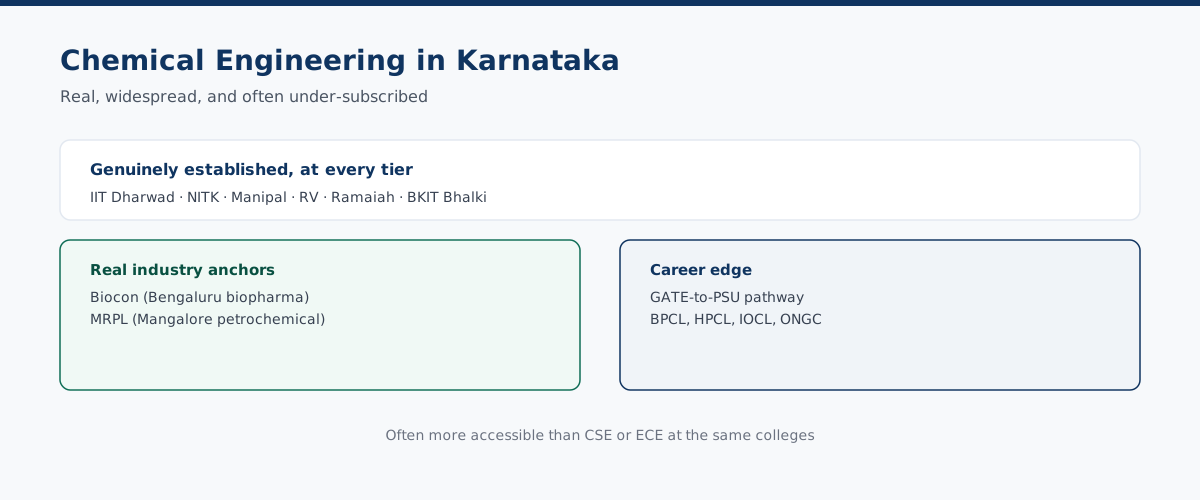
However, non-CSE branches at Tier 1 colleges (Mechanical, Civil, Chemical) show more movement between rounds. Students allotted Mechanical at RVCE in mock sometimes slide into ECE or ISE by Round 2 as CSE-allotted students leave for COMEDK or JEE seats.
Tier 2: NIE Mysuru, SIT Tumkur, DSCE, NHCE, RNSIT
Tier 2 colleges show significantly more movement between mock and final. Colleges in the 5,000-20,000 rank range see 20-30% seat churn between rounds because students at this level often have parallel COMEDK or management quota options they haven't decided on yet. If your mock shows a Tier 2 college and you wanted Tier 1, the Slide Up option gives you a genuine shot at upgrading.
Tier 3 and Regional Colleges
Colleges outside Bangalore – in Hubli, Belagavi, Davangere, Kalaburagi – show the most vacancy movement. Many of these seats remain unfilled until the mop-up round. If you're "Not Allotted" in mock, adding these colleges to your list is the fastest path to a confirmed seat. The KCET counselling complete guide covers how to research regional colleges effectively.
What If Your Mock Result Shows a College You Don't Know?
This happens more often than you'd think – students add colleges to their option list during a last-minute rush, and when mock allotment shows one of those colleges, they've got no idea whether it's any good. Here's how to evaluate quickly.
Check three things: NAAC accreditation grade (A or above is solid), the college's placement record for your specific branch (not just the headline number – ask about median salary, not average), and whether the college has NBA accreditation for your specific programme. You can start with our college directory which covers 1,677 institutions across Karnataka with verified data from AICTE, VTU, and university sources.
Branch vs College: The Dilemma Mock Allotment Forces
If mock shows CSE at a Tier 3 college versus ECE at a Tier 1 college, which should you prefer? This is the most debated question in KCET counselling, and there isn't a universal answer – but the data points in a clear direction.
For software careers specifically, branch matters more than college brand once you're past the top 5-6 institutions. A CSE student at DSCE (Tier 2) has access to the same Bangalore tech job market as a Mechanical student at BMSCE – but the CSE student's curriculum, projects, and campus recruitment are directly aligned with software roles. The Mechanical student at BMSCE needs to self-learn programming, which is doable but requires significantly more effort.
However, for core engineering careers (manufacturing, automotive, construction, power), college reputation and alumni network matter more than at smaller, newer institutions. An ECE student from RVCE or BMSCE has access to companies like Bosch, Siemens, and L&T that don't recruit from Tier 3 colleges regardless of branch.
COMEDK vs KCET: Should You Wait for Both Before Deciding?
Many students appear for both KCET and COMEDK. If your KCET mock shows a decent result but you're still waiting for COMEDK counselling, here's the practical approach: accept your KCET seat with "Slide Up." This protects your government quota seat at lower fees while you explore COMEDK. If COMEDK gives you a better college, surrender KCET then. If not, you've still got your KCET seat safe.
The fee difference matters here. KCET government quota fees at a college like DSCE run Rs 45,000-60,000 per year. The same college through COMEDK management quota charges Rs 1.5-2.5 lakh per year. Same college, same classrooms, same placements – the only difference is the fee. If your KCET rank gets you a seat, it's almost always better value than the COMEDK route to the same institution.
Timeline: What Happens After Mock Allotment
Here's the typical sequence based on KEA's 2024-25 schedule. Exact dates for the current year are published at cetonline.karnataka.gov.in – always verify before acting.
| Stage | What Happens | What You Do |
|---|---|---|
| Mock Allotment Published | KEA releases simulated result | Check result, analyse position |
| Modification Window (2-3 days) | Option list open for changes | Add options, reorder, remove if needed |
| Round 1 Allotment | Real seat allocation published | Accept+Freeze, Accept+Slide, or Surrender |
| Fee Payment Deadline | Pay admission fee to confirm seat | Pay online before cutoff time |
| Round 2 Option Entry | Modified option window for Round 2 | Update preferences if you chose Slide Up |
| Round 2 Allotment | Upgraded or new allotment published | Accept or continue to mop-up |
| Mop-Up Round | Final round with remaining vacant seats | Last chance – take what's available |
How to Use CollegesInfo.org Tools During KCET Counselling
We've built several tools specifically for this stage of the admission process. The KCET College Predictor uses 2024-25 KEA closing rank data to show you which colleges are realistic at your rank. Enter your rank, category, and preferred stream – you'll get a personalised list of colleges sorted by closing rank. No login required, no data collected.
For comparing specific colleges head-to-head, our college comparison guides cover fees, placements, KCET cutoffs, and campus infrastructure for every major Karnataka engineering institution. And our full college directory covers 1,677 institutions with verified AICTE and VTU data.
Frequently Asked Questions About KCET Mock Allotment
Is KCET mock allotment the same as the final result?
No. Mock allotment is a simulation. The final Round 1 result comes separately and may differ – sometimes significantly – because students modify their options between mock and final. Roughly 8-12% of allotments change between mock and Round 1 based on 2024-25 data.
Can I change my option list after seeing the mock result?
Yes. KEA opens a modification window (typically 2-3 days) after mock allotment specifically for this purpose. Use it to add options, remove unwanted choices, and reorder your preference list.
What does "Not Allotted" mean in mock?
It means no seat was available for you based on your current option list and rank. The fix: add more options during the modification window. Students who enter 40-50+ options across multiple cities and branches almost never remain unallotted in the actual rounds.
Should I choose "Slide Up" or "Freeze" after Round 1?
"Slide Up" is the safer choice for almost every student. It protects your current seat while keeping you in the system for potential upgrades in Round 2. Choose "Freeze" only if you've got your absolute top preference and want to lock it permanently.
How many options should I enter in KCET counselling?
At least 40-50 for ranks above 10,000. For ranks above 30,000, enter 60-80+ options. There's no upper limit and no penalty for entering more. The algorithm only assigns your highest available preference – extra options are insurance, not risk.
What happens if I don't pay the fee after Round 1 allotment?
Your seat is automatically cancelled. You'll still be eligible for subsequent rounds, but you'll have lost your Round 1 allotment permanently. Always pay the fee on time, even if you're planning to slide up – the fee is adjustable against your final admission.
Can I participate in COMEDK counselling while holding a KCET seat?
Yes. KCET and COMEDK are separate systems run by different authorities. You can hold a KCET government quota seat and simultaneously participate in COMEDK counselling. If COMEDK gives you a better option, you can surrender KCET then.
Need help analysing your mock allotment result? WhatsApp +91 6363 330 233 with your KCET rank, category, and mock allotment result. We help you get the best admission to your preferred colleges without hassle.
Published by L K Monu Borkala, founder of OneCity Technologies – publishing Karnataka education directories since 2006, covering college admissions data since 2019 through CollegesInfo.org. Content sourced from publicly available KEA counselling data from 2024-25. Always verify dates and deadlines at cetonline.karnataka.gov.in before acting.
Need help with admission?
CollegesInfo.org helps students secure admission to colleges they are eligible for under that college's actual published criteria. Chat with us on WhatsApp or explore admission assistance.
About the author
OneCity Technologies Pvt. Ltd began in 2006 publishing an annual print education directory for Karnataka students and parents. As demand grew, OneCity launched an education portal in 2019 to bring that same directory information online, and in 2025 relaunched as CollegesInfo.org, a comprehensive Karnataka college directory covering 1,500+ institutions across engineering, medical, management, arts, commerce, and more. Founder L K Monu Borkala brings 20+ years of business experience and 19 years of work across various education-sector services. CollegesInfo.org's content is built from publicly available KEA, NMC, AICTE, and university data, cross-checked against official sources wherever possible. CollegesInfo.org's admission assistance service helps students secure admission to colleges they are eligible for under that college's actual published criteria. We help you get the best admission to your preferred colleges without hassle.