Last Updated: September 7, 2026
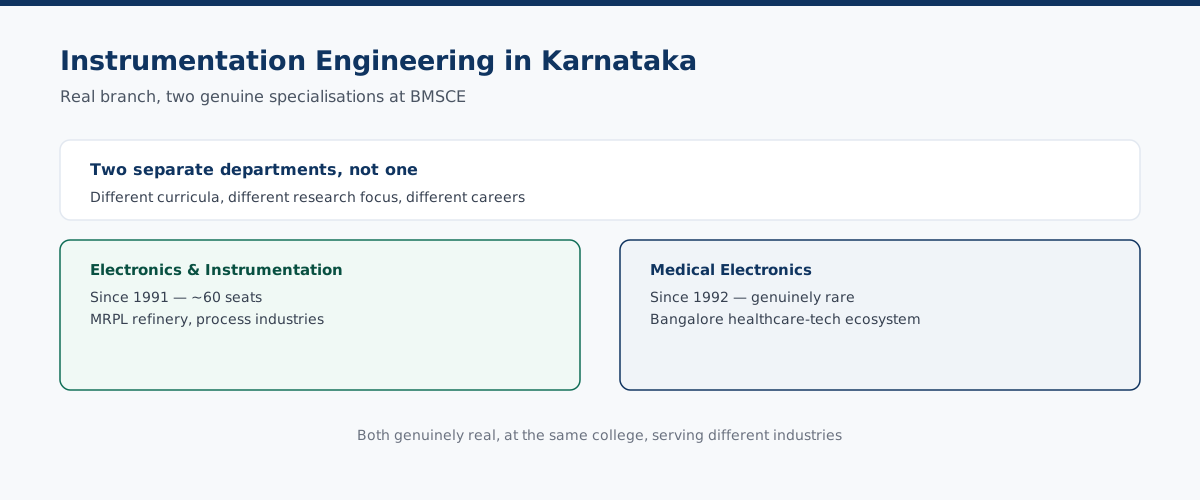
Unlike automobile or mining engineering, Electronics and Instrumentation Engineering is a real, established branch in Karnataka, not an employment-context mention dressed up as a degree. BMS College of Engineering in Bangalore runs the state's most established programme, tracing back to 1991 as the Department of Instrumentation Technology, before VTU renamed it Electronics and Instrumentation Engineering from the 2014 batch onwards. More than 25 batches have graduated from this single department. BMSCE also runs something rarer still – a distinct Department of Medical Electronics Engineering, started in 1992, focused specifically on biomedical instrumentation rather than general industrial instrumentation, uncommon enough among Karnataka's engineering colleges that BMSCE's own faculty describe it as a distinguishing feature of the college. This piece maps both programmes, plus the real regional industry – Mangalore's oil refinery sector and Bangalore's healthcare ecosystem – that actually employs these graduates.
Looking at the bigger picture? Our guide to the best engineering colleges in Karnataka compares KCET tier-wise cutoffs, COMEDK options, and real fee data across Bengaluru, Mangalore, Mysore, and north Karnataka for 2027.
Instrumentation Engineering in Karnataka – Quick Facts
| Most established programme | BMS College of Engineering, Bangalore – Electronics and Instrumentation Engineering (since 1991 as Instrumentation Technology) |
|---|---|
| Rarer specialisation | Medical Electronics Engineering, also at BMSCE, since 1992 – distinct from general instrumentation |
| BMSCE E&I intake | ~60 seats, 4-year B.E. |
| BMSCE Medical Electronics intake | 60 seats (increased from 30 in 2018), plus M.Tech in Biomedical Signal Processing & Instrumentation since 2013 (18 seats) |
| Admission route | KCET, COMEDK, JEE Main – standard VTU-affiliated college admission machinery |
| Approximate fee | ~Rs 1.6 lakh total course fee (verify current year) |
| Real regional industry | MRPL oil refinery (Mangalore) for general instrumentation; Bangalore's healthcare/hospital ecosystem for Medical Electronics |
| Other Karnataka colleges offering the branch | Roughly a dozen per aggregator listings – verify current offerings directly with each college |
BMSCE's Electronics and Instrumentation Engineering – a Real 35-Year History
BMS College of Engineering's programme in this space began in 1991 as the Department of Instrumentation Technology, and more than twenty-five batches of engineers have graduated from it since. VTU renamed the programme Electronics and Instrumentation Engineering starting with the 2014 batch, aligning it with the naming convention now used more broadly across Indian technical education, but the department's institutional continuity – same college, same core curriculum lineage, just a modernised name – runs back over three decades. The current programme takes roughly 60 students a year into a 4-year B.E., with a curriculum built around modern engineering tools including MATLAB, LabVIEW, Multisim, Xilinx and embedded systems development environments, reflecting how much the field has shifted from purely analog industrial instrumentation toward software-integrated measurement and control systems over the department's history.
Placement outcomes for this branch specifically have been described by students and alumni as "average" relative to BMSCE's headline CSE and ECE branches – an honest data point worth knowing rather than assuming the branch performs identically to the college's best-known programmes. As an interdisciplinary branch combining electronics, control systems and measurement engineering, Electronics and Instrumentation graduates find roles across process industries, automation companies, and increasingly in the sensor and IoT-adjacent technology sector, which has expanded the field's relevance considerably beyond its traditional industrial-instrumentation roots.
What the curriculum actually covers has shifted meaningfully since the department's 1991 founding as pure Instrumentation Technology. Core coursework today spans sensors and transducers, process control and automation, analytical instrumentation, industrial electronics, and increasingly, embedded systems and IoT-based measurement platforms – reflecting how the field has absorbed digital and connected-device technology into what was historically a more analog, single-purpose measurement discipline. Students work with tools like MATLAB for signal analysis and control system design, LabVIEW for instrumentation and data acquisition, and embedded development environments including Xilinx FPGA tools and Code Composer Studio for microcontroller-based systems – a broad technical toolkit that positions graduates for both traditional process-industry roles and newer sensor-technology and automation-adjacent software roles.
The Rarer Sibling – Medical Electronics Engineering
Separately from Electronics and Instrumentation, BMSCE runs a distinct Department of Medical Electronics Engineering, which began in 1992 with an initial intake of 30 students, later increased to 60 in 2018. This is described directly by the college as relatively uncommon among Karnataka's engineering colleges, and it shows in the specificity of what's taught: biological control systems, bio-signals and measurement, digital communication as applied to medical contexts, and digital image processing specifically for medical imaging applications, layered on top of standard engineering fundamentals. The department is NBA-accredited for six years and runs its own postgraduate programme – an M.Tech in Biomedical Signal Processing and Instrumentation, established in 2013 with an intake of 18 – giving it genuine depth as a specialised academic track rather than a recently added undergraduate label with no research infrastructure behind it. Faculty research areas span biomedical signal processing, biomedical image processing, biomedical instrumentation, biosensors and biomedical VLSI, with five active research guides currently supervising students in these areas.
This matters for a very specific kind of student: someone drawn to healthcare technology and medical devices but not necessarily wanting a Biomedical Engineering degree in the more general sense offered elsewhere. Medical Electronics at BMSCE sits precisely at the intersection of electronics engineering and clinical application, training graduates for roles in medical device companies, hospital biomedical engineering departments, and healthcare technology firms – a career direction distinct from what a standard ECE or Electronics and Instrumentation graduate would be positioned for.
Beyond BMSCE – the Wider Landscape
BMSCE is the most historically established and best-documented example, but it isn't the only Karnataka college offering Electronics and Instrumentation Engineering. Aggregator listings filtered specifically by this branch name show roughly a dozen Karnataka colleges carrying the programme, though seat counts, programme depth and placement outcomes vary considerably between institutions, and a branch listed on an aggregator doesn't guarantee the same institutional depth BMSCE has built up over three decades. Manipal Institute of Technology, part of the Manipal Academy of Higher Education deemed university in Udupi district, is frequently cited as a strong option for this branch nationally, though it's worth noting MIT Manipal operates outside the VTU/KCET system entirely, with its own separate admission process – a different pathway from the standard Karnataka engineering admission route covered elsewhere on this site.
For students specifically targeting VTU-affiliated, KCET-accessible colleges, BMSCE remains the benchmark; always verify a specific college's current programme offering, seat count and placement record directly rather than relying solely on aggregator branch-filter listings, which can include colleges with only nominal or recently discontinued programmes. The practical due-diligence step here is simple but frequently skipped: call or email the specific college's admissions office and ask directly whether Electronics and Instrumentation Engineering (or Medical Electronics) is currently being offered for the upcoming academic year, how many seats are sanctioned, and who currently heads the department – a college with a real, continuing programme will answer these questions immediately and specifically, while a college whose "offering" exists mainly on an aggregator's outdated database entry will struggle to give a confident answer.
The Real Regional Industry Context
Karnataka's coastal belt provides the clearest genuine industry link for general instrumentation engineering graduates: Mangalore Refinery and Petrochemicals Limited (MRPL), one of India's major oil refineries, located at Katipalla near Mangalore, employs instrumentation engineering graduates specifically for its process instrumentation and control systems, alongside Chemical, Mechanical and Electrical engineers, in a technically demanding sector known for competitive salaries. Several Mangalore-based engineering colleges – Canara Engineering College, PACE, AJIET, Bearys Institute of Technology – cite this MRPL connection as genuine regional employment context for their graduates, even where these specific colleges may not all run a dedicated Electronics and Instrumentation department themselves; students at these colleges more commonly access MRPL's instrumentation-related roles through Electrical or Chemical Engineering degrees with relevant specialisation, rather than a standalone Instrumentation branch.
A separate, distinct industry thread runs through Mangalore's healthcare-technology ecosystem, which several colleges in the region – AJ Institute of Engineering and Technology, Yenepoya Institute of Technology, and Bapuji Institute of Engineering and Technology in Davangere – connect to their parent healthcare-group hospital facilities for biomedical instrumentation and medical imaging project work, typically accessed through Electronics and Communication Engineering coursework rather than a dedicated Medical Electronics department. This gives students in the wider Mangalore region informal but genuine access to healthcare-technology project exposure even without enrolling in BMSCE's specific Medical Electronics programme, though the depth of formal curriculum and research infrastructure BMSCE has built since 1992 remains distinct from these informal, project-level connections elsewhere.
For Medical Electronics specifically, Bangalore's dense hospital and healthcare-technology ecosystem provides the natural industry base – a different regional context from MRPL's industrial-process orientation, and one BMSCE's own department history and research focus reflect directly.
This piece sits alongside the automobile, mining and textile engineering articles in this same Engineering Niche series, and it's worth being explicit about which pattern it follows: like textile engineering, Electronics and Instrumentation exists as a real, historically established branch – the honest correction needed here isn't "this branch is fiction," as with automobile and mining, but rather "verify which specific college's version of this branch has genuine depth versus a nominal listing," and "don't confuse the two distinct BMSCE departments with each other." Different niche branches in Karnataka's engineering landscape warrant different levels of scepticism, and treating them all identically – either uniformly dismissive or uniformly trusting – serves students poorly either way.Admission Routes and Documents
| Route | Notes |
|---|---|
| KCET | Primary state-quota route for BMSCE and other VTU-affiliated colleges' Electronics and Instrumentation and Medical Electronics seats |
| COMEDK | Parallel private-quota entrance, useful if KCET rank doesn't reach your target college's cutoff for this branch |
| JEE Main | Accepted by some VTU-affiliated colleges for a share of seats |
- Register for KCET (and COMEDK if targeting private-quota seats) in the respective notification windows.
- Shortlist colleges specifically offering Electronics and Instrumentation Engineering or Medical Electronics Engineering, verifying current programme status directly rather than trusting aggregator listings alone.
- During KEA counselling, list your specific branch preference explicitly and in genuine priority order among your other choices.
- Documents needed: Class 10 and 12 marks cards, KCET/COMEDK scorecard, transfer and conduct certificates, migration certificate for non-Karnataka boards, category and income certificates for reservation or scholarship claims, Aadhaar, and photographs.
Career Math
Electronics and Instrumentation Engineering graduates from BMSCE enter an interdisciplinary field spanning process industries, automation and control system companies, and increasingly sensor-and-IoT-adjacent technology roles, with placement outcomes for the branch specifically described by students as broadly average relative to the college's headline CSE and ECE placements – a realistic expectation rather than either an inflated or dismissive one. Starting offers in core instrumentation and automation roles typically track standard core-engineering placement ranges, with graduates who've built genuine embedded systems or IoT-adjacent project experience during their degree generally accessing stronger offers than those who completed the programme purely on coursework alone. Medical Electronics graduates enter a more specialised, smaller job market centred on medical device companies, hospital biomedical engineering departments and healthcare technology firms, where the specific combination of electronics training and clinical-application knowledge functions as a genuine differentiator rather than a generic ECE graduate's broader but less targeted skill set – starting offers here vary considerably depending on whether a graduate targets a medical device manufacturer, a hospital's technical department, or a healthcare-technology startup, each with meaningfully different compensation structures. Both branches reward students who treat the specialisation seriously – building genuine projects and internships in the relevant industry context – over students who chose the branch passively based on cutoff availability alone.
For students considering further study, BMSCE's M.Tech in Biomedical Signal Processing and Instrumentation offers a genuine postgraduate pathway specifically for Medical Electronics graduates, with real research infrastructure behind it given the department's five active research guides working in biomedical signal processing, image processing, instrumentation, biosensors and biomedical VLSI. This is a meaningfully deeper postgraduate option than what many niche undergraduate branches offer, since it's tied to an actively research-producing department rather than existing as a standalone add-on programme with limited faculty depth behind it.
Scholarships and Fee Support
At BMSCE's private-college fee levels, the Karnataka State Scholarship Portal (SSP) provides fee reimbursement for SC/ST students and graded support for OBC and minority categories – apply in the opening weeks of the academic year with certificates ready. Education loans through the Vidya Lakshmi portal are routinely available at nationalised banks for either programme's fee levels, and BMSCE's strong institutional reputation generally supports simple loan approval.
Mistakes Applicants Keep Making
- Assuming this branch doesn't exist after encountering the automobile or mining engineering pattern elsewhere in Karnataka – Electronics and Instrumentation Engineering is a real, well-established exception, not another aggregator-list fiction, and dismissing it based on a pattern seen in different branches costs students a viable option.
- Confusing Medical Electronics Engineering with general Electronics and Instrumentation Engineering – these are separate departments at BMSCE with different curricula, different research focuses and different career destinations, not variations on the same programme. A student who enrols in one expecting the other's career outcomes will be disappointed by a mismatch that proper research would have caught.
- Trusting aggregator "top colleges" lists for this branch without verifying current programme status directly with each institution, since a branch appearing on a filtered list doesn't guarantee the same institutional depth and continuity BMSCE has built since 1991 – some listed colleges may have discontinued the programme, reduced it to token seat counts, or never built genuine faculty depth around it in the first place.
- Assuming MIT Manipal is KCET-accessible because it's geographically in Karnataka – it operates under Manipal Academy of Higher Education's own separate admission system, not the state's KCET/VTU framework, a distinction that trips up students who assume "in Karnataka" automatically means "KCET-reachable."
- Choosing the branch purely because it seems less competitive than CSE or ECE, without genuine interest in instrumentation, control systems or (for Medical Electronics) healthcare technology – a branch this specialised rewards genuine engagement far more than a generalist branch would, and a student who picked it only for an easier cutoff typically underperforms relative to peers who chose it deliberately.
- Overlooking the M.Tech pathway for Medical Electronics specifically, given how few Indian institutions offer equivalent postgraduate depth in biomedical signal processing and instrumentation outside the major metros – a genuine differentiator for students planning research or senior technical careers in healthcare technology.
How We Help
Tell us your KCET/COMEDK score, whether you're drawn to general Electronics and Instrumentation or specifically Medical Electronics, and your budget, and we'll return a realistic shortlist checked against our database of every active Karnataka college – including honest verification of whether a college's listed branch offering is current, not copied from an outdated aggregator record. We help you get the best admission to your preferred colleges without hassle.
Need help with admission?
Instrumentation Engineering in Karnataka – FAQs
Does Electronics and Instrumentation Engineering exist as a branch in Karnataka?
Yes – unlike automobile or mining engineering, this is a real, established VTU-recognised branch. BMSCE runs the state's oldest example, tracing back to 1991 as Instrumentation Technology, renamed by VTU from the 2014 batch onwards.
What is Medical Electronics Engineering, and is it different?
Yes, a distinct, rarer specialisation. BMSCE's department started 1992, focused on biomedical instrumentation and medical imaging rather than general industrial instrumentation, with its own M.Tech since 2013.
Which colleges offer Electronics and Instrumentation Engineering?
BMS College of Engineering is the most established. Aggregator data suggests roughly a dozen additional Karnataka colleges offer it, though verify current offerings directly since depth and seat availability vary.
What does BMSCE's Medical Electronics programme cover?
Biological control systems, bio-signals and measurement, digital image processing for medical imaging, plus research in biomedical signal processing, biosensors and biomedical VLSI.
What's the real regional industry for these graduates?
MRPL, a major oil refinery near Mangalore, employs instrumentation graduates for process instrumentation and control systems. Bangalore's healthcare ecosystem provides the industry context for Medical Electronics graduates specifically.
What KCET rank do I need for this branch at BMSCE?
Varies by year; as a smaller specialised branch it generally shows more accessible cutoffs than CSE or ECE. Check the current year's KEA data directly.
Does CollegesInfo charge for admission guidance?
Our admission assistance service helps students secure admission to colleges they're eligible for under that college's actual published criteria. WhatsApp us and we'll explain how we work before anything else.