Quick Facts: BSc Genetics in Karnataka
| How it's actually offered | Almost always bundled – "BSc Biotechnology and Genetics," "BSc Genetics, Biochemistry and Biotechnology," or similar combination degrees, rarely a standalone BSc Genetics |
|---|---|
| Duration | 3 years |
| Where it's concentrated | Bengaluru, at autonomous private colleges affiliated to Bangalore University, Bengaluru City University, or Bengaluru North University |
| Entrance routes | Direct merit-based admission on PUC marks; no dedicated entrance exam |
| Typical annual fees | Roughly Rs 75,000–2,85,000+ total course fees at private autonomous colleges, varying widely by institution |
| Notable anchors | M.S. Ramaiah College of Arts, Science and Commerce; Kristu Jayanti College; Jyoti Nivas College; Seshadripuram College |
If a college brochure or website lists "BSc Genetics" as a standalone degree in Karnataka, read the fine print carefully – in practice, almost no Karnataka college offers pure genetics on its own at the undergraduate level. What you'll actually find is genetics bundled into a combination degree alongside biotechnology, microbiology, or biochemistry – "BSc Biotechnology and Genetics," "BSc Genetics, Biochemistry and Biotechnology," or similar three-subject combinations. That's not a downside; it reflects how genetics is taught at the UG level everywhere – as a foundational subject that sits inside a broader life-sciences degree, not a narrow specialisation on its own – but it does mean you need to look past the headline course name and check exactly which three subjects are bundled together before applying.
What Genetics Actually Covers
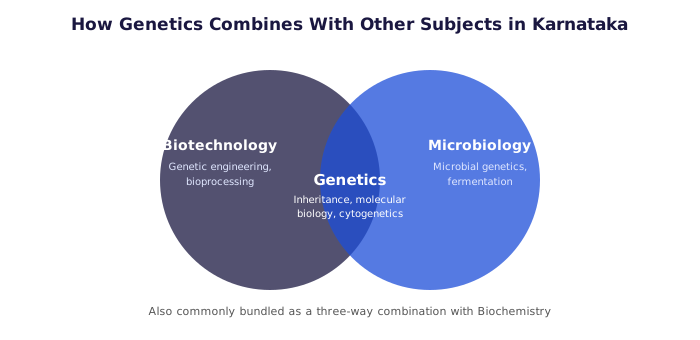
At the undergraduate level, genetics coursework covers the molecular structure and function of genes, patterns of inheritance, genetic variation and mutation, population genetics, cytogenetics, genome organisation, and increasingly, the DNA technology and bioinformatics tools used in modern genetic research. It sits close to both biotechnology (the applied, industrial side of manipulating genetic material) and microbiology (the study of microorganisms, some of which are core genetics research models), which is exactly why Karnataka colleges tend to teach all three together rather than isolating genetics as its own three-year track.
Why the Combination-Degree Structure Makes Sense Here
M.S. Ramaiah College of Arts, Science and Commerce (Autonomous) runs its genetics teaching through a dedicated Department of Biotechnology & Genetics, selected under the DBT-Star College Scheme in February 2022 – a Department of Biotechnology (Government of India) initiative that specifically funds and strengthens laboratory infrastructure at colleges teaching life sciences. The department's own equipment list, published on their site, includes thermocyclers and PCR systems, gel documentation systems, ELISA readers, electrophoresis and SDS-PAGE units, and a bioinformatics workstation – research-grade equipment for an undergraduate programme, and a useful benchmark if you're comparing lab facilities across colleges.
Kristu Jayanti College (Autonomous), founded in 1999 and run by the Bodhi Niketan Trust, offers both "BSc Biotechnology and Genetics" and "BSc Microbiology and Genetics" as separate combination tracks – worth noting if your specific interest leans toward one of those adjacent fields more than the other. The college holds NAAC A++ accreditation from its third accreditation cycle in 2021 and is recognised by UGC under sections 2(f) and 12(B), and became autonomous in 2013 under UGC sanction.
Comparing Your Main Options
| College | Established | Combination offered | Affiliation | Accreditation |
|---|---|---|---|---|
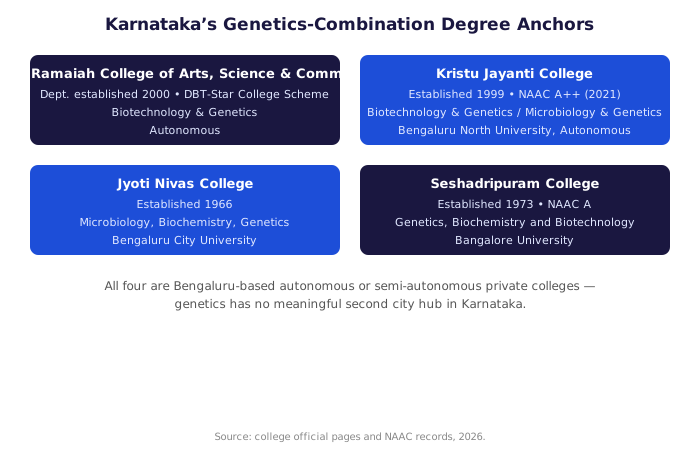
| M.S. Ramaiah College of Arts, Science and Commerce | Dept. est. 2000 | Biotechnology & Genetics | Autonomous | DBT-Star College Scheme recognised |
| Kristu Jayanti College | 1999 | Biotechnology & Genetics / Microbiology & Genetics | Bengaluru North University, Autonomous | NAAC A++ (2021) |
| Jyoti Nivas College | 1966 | Microbiology, Biochemistry, Genetics | Bengaluru City University | Established, long-running programme |
| Seshadripuram College | 1973 | Genetics, Biochemistry and Biotechnology | Bangalore University | NAAC A (2nd and 3rd cycles) |
A pattern worth noticing across this list: every genuine genetics option in Karnataka is at a private, autonomous or semi-autonomous college in Bengaluru specifically, not at a government college or in a smaller city. If you're outside Bengaluru and specifically want genetics as part of your undergraduate degree, relocating to the city is, realistically, part of the plan – this isn't a field with a meaningful second hub the way engineering or general BSc programmes have across multiple Karnataka cities.
Admission: Direct Merit, No Dedicated Entrance Exam
Unlike engineering (KCET) or medical programmes (NEET), BSc genetics-combination degrees in Karnataka are admitted through direct merit based on your PUC or Class 12 marks, following each individual autonomous college's own admission process and cutoff. Since most of these are autonomous colleges, admission criteria, cutoff percentages, and application timelines are set independently by each college rather than through a centralised state counselling system – so you'll need to check each specific college's admission notification directly rather than relying on a single centralised portal the way KCET applicants do.
What Studying Genetics as Part of a Combination Degree Looks Like
Because genetics is taught alongside biotechnology or microbiology rather than in isolation, your three years will split roughly evenly across all subjects in the combination, with genetics-specific coursework – Mendelian and molecular genetics, cytogenetics, population genetics, human genetics, and genetic engineering techniques – woven throughout rather than front-loaded or back-loaded. Lab work is a substantial part of the degree at colleges with strong facilities like M.S. Ramaiah's DBT-Star College-recognised department, giving you hands-on experience with the same PCR, electrophoresis, and analytical instruments used in professional genetics and biotechnology labs.
If you're deciding between a genetics-combination degree and standalone BSc Biotechnology, the practical difference is depth versus breadth: biotechnology gives you a fuller three-year immersion in applied genetic engineering, fermentation technology, and industrial bioprocessing specifically, while a genetics-combination degree gives you a strong grounding in genetics itself alongside a second closely related subject, which suits students who want the genetics depth without narrowing entirely into one applied direction this early. Compared to BSc Microbiology, the genetics-and-microbiology combination tracks offered at colleges like Kristu Jayanti split your attention across both subjects rather than specialising fully in either, so it's worth asking yourself whether you want the combination or a full standalone microbiology degree before choosing. If your interest leans toward applied production over pure life-sciences research, Food Technology is worth a look too, and if it's ecological or regulatory work that draws you more than lab genetics specifically, Environmental Science is the closer fit.
NEP 2020 and What It Means for Combination Degrees
Under the National Education Policy 2020's four-year undergraduate framework, several Karnataka colleges have restructured their combination degrees into a major-minor system, where genetics might now sit as a minor alongside a biotechnology or microbiology major, or vice versa, with multiple exit points (certificate, diploma, degree, Honours degree with research component) depending on credits completed. If genetics specifically is your priority within a combination degree, it's worth asking the specific college directly whether their NEP-restructured curriculum lets you weight your electives toward genetics coursework, rather than assuming the split will be even across all subjects in the combination.
Funding Your Degree
If you're an SC, ST, OBC, or minority-category student, Karnataka's State Scholarship Portal (SSP) – covered in our SSP scholarship guide – covers science degrees broadly, including combination life-sciences degrees like this one. Since most genetics options in Karnataka are at private autonomous colleges rather than government institutions, fees run meaningfully higher than government-college science degrees, so scholarship eligibility and any college-specific merit scholarships are worth checking early in your application process rather than after you've already committed.
Career Paths and Realistic Salary Ranges
Genetics-combination graduates in Karnataka move into research assistant and junior research fellow roles at academic and government research institutions, genetic testing and diagnostic laboratory roles (a growing sector as genetic testing becomes more mainstream in Indian healthcare), roles in biotechnology and pharmaceutical companies working on genetic engineering or molecular diagnostics, and further postgraduate study toward an MSc in Genetics, Human Genetics, Genomics, or a related specialisation, often as a stepping stone toward research careers or genetic counselling.
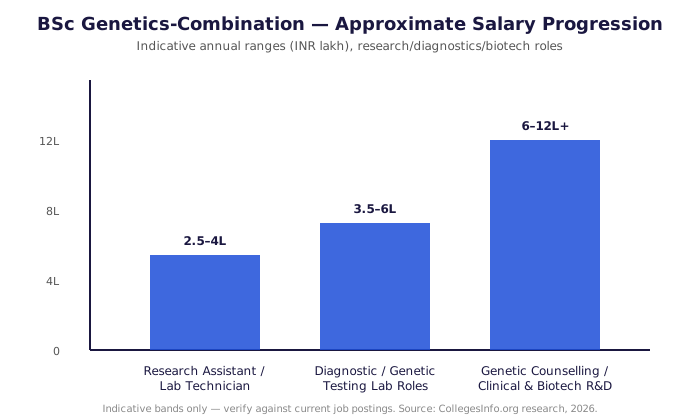
Salary ranges vary considerably by role and employer, so treat these as approximate bands: entry-level research assistant or lab technician roles typically start around Rs 2.5-4 lakh per year, diagnostic and genetic testing lab roles in the Rs 3.5-6 lakh range with some experience, and specialised roles in genetic counselling, clinical genetics labs, or biotech R&D moving into the Rs 6-12+ lakh range for experienced professionals, particularly with a relevant postgraduate qualification. These figures should be cross-checked against current job postings for the specific sector and employer you're targeting, since genetics-adjacent salaries vary significantly between academic research, diagnostic labs, and private biotech companies.
Postgraduate Pathways: Where Genetics Leads
An MSc in Genetics, Human Genetics, or Genomics is the natural next step if you want to specialise more deeply after a combination BSc – and Bangalore University itself, along with several deemed universities in Karnataka, offers postgraduate genetics programmes that combination-degree graduates commonly move into. Genetic counselling is a smaller but growing specialised postgraduate path in India, relevant if you're drawn to the clinical and patient-facing side of genetics rather than pure research. For students interested in human genetics research specifically, institutions like the Department of Human Genetics and Molecular Biology at Bharathiar University in neighbouring Tamil Nadu (established as an independent department in 2014, growing out of the Zoology department) illustrate the kind of dedicated postgraduate research infrastructure this field can lead toward, even if Karnataka's own postgraduate genetics options are your first stop.
A Quick Word on Choosing the Right Combination
Because every genetics option in Karnataka comes bundled with at least one other subject, the real decision isn't just "which college" but "which combination." If your longer-term interest leans toward industrial biotechnology, prioritise a Biotechnology-and-Genetics combination. If you're more drawn to microbial genetics, fermentation, or infectious disease research, a Microbiology-and-Genetics combination fits better. And if you want the broadest possible life-sciences foundation before specialising at the postgraduate level, a three-subject combination like Seshadripuram's Genetics, Biochemistry and Biotechnology track gives you the widest base to decide from later. None of these is objectively "better" – it depends entirely on which adjacent field interests you more.
NIMHANS: Bengaluru's Real Human Genetics Research Destination
One institution deserves a specific mention that most college guides for this field skip entirely: NIMHANS (the National Institute of Mental Health and Neurosciences), on Hosur Road in Bengaluru, runs a dedicated Department of Human Genetics as one of its many specialised departments. NIMHANS is primarily known for psychiatry and neurosciences, but its Human Genetics department does genuine, published research – recent published work from the department includes studies on the genetic basis of neurological conditions like Duchenne muscular dystrophy and progressive supranuclear palsy in Indian patient populations, and the department regularly recruits junior research fellows holding an MSc in Genetics, Biochemistry, Zoology, Biotechnology, or Molecular Biology. If a research career in human genetics specifically – as opposed to industrial biotechnology or diagnostic lab work – interests you, NIMHANS is worth knowing about as a genuine Bengaluru-based postgraduate and research destination, once you've completed your undergraduate combination degree and, typically, an MSc.
Comparing Lab Facilities Before You Choose
Because genetics-combination degrees live or die on the quality of practical lab exposure, it's worth asking specific questions before committing to a college rather than assuming all "Biotechnology and Genetics" programmes offer comparable facilities. M.S. Ramaiah's own published equipment list – thermocyclers, gel documentation systems, ELISA readers, SDS-PAGE units, a dedicated bioinformatics workstation – gives you a concrete benchmark to ask other colleges about directly: does the college have its own PCR and electrophoresis equipment, or do students only get lab exposure through occasional external visits? Is there a dedicated bioinformatics facility, given how central computational tools have become to modern genetics? Colleges recognised under schemes like DBT's Star College Scheme have typically had their lab infrastructure specifically vetted and funded for life-sciences teaching, which is a reasonably reliable signal of genuine investment in practical training, not just a well-written prospectus.
Who Should Actually Choose a Genetics-Combination Degree
This path suits students who are specifically drawn to the molecular and inheritance side of biology – how genes work, how traits pass between generations, how genetic variation drives everything from evolution to disease – but who also want the flexibility of a second closely related subject rather than narrowing immediately into one specialisation. If you already know for certain that industrial bioprocessing or fermentation technology is your target career, a standalone biotechnology degree may serve you more directly. If diagnostic genetic testing, research, or eventually genetic counselling appeals to you, the genetics-heavy combination degrees profiled here – particularly at colleges with strong documented lab infrastructure – are a solid three-year foundation, provided you follow through with the right postgraduate specialisation afterward.
What the Coursework Actually Looks Like, Semester by Semester
Since these are combination degrees, the semester structure typically splits your coursework across all subjects in the bundle from the first year onward, rather than sequencing one subject after another. In the first year, expect foundational biology, cell biology, and basic biochemistry alongside an introduction to genetics – Mendelian inheritance, chromosome structure, and basic molecular biology. The second year deepens into molecular genetics, microbial genetics (if microbiology is part of your combination) or genetic engineering techniques (if biotechnology is your pairing), along with biostatistics, which matters more in genetics than students often expect since population genetics and quantitative trait analysis both depend on statistical methods. The third year typically covers human genetics, cytogenetics, genomics, and bioinformatics, plus your specific combination subject's more applied coursework – industrial biotechnology processes, or advanced microbiology, depending on your track – along with a project or dissertation component at many autonomous colleges.
Practical lab sessions run throughout all three years rather than concentrating in the final year the way some applied degrees structure their industrial training. Expect regular hands-on sessions in microscopy, karyotyping and chromosome analysis, PCR-based techniques, and increasingly, computational genomics and bioinformatics tool use, particularly at colleges with dedicated bioinformatics workstations like M.S. Ramaiah's programme.
Government Schemes Supporting Life Sciences Research Students
A few government schemes are worth knowing about if you're pursuing genetics specifically with research ambitions. The INSPIRE Scholarship (Innovation in Science Pursuit for Inspired Research), run by the Department of Science and Technology, supports students pursuing science degrees including life sciences combinations like these, provided you meet the scheme's academic performance criteria – check your eligibility directly on the official INSPIRE portal rather than assuming eligibility either way. The DBT-Star College Scheme, which colleges like M.S. Ramaiah's are recognised under, doesn't fund individual students directly but does fund the laboratory infrastructure your college teaches you with – so a DBT-Star College recognition is a genuine, government-vetted signal of lab quality investment, not just marketing language on a college website.
Before You Enrol: A Quick Verification Checklist
Given how much variation exists between "genetics" programmes at different colleges, it's worth verifying a few specifics directly with each college before committing, rather than assuming all combination degrees are equivalent. Confirm the exact three (or two) subjects bundled into the specific degree you're applying for, since the combination name alone can be ambiguous; ask directly about lab equipment and whether the college holds any DBT, UGC, or other government recognition for its life-sciences infrastructure; check the college's current cutoff percentages and application deadlines, since these are set independently by each autonomous college and change annually; and if a research or postgraduate career is your goal, ask what proportion of recent graduates have gone on to MSc programmes or research positions, since placement-focused colleges and research-focused colleges can have meaningfully different outcomes even within the same combination-degree structure.
Campus Environment at These Colleges
Unlike the large, semi-rural agricultural university campuses you'd find for a degree like food technology, every genetics option profiled here sits on a compact, urban Bengaluru college campus – M.S. Ramaiah, Kristu Jayanti, Jyoti Nivas, and Seshadripuram are all established city colleges with the facilities, hostel options (where offered), and campus culture typical of Bengaluru's autonomous private college sector, rather than agricultural research campuses. Jyoti Nivas College and several others in this space have historically strong representation of women students, reflecting Bengaluru's broader autonomous-college sector, which tends to skew toward strong female enrolment in life sciences combination degrees specifically. If campus size, hostel availability, or a specific gender-composition environment matters to your decision, it's worth visiting or at least thoroughly researching each specific college's campus directly, since these details vary meaningfully even among colleges offering similar combination degrees.
Karnataka's Genetics Landscape in the National Picture
It's worth knowing that Karnataka's undergraduate genetics offering – bundled combination degrees at Bengaluru's autonomous colleges – is actually fairly typical of how genetics is taught at the UG level across most of India, rather than an unusual local quirk. Dedicated standalone undergraduate genetics degrees are rare nationally; most Indian universities and colleges teach genetics either as a combination BSc (the Karnataka pattern) or as part of a broader zoology or botany degree, reserving genetics specialisation for the postgraduate level. What does vary meaningfully by state is postgraduate and research infrastructure – and Karnataka's combination of Bengaluru's private autonomous college sector, Bangalore University's own postgraduate genetics programmes, and research institutions like NIMHANS gives the state a strong pipeline from undergraduate combination degree through to serious postgraduate research, even without a standalone UG genetics degree at any single point in that pipeline.
Frequently Asked Questions
Can I do a standalone BSc in Genetics in Karnataka?
Realistically, no – Karnataka colleges teach genetics as part of a combination degree alongside biotechnology, microbiology, or biochemistry, not as an isolated three-year programme. Check the exact combination before applying rather than assuming "BSc Genetics" in a brochure means a standalone degree.
Is there an entrance exam for BSc Genetics-combination degrees?
No. These are direct-merit admissions based on PUC or Class 12 marks, through each individual autonomous college's own admission process – there's no centralised entrance exam or counselling system involved, unlike KCET for engineering.
Which combination should I choose: Genetics with Biotechnology, or Genetics with Microbiology?
It depends on your longer-term interest. Biotechnology-and-Genetics suits students leaning toward applied genetic engineering and industrial biotech careers; Microbiology-and-Genetics suits students more interested in microbial genetics, infectious disease, or fermentation-adjacent research.
What can I do after a BSc in a genetics combination degree?
Common paths include an MSc in Genetics, Human Genetics, or Genomics, research assistant roles at academic or government labs, diagnostic and genetic testing laboratory roles, or biotechnology and pharmaceutical company roles in genetic engineering or molecular diagnostics.
Are genetics-combination colleges in Karnataka only in Bengaluru?
Effectively, yes. Every genuine genetics-combination option identified for this guide is a Bengaluru-based autonomous or semi-autonomous private college – there isn't a meaningful second hub for this specific field elsewhere in Karnataka the way there is for general science or engineering degrees.
Is genetics a good foundation for a career in genetic counselling?
Yes, a genetics-combination BSc gives you a reasonable foundation, though genetic counselling as a specific career typically requires a dedicated postgraduate qualification in genetic counselling afterward – it isn't something you can practise directly with just an undergraduate degree.
How much do fees vary between these colleges?
Meaningfully – total course fees across Karnataka's genetics-combination colleges have been quoted anywhere from roughly Rs 75,000 to Rs 2,85,000+ for the full three-year programme, depending on the specific college, its accreditation status, and facilities. Always confirm current fees directly with each college rather than relying on aggregator listings, which can be outdated.
Is a genetics-combination degree harder than a standalone biotechnology or microbiology degree?
Not inherently harder, but the workload is split across more subjects, which some students find more demanding in terms of breadth, while others prefer it precisely because it keeps career options open across two related fields rather than committing fully to one this early.
For admission guidance on BSc Genetics-combination degrees or related science programmes in Karnataka, WhatsApp +91 6363 330 233. We help you get the best admission to your preferred colleges without hassle.
Last Updated: September 7, 2026
Need help with admission?
CollegesInfo.org helps students secure admission to colleges they are eligible for under that college's actual published criteria. Chat with us on WhatsApp or explore admission assistance.