🎯 Use the Free KCET Rank Predictor – Enter your rank and category to instantly see which colleges you can get in 2026. No login required. Try KCET Predictor →
Last Updated: August 26, 2026
Comparing engineering colleges across Karnataka? Our statewide guide to the best engineering colleges in Karnataka for KCET 2027 covers tier-wise cutoffs, COMEDK options, management quota fees, and branch-wise placement data across all major cities.
Common Mistakes Students Make With Category Cutoffs
The most expensive mistake is confusing qualifying cutoff with closing rank. A student sees the SC engineering cutoff at 22 marks, scores 80, and assumes every college is accessible. In reality, the cutoff only means they can participate in counselling. The actual closing rank at a good college like BIT Bangalore might be SC rank 3,500 to 4,000, which corresponds to a composite score of 100 or higher. Qualifying is the starting line, not the finish line.
Second, students from OBC categories frequently forget to check creamy layer status. If your family income exceeds Rs 8 lakh per annum, you are classified as creamy layer and receive zero OBC reservation benefits in KCET. Many students discover this at document verification when KEA rejects their OBC certificate, forcing them into the GM pool with a rank that cannot compete for the colleges they listed in option entry. Check creamy layer status before counselling, not during.
Third, students with valid HK or rural certificates sometimes fail to upload them during online registration, assuming they can submit them at verification. KEA's system assigns seat buckets based on what was declared during registration. If you registered as plain GM and show up with an HK certificate at verification, the system may not retroactively consider you for HK seats. Declare every applicable category at the registration stage itself.
Finally, many students list too few options because they only checked GM closing ranks and assumed their category rank would get them better colleges. This is true, but the extent of improvement is unpredictable. Category closing ranks fluctuate more than GM closing ranks year-on-year because the candidate pool is smaller and more sensitive to individual choices. List 30 to 50 options to insulate yourself against these fluctuations.
KCET Cutoff Trends 2022 to 2025
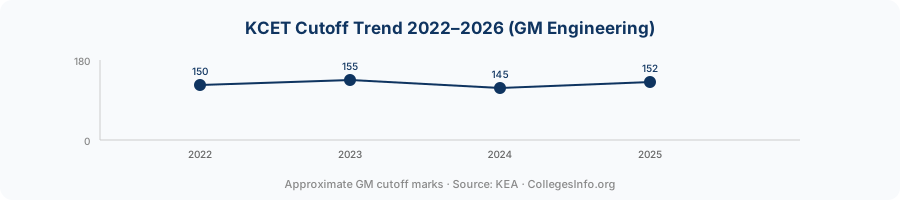
Tracking cutoff trends across years reveals useful patterns. Engineering GM cutoffs have remained relatively stable at 42 to 46 marks over the last four years, with 2023 being slightly lower (42.67) due to a harder paper and 2024 slightly higher (45.00) due to increased registrations. The variation band of 3 to 4 marks year-on-year means students scoring 50 or above in KCET are safely above the qualifying line regardless of paper difficulty fluctuations.
Category cutoffs track GM cutoffs proportionally. When GM rises by 2 marks, SC cutoffs rise by approximately 1 mark and ST cutoffs by 0.5 to 1 mark. The relaxation ratio stays consistent even when absolute numbers shift. This proportional relationship means category students can estimate their qualifying status from GM cutoff predictions without waiting for official category-wise announcements.
Pharmacy cutoffs have trended upward more sharply than engineering over the same period, rising from approximately 30 marks (GM, 2022) to 38 marks (GM, 2025). This reflects growing awareness of Bangalore's pharma job market and improved B.Pharm placement statistics driving more students to list pharmacy options in KCET counselling.
Category Certificates Required for KCET Counselling
Claiming your category benefits during KCET counselling requires valid certificates submitted during document verification. Without the correct paperwork, KEA treats you as GM regardless of your actual category, and you lose access to reserved seats that could dramatically improve your college options.
SC and ST candidates need a caste certificate issued by the Tahsildar or Deputy Commissioner of their home district. The certificate must be in the student's name (not parent's) and issued within the current academic year. Certificates older than one year are rejected at verification. Apply at the Nadakacheri portal (nadakacheri.karnataka.gov.in) or visit your local Tahsildar office at least 4 weeks before counselling begins since processing takes 7 to 15 working days.
OBC candidates (categories 1, 2A, 2B, 3A, 3B) need both a caste certificate and an income certificate. The income ceiling for OBC reservation benefits is Rs 8 lakh per annum for the creamy layer exclusion. Families earning above this threshold are classified as creamy layer and do not receive OBC reservation benefits in KCET. The income certificate must also be current-year issue from the Tahsildar.
Hyderabad-Karnataka (371J) candidates need the Article 371(J) eligibility certificate from the Tahsildar of their HK district, proving 7 or more years of continuous residence in one of the 6 HK districts. This certificate is separate from and in addition to any caste certificate. Rural study certificates, proving 7 years of education in a rural area, are issued by the school headmaster or BEO (Block Education Officer) and must cover Classes 1 through 10 or equivalent.
How to Use Cutoff Data for Your Counselling Strategy
Cutoff data from previous years is your most reliable tool for option entry during KEA counselling. Download the official closing rank documents from cetonline.karnataka.gov.in for the last 2 to 3 years and create a shortlist of college-branch combinations where your rank falls within the closing range. List all of them in your option entry, in strict preference order.
A common mistake is listing only 5 to 10 options based on overly optimistic expectations. Students who list 30 to 50 options (every combination they would accept) are far less likely to go unallotted. KEA's algorithm picks the highest-preference option your rank can secure, so adding more options below your target colleges does not hurt your chances at the top choices.
Factor in year-on-year cutoff fluctuation. Closing ranks can shift by 5 to 15% between years depending on paper difficulty, total registrations, and changes in college intake. If a college closed at rank 20,000 last year, list it even if your rank is 22,000 to 23,000 because it might shift in your favour this year. Never assume last year's closing rank is an absolute boundary.
KCET 2027 Cutoff Marks – What They Mean
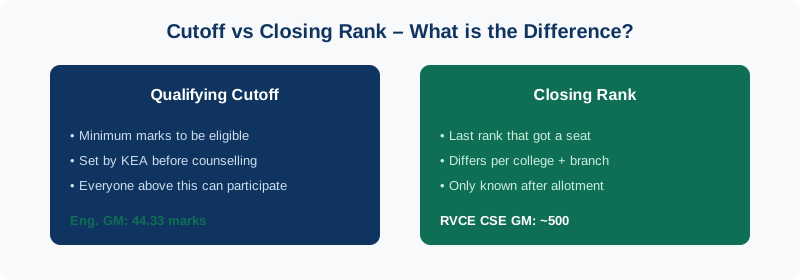
KCET cutoff marks refer to the minimum qualifying score set by KEA before counselling begins. This is the floor to participate in the counselling process, not the score that guarantees you a seat at any specific college. In 2025, the GM engineering cutoff was 44.33 marks out of 180, meaning any GM candidate scoring 45 or above was eligible to enter counselling. Scoring exactly at the cutoff places you at the bottom of the merit list with limited options, while scoring 20 to 30 marks above it opens mid-tier college possibilities.
The cutoff varies by stream. Engineering and pharmacy share the PCM component but have different qualifying thresholds. Medical stream candidates need NEET, not KCET, so KCET medical cutoffs are irrelevant for MBBS and BDS. Architecture candidates take KCET but are ranked on a separate merit list using only Maths and aptitude scores.
Cutoff marks also differ sharply by category. SC candidates qualify at approximately 50 to 60% of the GM cutoff. ST candidates qualify at even lower thresholds. OBC categories (2A, 2B, 3A, 3B) fall between GM and SC, with each sub-category having its own cutoff line. These category cutoffs exist because reservation policy mandates lower barriers to ensure equitable access across social groups.
KCET cutoff marks refer to the minimum marks in the KCET exam required to be eligible for counselling in a specific stream. Don't confuse KCET cutoff marks with KCET closing ranks – they're different things. Cutoff marks determine whether you qualify to participate in counselling. Closing ranks determine which specific college-branch you can get.
For engineering (E&T stream), the KCET cutoff is the minimum aggregate marks in Physics and Mathematics in KCET. For medical stream, it's the minimum in Physics, Chemistry, and Biology. For agriculture, it's Physics, Chemistry, and Biology or Mathematics combined.
KCET 2027 Cutoff Marks by Category (Expected)
The category-wise cutoff table reflects qualifying marks, not closing ranks. This distinction trips up many students. A GM cutoff of 44.33 means you need at least 45 marks to enter counselling. But the closing rank at RVCE CSE for GM is approximately 500, corresponding to a composite score far above the qualifying cutoff. Think of the cutoff as the entry ticket to the stadium and the closing rank as the seat number you actually get.
Expected qualifying cutoffs for KCET 2026 engineering: GM around 44 to 46 marks, OBC (2A/2B/3A/3B) around 35 to 40 marks, SC around 20 to 28 marks, and ST around 15 to 22 marks. These estimates are based on the 2024 and 2025 patterns and assume similar paper difficulty and registration numbers. A harder paper pushes all cutoffs down by 3 to 5 marks; an easier paper pushes them up by the same margin.
Hyderabad-Karnataka candidates with valid 371(J) certificates benefit from an additional relaxation of approximately 5 to 8 marks below their base category cutoff. An HK candidate who is also SC effectively qualifies at the lowest threshold in the entire system, often around 10 to 15 marks out of 180.
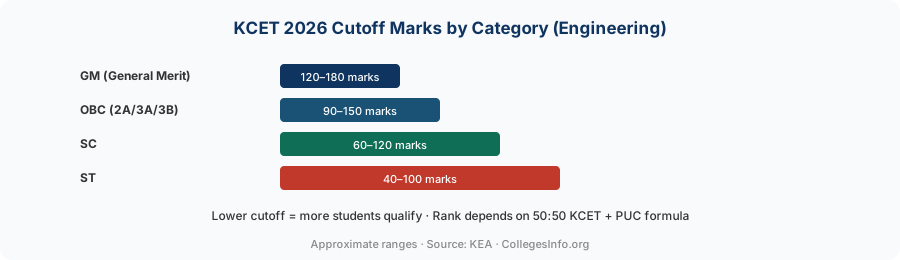
KCET 2026 cutoff marks by category for engineering
| Category | Engineering Stream | Medical Stream | Agriculture Stream |
|---|---|---|---|
| General Merit (GM) | Merit-based (no minimum) | Merit-based (no minimum) | Merit-based (no minimum) |
| OBC (2A, 2B, 3A, 3B) | Eligible if appeared | Eligible if appeared | Eligible if appeared |
| SC | Eligible if appeared | Eligible if appeared | Eligible if appeared |
| ST | Eligible if appeared | Eligible if appeared | Eligible if appeared |
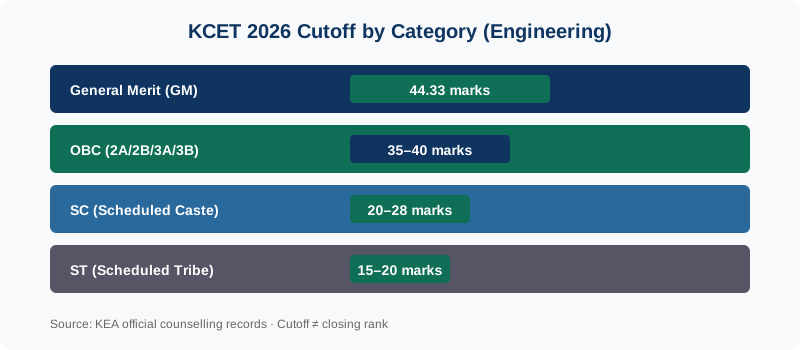
In KCET, there's typically no minimum marks cutoff to participate in counselling – all students who appeared for KCET and passed 2nd PUC with required subjects are eligible. What matters is your rank among all candidates in your category. Even a low rank can get you a seat in your category if enough seats are available.
KCET 2027 Closing Ranks – What to Expect
Closing ranks represent the last rank that received a seat at a specific college and branch combination during KEA counselling. Unlike cutoff marks (which are pre-set), closing ranks are determined by actual demand during counselling and change every year. A college that closed at rank 15,000 in 2025 might close at 13,000 or 17,000 in 2026 depending on how many students chose it during option entry.
Closing ranks differ by quota type. Government quota (KCET) seats close at lower (better) ranks than management quota seats because government fees are cheaper and attract more applicants. COMEDK seats at the same college close at different ranks entirely since COMEDK has a separate merit list. When comparing colleges, always specify which quota and which year you are referencing, otherwise the numbers are misleading.
Category-wise closing ranks follow a predictable pattern: SC closing ranks are roughly 4 to 6 times the GM closing rank at the same college and branch. If RVCE CSE closes at GM rank 500, the SC closing rank is typically 2,000 to 3,000. ST closing ranks extend further, often 6 to 10 times the GM figure. OBC closing ranks are 1.5 to 2.5 times the GM rank.
Closing rank is the last rank allotted to a specific college-branch in a specific category in a specific round. This is what students actually need to track for college selection. Here's what recent KCET closing ranks looked like for top colleges:
| College | Branch | GM Closing Rank (approx) | OBC Closing Rank |
|---|---|---|---|
| RVCE Bangalore | CSE | ~500 | ~1,200 |
| BMSCE Bangalore | CSE | ~800 | ~2,000 |
| MSRIT Bangalore | CSE | ~1,200 | ~2,800 |
| UVCE Bangalore | CSE | ~2,500 | ~5,000 |
| PES University | CSE | ~3,000 | ~6,000 |
| BIT Bangalore | CSE | ~5,036 | ~10,000 |
| NHCE Bangalore | CSE | ~11,000 | ~20,000 |
| RNSIT Bangalore | CSE | ~10,500 | ~18,000 |
How Category Affects Your KCET Rank
Karnataka's reservation structure for KCET engineering allocates seats across multiple category buckets: General Merit (GM), SC (15%), ST (3%), and OBC sub-categories 1, 2A, 2B, 3A, 3B (collectively ~32%). Each bucket has its own merit list. A student's composite score determines their position within their category rank list, and KEA allots seats category by category during counselling.
The practical impact is significant. An SC student with KCET rank 3,000 in the SC merit list has access to colleges that GM students need rank 500 to 800 for. This is because 15% of seats at every participating college are exclusively reserved for SC candidates, and the number of SC applicants at the top of the merit list is far smaller than GM applicants.
Students belonging to multiple categories (for example, SC plus Hyderabad-Karnataka plus rural) are considered for every applicable seat bucket. KEA's algorithm checks each bucket sequentially and allots the best possible seat across all eligible categories. This is why students should claim every valid certificate during document verification rather than assuming one category is sufficient. Missing a valid 371(J) certificate or rural certificate can cost you a seat at a significantly better college.
OBC sub-categories in Karnataka are nuanced. Category 2A (Vokkaligas and related groups) and 3B (Muslims) are the two largest OBC pools, meaning competition within these sub-categories is higher than in 2B or 3A. A 3A candidate with a given score will typically get a better seat than a 2A candidate with the same score because the 3A pool has fewer applicants competing for a similar number of reserved seats.
KCET generates separate rank lists for different categories: GM (General Merit), 2A, 2B, 3A, 3B (OBC categories), SC, ST, and Kannada Medium (KM). Your rank within your category is what matters for seat allotment in category-reserved seats.
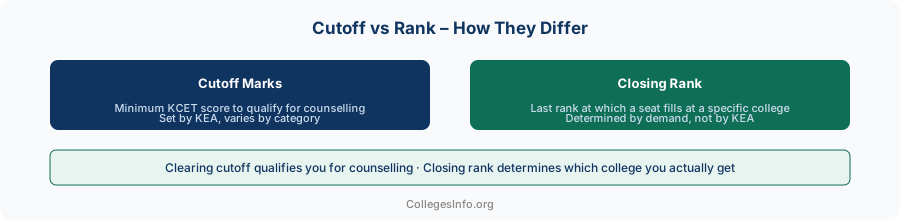
Cutoff marks vs closing rank: two different things
Key points:
- OBC (2A/2B/3A/3B) candidates compete among themselves for OBC-reserved seats, which typically have higher closing ranks than GM seats
- SC/ST categories have the highest closing ranks (most relaxed) because fewer candidates compete for reserved seats
- Kannada Medium students get a separate KM rank for KM-reserved seats
- All categories compete together for GM seats – your GM rank is used for this
KCET 2027 Cutoff vs NEET Cutoff – Key Difference
KCET and NEET are entirely separate exams with no overlap in purpose or administration. KCET is a state-level exam conducted by KEA for admission to engineering, pharmacy, agriculture, and allied health courses in Karnataka. NEET UG is a national exam conducted by NTA for admission to MBBS, BDS, BAMS, BHMS, and nursing courses across India.
The confusion arises because both exams test Physics, Chemistry, and Biology. However, KCET also tests Mathematics (for engineering applicants), uses a 50:50 weightage formula with PUC marks, and applies only to Karnataka colleges. NEET scores out of 720 marks with no board-marks component, applies to all India medical seats, and is the sole gateway to MBBS at every government and private medical college in the country.
A critical difference for Karnataka students: pharmacy admission through KCET does not require NEET. But BSc Nursing, which was previously under KCET, shifted to NEET-based admission in Karnataka from 2024 onward. Students targeting nursing must take NEET, not KCET, regardless of whether they are applying to Karnataka colleges only.
Students preparing for both engineering and medical options should write both KCET and NEET. The exams are scheduled on different dates, and there is no rule preventing a student from appearing for both. KCET preparation (PCM) covers roughly 70% of NEET Physics and Chemistry, so dual preparation is feasible with additional Biology focus for NEET.
KCET cutoff and NEET cutoff are completely different systems. NEET cutoff is a percentile score that determines whether you qualify for medical admissions nationally – 50th percentile for GM (approximately 137/720 in recent years). KCET doesn't have a minimum score cutoff for eligibility – your rank is generated based on your score and you participate in counselling with that rank. There's no KCET "cutoff score" that prevents you from applying to counselling.
Frequently Asked Questions
What is the KCET 2027 minimum marks to qualify?
KCET doesn't have a minimum marks threshold for counselling eligibility. Any student who appeared in KCET and passed 2nd PUC with the required subjects can participate in counselling. Your rank among all candidates determines which seats you can get.
Are OBC closing ranks better than GM closing ranks in KCET?
Yes. OBC-reserved seats have higher closing ranks (more relaxed) than GM seats at the same college-branch. If you have OBC certificate, check your OBC rank – you may qualify for better options than your GM rank suggests.
How do I check KCET 2027 category-wise cutoff data?
KEA publishes the complete seat allotment data after each counselling round on cetonline.karnataka.gov.in. This shows the opening and closing rank for every college-branch-category combination.
Does KCET cutoff change every year?
Yes – KCET closing ranks change every year based on total candidates, paper difficulty, and available seats. Use previous year data as a guide, but treat it as approximate rather than exact for 2026 planning.
Need help with admission?
CollegesInfo.org helps students secure admission to colleges they are eligible for under that college's actual published criteria. Chat with us on WhatsApp or explore admission assistance.
About the author
OneCity Technologies Pvt. Ltd began in 2006 publishing an annual print education directory for Karnataka students and parents. As demand grew, OneCity launched an education portal in 2019 to bring that same directory information online, and in 2025 relaunched as CollegesInfo.org, a comprehensive Karnataka college directory covering 1,500+ institutions across engineering, medical, management, arts, commerce, and more. Founder L K Monu Borkala brings 20+ years of business experience and 19 years of work across various education-sector services. CollegesInfo.org's content is built from publicly available KEA, NMC, AICTE, and university data, cross-checked against official sources wherever possible. CollegesInfo.org's admission assistance service helps students secure admission to colleges they are eligible for under that college's actual published criteria. We help you get the best admission to your preferred colleges without hassle.