KCET 2026 Round 2 is the decision point most students actually need help with – not the exam, but whether to accept, slide, or surrender your Round 1 seat. Get this choice wrong and you could forfeit your entire counselling fee. Here's exactly how the choice codes work and what happens next.
Last updated: July 20, 2026. Round 1 final allotment was declared July 15; reporting deadline is July 24.
| Quick Facts | KCET 2026 Round 1 → Round 2 |
|---|---|
| Round 1 Seats Filled | 1,22,512 of 1,41,872 professional seats (19,374 vacant) |
| Engineering Fill Rate | 90,748 of 91,724 seats allotted |
| Round 1 Reporting Deadline | July 24, 2026 |
| Choice Options After Allotment | 4 distinct codes – Accept & Exit, Accept & Continue, Decline & Continue, Reject & Exit |
| Surrender Refund (Round 1/2) | Fee refunded minus Rs 5,000 processing charge |
| Surrender After Extended Round | Full fee forfeited – no refund |
🎯 Use the Free KCET Rank Predictor – Enter your rank and category to see what Round 2 might realistically offer. No login required. Try KCET Predictor →
Comparing engineering colleges across Karnataka? Our statewide guide to the best engineering colleges in Karnataka for KCET 2027 covers tier-wise cutoffs, COMEDK options, management quota fees, and branch-wise placement data across all major cities.
What Do the 4 Choice Codes Actually Mean?
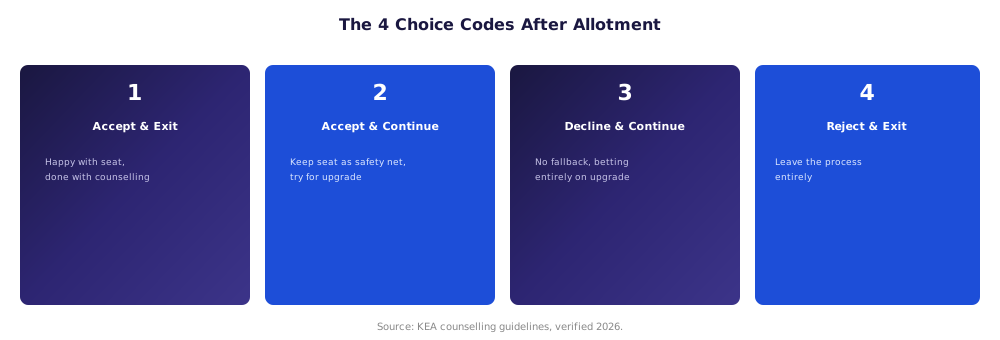
This is the single most important thing to understand before you touch your KEA portal, since choosing wrong can cost you real money or your seat entirely. Choice 1 means you accept your allotted seat and exit the counselling process – you're satisfied and want to join that specific college and branch, full stop. Choice 2 means you accept the seat for now but stay in the process for Round 2, hoping to get upgraded to something better – you keep your current seat as a safety net while still competing for an upgrade. Choice 3 means you don't accept the current seat but want to stay in the process for Round 2 – you're betting entirely on getting something better, with no fallback if you don't. Choice 4 means you reject the seat and exit the entire process – you're done with KCET counselling altogether, for this cycle.
Should You Choose 1, 2, 3, or 4 Specifically?
This depends on how confident you are about upgrading, not a one-size-fits-all answer. If you're already happy with your Round 1 college and branch, Choice 1 is the simple move – lock it in and stop worrying about further rounds. If you'd accept your current seat but would prefer something better, Choice 2 is the safer bet – you keep your current seat as insurance while still competing for an upgrade. If you're confident you'll get meaningfully better in Round 2 and don't mind losing your current seat entirely as a risk, Choice 3 is the more aggressive option. Choice 4 makes sense mainly if you've decided to pursue a different path entirely – a different exam, a private college outside KCET, or a gap year – not as a first reaction to a Round 1 seat you're merely lukewarm about.
What Does Surrendering Actually Cost You?
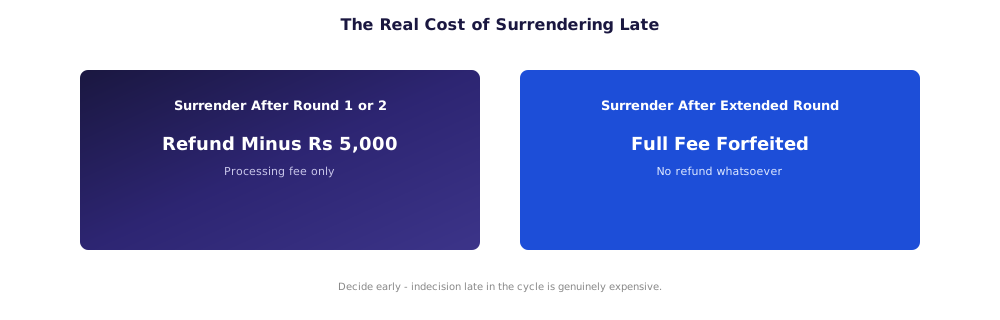
This is worth understanding precisely before you make a decision you can't undo. If you surrender your seat after Round 1 or Round 2 specifically, you get your fee refunded, but only after a Rs 5,000 processing fee is deducted – a real, meaningful cost, not a rounding error. If you surrender after the second extended round instead, the entire fee is forfeited with no refund whatsoever. This escalating penalty structure exists specifically to discourage last-minute seat-hopping late in the process, when it disrupts allotment for other candidates still waiting. Given this, the earlier in the process you're certain about your decision, the less this costs you financially – indecision late in the cycle is expensive, not free.
Why Does the NEET Counselling Delay Actually Affect Your KCET Seat?
This is an important, non-obvious mechanic worth understanding if you're holding a KCET seat as backup while also pursuing NEET. Karnataka's counselling software processes medical and dental seats through NEET counselling first, and this directly affects engineering seat vacancies afterward – when NEET seats get confirmed, students who'd been holding a KCET engineering seat as a backup (Choice 2 specifically) withdraw once their medical seat is secured, freeing up that engineering seat for the next KCET round. Given Karnataka's own NEET counselling hasn't officially opened yet as of this update, some genuine KCET Round 2 movement may still be pending specifically because of this NEET-KCET interdependency, not due to any KCET-specific delay. If you're tracking Round 2 numbers closely, keep this connection in mind rather than assuming KCET operates in complete isolation from the medical counselling timeline.
What Actually Happens in Round 2 Itself?
Round 2 follows broadly the same sequence as Round 1: KEA releases an updated seat matrix reflecting vacancies from Round 1 non-joiners and Choice 2/3 candidates who didn't confirm, followed by a fresh choice-filling window, a mock allotment, an objection window, and final allotment. If you selected Choice 2 or 3 after Round 1, you don't need to re-register – you're automatically carried into Round 2 based on your existing profile and updated preferences. New candidates who didn't participate in Round 1 at all typically cannot join at Round 2 stage directly in most years – verify this specifically against KEA's current-year notification, since fresh-entry rules can vary.
How Does the 50:50 Weightage Actually Affect Your Round 2 Chances?
Worth remembering as you evaluate your realistic Round 2 options: KCET's final rank isn't based on your CET exam score alone – it's calculated on a 50:50 weightage between your KCET score and your Class 12 (II PUC) board marks. This means a candidate with a moderate raw CET score but strong board performance can still land a meaningfully better effective rank than the CET score alone would suggest, and vice versa. If you're recalculating your realistic Round 2 chances, factor in this weighted rank, not your raw exam score in isolation.
What Should Out-of-State Candidates Know Specifically?
If you're not a Karnataka domicile holder, KCET's state quota process isn't your primary route at all – COMEDK remains the main merit-based gateway for non-Karnataka candidates into prestigious institutes like RVCE, MSRIT, and BMSCE. Worth noting as a current, practical detail: COMEDK's own Round 1 counselling is running on a slightly different, later timeline than KCET's – its B.Tech Round 1 choice filling window was recently extended through July 24, meaning KCET and COMEDK aren't perfectly synchronized even in the same admission season, so track each process separately rather than assuming identical deadlines. KCET seats are, with limited exceptions, Karnataka state quota seats specifically, distributed through KEA's own counselling. If you're weighing KCET Round 2 against a COMEDK-based strategy, understand these are separate systems with separate eligibility bases, not interchangeable options for the same candidate pool.
What Documents and Steps Does Round 2 Actually Require?
If you're continuing into Round 2 via Choice 2 or 3, the practical steps are simpler than Round 1 since your core documents are already verified – but a few things still need attention. Keep your admission order, bank challan, verification slip, and any original documents you may have submitted at your Round 1 college readily accessible, since surrender or cancellation specifically isn't permitted if you haven't returned these originals where applicable. If Round 2 allots you an upgraded seat, you'll typically need to complete a fresh reporting process at the new college within the specified deadline, similar to Round 1's process, even though your initial document verification already happened. Keep a close eye on KEA's official notifications specifically for your exact Round 2 reporting window, since these deadlines are generally treated as firm.
Which Branches See the Most Round 2 Movement?
Based on Round 1's fill pattern, some branches are more likely to see genuine movement in Round 2 than others. Computer Science and Information Science branches at top-tier colleges specifically tend to fill almost completely in Round 1, meaning Round 2 movement there is typically limited to a handful of seats freed by non-joiners or NEET-related withdrawals covered above. Branches like Electronics and Communication, and core branches such as Mechanical and Civil Engineering, generally see comparatively more Round 2 movement, since they don't fill as tightly in Round 1 at every college tier. If you're specifically hoping to upgrade into a high-demand branch at a top college via Round 2, treat this as a lower-probability outcome and plan your Choice selection accordingly – holding your current seat via Choice 2 rather than gambling everything via Choice 3, unless you're prepared to accept the outcome either way.
What Happens If Round 2 Still Doesn't Work Out?
This is worth knowing before you assume Round 2 is your last real chance. Beyond Round 2, KCET typically runs a Mop-Up round and, if seats remain, a Stray Vacancy round specifically to fill whatever's still unfilled after earlier rounds – these later rounds sometimes open participation more broadly, occasionally even to candidates who didn't fully engage with earlier rounds, though exact rules vary year to year and should be verified against KEA's current notification. If you're unhappy with everything KCET has offered through Round 2 specifically, this is also the point where seriously evaluating private engineering colleges outside KCET's own counselling, or a COMEDK-based path if your domicile situation allows it, becomes a realistic parallel option worth exploring rather than waiting indefinitely on KCET rounds alone.
Who Should Pay Closest Attention to Round 2 Specifically?
- Students who selected Choice 2 or 3 after Round 1 and are now waiting to see updated seat availability
- Anyone considering surrendering their seat – understand the Rs 5,000 processing fee now, before the extended round makes it a full forfeiture instead
- Students specifically holding an engineering seat as backup while awaiting NEET counselling outcomes, given the genuine interdependency covered above
- Parents helping track deadlines, given Round 1 reporting closes July 24 and Round 2 typically follows within a few weeks
Frequently Asked Questions
What are the 4 choice codes after KCET seat allotment?
Choice 1 (accept and exit), Choice 2 (accept but continue to next round for upgrade), Choice 3 (decline but continue to next round), and Choice 4 (reject and exit the process entirely).
How much does it cost to surrender a KCET seat?
After Round 1 or Round 2, you get a refund minus a Rs 5,000 processing fee. After the second extended round, the entire fee is forfeited with no refund.
Why would my KCET Round 2 seat availability be affected by NEET counselling?
Karnataka's system processes medical seats through NEET counselling first – when students confirm a NEET medical seat, they withdraw from any backup KCET engineering seat they were holding, freeing it up for Round 2.
Do I need to re-register for KCET Round 2 if I chose Choice 2 or 3?
No – you're automatically carried into Round 2 based on your existing profile if you selected Choice 2 or 3 after Round 1.
Is KCET rank based purely on my CET exam score?
No – it's calculated on a 50:50 weightage between your KCET score and Class 12 (II PUC) board marks, so strong board performance can meaningfully improve your effective rank.
What's the alternative for students without Karnataka domicile?
COMEDK is the primary merit-based route for non-Karnataka candidates into top Karnataka engineering colleges, since KCET seats are largely reserved for state quota candidates.
Which branches see the most movement in Round 2?
Core branches like Mechanical, Civil, and Electronics and Communication typically see more Round 2 movement than Computer Science or Information Science, which tend to fill almost completely in Round 1.
Do I need to keep my original documents if I'm continuing to Round 2?
Yes – surrender or cancellation isn't permitted if you haven't returned originals like your admission order and verification slip where applicable, so keep these accessible throughout the process.
Information on this page is compiled from publicly available KEA sources, cross-checked across multiple sources, and will be updated as Round 2 progresses. Always confirm current details directly at the KEA official portal before making any decision. Published by L K Monu Borkala, founder of OneCity Technologies – publishing Karnataka education directories since 2006.
Need help with admission?