Looking at one college rather than the field? The profiles for RVCE and MSRIT carry the branch-level detail this page summarises.
Bangalore engineering colleges ranked by KCET cutoff, 2027-28 entry
At a glance
- Toughest CSE cutoffs, KCET 2026 Round 1 General Merit: RVCE 144, PES University 628, MSRIT 976, BMSCE 1,920, UVCE 2,952, DSCE 3,572, BIT 4,567. All figures from the Karnataka Examinations Authority.
- The order is not the one most lists give. PES University is the second hardest CSE seat in Bangalore on official data, not a mid-table option.
- IISc, Dayananda Sagar University and MS Ramaiah University of Applied Sciences do not admit undergraduates through KCET General Merit in the way the other colleges here do, so a KCET rank will not reach them. They are covered separately below.
- Cutoffs loosen a lot between rounds. RVCE CSE moves from 144 to 425 and BMSCE from 1,920 to 5,200 across Rounds 1 to 3, so the round matters as much as the number.
Every rank on this page comes from the Karnataka Examinations Authority UGCET-2026 round-wise allotment cut-off documents, Rest of Karnataka seat type. Fees, accreditation and rankings come from each college's own published pages. Figures that circulate widely online but are not published by either are flagged rather than repeated, and the Hyderabad-Karnataka quota has its own KEA documents with different ranks.
Which Bangalore engineering college has the toughest CSE cutoff?
RV College of Engineering, at a General Merit closing rank of 144 in Round 1 of KCET 2026. PES University is next at 628, then MSRIT at 976 and BMSCE at 1,920.
| College | KEA code | Round 1 | Round 3 |
|---|---|---|---|
| RV College of Engineering (RVCE) | E005 | 144 | 425 |
| PES University | E009 | 628 | 1,584 |
| MS Ramaiah Institute of Technology (MSRIT) | E006 | 976 | see note |
| BMS College of Engineering (BMSCE) | E048 | 1,920 | 5,200 |
| University Visvesvaraya College of Engineering (UVCE) | E001 | 2,952 | 6,659 |
| Dayananda Sagar College of Engineering (DSCE) | E007 | 3,572 | 11,020 |
| Bangalore Institute of Technology (BIT) | E008 | 4,567 | 13,882 |
| Ramaiah University College of Engineering | E319 | 8,113 | 34,452 |
| R.R. Institute of Technology (RRIT) | E172 | 99,013 | 271,825 |
MSRIT's Round 3 figure is left out on purpose. Its block in the KEA document has course names split across lines in a way that makes two candidate values ambiguous, and publishing the wrong one is worse than publishing none. Its Round 1 figure of 976 is unambiguous.
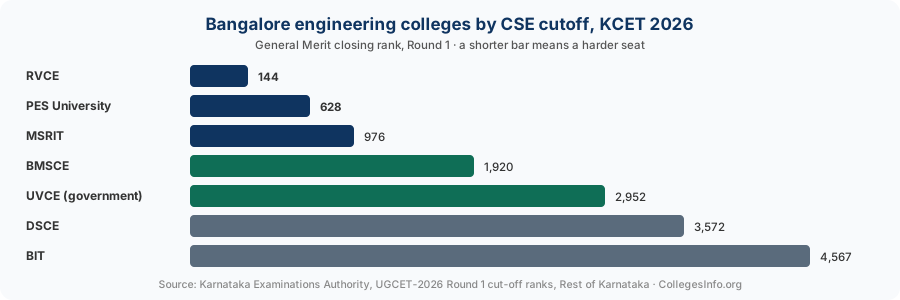
Two things in that table are worth sitting with. The gap between RVCE at 144 and RRIT at 99,013 is the real shape of engineering admission in Bangalore: a handful of seats are very scarce and a long tail is effectively open. And the spread between Round 1 and Round 3 at every college is wide enough that a rank which looks hopeless in July can become an offer by September.
How much do cutoffs move between rounds?
Enough to change which colleges are realistic for you. Across KCET 2026, CSE closing ranks roughly tripled between Round 1 and Round 3 at most of these colleges, so the same rank reaches a different set of colleges depending on when you are looking.
| College | Round 1 | Round 3 | Multiple |
|---|---|---|---|
| RVCE | 144 | 425 | 3.0x |
| PES University | 628 | 1,584 | 2.5x |
| BMSCE | 1,920 | 5,200 | 2.7x |
| UVCE | 2,952 | 6,659 | 2.3x |
| DSCE | 3,572 | 11,020 | 3.1x |
| BIT | 4,567 | 13,882 | 3.0x |
Read that as a planning tool rather than a reason to gamble. If your rank clears a college's Round 1 figure, taking the seat removes risk and the later rounds offer you nothing you do not already have. If your rank sits between the Round 1 and Round 3 figures, the later rounds are the only place that seat exists, and the question becomes whether to hold a safer allotment while waiting. Surrendering a held seat to chase a better one is the decision that goes wrong most often, because a surrendered seat does not come back.
The multiples are also a useful sanity check on any single advertised cutoff. A page that quotes one number for a college without naming the round is quoting something between these two columns, and you cannot tell which. That is worth remembering when a figure here disagrees with one you have seen elsewhere.
What a cutoff does not tell you
A closing rank measures demand, not quality. It tells you how many candidates ranked above the last person admitted and nothing about teaching, placement or whether the branch you want is strong at that college.
Three things the cutoff hides. First, fees: UVCE closes looser than RVCE, PES and MSRIT while charging considerably less as the government college in this group, so a looser cutoff here buys a cheaper degree rather than a worse one. Second, branch strength within a college: MSRIT's Information Science closes at 2,104 while its Mechanical closes at 7,676, and those departments are not equally resourced simply because they share a campus. Third, which seats are actually available to you: a college with a tight General Merit figure may have a very different picture in your own category column, which is the one that decides your allotment.
The honest way to use this page is to narrow the field by rank, then compare the shortlist on fees, branch and location rather than on cutoff order. Two colleges three places apart in the table above can be very different propositions for a particular student.
Why do some colleges show no General Merit cutoff at all?
Four colleges on most Bangalore top-ten lists show a dash rather than a rank for plain Computer Science under General Merit in KEA's Rest of Karnataka documents: JSS Academy of Technical Education, Acharya Institute of Technology, RNS Institute of Technology and Dayananda Sagar University. They do run the course, and they do have allotments in other categories.
| College | KEA code | CSE General Merit | CSE category 1G | Nearest CSE variant with a GM rank |
|---|---|---|---|---|
| RNS Institute of Technology | E118 | no allotment | 15,053 | CSE (AI) 11,356 · CSE (Cyber Security) 12,278 · CSE (Data Science) 12,467 |
| JSS Academy of Technical Education | E082 | no allotment | 22,026 | CSE (AI) 14,934 |
| Acharya Institute of Technology | E079 | no allotment | 26,514 | CSE (Data Science) 20,920 |
| Dayananda Sagar University | E240 | no allotment | 41,017 | CSE (Cyber Security) 26,816 · CSE (Data Science) 28,759 |
This matters practically. If you read a single advertised "cutoff" for one of these colleges, it is almost certainly a different branch or a different category than the one you are applying under, and your own category column is the one to read. It also explains why the CSE variants at these colleges often close tighter than plain CSE: the variants are where the General Merit seats actually moved.
Read your own category column, not the General Merit one
Every figure on this page so far is General Merit, and for most applicants that is not the column that decides the allotment. Category ranks run well behind General Merit at the same college and branch, and the gap widens as the branch gets less competitive.
BMSCE's Computer Science in Round 3 of KCET 2026 is a clear illustration: General Merit closed at 5,200, category 2A General at 7,073, category 2B General at 11,028 and Scheduled Caste category A at 37,380, all from the same KEA document. A candidate reading only the General Merit figure would write off a college that was comfortably within reach on their own rank. The same pattern runs through the colleges with no General Merit allotment above, where the category columns carry ranks even though the General Merit column is blank.
KEA publishes every category column in the same round-wise document, with its own footnote defining the Scheduled Caste sub-categories as SCA, SCB, SCC at 80 per cent and SCC at 20 per cent. Find your category code first, then read across.
Branch-wise closing ranks at the top Bangalore colleges
Computer Science is the tightest branch at every college in the table, and the gap between CSE and the core branches is usually an order of magnitude. At BIT, CSE closes at 4,567 while Civil closes at 51,350.
| College | CSE | ISE | ECE | EEE | Mechanical | Civil |
|---|---|---|---|---|---|---|
| RVCE | 144 | - | 375 | 721 | 2,458 | 5,266 |
| PES University | 628 | - | - | 1,550 | 4,935 | - |
| MSRIT | 976 | 2,104 | 1,557 | 2,431 | 7,676 | 12,463 |
| BMSCE | 1,920 | - | 2,204 | - | 6,844 | 22,210 |
| UVCE | 2,952 | 4,016 | 4,082 | 9,426 | no allotment | 37,819 |
| DSCE | 3,572 | - | no allotment | 9,513 | 15,873 | 49,666 |
| BIT | 4,567 | 6,245 | 5,628 | 11,793 | 27,757 | 51,350 |
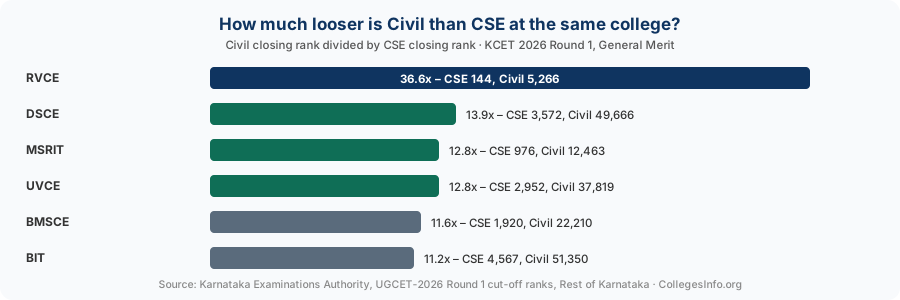
A dash means the college did not offer that branch under this code, or KEA did not list it; "no allotment" means the branch exists but no General Merit candidate was allotted in that round. Note that BMSCE's Electronics and Communication appears under two KEA codes at different ranks, 1,049 under E003 and 2,204 under E048, so the figure above is only half the picture for that one branch. The BMSCE profile sets out both codes.
If you are weighing a tighter branch at a lower-ranked college against a core branch at a top one, the comparison of CSE against AI, ML and data science as KCET choices is the more useful question than college prestige alone.
Which colleges here do not take KCET at all?
Three institutions commonly listed among Bangalore's best engineering options cannot be reached with a KCET rank. Including them in a KCET-ranked list without saying so is the most common error in these roundups.
- Indian Institute of Science (IISc). Its undergraduate programme admits through national channels rather than KCET counselling, and it is a research institution rather than a conventional engineering college. Comparing its cutoff with RVCE's is not a like-for-like comparison.
- Dayananda Sagar University. Present in the KEA documents under code E240, but with no General Merit allotment for plain CSE and GM ranks only on some variants, so in practice its undergraduate intake runs through its own and other channels.
- MS Ramaiah University of Applied Sciences. The university itself (code E235) shows no General Merit CSE allotment. Its constituent Ramaiah University College of Engineering (code E319) does, at 8,113 in Round 1, and that is the entry a KCET rank can actually reach.
Government, private aided or private unaided: what changes?
The three categories differ mainly in fee structure and in how many seats go through KEA counselling. UVCE is the government option in this list and closes at 2,952 for CSE, which is looser than RVCE, PES and MSRIT despite much lower fees.
Private aided colleges such as RVCE, BMSCE and MSRIT receive government aid towards faculty salaries and fill a share of seats at government-quota fees through KEA, with the rest through COMEDK and management quota. Private unaided universities set their own fees across the board. For the management-quota route and what it costs at each college, the management quota guide for Bangalore engineering colleges has the branch-wise figures.
Fees are set annually under the Karnataka government fee notification for KCET seats and under the COMEDK consensual fee agreement for COMEDK seats, so check the current year's notification during counselling rather than relying on a figure from a previous cycle. Where a college publishes its own management-quota fees, as BMSCE does, those are the figure of record.
KCET or COMEDK: which route into Bangalore engineering?
They are separate exams with separate rank lists and separate counselling, and most serious applicants sit both. KCET governs the government-quota share at aided and government colleges; COMEDK governs a share at private colleges and has no government-quota equivalent.
The practical difference is which colleges each route opens. A KCET rank reaches UVCE and the government-quota seats at RVCE, BMSCE and MSRIT; a COMEDK rank reaches a different share of the same private colleges but not the government ones. The KCET counselling process guide and the COMEDK counselling guide cover option entry and seat allotment for each, and the COMEDK colleges and cutoffs guide lists what a COMEDK rank reaches.
How do you apply, and when?
KCET applications open through KEA early in the year, with the exam around April or May and counselling from July. The sequence that matters is exam, rank list, option entry, mock allotment, then three rounds of allotment.
Option entry is where most ranks are won or lost. Order your choices by what you actually want rather than by reputation, because allotment follows your stated order strictly, and include enough realistic options that you are not left out of all three rounds. The KCET rank predictor will tell you which colleges your rank is likely to reach before you commit to an order, and the tier-wise guide to Karnataka engineering colleges by KCET rank widens the field beyond Bangalore.
For a head-to-head between the colleges at the top of this list, see RVCE against BMSCE, BMSCE against MSRIT, PES University against MSRIT, or the three-way RVCE, MSRIT and BMSCE comparison. Individual profiles are at PES University, UVCE, DSCE and BIT. Every engineering college in Bangalore is listed with its own rank band.
Frequently Asked Questions
Which is the best engineering college in Bangalore for CSE?
On KCET cutoffs, RV College of Engineering, which closed at General Merit rank 144 in Round 1
of KCET 2026 per the Karnataka Examinations Authority. PES University is second at 628 and
MSRIT third at 976, so the top three are tighter than most lists suggest.
What KCET rank is needed for top Bangalore engineering colleges?
For CSE in Round 1 of KCET 2026 under General Merit: RVCE 144, PES University 628, MSRIT 976,
BMSCE 1,920, UVCE 2,952, DSCE 3,572 and BIT 4,567. Every one of these loosens substantially
by Round 3, so a rank outside these figures is still worth an option entry.
Is UVCE better than MSRIT for engineering?
MSRIT closes tighter for CSE at 976 against UVCE's 2,952 in Round 1 of KCET 2026, which
reflects higher demand. UVCE is the government college in this group and charges considerably
less, so the trade is fees against cutoff rather than one being plainly better.
Can I get into a Bangalore engineering college with KCET rank 50,000?
Yes, though not into CSE at the colleges at the top of this list. At rank 50,000 the realistic
Bangalore options include Civil at DSCE, which closed at 49,666, and R.R. Institute of
Technology, which closed at 99,013 for CSE in Round 1 of KCET 2026.
Why does PES University rank higher than most lists show?
Because its official KCET closing rank is 628 for CSE in Round 1 of KCET 2026, second only to
RVCE. Lists that place it mid-table are using figures that do not match the Karnataka
Examinations Authority documents.
Does IISc Bangalore admit through KCET?
No. Its undergraduate programme admits through national channels rather than KEA counselling,
so a KCET rank will not reach it. It does not appear in the KEA engineering cut-off documents.
Why do some colleges show no cutoff for Computer Science?
Because no General Merit candidate was allotted plain CSE at that college in that round, even
though other categories were. RNSIT, JSS Academy, Acharya Institute of Technology and
Dayananda Sagar University all show this pattern in KCET 2026, with ranks present in their
category columns and in their CSE variants.
How much do cutoffs move between rounds?
A great deal. RVCE CSE moves from 144 in Round 1 to 425 by Round 3, BMSCE from 1,920 to 5,200
and DSCE from 3,572 to 11,020, all in KCET 2026. Waiting for a later round widens what your
rank reaches but costs you the certainty of a held seat.
Sources
All closing ranks are from the Karnataka Examinations Authority UGCET-2026 round-wise allotment cut-off documents for engineering, Rest of Karnataka seat type, published at cetonline.karnataka.gov.in. Rounds 2 and 3 are KEA's provisional allotment documents. Approval and affiliation details sit with AICTE. Cutoffs for 2027-28 are not published until KCET 2027 counselling runs, so the 2026 figures here are the evidence base and the 2027-28 expectation should be read as an expectation.
Written by L K Monu Borkala, publishing Karnataka education directories since 2006. If a figure here no longer matches the KEA document, tell us and we will correct it.