By L K Monu Borkala · Tracking Karnataka engineering admissions since 2006
At a glance
BIT closed Computer Science at rank 4,567 in Round 1 of KEA UGCET-2026, General Merit, Rest of Karnataka. By Round 2 it was 6,967 and by Round 3, 13,882.
An earlier version of this page contradicted itself by about two times. Its title said 5,036 while its body said CSE closes at 8,000 to 12,000 and repeated that BIT suits ranks of 8,000 to 20,000. Neither figure matches the official sheet, and the gap between them was wide enough to mislead.
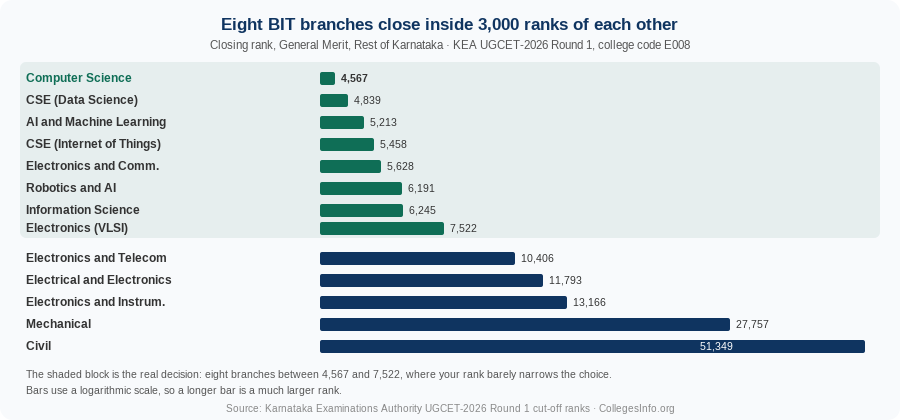
Eight branches close inside 3,000 ranks. From Computer Science at 4,567 to Electronics VLSI at 7,522, your rank barely narrows the choice, so the decision is about the subject rather than what you can reach.
BMSCE is a short walk away and 2.4 times tighter, closing at 1,920. Both sit in the Basavanagudi and V.V. Puram area of central Bangalore.
Every closing rank on this page comes from the Karnataka Examinations Authority UGCET-2026 cut-off rank sheets, for the General Merit seat type under the Rest of Karnataka quota, read round by round under college code E008. KEA prints the institution as "Bangalore Institute of Technology, K.R.Road, Bangalore (AUTONOMOUS)". The sheets are published at cetonline.karnataka.gov.in.
What KCET rank do you need for BIT?
Rank 4,567 or better secured BIT Computer Science in Round 1 of KEA UGCET-2026. By Round 2 the closing rank had widened to 6,967 and by Round 3 to 13,882, so a candidate who can wait has roughly three times the room by the final round.
If you arrived expecting 8,000 to 12,000, that range was on the earlier version of this page and it is the single most consequential error there. A candidate at rank 10,000 reading it would have placed BIT high in their option list for Computer Science and found the seat already gone in Round 1 and Round 2. The threshold only reaches 10,000 by the third round, and by then the branch may be full.
The page used to disagree with itself
The earlier version carried 5,036 in its title and meta description and 8,000 to 12,000 in its body table and FAQ. Both appeared on the same page, about two times apart, and neither matches the KEA sheet.
This is worth naming rather than quietly fixing, because a page that contradicts itself gives a reader no way to tell which half to trust. The title figure was the closer of the two, at about 10 per cent off 4,567. The body figure was wrong by a factor of two in the direction that costs a candidate a seat: it made the college look reachable at a rank where it was not. Every cutoff on this page is now a single sourced number per branch per round.
Eight branches, one decision
Computer Science at 4,567, Data Science at 4,839, Artificial Intelligence at 5,213, Internet of Things at 5,458, Electronics and Communication at 5,628, Robotics at 6,191, Information Science at 6,245 and Electronics VLSI at 7,522 all close within about 3,000 ranks of each other.
That matters more than any single figure on this page. If your rank is anywhere in the 4,500 to 7,500 band, BIT will not force a branch on you: eight of its thirteen are reachable, and the choice is yours to make. Compare that with Acharya, where the branches span almost five-fold, or with the college's own Mechanical at 27,757 and Civil at 51,349, which sit in a different world from its computing block. The practical move is to decide what you actually want to study and order your options that way, rather than ranking the branches by how impressive the cutoff looks.
| Branch | Round 1 | Round 2 | Round 3 |
|---|---|---|---|
| Computer Science and Engineering | 4,567 | 6,967 | 13,882 |
| CSE (Data Science) | 4,839 | 8,289 | 16,862 |
| Artificial Intelligence and Machine Learning | 5,213 | 8,470 | 16,276 |
| CSE (Internet of Things) | 5,458 | 8,975 | 17,971 |
| Electronics and Communication | 5,628 | 9,438 | 16,844 |
| Robotics and Artificial Intelligence | 6,191 | 12,070 | 24,723 |
| Information Science and Engineering | 6,245 | 9,963 | 20,231 |
| Electronics (VLSI Design and Technology) | 7,522 | 12,462 | 22,887 |
| Electronics and Telecommunication | 10,406 | 16,131 | 30,984 |
| Electrical and Electronics | 11,793 | 19,738 | 33,019 |
| Electronics and Instrumentation | 13,166 | 24,563 | 45,143 |
| Mechanical Engineering | 27,757 | 33,966 | 54,971 |
| Civil Engineering | 51,349 | 65,343 | 116,651 |
Three of the earlier version's branch figures were wrong in the direction that matters most. It gave Electronics and Communication as 15,000 to 20,000 when the real Round 1 close is 5,628, Telecommunication as 28,000 to 35,000 against a real 10,406, and Electrical and Electronics as 25,000 to 32,000 against a real 11,793. All three made competitive seats look like fallbacks.
How far each branch moves between rounds
Computer Science triples across the three rounds, from 4,567 to 13,882. Robotics and Artificial Intelligence moves furthest in relative terms, from 6,191 to 24,723, a four-fold widening, while Mechanical barely shifts, from 27,757 to 54,971.
The pattern tells you where waiting pays. A branch that widens four-fold was taken early by candidates who then moved to something they preferred, releasing seats back into the pool; a branch that widens less was taken by candidates who stayed. For option entry at BIT that means the tight computing block is worth listing even if your rank looks short in Round 1, because the thresholds move a long way by Round 3. What it does not mean is that the seat will still be there: by the final round the branch may be full even though the rank threshold has passed you, and in a block where eight branches sit within 3,000 ranks the ones that fill first are the ones everybody listed first.
| Branch | Round 1 | Round 3 | Widens by |
|---|---|---|---|
| Robotics and Artificial Intelligence | 6,191 | 24,723 | 4 times |
| CSE (Data Science) | 4,839 | 16,862 | 3.5 times |
| Electronics and Instrumentation | 13,166 | 45,143 | 3.4 times |
| CSE (Internet of Things) | 5,458 | 17,971 | 3.3 times |
| Information Science and Engineering | 6,245 | 20,231 | 3.2 times |
| Artificial Intelligence and Machine Learning | 5,213 | 16,276 | 3.1 times |
| Computer Science and Engineering | 4,567 | 13,882 | 3 times |
| Electronics and Communication | 5,628 | 16,844 | 3 times |
| Electronics and Telecommunication | 10,406 | 30,984 | 3 times |
| Electronics (VLSI) | 7,522 | 22,887 | 3 times |
| Electrical and Electronics | 11,793 | 33,019 | 2.8 times |
| Civil Engineering | 51,349 | 116,651 | 2.3 times |
| Mechanical Engineering | 27,757 | 54,971 | 2 times |
Where BIT sits, and the BMSCE question
BIT closes nearer to Dayananda Sagar College of Engineering at 3,572 than to Dr Ambedkar Institute of Technology at 8,484, which puts it in the upper half of the Bangalore private field rather than the middle.
The comparison most readers actually want is with BMS College of Engineering, which sits in the same part of the city and closed at 1,920, about 2.4 times tighter. Both are in the Basavanagudi and V.V. Puram area, close enough that students at each pass the other daily, and the two are often spoken about together for that reason. On selectivity they are not alternatives: a rank that reaches BIT Computer Science comfortably will not reach BMSCE. What the shared location does mean is that the same commute, the same neighbourhood and the same rent apply to both, so if central Bangalore is the draw, BIT delivers it at a rank BMSCE does not.
That is a sharper advantage than it first appears, and it is the one thing on this page a cutoff table cannot show you. Most colleges in BIT's selectivity band sit on the outskirts: Dr Ambedkar Institute of Technology is on the Outer Ring Road, RNSIT at Channasandra off the Uttarahalli-Kengeri road, Sir MVIT at Hunasamaranahalli past Yelahanka, New Horizon at Varthur near Marathahalli. Each of those is a long daily commute from central Bangalore or a reason to move into a hostel. BIT is on K.R. Road in V.V. Puram, inside the old city. For a candidate living in south or central Bangalore the difference over four years is measured in hours a week and in whether staying at home is realistic, and neither shows up anywhere in a closing rank.
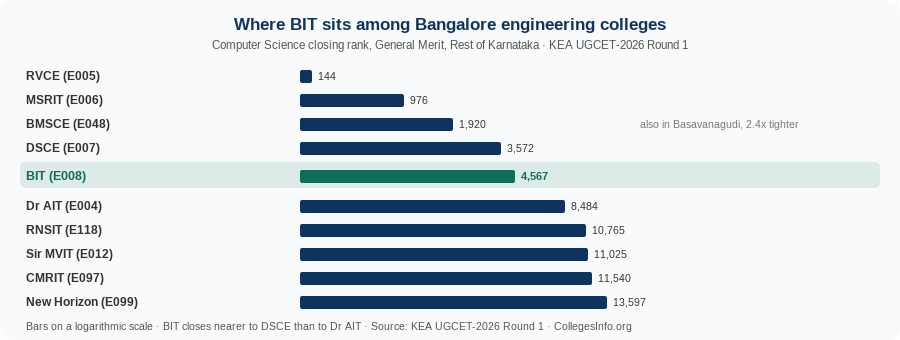
| College | KEA code | Round 1 | Against BIT |
|---|---|---|---|
| RVCE | E005 | 144 | 32 times tighter |
| MSRIT | E006 | 976 | 4.7 times tighter |
| BMSCE | E048 | 1,920 | 2.4 times tighter |
| DSCE | E007 | 3,572 | 1.3 times tighter |
| Bangalore Institute of Technology | E008 | 4,567 | – |
| Dr Ambedkar Institute of Technology | E004 | 8,484 | 1.9 times looser |
| RNS Institute of Technology | E118 | 10,765 | 2.4 times looser |
| Sir M Visvesvaraya Institute of Technology | E012 | 11,025 | 2.4 times looser |
| CMR Institute of Technology | E097 | 11,540 | 2.5 times looser |
| New Horizon College of Engineering | E099 | 13,597 | 3 times looser |
For the wider field see the Bangalore engineering colleges comparison, and for the state-funded options at the top of the table the government engineering colleges in Bangalore guide. If BMSCE is what you are weighing BIT against, the RVCE against BMSCE comparison covers where BMSCE itself sits.
What a reserved category is worth at BIT
Category 3AG closed at 4,939 against a General Merit rank of 4,567, about 8 per cent more room. Category 1G at 6,982 and 2AG at 7,473 add more, and the Scheduled Caste sub-category S1G at 37,049 is where the difference becomes large.
KEA considers a candidate in both the General Merit pool and their own category pool, and the seat comes from whichever closes later for them. The narrow 3AG gap here is worth knowing precisely because BIT is in demand: General Merit has been bid close to the category ranks for the backward-class pools, so a 3AG candidate planning around a comfortable margin will not find one. The gap widens by Round 3 but not dramatically: 14,207 for 3AG against 13,882 General Merit.
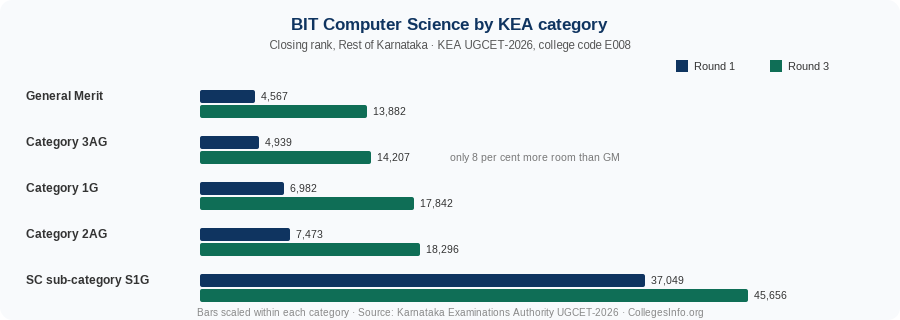
| Round | GM | 1G | 2AG | 2BG | 3AG | STG | S1G |
|---|---|---|---|---|---|---|---|
| Round 1 | 4,567 | 6,982 | 7,473 | 9,297 | 4,939 | 13,707 | 37,049 |
| Round 3 | 13,882 | 17,842 | 18,296 | 19,072 | 14,207 | 31,734 | 45,656 |
Category codes follow KEA's own notation, where 1G, 2AG, 2BG and 3AG are backward class categories, STG is Scheduled Tribe and S1G is a Scheduled Caste sub-category.
What you will actually pay
No fee figure is quoted on this page. The earlier version gave Rs 88,000 to Rs 1.2 lakh a year in its meta description, Rs 90,000 to Rs 1,30,000 in the body, Rs 1,80,000 to Rs 2,50,000 for management quota with a four-year total of Rs 7 to 10 lakh, and hostel rents of Rs 6,000 to Rs 10,000 a month. None of it could be traced to a published source.
The structure is what holds year to year. A seat allotted through KCET counselling is priced by the Karnataka government fee agreement and published in the KEA fee notification. A COMEDK seat sits above it. A management-quota seat is set by the institution and is the highest, often several times the government-quota figure, as the Bangalore management quota guide sets out, and the COMEDK against KCET comparison covers the middle route. Read the current year's government-quota figure from the KEA notification and the other two from the college's own fee circular before committing. The earlier version also gave COMEDK CSE as 4,000 to 7,000 and a management-quota route at rank 20,000 to 30,000; neither is a KEA figure and both have been removed.
Placements and accreditation
No placement average or NAAC grade is quoted here. The earlier version gave neither a source, and the college's own website does not serve readable content to an automated request, so nothing could be confirmed either way.
That last point is a limitation of this page rather than a finding about the college. Where an institution publishes its own placement count or accreditation record, this site quotes it with attribution; here the figures could not be read, so they are absent rather than repeated. If you are weighing BIT seriously, ask the placement office for the number of students placed in the most recent completed year and the median package, and read the NAAC grade and its validity period from the institutional record on the NAAC portal rather than from any aggregator.
Who BIT suits
BIT fits a candidate between about 4,500 and 7,500 who wants a computing or electronics branch in central Bangalore. Below 4,500 the question changes, because DSCE, BMSCE and MSRIT come into range and are measurably more selective.
| Your rank | What is in reach | What to weigh |
|---|---|---|
| Under 4,500 | Every branch at BIT, in Round 1 | DSCE at 3,572 and BMSCE at 1,920 are tighter; compare before settling |
| 4,500 to 7,500 | Eight branches, Computer Science through VLSI | Your rank barely narrows the choice; pick on the subject |
| 7,500 to 13,200 | Telecommunication, Electrical, Instrumentation | Computer Science reopens at 6,967 in Round 2 if you can wait |
| 13,200 to 28,000 | Most branches by Round 3; Mechanical in Round 1 | CSE reaches 13,882 by Round 3, Data Science 16,862 |
| 28,000 to 51,000 | Mechanical, and Civil in later rounds | Dr AIT and RNSIT offer computing branches at this rank |
| Above 51,000 | Civil | A computing branch at a looser college may serve you better |
If your rank is under 4,500 it is worth reading what rank 1 to 5,000 reaches before settling, and the state-wide engineering college list for options outside the city. The KCET rank predictor works off the same official sheets, the option entry order guide explains how the rounds interact, and the college choice checklist covers what a cutoff cannot tell you.
How to apply for 2027-28 admission
BIT admits through KCET for the government-quota seats covered here, with the 2027 examination feeding the 2027-28 academic year. Registration, the examination, results and three counselling rounds all run through the KEA portal.
The sequence is stable: online application and document upload, the examination, provisional results and rank card, document verification, then option entry followed by the three allotment rounds. Option entry decides the outcome, because the allotment runs on the order of your choices. At BIT the useful consequence of the tight eight-branch block is that you can list all of them in the order you actually want them, rather than hedging: if your rank reaches one it very likely reaches several. Examination rules run through Visvesvaraya Technological University, with BIT holding autonomous status in the KEA register. Figures here will be updated when the 2027 sheets are published.
The BIT college profile carries the department and campus detail, and the full college directory covers the rest.
Frequently Asked Questions
What KCET rank is needed for BIT Bangalore CSE?
Rank 4,567 or better secured BIT Computer Science in Round 1 of KEA UGCET-2026 under the General Merit, Rest of Karnataka seat type. By Round 2 it had widened to 6,967 and by Round 3 to 13,882.
Does BIT CSE close at 8,000 to 12,000?
No. That range was in an earlier version of this page and cannot be traced to the KEA sheets. The Round 1 General Merit closing rank under code E008 is 4,567, and 8,000 is not reached until between Round 2 and Round 3.
Is BIT easier to get into than BMSCE?
Yes, considerably. BIT closed CSE at 4,567 in Round 1 against BMSCE at 1,920, about 2.4 times tighter. Both are in the Basavanagudi and V.V. Puram area of central Bangalore.
How many branches at BIT are reachable at rank 7,000?
Eight of thirteen. Computer Science, Data Science, Artificial Intelligence, Internet of Things, Electronics and Communication, Robotics, Information Science and Electronics VLSI all closed between 4,567 and 7,522 in Round 1.
Which BIT branch is the hardest to get into?
Computer Science, at 4,567 in Round 1. Data Science at 4,839 and Artificial Intelligence at 5,213 follow closely, so the top of the list is tightly packed.
Is BIT Bangalore autonomous?
Yes. KEA prints it as Bangalore Institute of Technology, K.R.Road, Bangalore (AUTONOMOUS) in the UGCET-2026 register, and examination rules run through Visvesvaraya Technological University.
What is the BIT fee?
No figure is quoted here. The ranges on the earlier version of this page could not be traced to a published source, and the government-quota fee is set by the Karnataka fee agreement and published in the KEA fee notification each year.
What are BIT placements?
No figure is quoted here. The college's website does not serve readable content to an automated request, so no placement count or average could be confirmed. Ask the placement office for the most recent completed year.
Does a reserved category help much at BIT?
Less than you might expect for the backward-class pools. Category 3AG closed at 4,939 against a General Merit rank of 4,567, about 8 per cent more room. The Scheduled Caste sub-category S1G at 37,049 is the exception.
How much does the BIT cutoff move between rounds?
Computer Science triples, from 4,567 in Round 1 to 13,882 in Round 3. Robotics moves furthest in relative terms, from 6,191 to 24,723, so waiting helps most for the branches outside the core computing block.