Want one college in depth instead? The RVCE profile and the BMSCE profile carry the branch-level and category-level detail this comparison summarises.
RVCE vs BMSCE for 2027-28: what the official data says
At a glance
- Cutoffs are not close. RVCE closed Computer Science at General Merit rank 144 in Round 1 of KCET 2026; BMSCE closed at 1,920. That is a 13-fold gap, not a marginal one.
- NIRF 2025 puts RVCE ahead but both behind MSRIT. RVCE sits in the 101-150 band, BMSCE in 151-200, while MSRIT is ranked 74 outright.
- BMSCE holds the higher accreditation. NAAC A++ at CGPA 3.56, valid to October 2031, against RVCE's A+.
- RVCE offers Aerospace and Electronics and Telecommunication; BMSCE does not. BMSCE offers Computer Science and Business Systems and an IoT and Cyber Security programme that RVCE lists differently.
- This page does not compare fees or placements. BMSCE publishes both; RVCE does not publish either in a form that can be verified, and the reason is set out below rather than filled with estimates.
Both colleges sit in south Bangalore, both are private aided institutions affiliated to VTU with autonomous status, and both appear on every shortlist of the city's established engineering colleges. The question most applicants actually face is narrower than "which is better": it is whether a given KCET rank reaches either, and what the difference in selectivity signals.
Which is harder to get into, RVCE or BMSCE?
RVCE, by a wide margin, in every branch the two share. Its Computer Science closed at General Merit rank 144 in Round 1 of KCET 2026 against BMSCE's 1,920, per the Karnataka Examinations Authority.
| Branch | RVCE (E005) | BMSCE | RVCE tighter by |
|---|---|---|---|
| Computer Science and Engineering | 144 | 1,920 (E048) | 13.3x |
| CSE, Artificial Intelligence | 243 | 2,388 (AI and ML) | 9.8x |
| CSE, Data Science | 266 | 2,084 | 7.8x |
| CSE, Cyber Security | 288 | 2,255 (IoT and Cyber Security) | 7.8x |
| Electronics and Communication | 375 | 1,049 (E003) / 2,204 (E048) | 2.8x / 5.9x |
| Electrical and Electronics | 721 | 3,248 (E003) | 4.5x |
| Mechanical Engineering | 2,458 | 6,844 | 2.8x |
| Bio-Technology | 2,783 | 5,022 | 1.8x |
| Chemical Engineering | 4,067 | 9,627 | 2.4x |
| Civil Engineering | 5,266 | 19,141 (E003) / 22,210 (E048) | 3.6x / 4.2x |
| Industrial Engineering and Management | 6,656 | 17,336 (E003) | 2.6x |
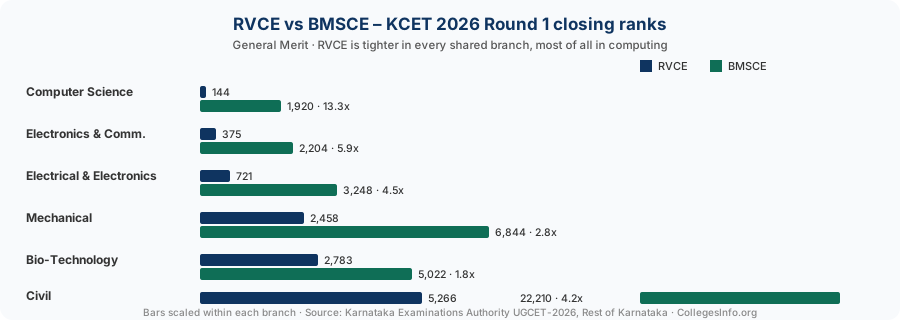
One wrinkle worth knowing before reading any BMSCE cutoff table. KEA lists BMSCE under two college codes with its branches divided between them: E048 carries Computer Science and the AI programmes, E003 carries Electrical and Electronics, Industrial Engineering and Management, and Civil. Electronics and Communication appears under both at different ranks, 1,049 under E003 and 2,204 under E048, so there is no single BMSCE ECE figure. RVCE has one code, E005, which makes its numbers simpler to read.
The gap is widest exactly where demand is highest. In the computing branches RVCE is eight to thirteen times tighter; in the core branches the ratio narrows to between 1.8 and 4.5. If you are set on Mechanical or Bio-Technology the two colleges are much closer propositions than a CSE applicant would guess.
Does the gap close in later rounds?
No. Both loosen as candidates surrender seats, but they loosen in step, so the ratio holds. RVCE Computer Science moves from 144 to 425 across Rounds 1 to 3 while BMSCE moves from 1,920 to 5,200, leaving RVCE roughly twelve times tighter at the end.
| Round | RVCE | BMSCE | Ratio |
|---|---|---|---|
| Round 1 | 144 | 1,920 | 13.3x |
| Round 2 | 285 | 2,856 | 10.0x |
| Round 3 | 425 | 5,200 | 12.2x |
The practical reading is that waiting for a later round does not convert a BMSCE-range rank into an RVCE-range one. It widens what each college will accept, but it does not change their order. A rank of about 2,000 is an RVCE near-miss in every round and a comfortable BMSCE Round 1 result; a rank of about 5,000 reaches BMSCE Computer Science only by Round 3 and does not reach RVCE at all.
If you want to see where your own rank lands across the whole state rather than these two colleges, the KCET rank predictor covers every Karnataka college, and the KCET counselling process guide covers option entry and the accept, slide or surrender decision.
The gap is narrower outside General Merit
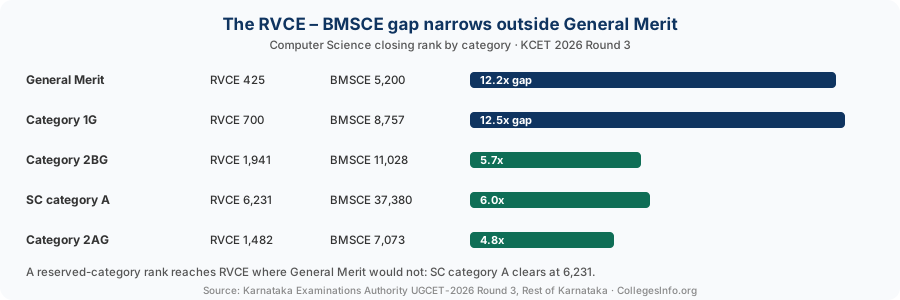
Every figure above is General Merit, and for most applicants that is not the column that decides the allotment. Reading the category columns changes the picture: RVCE's Computer Science closed at 6,231 for Scheduled Caste category A in Round 3 of KCET 2026, against a General Merit figure of 425 for the same branch and round.
| Category | RVCE (E005) | BMSCE (E048) | Ratio |
|---|---|---|---|
| General Merit | 425 | 5,200 | 12.2x |
| 1G | 700 | 8,757 | 12.5x |
| 2AG | 1,482 | 7,073 | 4.8x |
| 2BG | 1,941 | 11,028 | 5.7x |
| 3AG | 852 | no allotment | - |
| SC category A | 6,231 | 37,380 | 6.0x |
Two things follow. First, a reserved-category candidate reaches RVCE at ranks that look impossible from the General Merit column: an SC category A rank of 6,000 clears RVCE Computer Science, where General Merit needs 425. Second, the gap between the two colleges narrows outside General Merit, from roughly twelve times down to five or six, so the choice becomes a closer call for category candidates than the headline figures suggest.
The same pattern holds in Electronics and Communication, where RVCE closed at 765 for General Merit and 14,217 for SC category A, against BMSCE's 4,165 and 64,237. KEA publishes every category column in the same round-wise document and defines the Scheduled Caste sub-categories in its own footnote as SCA, SCB, SCC at 80 per cent and SCC at 20 per cent. Find your category code, then read across rather than down.
What do the rankings say, and why do they disagree with the cutoffs?
RVCE ranks ahead of BMSCE on NIRF, but neither is near the top of the Bangalore field. In NIRF 2025 Engineering, RVCE falls in the 101-150 band and BMSCE in 151-200, while MSRIT is ranked 74 outright.
| College | NIRF 2025 Engineering | KCET 2026 CSE, Round 1 |
|---|---|---|
| MSRIT | Rank 74 | 976 |
| RVCE | Band 101-150 | 144 |
| PES University | Band 101-150 | 628 |
| BMSCE | Band 151-200 | 1,920 |
| DSCE | Band 201-300 | 3,572 |
Read those two columns together and they tell opposite stories. RVCE is the hardest CSE seat in Bangalore by a long way yet ranks behind MSRIT, which closes at 976. NIRF scores research output, graduation outcomes, faculty ratios, perception and outreach; a KCET closing rank measures only how many candidates wanted that seat more than the last person admitted. Student demand and institutional assessment are not the same thing, and this pair is a clear case of them pointing in different directions.
Which you weight depends on what you want from the degree. If the aim is a peer group of very high rankers and the recruiter attention that follows, the cutoff is the better signal. If the aim is research exposure or a postgraduate path, NIRF's components are closer to what matters, and on that measure MSRIT deserves a look alongside these two. The three-way RVCE, MSRIT and BMSCE comparison sets all three side by side, and BMSCE against MSRIT covers that pair directly.
Accreditation: BMSCE holds the higher grade
BMSCE is NAAC A++ with a CGPA of 3.56 on a four-point scale, valid from 30 October 2024 to 29 October 2031, its third consecutive cycle at the A++ grade. RVCE states NAAC A+ on its own site.
This is the one headline measure where BMSCE is ahead, and it is worth stating plainly because the selectivity gap makes the opposite assumption easy. A++ against A+ is a real difference in NAAC's own terms, though both are strong grades and neither college is unaccredited or marginal. RVCE's published NAAC material shows a Cycle 1 entry from 2016 at CGPA 2.80 and grade B, with the current A+ cycle's CGPA not published where it can be read, so the grades can be compared but the underlying scores cannot.
Both are autonomous institutions affiliated to Visvesvaraya Technological University, so degree-awarding and curriculum control are equivalent. Approvals sit with AICTE for both.
Branches only one of them offers
The shared branches are the ones compared above. Two sit outside that overlap and can settle the choice for a particular applicant.
- RVCE only: Aerospace Engineering, which closed at General Merit rank 959 in Round 1 of KCET 2026, and Electronics and Telecommunication Engineering at 632. If either is the target, BMSCE is not an alternative.
- BMSCE only: Computer Science and Business Systems at 2,550, and a CSE programme in IoT and Cyber Security including Blockchain at 2,255. RVCE's nearest equivalents are its Cyber Security stream at 288 and its Data Science stream at 266, both far tighter.
A branch you want that exists at only one of the two removes the comparison entirely. Before weighing colleges, it is worth deciding how firmly you hold the branch, and the comparison of CSE against AI, ML and data science as KCET choices is the more useful question for most applicants than which college ranks higher.
Location, which is a real difference
The two sit in different kinds of Bangalore. KEA's own college list gives BMSCE's address as Post Box No 1908, Bull Temple Road, Basavanagudi, and RVCE's as R.V. Vidyaniketan Post, Mysore Road.
Basavanagudi is inside the old city, about 4 km from Bangalore City Railway Station and 2 km from Lalbagh metro station, which makes term-time internships in the central business district practical without a long commute. Mysore Road runs southwest toward Kengeri, so RVCE sits further out on a larger site with the trade that commuting into the city centre takes longer. Neither is better in the abstract; it depends on whether you expect to be a day scholar, where family live, and whether you intend to work during term.
What this comparison does not cover, and why
Fees and placement figures are missing from this page on purpose. BMSCE publishes both: its management-quota fees run from Rs 4,00,000 a year for Chemical Engineering to Rs 15,00,000 for Computer Science, and its NIRF 2026 submission reports a median salary of Rs 10,00,000 with 972 of 1,291 graduates placed in 2024-25.
RVCE publishes neither in a form that can be verified from outside. Its website refuses automated access, and the copy of its NIRF submission hosted on the ranking framework's own servers is equally unreachable, so there is no primary source to quote. Rather than pair a sourced BMSCE figure with an estimated RVCE one and present the result as a comparison, this page leaves the row out and says so.
If you need the fee and placement comparison, ask each college's admissions office directly during counselling and ask for the figure in writing. For the management-quota route and what it costs across Bangalore, the management quota guide for Bangalore engineering colleges has the branch-wise figures where colleges publish them. Fees for KCET and COMEDK seats are set annually under the Karnataka government fee notification and the COMEDK consensual fee agreement rather than by the colleges, so those are worth checking against the current year's notification in any case.
The same caution applies to the COMEDK comparison this page used to carry. COMEDK publishes its own cut-off ranks separately from KEA, and without that document in hand the COMEDK columns were not verifiable, so they have been removed. The COMEDK counselling guide and the COMEDK colleges and cutoffs guide cover that route on its own terms.
So which should you choose?
If your rank reaches RVCE in the branch you want, take it. Nothing in the data suggests a reason to pass up the harder seat, and the cutoff gap means an RVCE-range rank will usually reach BMSCE anyway, so the choice rarely arises in that direction.
For most applicants the decision is not between the two but about which is realistic. A rank inside roughly 500 puts RVCE's computing branches in play; between about 500 and 2,000 the realistic target is BMSCE computing or RVCE's core branches; beyond about 6,000 both colleges' computing branches are out of reach in Round 1 and the question becomes which core branch at which college, where the two are far more comparable.
Where BMSCE has the stronger case: the higher NAAC grade, published fees you can plan around, a published placement median, and a central Basavanagudi location. Where RVCE has it: selectivity, the peer group that follows from it, a better NIRF band, and two branches BMSCE does not teach. Neither of those lists is a ranking, and a reader choosing between them should weigh whichever column matches what they want.
For the wider field, the ranked list of Bangalore engineering colleges by KCET cutoff covers nine colleges with official figures, the tier-wise guide to Karnataka engineering colleges widens it beyond the city, and PES University is the option most often overlooked at 628. Every engineering college in Bangalore is listed with its rank band.
Frequently Asked Questions
Which is better, RVCE or BMSCE, for Computer Science?
RVCE is far harder to get into: its CSE closed at General Merit rank 144 in Round 1 of
KCET 2026 against BMSCE's 1,920, a 13-fold gap. BMSCE holds the higher NAAC grade at A++
against RVCE's A+, so selectivity favours RVCE and accreditation favours BMSCE.
Is RVCE harder to get into than BMSCE?
Yes, in every branch the two share, and by the widest margin in computing. The ratio runs
from 1.8 times in Bio-Technology to 13.3 times in Computer Science on KCET 2026 Round 1
General Merit figures.
What KCET rank do I need for RVCE Computer Science?
Inside 144 for Round 1 of KCET 2026 under General Merit, easing to 425 by Round 3. A rank
beyond 425 did not reach RVCE Computer Science in any round of that cycle.
What KCET rank do I need for BMSCE Computer Science?
Inside 1,920 for Round 1 of KCET 2026 under General Merit, easing to 5,200 by Round 3. Ranks
between those two figures become realistic only in the later rounds.
Which college has the better NIRF ranking?
RVCE, in the 101-150 band of NIRF 2025 Engineering against BMSCE in 151-200. Both sit behind
MSRIT, which is ranked 74 outright despite closing its CSE at 976.
Which college has the better NAAC grade?
BMSCE, at NAAC A++ with a CGPA of 3.56 valid to October 2031, against RVCE's A+. This is the
one headline measure where BMSCE is ahead of RVCE.
Does RVCE or BMSCE have better placements?
This page does not say, because only BMSCE publishes a verifiable figure: a median salary of
Rs 10,00,000 with 972 of 1,291 graduates placed in 2024-25, from its NIRF 2026 submission.
RVCE does not publish placement data in a form that can be verified from outside.
Which branches does RVCE offer that BMSCE does not?
Aerospace Engineering, which closed at 959, and Electronics and Telecommunication
Engineering at 632 in Round 1 of KCET 2026. BMSCE in turn offers Computer Science and
Business Systems at 2,550 and a CSE programme in IoT and Cyber Security at 2,255.
Why does BMSCE have two KCET college codes?
KEA lists it as E003 and E048 with its branches split between them, so Electronics and
Communication appears twice at different closing ranks, 1,049 and 2,204. RVCE has a single
code, E005.
Sources
Closing ranks come from the Karnataka Examinations Authority UGCET-2026 round-wise allotment cut-off documents for engineering, Rest of Karnataka seat type, published at cetonline.karnataka.gov.in; Rounds 2 and 3 are KEA's provisional allotment documents, and the Hyderabad-Karnataka quota has separate documents with different ranks. Ranking bands come from the National Institutional Ranking Framework for 2025. Accreditation and approval details sit with NAAC, each college's own disclosures and AICTE.
Cutoffs for 2027-28 are not published until KCET 2027 counselling runs. The 2026 figures above are the evidence base, and any 2027-28 band should be read as an expectation rather than a cutoff.
Written by L K Monu Borkala, publishing Karnataka education directories since 2006. If a figure here no longer matches the source document, tell us and we will correct it.