By L K Monu Borkala · Tracking Karnataka admissions since 2006 · Checked against the 2026-27 consensual agreement on 13 November 2026
At a glance
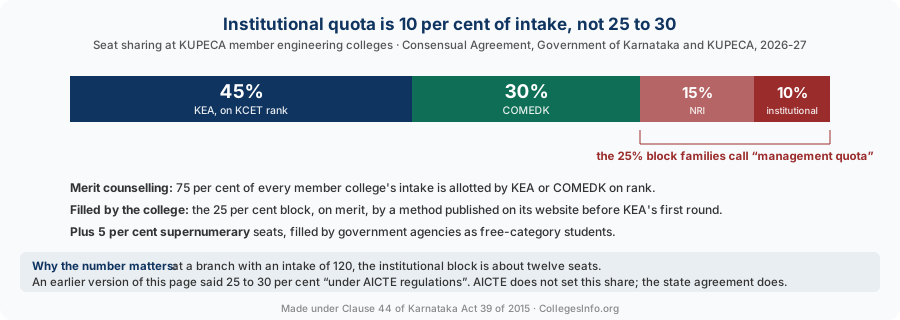
Institutional quota is 10 per cent of intake, not 25 to 30 per cent. The 2026-27 agreement between the Government of Karnataka and the private engineering colleges' association splits intake 45 per cent to KEA counselling, 30 per cent to COMEDK, and the remaining 25 per cent into NRI and NRI-sponsored seats at 15 per cent plus institutional or local preference at 10 per cent.
No rupee figure for a management quota seat appears on this page. The agreement fixes tuition for the KEA and COMEDK routes and gazettes it. For the management and NRI block it says only that each private institution shall notify its own upper limit. There is no state figure to quote.
What is capped for every seat is the rest of the bill. Other fees must not exceed Rs 20,000 per student per year, and the agreement states that no other fee shall be collected by the colleges. A skill lab fee of Rs 10,000, Rs 15,000 or at most Rs 20,000 a year applies only where VTU has notified it for that college.
Complaints go to the Fee Regulatory Committee and Admission Overseeing Committee, which the agreement makes responsible for receiving complaints and resolving disputes. An earlier version of this page told readers to report capitation demands to KEA, which runs counselling and is not the complaints body.
Everything below is read from the Consensual Agreement between the Government of Karnataka and the Karnataka Unaided Private Engineering Colleges Association for the academic year 2026-27, the document that actually governs seat sharing and fees at private engineering colleges in the state. It is published on the websites of member colleges. The agreement is made under Clause 44 of Karnataka Act 39 of 2015 in place of implementing the other provisions of Karnataka Act 8 of 2006, and its fee structure is given effect by gazette notification under the Karnataka Educational Institutions (Prohibition of Capitation Fees) Act, 1984. It rests on the Supreme Court's judgments in TMA Pai Foundation [(2002) 8 SCC 481] and P.A. Inamdar [(2005) 6 SCC 537], and on Article 15(5) of the Constitution.
That sounds like paperwork. It is the difference between knowing what a college may charge you and taking its word for it.
How the seats are actually divided
Member colleges hand 45 per cent of sanctioned intake to the Karnataka Examinations Authority for merit counselling on KCET rank. Of the 55 per cent they keep, 30 per cent of total intake goes to COMEDK's centralised merit counselling. The remaining 25 per cent is split: NRI and NRI-sponsored seats at 15 per cent, and institutional or other local preference seats at 10 per cent. A further 5 per cent supernumerary quota is filled by government agencies as free-category students.
| Route | Share of intake | Who allots the seat | Who fixes the fee |
|---|---|---|---|
| Government quota, on KCET rank | 45 per cent | Karnataka Examinations Authority | Fixed in the agreement and gazetted |
| COMEDK | 30 per cent | COMEDK centralised counselling | Upper limit fixed in the agreement |
| NRI and NRI-sponsored | 15 per cent | The college | The college notifies its own upper limit |
| Institutional or other local preference | 10 per cent | The college, on merit | The college notifies its own upper limit |
| Supernumerary, free category | 5 per cent additional | Government agencies | Free category |
So the seat most families call management quota is the 10 per cent institutional block, or the 15 per cent NRI block if the candidate qualifies as NRI or NRI-sponsored. An earlier version of this page said private unaided colleges may fill "approximately 25 to 30 per cent" of intake through management quota "under AICTE regulations". Both halves are wrong. The share is set by a state-level consensual agreement, not by AICTE, and the institutional share within it is 10 per cent. At a college with an intake of 120 in a branch, that is twelve seats, not thirty.
This matters practically. If you are told a college has plenty of management seats in Computer Science, the agreement says the institutional block in that branch is about a tenth of its sanctioned intake, and the method of filling it has to be published in advance. A promise of unlimited availability is a promise about something the college does not have.
One fee is uncapped. The rest of the bill is not
The agreement fixes tuition for the KEA and COMEDK routes, with a 7.5 per cent increase for 2026-27 over the previous year. As reported from the government order, the KCET-route tuition was set at Rs 87,935 a year at Type-1 private engineering colleges and Rs 97,825 at Type-2 colleges, and the COMEDK upper limit at Rs 2,15,000 and Rs 3,02,182 respectively, each college having opted for one band before counselling.
For the third route the agreement says something different. For NRI, NRI-sponsored and other management quota seats, "an upper limit of fees payable, including development fees and skill development fees for the entire course... shall be notified by each of the private institutions, and tuition fees shall be collected accordingly." There is no state-set number. That is why this page carries no management quota fee table: a range presented as fact would be describing something the state does not publish and which differs by college, by branch and by year.
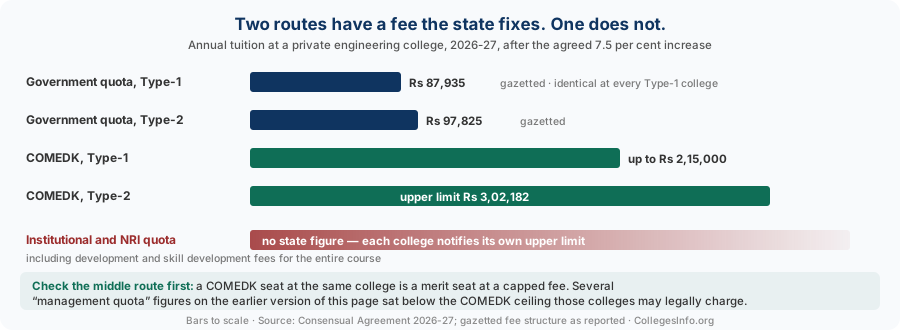
Notice what the comparison does to the earlier version of this page. It listed management quota fees of Rs 1.8 to 3 lakh a year at several colleges, below the Rs 3,02,182 the same colleges may charge a COMEDK candidate under a legally capped rate. A management quota seat priced under the COMEDK ceiling is possible, but a page that quotes one without mentioning COMEDK has hidden the middle route entirely. If your budget stretches to Rs 3 lakh a year, the COMEDK route gets you a merit seat at a capped fee, and it should be exhausted before you look at an uncapped one.
| Route | Annual tuition | Status of the figure |
|---|---|---|
| Government quota, Type-1 college | Rs 87,935 | Gazetted, same at every Type-1 college |
| Government quota, Type-2 college | Rs 97,825 | Gazetted, same at every Type-2 college |
| COMEDK, Type-1 college | Up to Rs 2,15,000 | Upper limit; a college may charge less |
| COMEDK, Type-2 college | Up to Rs 3,02,182 | Upper limit; a college may charge less |
| NRI and NRI-sponsored, 15 per cent | No state figure | Each institution notifies its own upper limit |
| Institutional quota, 10 per cent | No state figure | Each institution notifies its own upper limit |
The caps that apply to your seat whatever route you took
Three limits in the agreement apply regardless of quota, and they are the ones most often exceeded, because families do not know they exist.
Other fees must not exceed Rs 20,000 per student per year. For government quota seats KEA collects them at counselling itself, from a breakup each college submits to KEA at least a week before the first round of option entry, and the agreement states plainly that no other fee shall be collected by the colleges. From the second year onwards the college collects them, still within Rs 20,000 a year. The details of what those other fees are must be published on the college's own website, with intimation to Visvesvaraya Technological University, KEA and the Commissioner of the Department of Collegiate and Technical Education.
A skill lab fee applies only where VTU has notified it. Where a college has skill labs and offers additional credits, it may collect a fee set by the categorisation recommended by the Prof. Karisiddappa Committee: Rs 10,000, Rs 15,000, or at most Rs 20,000 per student per year, as notified by VTU. These details too must be published on the college website.
Every college must report candidate-wise fees to the government. Colleges submit a detailed report with candidate-wise fee particulars to the Commissioner, Department of Collegiate and Technical Education, within two weeks after the last date AICTE notifies for admissions, in a format the Commissioner shares with them in advance.
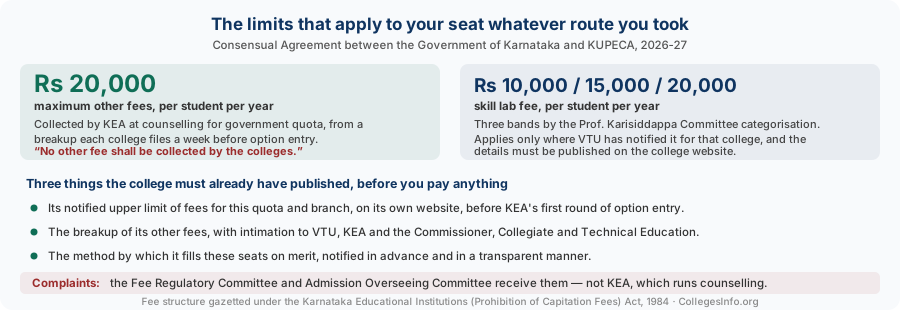
Put together, these give you three questions that a college has already had to answer in writing before you walked in. What is your notified upper limit for this quota and branch, and where on your website is it published? What is the breakup of your other fees, and does it come to Rs 20,000 or less? Has VTU notified a skill lab fee for this college, and at which of the three bands? A college that cannot point to the published page for each is not following the agreement it signed, whatever the seat is being sold for.
These are merit seats with a published method
The agreement requires the 25 per cent block to be filled "based on merit and by notifying the method of filling up of the seats and the fees determined as per rules in the website of the respective institution well before the commencement of the first round of option entry by KEA, in a transparent manner".
Two things follow. The college must publish both the method and the fee before KEA's first round, not after you have paid a deposit. And the seat is a merit seat: the earlier version of this page told readers that any college interview is "usually to verify your documents and confirm branch preference, not a competitive screening", which describes something the agreement does not permit. Ask to see the published method and where you stand in it.
If no candidate is available in the NRI or institutional category, the agreement lets the seat be filled by any other academically eligible candidate on the same fee liability as that category, or lets the institution surrender it.
An unsold management seat can become a government-fee seat
This is the most useful clause in the agreement and it appeared nowhere on the earlier version of this page. A college may surrender its management or NRI seats to KEA or COMEDK up to 15 days before the first round of counselling, and the agreement is explicit about what happens to the price: the fee for such management-surrendered seats to KEA shall be the government fee, and for COMEDK the COMEDK fee that institution opted for. The same applies to COMEDK seats a college chooses to surrender to KEA.
Movement runs the other way too. All unfilled government quota seats revert to the college ten days before the last date AICTE prescribes for merit-based counselling, and any seat still unfilled after the final round and the joining time goes back to the college to fill from other eligible general merit candidates, so that seats are not wasted.
The practical reading: a seat's price depends on which route it is sitting in at the moment it is allotted, not on the college's prestige. The same physical seat in the same branch can cost Rs 87,935 through KEA or several times that through the institutional block. Before paying an uncapped fee in June, it is worth asking whether the college intends to surrender unfilled seats, and following KEA's later rounds through our option entry guide.
Where to complain, and to whom
The agreement makes the Fee Regulatory Committee and the Admission Overseeing Committee responsible for ensuring the fee structure and the agreement's regulations are implemented, and states that the committee "shall receive the complaints and resolve the disputes or differences, if any, among all the stake holders, affording opportunity of being heard to the other party". KUPECA institutions are required to assist statutory committees.
That is the forum. The earlier version of this page told readers to "walk away and report to KEA". KEA conducts the entrance test and the government-quota counselling; it is not the body the agreement gives the complaint to. For a demand for money beyond the notified fee, the governing law is the Karnataka Educational Institutions (Prohibition of Capitation Fees) Act, 1984, the same Act under which the agreed fee structure is gazetted.
Keep the paper trail that makes a complaint possible: the college's published fee notification as it stood when you applied, every receipt, and the fee schedule for all four years. A demand made only in conversation is the hardest kind to act on, which is why the publication duties above matter more than any warning sign.
What the earlier version of this page got wrong
| Claim on the earlier page | What the record shows |
|---|---|
| Management quota is 25 to 30 per cent of intake "under AICTE regulations" | A state consensual agreement sets it. Institutional quota is 10 per cent, NRI 15 per cent. |
| Report capitation demands to KEA | The Fee Regulatory Committee and Admission Overseeing Committee receive complaints. |
| Fee tables for ten colleges and eight branches | Management quota fees are notified by each institution; no state figure exists to compare. |
| Government quota four-year total of Rs 2.0 to 4.8 lakh | At Rs 87,935 to Rs 97,825 a year plus other fees within Rs 20,000, four years runs higher than the lower end quoted. |
| Average placement packages per college | None was sourced to a college placement report; all removed. |
| A college interview is not competitive screening | The agreement requires these seats be filled on merit by a published method. |
| An unaccredited degree faces recognition problems | Degree validity follows AICTE approval and university affiliation. NAAC grades an institution; NBA accredits programmes. |
| Agents charge commissions of Rs 50,000 to Rs 3 lakh | Not sourced; removed. The agreement's publication duties are the usable protection. |
| Shortlist colleges in April to May 2026 | That cycle has closed. KEA was to finish its first round by 10 July 2026. |
| RV College of Engineering is NAAC A++ | Could not be confirmed on an official record. BMS College of Engineering publishes A++ with CGPA 3.56, Cycle III, valid 30 June 2024 to 29 October 2031. |
One college was in the wrong list altogether. PES University is a state private university, established in 2013 under the PES University Act, 2012 of the Karnataka legislature, upgrading the PES Institute of Technology founded in 1972. It awards its own degree and is not a VTU-affiliated college inside the KUPECA seat-sharing structure described here, so the earlier version's assurance that "your VTU degree is identical" did not apply to it. Its engineering admissions run on JEE Main or KCET scores rather than the quota split above; confirm the current rules on the university's own site.
The comparison worth making
The useful four-year comparison is between three routes at the same college, not between management quota and nothing.
| Route | Year one tuition | Four years at current rates | What you need |
|---|---|---|---|
| Government quota through KEA | Rs 97,825 | About Rs 3.9 lakh | A KCET rank that reaches the branch |
| COMEDK | Up to Rs 3,02,182 | Up to about Rs 12.1 lakh | A COMEDK rank that reaches the branch |
| Institutional or NRI quota | As notified by the college | As notified by the college | Eligibility, plus the college's published merit method |
Tuition is revised each year, so four years at current rates is an indication rather than a quotation. The agreement itself raised government and COMEDK tuition by 7.5 per cent for 2026-27, and the fee you pay in year one is the fee collected for that year only. Ask for the signed four-year schedule before you pay anything.
Before concluding that the uncapped route is the only one open, check what your rank actually reaches. Our KCET rank predictor works off the official cut-off sheets, the Bangalore engineering college comparison gives the real Round 1 closing ranks college by college, and the government engineering colleges guide covers the state-funded options where the fee question looks different again.
How to approach 2027-28
The 2026-27 cycle is closed. For 2027-28 the sequence is: KCET and COMEDK registration early in the year, the examinations, then KEA's counselling rounds, with COMEDK beginning only after KEA completes its first round. A fresh consensual agreement is negotiated each year, so the percentages above hold only until the next one is signed, and the fee figures certainly change.
If an institutional or NRI seat is your route, the useful work happens before counselling starts. Find each shortlisted college's notified fee and method for that quota on its own website, which has to be up before KEA's first round of option entry. Get the four-year fee schedule and the other-fees breakup in writing. Keep your KCET or COMEDK scorecard even if a college says it is not needed, because the seat has to be awarded on merit and your rank is the merit you can document. Then compare the notified figure against the gazetted government fee and the COMEDK ceiling for that same college, which is the comparison this page exists to let you make.
Our college choice checklist covers what a fee table cannot tell you, and the college directory carries profiles for the colleges named here.
Frequently Asked Questions
What percentage of seats is management quota in Karnataka engineering colleges?
Institutional or local preference quota is 10 per cent of sanctioned intake and NRI or NRI-sponsored seats are 15 per cent, together the 25 per cent block in the 2026-27 agreement. The other 75 per cent is 45 per cent through KEA on KCET rank and 30 per cent through COMEDK.
Is management quota admission legal in Karnataka?
Yes. The seats exist under the consensual agreement between the Government of Karnataka and the private engineering colleges' association, made under Clause 44 of Karnataka Act 39 of 2015. What is prohibited is collecting money beyond the notified fee, under the Karnataka Educational Institutions (Prohibition of Capitation Fees) Act, 1984.
What is the management quota fee for engineering in Bangalore?
No figure is quoted here. The agreement fixes tuition only for the KEA and COMEDK routes and says that for management and NRI seats each private institution notifies its own upper limit. Read it from the college's own website, where it must be published before KEA's first round of option entry.
What is the government quota engineering fee in Karnataka for 2026-27?
As reported from the gazetted structure, Rs 87,935 a year at Type-1 private engineering colleges and Rs 97,825 at Type-2, after a 7.5 per cent increase for 2026-27. Other fees are capped separately at Rs 20,000 per student per year.
Can a college charge me extra fees on top of tuition?
Only within limits. Other fees must not exceed Rs 20,000 per student per year and the agreement states that no other fee shall be collected by the colleges. A skill lab fee of Rs 10,000, Rs 15,000 or at most Rs 20,000 a year applies only where VTU has notified it for that college, and the breakup must be published on the college website.
Where do I complain about a capitation fee demand?
To the Fee Regulatory Committee and the Admission Overseeing Committee, which the agreement makes responsible for receiving complaints and resolving disputes. KEA conducts the entrance test and government-quota counselling and is not the complaints body.
Do I need a KCET or COMEDK score for a management quota seat?
The agreement requires these seats to be filled on merit by a method the college publishes in advance, so a rank is the merit you can document even where a college says a score is not required. Keep your scorecard and ask to see the published method.
Is a management quota degree different from a KCET degree?
At a VTU-affiliated or autonomous VTU college the degree is the same whichever route you entered by. The exception is a college that is itself a university, such as PES University, which awards its own degree and sits outside the VTU seat-sharing structure.
Can a management quota seat become cheaper?
Yes, if the college surrenders it. Management and NRI seats surrendered to KEA up to 15 days before the first round of counselling carry the government fee, and those surrendered to COMEDK carry that institution's COMEDK fee.
Does a college need NAAC accreditation for its degree to be valid?
No. Degree validity follows AICTE approval and affiliation to the university awarding it. NAAC grades an institution and NBA accredits individual programmes, and both are worth checking on quality grounds, but a missing NAAC grade does not invalidate a degree.
For the branch-by-branch closing ranks that decide whether you need any of this, see the Bangalore engineering colleges comparison.