Last Updated: August 26, 2026
If you're from Bidar, Kalaburagi, Yadgir, Raichur, Koppal, Ballari or Vijayanagara, Article 371(J) of the Constitution gives you two separate admission advantages in Karnataka: 70% of the seats in colleges located inside the Hyderabad-Karnataka region are reserved for local students, and roughly 8% of seats in colleges across the rest of Karnataka are set aside for you as well. To claim either, you need one document – the 371(J) eligibility certificate issued by the Assistant Commissioner of your revenue sub-division – produced at KEA's document verification. That's the whole system in one paragraph. The rest of this guide explains how each piece actually works, because families lose real seats every year over small paperwork mistakes that aren't explained anywhere in plain language.
What Article 371(J) actually is
Article 371(J) is a special constitutional provision for one specific part of Karnataka. It was inserted by the Constitution (Ninety-eighth Amendment) Act, 2012 and came into force on 1 January 2013. The article allows the President to direct special arrangements for the Hyderabad-Karnataka region – a development board, reservation in education, and reservation in state government jobs.
Why this region and not others? The districts that make up Hyderabad-Karnataka were part of the old Hyderabad State under the Nizam, and they joined Karnataka after the States Reorganisation Act. For decades afterwards they trailed the rest of the state on literacy, health and infrastructure. Article 371(J) was the constitutional answer to that gap: give students and job-seekers from the region a protected share of opportunities until development catches up.
In 2019 the state government renamed the region Kalyana Karnataka. You'll see both names used interchangeably – KEA's counselling documents and seat matrix still mostly say "Hyderabad-Karnataka" or just "HK," while government development schemes now say Kalyana Karnataka. They mean the same districts and the same quota. Don't let the two names confuse you during counselling.
Which districts count as Hyderabad-Karnataka
The region originally covered six districts. In 2021, Vijayanagara was carved out of Ballari as a new district, so today the same territory is administered as seven districts. If your taluk was part of the original six, the bifurcation didn't change your eligibility – Vijayanagara inherits the 371(J) status of the Ballari territory it came from.
| District | Notes |
|---|---|
| Bidar | Northern-most district of the region |
| Kalaburagi (Gulbarga) | Largest city in the region; the 371(J) implementation cell has been shifted here |
| Yadgir | Carved out of Kalaburagi in 2010; fully covered |
| Raichur | Home to RIMS Raichur and a government engineering college |
| Koppal | Fully covered |
| Ballari | One of the original six districts |
| Vijayanagara | Created from Ballari in 2021; carries the same 371(J) status |
One point that trips people up: the quota follows the region, not your caste or income. A General Merit student from Yadgir gets it. A student whose family moved to Bengaluru but who completed schooling in Koppal may still get it, depending on the residence and study rules explained below. And a student born in Kalaburagi who did all their schooling in Mumbai may not get it. Where you and your family actually lived and studied matters more than where you were born.
How the reservation works: two separate pools
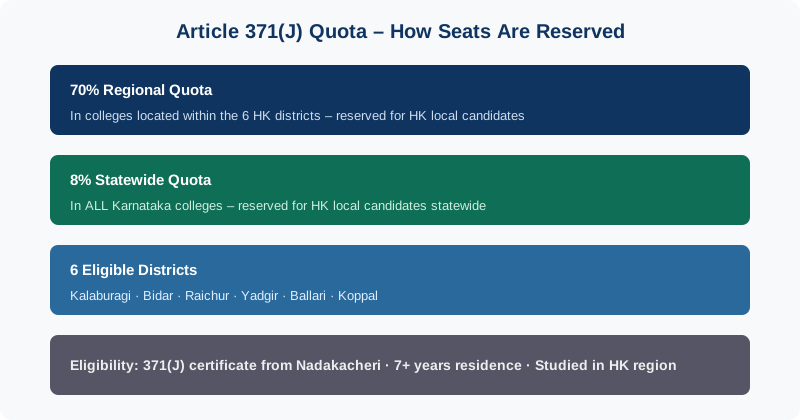
This is the part most articles get wrong, and it's why you'll see three different percentages floating around online – 70%, 75%, 8%. There are exactly two pools, and they don't overlap:
| Pool | Where it applies | Share of seats | Who competes |
|---|---|---|---|
| Regional quota | Colleges located inside the HK region (Kalaburagi, Ballari, Raichur, Bidar, Koppal, Yadgir, Vijayanagara) | 70% of seats in every course | Only HK-certificate holders |
| Statewide quota | Colleges in the rest of Karnataka (Bengaluru, Mysuru, Mangaluru and everywhere else) | About 8% of seats in every course (KEA's medical counselling documents have put the medical share at around 7%) | Only HK-certificate holders |
Read that carefully and you'll see why the quota is so valuable. Inside the region, you're competing for 70% of every course against only other HK students. Outside the region – including the most sought-after Bengaluru colleges – a protected slice of roughly 8% of seats is ring-fenced for HK students, and the general pool can't touch it.
The remaining 30% of seats inside HK-region colleges stay open to everyone, including non-HK students. So a Bengaluru student can still get into a Kalaburagi college through the open share – the region isn't closed off, it's weighted.
The HK quota also stacks with your caste category. KEA treats HK as its own eligibility layer that combines with GM, SC, ST, Category-1, 2A, 2B, 3A and 3B. In the seat matrix and the allotment results you'll see combined codes – an HK General Merit seat and an HK SC seat are separate buckets. You don't choose between your caste category and the HK quota; you claim both, and KEA allots you whichever seat your rank reaches first.
Who qualifies as a "local person"
The presidential order and the 2013 state rules define who counts as local to the region, and the definition is broader than most families assume. In practice, the routes that matter for students are these:
Study route: you completed a substantial part of your schooling – commonly understood as around ten academic years – in institutions located within the region. Your school study certificates are the proof.
Residence route: you or your parents have been ordinarily resident in the region. Residence certificates from the revenue authorities are the proof, and the Karnataka High Court clarified in a 2019 ruling that the benefit extends to persons domiciled in the region – it's not limited to those born there.
Marriage route: a woman from outside the region who marries a local person becomes eligible through her husband's local status.
The 2013 rules recognise several certificate types as proof of local status – eligibility certificate, residence certificate, study certificate, validity certificate and others. For admission purposes, what KEA wants to see at document verification is the consolidated 371(J) eligibility certificate, so treat that as the target document and the study or residence certificates as the supporting evidence you'll submit to get it.
Two honest caveats. First, the exact residency and study thresholds are defined in the government rules, and revenue offices apply them with some local variation – if your family's history is complicated (transfers, split schooling, one parent from the region), speak to the Assistant Commissioner's office or the Nadakacheri operator before assuming you do or don't qualify. Second, don't rely on a relative's experience from years ago; interpretations have shifted, particularly after the 2019 High Court ruling widened the domicile reading.
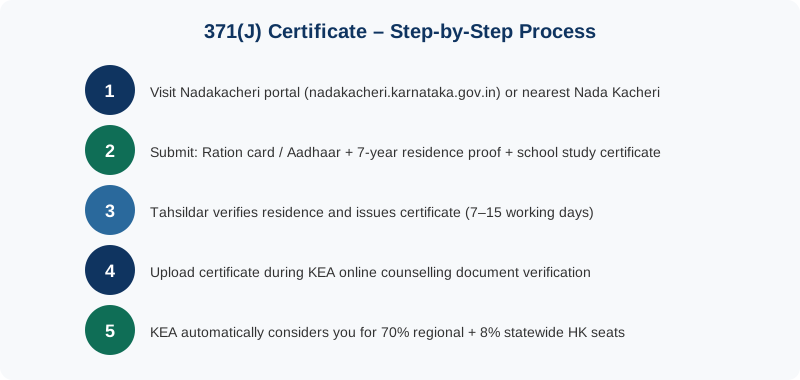
The eligibility certificate: where and how to get it
The certificate is issued by the Assistant Commissioner of your revenue sub-division – not the tahsildar, not the school, not KEA. There are two ways to apply:
Online through Nadakacheri (nadakacheri.karnataka.gov.in), the Atalji Janasnehi Kendra portal that handles Karnataka's caste, income and residence certificates. You apply, upload documents, and collect the signed certificate.
Offline at the Assistant Commissioner's office of your sub-division, which some families still prefer when the case needs explaining in person.
Documents you'll typically need: your SSLC and PUC marksheets, study certificates from each school you attended in the region, your parents' residence proof, Aadhaar, and passport photos. The exact list varies slightly by sub-division, so check what your AC office asks for rather than assuming.
The single most important piece of advice in this entire guide: apply months before counselling, not during it. The certificate involves field verification by revenue staff and it doesn't arrive in a day or two. Every counselling season, students with valid claims lose the quota because they started the certificate process after the KCET results came out and it didn't arrive before document verification. If your child is in 2nd PUC and you intend to claim 371(J), start the application in the winter – December or January – so the certificate is sitting in your file long before KEA opens.
Also check the name. The name on the certificate must match your marksheets and your KCET application exactly. A mismatched initial or a differently-spelt surname is one of the most common reasons a claim gets held up at the verification counter.
Claiming the quota in KCET counselling
Having the certificate isn't enough by itself – you have to actually claim the quota inside KEA's process. Here's the sequence:
Step 1 – Declare it in the KCET application. The application form asks whether you're claiming Hyderabad-Karnataka reservation. Tick it. If you didn't tick it and you've since obtained the certificate, raise it with KEA during the document verification stage rather than assuming it's too late – but the clean path is declaring it upfront.
Step 2 – Produce the certificate at document verification. Whether your verification happens at a Helpline Centre or through KEA's digital verification flow, the 371(J) eligibility certificate goes in with your other documents. No certificate at verification means no quota, full stop – KEA won't take it later on trust.
Step 3 – Understand what changes in option entry. Your option entry doesn't need special HK versions of colleges. You enter your college-course preferences normally; KEA's allotment engine automatically considers you for HK seats and general seats wherever both exist. Your allotment result will show the category of the seat you got – if it's an HK seat, the code says so.
Step 4 – Verify before you accept. When the allotment comes, check which pool your seat came from. It affects nothing about fees or the course itself, but it matters if you're weighing whether to slide to a later round – an HK seat you surrender goes back into the HK pool, and your odds in the next round depend on how deep that pool runs for your branch. Our KCET predictor can help you judge realistic options before you lock anything in.
If you're working through a Round 1 decision right now – accept, slide or surrender – the same logic from our general counselling guides applies, with one HK-specific addition: HK-quota closing ranks in later rounds are less predictable than general-quota ranks because the pool is smaller, so a bird in hand is worth slightly more under this quota than outside it.
371(J) and medical admissions
The quota applies to KEA's medical counselling too, and this is where it produces its most dramatic results. Government medical colleges located inside the region – GIMS Kalaburagi, RIMS Raichur and BRIMS Bidar among them – reserve 70% of their state-quota MBBS seats for HK-certificate holders. Outside the region, KEA's UG NEET documents have applied a statewide HK share of about 7% of seats in Karnataka's medical colleges.
What it means in practice: an HK student's NEET score goes considerably further inside the quota than the same score would in the open Karnataka pool, especially for the in-region government colleges. The exact rank advantage moves around every year with seat matrix changes and applicant numbers, so treat any fixed "HK cutoff" figure you see online with suspicion – check the current year's KEA cutoff files instead. Our Karnataka medical college NEET cutoff guide covers how to read those files, and if you're weighing paid routes as a fallback, read our management quota MBBS guide first – because one thing 371(J) does not touch is management quota.
That's worth repeating clearly: the quota exists only inside KEA's counselling. Management quota seats, NRI seats, COMEDK counselling and deemed university admissions don't carry any HK reservation. If a consultant tells you your 371(J) certificate gets you a discount or a reserved seat in a management-quota admission, that's a sales line, not the rules.
How much does the quota actually help?
Honest answer: a lot inside the region, meaningfully but less dramatically outside it.
Inside the region, 70% of every course reserved for a small local applicant pool means closing ranks at HK-region colleges run far later than equivalent colleges elsewhere. For students who want to study close to home, this is the single biggest admission advantage available in Karnataka.
Outside the region, the 8% statewide slice is protected but small, and demand for the top Bengaluru colleges is intense even within the HK pool. HK closing ranks at the most sought-after colleges typically sit several thousand ranks later than the General Merit closing ranks for the same branch – a real cushion, but not a free pass. The gap varies by college, branch and year, so use the actual KEA cutoff files from cetonline.karnataka.gov.in rather than any fixed number, including anything you read here. For branch-level planning, our guides on colleges for top KCET ranks and the best branches in the next rank band show how the general cutoffs stack up – as an HK candidate you can expect your effective reach to extend past those figures.
One more honest note: the quota can't manufacture seats that don't exist. In branches with tiny intakes, 8% of a small number rounds down to very few seats statewide, and competition inside the HK pool for those few seats is sharp. The quota rewards good ranks; it doesn't replace them.
Which colleges fall under the quota
Families often ask for "the list of 371(J) colleges," and the honest answer is that there are two lists, and one of them is nearly every college in Karnataka.
The 70% regional pool covers every institution physically located in the seven districts that takes admissions through KEA. That includes the government engineering colleges at Raichur and elsewhere in the region, the government medical colleges – GIMS Kalaburagi, RIMS Raichur, BRIMS Bidar – the region's private engineering, pharmacy, nursing and other professional colleges that surrender seats to KEA counselling, and the universities headquartered in the region. If the college sits inside the seven districts and its seats appear in KEA's seat matrix, the 70% rule applies to those seats.
The statewide pool covers essentially every other KEA-counselled college in Karnataka – the Bengaluru colleges, the Mysuru colleges, the coastal colleges, all of them. You don't need a special list for this; wherever the seat matrix shows an HK column for a course, HK-certificate holders can compete for it. The practical way to check any specific college is to open KEA's current seat matrix on cetonline.karnataka.gov.in and look at the category columns for the branch you want – the HK buckets are shown right there, college by college, course by course. That document is the ground truth; no third-party list, ours included, should outrank it in your planning.
What the quota never covers, worth repeating: seats that don't flow through KEA. A private college's management-quota share, COMEDK seats, NRI seats and deemed university seats sit entirely outside the system. The same college can therefore be "a 371(J) college" for its KEA seats and completely quota-free for its management seats – which is exactly why a seat matrix column, not a college name, is the thing to check.
Beyond admissions: the jobs side of 371(J)
This guide is about college admissions, but students planning a government career should know the provision doesn't stop at the college gate. Article 371(J) also directs reservation in state government recruitment – a share of posts in offices located within the region is reserved for local candidates, and a further share of posts across the state is reserved for candidates from the region, on a structure that mirrors the education quota. The same eligibility certificate machinery applies, though job recruitment uses its own certificate formats under the 2013 rules.
Why mention it in an admissions guide? Because it changes the value calculation for students choosing between a marginally better-ranked college outside the region and a solid college inside it. A student who studies in the region, keeps their local documentation current and later sits for KPSC or other state recruitment carries the regional advantage into that process too. For families whose long-term plan is a government posting close to home, the quota compounds – it isn't a one-time admission benefit.
The development side of the article matters to students too, even if indirectly. The Kalyana Karnataka Region Development Board, set up under the same provision, funds infrastructure in the region's institutions – new buildings, hostels, equipment. The region's colleges in 2026 aren't the under-resourced institutions their reputation from a decade ago suggests, and dismissing them without looking is a mistake we see families make from Bengaluru far more often than the reverse.
Common mistakes that cost students the quota
Starting the certificate too late. Covered above, and it's still the number one failure. Revenue verification takes time you don't have in June.
Assuming birth in the region is enough. It isn't, by itself. Local status runs on residence and study, and the certificate process checks those records.
Name mismatches. Certificate says one spelling, marksheet says another, application says a third. Fix discrepancies before verification, not at the counter.
Not declaring the claim in the application. The certificate in your drawer does nothing if KEA's system doesn't know you're claiming HK status.
Expecting it to work outside KEA. COMEDK, management quota, NRI and deemed admissions carry no HK reservation. Plan those routes at general-pool difficulty.
Confusing the two pools. The 70% figure applies inside the region, the roughly 8% figure applies outside it. Websites that quote a single percentage – including the occasional "75%" you'll see around – are simplifying to the point of being wrong.
Frequently asked questions
What is the Article 371(J) quota in simple terms?
It's a constitutional reservation for students from the Hyderabad-Karnataka (Kalyana Karnataka) region. It reserves 70% of seats in colleges inside the region and about 8% of seats in colleges across the rest of Karnataka for students who hold the region's eligibility certificate.
Which districts come under the Hyderabad-Karnataka region?
Bidar, Kalaburagi, Yadgir, Raichur, Koppal, Ballari and Vijayanagara. Vijayanagara was created from Ballari in 2021 and carries the same status. The region was renamed Kalyana Karnataka in 2019, but KEA documents still commonly say Hyderabad-Karnataka.
How do I get the 371(J) eligibility certificate?
Apply to the Assistant Commissioner of your revenue sub-division, either online through the Nadakacheri portal or in person at the AC office, with your marksheets, school study certificates, residence proof and Aadhaar. Apply months before counselling – field verification takes time.
Is the quota 70% or 8%?
Both, in different places. 70% of seats in colleges located inside the HK region are reserved for local students. Roughly 8% of seats in colleges outside the region are reserved for HK students statewide. They're two separate pools.
Does 371(J) apply to NEET medical admission?
Yes, within KEA's state counselling. In-region government medical colleges reserve 70% of state-quota seats for HK students, and KEA's medical counselling documents have applied a statewide HK share of about 7%. It doesn't apply to All India Quota seats handled by MCC, or to management and NRI seats.
Can I claim 371(J) and my caste category together?
Yes. HK status combines with GM, SC, ST and OBC categories. KEA maintains separate seat buckets for each combination, and you're considered for all the buckets you're eligible for.
Does 371(J) work for COMEDK or management quota seats?
No. The reservation exists only inside KEA's counselling. COMEDK, management quota, NRI quota and deemed university admissions have no HK reservation.
Need help with admission?
CollegesInfo.org helps students secure admission to colleges they are eligible for under that college's actual published criteria. Chat with us on WhatsApp or explore admission assistance.