Last Updated: September 7, 2026
KCET 2027 Result Card – Share Your KCET Rank Instantly
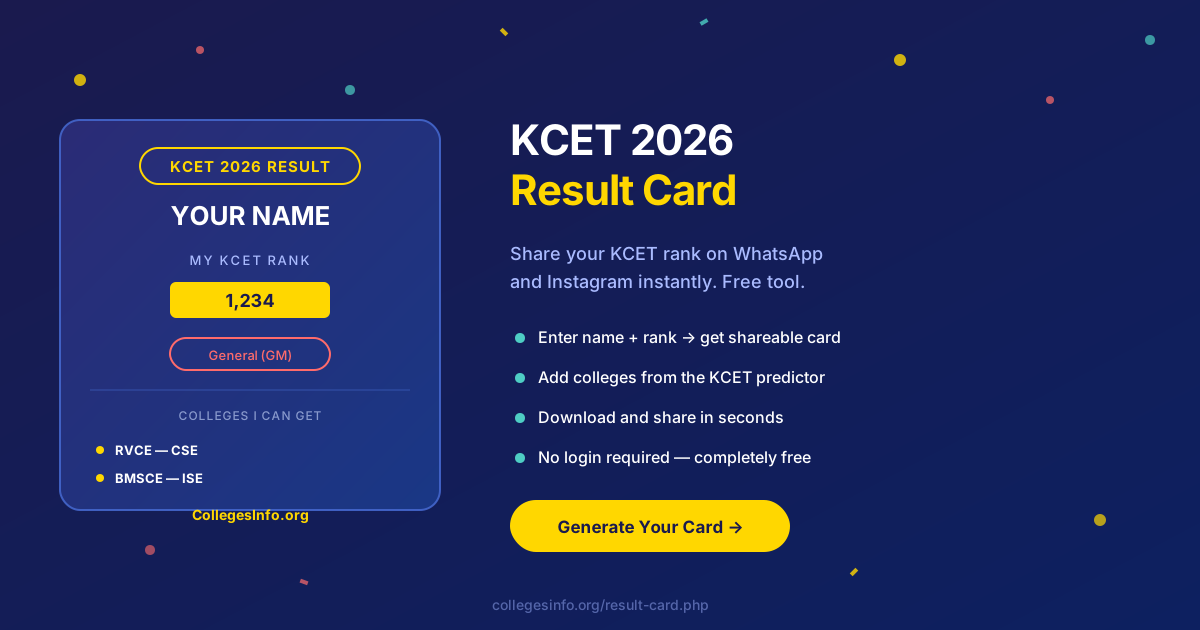
The KCET Result Card tool lets you generate a personalised shareable image with your KCET 2026 rank in seconds. Enter your name, your rank, and your category, and you get a ready-to-share card you can post on WhatsApp, Instagram, or any social platform. The tool is hassle-free, requires no login, and works on mobile and desktop. This page explains how the KCET result card works, what KCET 2026 rank means for college admissions, and how to use your rank to find colleges you can get through KEA counselling. What Is the KCET Result Card? The KCET 2026 Result Card is a digital image generator built specifically for Karnataka CET rank holders. When KCET results are announced by the Karnataka Examinations Authority, lakhs of students want to share their rank with family and friends. The result card tool makes this instant – you type in your name and rank, choose your category, and download or share a branded card that looks clean and celebratory. The card shows your name prominently, your KCET 2026 rank, your category such as General Merit or SC or ST or OBC, and space to add the colleges your rank qualifies you for using the KCET predictor. The CollegesInfo.org branding at the bottom connects the card to the site's free college predictor tools, so anyone who sees your shared card knows where to check their own rank's college eligibility. The result card is designed for the WhatsApp story format and Instagram stories – portrait orientation, dark background with confetti, bold typography that reads clearly even as a thumbnail. How KCET 2026 Results Work KCET 2026 is conducted by the Karnataka Examinations Authority for admission to undergraduate engineering, pharmacy, agriculture, and veterinary courses in Karnataka. The examination covers Physics, Chemistry, and Mathematics for engineering aspirants, and Physics, Chemistry, and Biology for pharmacy, agriculture, and veterinary streams. KEA announces KCET results as a rank list, not just marks. Your rank is calculated based on marks secured in the CET examination combined with your qualifying examination marks in a prescribed weightage. The General Merit rank determines your position in the overall statewide queue for government and private engineering college seats. KCET ranks are category-specific. A student qualifies for both a General Merit rank and, if belonging to a reserved category, a category-specific rank. The category rank matters because reserved category seats at government quota have separate cut-off lists. Understanding which rank applies to which seats is essential before going into KEA counselling. The rank you receive on your KCET result card is your statewide position among all candidates who appeared for the examination in the same stream. For engineering, this is the Physics, Chemistry, and Mathematics combination rank. A rank of 5,000 means approximately 4,999 students scored higher than you in the combined merit calculation. How to Use the KCET Result Card Tool Using the KCET result card on CollegesInfo.org takes under two minutes. Visit the result card page at collegesinfo.org/result-card.php, enter your full name as you want it displayed on the card, type in your KCET 2026 rank, and select your category from the dropdown. The tool generates a shareable card immediately without any login or account creation. The section on the card labelled Colleges I Can Get is designed for you to add college names from the KCET predictor results. Use the CollegesInfo.org KCET predictor to find colleges your rank qualifies for based on last year's closing ranks. Then enter those college names into the result card tool to create a complete card showing both your rank and your likely college options. Once your card is generated, download it as an image file directly to your phone or desktop and share it on WhatsApp, post it to Instagram stories, or send it on any other platform. What Your KCET Rank Means for College Admissions Your KCET rank determines which colleges and branches you can access through KEA's online counselling process. KEA conducts multiple rounds of counselling where seats are allotted based on merit rank, category, and the preferences you submit. Understanding your rank's college eligibility before counselling begins gives you a significant advantage in submitting an optimal preference list. Ranks below 5,000 in General Merit typically qualify for Computer Science Engineering at Bangalore's top autonomous private colleges including RVCE, BMSCE, and Ramaiah Institute of Technology. These colleges have historically had KCET CSE closing ranks in the 1,500 to 5,000 range for General Merit, though this varies each year. Students with ranks in this range should also consider programmes at NITK Surathkal through JEE Main's JoSAA process as a parallel pathway. Ranks between 5,000 and 20,000 qualify for Computer Science and Information Science at well-regarded Bangalore private colleges including PES University, CMRIT, NHCE, BMSIT, and NMIT. This rank range also opens CSE at strong colleges in Mysuru including NIE Mysuru and SJCE Mysuru. The choice between a Bangalore college at a higher cut-off range and a Mysuru or Mangalore college with NAAC A or A+ accreditation is a real decision that many students in this range face. Ranks between 20,000 and 50,000 open a broad range of Bangalore colleges for CSE, ISE, ECE, and other branches, alongside top colleges in Mangalore including PACE, AJ Institute of Engineering and Technology, and SJEC for coastal Karnataka students. North Karnataka colleges in Dharwad, Belagavi, Hubli, and Davangere with NAAC A and A+ grades become accessible at these ranks. Colleges like Gogte IT Belagavi, SDM College Dharwad, Siddaganga IT Tumkur, and BGSIT Mandya serve students in this range. Ranks above 50,000 access the broader range of VTU-affiliated private colleges across Karnataka in cities including Bangalore, Mysuru, Hubli, Mangalore, Davangere, Kalaburagi, and smaller district towns. Government engineering colleges with lower competition due to geographic location also become accessible at these ranks, often with better quality credentials than equivalent-rank private colleges. For reserved category students, category-specific ranks open substantially better college options than General Merit ranks suggest. Why Sharing Your KCET Rank Matters Sharing your KCET 2026 rank is a moment of personal achievement that many Karnataka families celebrate. The months of preparation, the pressure of the examination, and the wait for results make the rank announcement a significant milestone. Sharing it on social platforms is a natural celebration that students across the state participate in each year when KEA announces results. Beyond celebration, sharing your KCET result card serves a practical function. When friends and family see your card, they often know your interests and abilities better than any algorithm. Their responses can provide useful inputs on college choices, especially from older relatives or friends who've worked through Karnataka's engineering college admissions previously and can offer firsthand perspective on specific institutions. The result card's college section, where you list colleges from the predictor, often sparks conversations that help with the final decision. KCET 2026 Important Dates and Timeline Karnataka CET 2026 follows a predictable annual timeline that students and families should track carefully. KEA typically announces the KCET examination date and application window in early January for the academic year beginning in July. The examination is usually conducted in April. Results are typically announced within four to six weeks of the examination, often in May or early June. Counselling rounds begin after results and continue through July as colleges finalise their intake for the academic year starting in August or September. Specific dates for KCET 2026 including the application deadline, examination date, result announcement date, and counselling schedule must be verified from KEA's official website at kea.kar.nic.in. Dates change from year to year and relying on previous year timelines without verifying the current year's official schedule can result in missed deadlines. KCET 2026 Marks and Rank Calculation Understanding how KCET ranks are calculated helps you interpret your rank correctly. The Karnataka CET mark is calculated from your performance in the written examination covering Physics, Chemistry, and Mathematics for engineering. Your qualifying examination performance in II PUC or equivalent is factored into the final merit calculation alongside the CET marks. KEA uses a prescribed weightage between CET marks and qualifying examination marks in the merit calculation. The specific weightage formula for KCET 2026 must be verified from KEA's official announcement, as weightage formulas have been subject to policy changes in recent years. Understanding whether your II PUC performance significantly affects your CET rank requires knowing the exact weightage formula applicable to your year's examination. Marks scored in the Physics, Chemistry, and Mathematics papers of the CET are out of 60 marks each, making a total of 180 marks for the engineering stream. The actual rank depends not just on your absolute marks but on where your marks position you relative to all other candidates who appeared for the same examination. A marks total that gives rank 10,000 in one year might give rank 15,000 in a year when the overall examination was easier and more candidates scored higher. KCET 2026 vs COMEDK – Which Should You Target? Karnataka engineering admissions run on two parallel tracks – KCET for government and COMEDK quota seats at private colleges, and COMEDK UGET for the COMEDK quota independently. Many students appear for both, and the decision of which seats to prioritise during counselling depends on rank outcomes, college preferences, and family financial planning. KCET government quota seats are the most cost-regulated, with fees set by Karnataka's Fee Regulatory Authority at levels substantially below COMEDK quota fees at the same colleges. For the same college and branch, a KCET government quota seat typically costs considerably less annually than a COMEDK quota seat at the same institution. Students who secure a KCET government quota seat at a preferred college should evaluate carefully before choosing COMEDK quota at the same or a different institution. COMEDK UGET gives students who didn't score competitive KCET ranks an alternative pathway to private engineering college seats. COMEDK's rank list is separate from KCET and is used exclusively for the COMEDK quota at participating private colleges. Students from Karnataka and other Indian states can appear for COMEDK. Many students who have a moderate KCET rank but a better COMEDK rank use COMEDK to access a college or branch that their KCET rank wouldn't have opened. The JEE Main pathway to NITK Surathkal and other NITs operates completely independently of both KCET and COMEDK. Karnataka state students who qualify JEE Main and secure a rank that opens NITK through JoSAA counselling are accessing a nationally funded central government Institution of National Importance categorically different from VTU-affiliated private engineering colleges. KCET 2026 Counselling Process Overview After KCET results are announced, KEA initiates the online counselling process. For a detailed walkthrough of what happens after results, see our guide on KCET 2026 counselling and cut-off marks. Understanding the counselling timeline and steps helps you prepare your preference list and documents effectively before counselling opens. Document verification at a designated Helpline Centre is typically the first step for students who want to participate in counselling. Documents required include SSLC marks card and passing certificate, II PUC or equivalent marks card, KCET rank card, category certificate for SC, ST, and OBC candidates, income certificate for economically weaker sections, Karnataka domicile proof, and passport-size photographs. Document verification must be completed before online option entry. Option entry is the process where students fill their college and branch preferences in a ranked list through KEA's online counselling portal. The quality of your option entry directly determines your counselling outcome. Students who enter preferences strategically – listing preferred options in priority order rather than only safe options – consistently achieve better counselling outcomes. Mock allotments are typically conducted before final rounds. Mock allotments show you a provisional seat based on your current preference list, giving you an opportunity to revise your list before final allotment. Taking mock allotments seriously and comparing them against your actual preferences helps catch errors and suboptimal ordering before the final round is locked. How to Research Colleges After Seeing Your KCET Rank The first step after receiving your KCET rank is to run the KCET predictor to understand which colleges your rank historically qualifies for. The second step is to research each college in the predictor results using the detailed information available on CollegesInfo.org's individual college pages. Key factors to assess for each college in your shortlist include the accreditation grade – NAAC A++ and A+ are the highest, followed by NAAC A and NAAC B+. NBA accreditation for specific programmes confirms programme-level quality benchmarks. Affiliation structure matters – autonomous VTU colleges like RVCE, BMSCE, and Ramaiah IT set their own examination papers while standard VTU-affiliated colleges follow VTU's standardised curriculum. University colleges like PES University, RUAS, and KLE Technological University award their own degrees with complete curriculum autonomy. Location relative to family home and target employment city shapes both day-to-day quality of life and post-graduation career geography. A college in Whitefield or Marathahalli in east Bangalore places you in the technology corridor from day one. A college in Mangalore builds career foundations in coastal Karnataka. A college in Mysuru offers south Karnataka's quality of life at lower costs than Bangalore. A college in Hubli or Dharwad gives you north Karnataka's distinct professional ecosystem. Infrastructure quality is best assessed through a campus visit before the final admission decision. Laboratory quality, hostel standards, canteen facilities, and the overall campus environment provide information that accreditation grades and placement statistics alone don't convey. Building Your KCET 2026 Preference List The option entry stage of KCET counselling is where your research translates into actual seat allotment decisions. A well-constructed preference list starts with your most preferred option – the college and branch you would accept if allotted – and proceeds down through options in true preference order. Common preference list mistakes include listing only safe options conservatively and missing out on aspirational choices that might have been allotted, and listing options in reverse order of preference due to misunderstanding the counselling system. Mock allotments during KCET counselling simulate what your current preference list would produce if counselling closed at that moment. Running the KCET predictor, comparing mock allotment outcomes with your preferences, and revising the list based on what you learn consistently produces better final allotments than entering preferences once without revision. Using the CollegesInfo.org KCET Predictor The CollegesInfo.org KCET predictor uses previous year closing ranks to estimate which colleges and branches your 2026 rank might qualify for. Enter your KCET rank, select your category, and choose your stream. The predictor shows colleges where your rank falls within the previous year's closing rank range. These are estimates based on historical data – actual 2026 closing ranks will differ from 2025 based on applicant pool size, seat matrix changes, and year-to-year variation. After running the predictor, visit the college pages on CollegesInfo.org for each college in your results. Each college page includes accreditation grades, affiliation, established year, address, and detailed descriptions covering programmes, admissions, infrastructure, placements, and institutional character. Frequently Asked Questions About KCET 2026 Result Card Can I use the result card before official KCET 2026 results are announced? The result card tool is available year-round. You can enter any rank to generate a card. If you are using it with a predicted or estimated rank before official results, clearly communicate to anyone you share it with that it is an estimate rather than an official result. Is the KCET result card an official KEA document? No. The CollegesInfo.org KCET result card is a social sharing tool, not an official document from the Karnataka Examinations Authority. For official rank and marks data, always refer to kea.kar.nic.in. Does sharing the result card give CollegesInfo.org access to my personal data? The result card tool generates an image based on the information you enter. Your name and rank data are used only to create the shareable image and are not stored in any database. Can I edit the colleges listed on my result card? Yes. The colleges section is editable before you generate the final image. Run the KCET predictor to get college suggestions, then add the colleges you are interested in before downloading and sharing. What category should I select for my KCET result card? Select the category that matches your KCET category as per KEA's records. General Merit applies to students without any reservation category. Other categories include Scheduled Caste, Scheduled Tribe, Other Backward Communities, and economically weaker sections. Your category affects which reserved seats you are eligible for during counselling. KCET 2026 Stream-Wise Rank Implications Engineering stream KCET ranks are used exclusively for engineering college seat allotment through KEA counselling. If you appear for both the engineering stream and the biology stream of KCET, you get separate ranks for each. Your engineering rank applies to engineering college options and your biology rank applies to pharmacy, agriculture, and veterinary college options. Students who appear for engineering stream and want to keep pharmacy or agriculture options open should appear for the biology stream of KCET as well, since separate ranks are maintained for each stream combination. The KCET result card tool can be used to celebrate and share any of these stream-specific ranks. KCET 2026 and Lateral Entry Admissions Diploma holders seeking direct second-year engineering admission through lateral entry follow a separate KEA process. The DCET – Diploma Common Entrance Test – is the examination for lateral entry into the second year of B.E. or B.Tech programmes at VTU-affiliated and autonomous colleges in Karnataka. DCET is separate from KCET and has its own rank list and counselling process. Students who completed a three-year engineering diploma from a Karnataka polytechnic or equivalent institution and want to pursue a B.E. degree should apply for DCET rather than KCET. Lateral entry students join the second year directly, completing three years of the four-year B.E. programme. DCET rank and counselling information is available at kea.kar.nic.in alongside KCET information. Share Your KCET 2026 Success Story The KCET 2026 result card is the starting point of your engineering college journey in Karnataka. Your rank is a number that represents months of preparation, the discipline of consistent study, and the performance on examination day. Sharing it is both a celebration and an invitation for the people in your life to engage with your next step. After sharing your rank card, the practical work begins – running the predictor, researching colleges, visiting campuses, and submitting a well-considered preference list through KEA counselling. CollegesInfo.org supports this entire process with free tools and detailed college information covering over 1,500 Karnataka colleges across all streams. Use the KCET predictor, browse individual college pages, and make an informed decision about the four years that will shape your professional foundation. For current and official information on KCET 2026, always refer to the Karnataka Examinations Authority at kea.kar.nic.in. For college research, predictor tools, and detailed institution information across Karnataka, visit CollegesInfo.org.Need help with admission?
Comparing engineering colleges across Karnataka? Our statewide guide to the best engineering colleges in Karnataka for KCET 2027 covers tier-wise cutoffs, COMEDK options, management quota fees, and branch-wise placement data across all major cities.
CollegesInfo.org helps students secure admission to colleges they are eligible for under that college's actual published criteria. Chat with us on WhatsApp or explore admission assistance.
About the author
OneCity Technologies Pvt. Ltd began in 2006 publishing an annual print education directory for Karnataka students and parents. As demand grew, OneCity launched an education portal in 2019 to bring that same directory information online, and in 2025 relaunched as CollegesInfo.org, a comprehensive Karnataka college directory covering 1,500+ institutions across engineering, medical, management, arts, commerce, and more. Founder L K Monu Borkala brings 20+ years of business experience and 19 years of work across various education-sector services. CollegesInfo.org's content is built from publicly available KEA, NMC, AICTE, and university data, cross-checked against official sources wherever possible. CollegesInfo.org's admission assistance service helps students secure admission to colleges they are eligible for under that college's actual published criteria. We help you get the best admission to your preferred colleges without hassle.