Working out where your rank lands? See every engineering college in Bangalore by rank band, or the COMEDK rank-wise college predictor if you are sitting that exam too.
BMSCE Bangalore: cutoffs, fees and placements for 2027-28
At a glance
- KCET cutoff (CSE, General Merit): closing rank 1,920 in Round 1 and 5,200 by Round 3 of KCET 2026, per the Karnataka Examinations Authority. Expect a similar band for 2027-28.
- Accreditation: NAAC A++, CGPA 3.56 on 4.00, valid to 29 October 2031 (BMSCE AQAR 2024-25). Autonomous since 2008, affiliated to VTU.
- Management quota fees 2026-27: Rs 4 lakh to Rs 15 lakh per year depending on branch, published by BMSCE. CSE is the highest at Rs 15 lakh.
- Placements: median salary Rs 10,00,000 and 972 of 1,291 graduates placed in 2024-25, per BMSCE's NIRF 2026 submission.
BMS College of Engineering was founded in 1946 by Late Sri B.M. Sreenivasaiah and is the oldest private engineering college in India. It sits on a 15-acre campus on Bull Temple Road in Basavanagudi, about 4 km from Bangalore City Railway Station and 2 km from Lalbagh metro station. That central position is a practical advantage for internships during term time, which colleges on the outer ring road cannot match.
This guide uses two primary sources and names them at every figure: the Karnataka Examinations Authority round-wise cut-off documents for ranks, and BMSCE's own published pages and NIRF submission for fees, accreditation and placements. Where a number is widely repeated online but not published by either, it is flagged rather than stated.
What is the KCET cutoff for BMSCE?
For Computer Science and Engineering under General Merit, the closing rank was 1,920 in Round 1 of KCET 2026 and 5,200 by Round 3. Cutoffs loosen with each round as candidates surrender seats, so the round matters as much as the number.
One point that trips up most rank-vs-college tables: KEA lists BMSCE under two college codes, and the branches are split between them. Code E003 carries Civil, Electrical and Electronics, Electronics and Communication, Industrial Engineering and Management, and Mechanical. Code E048 carries Computer Science and its variants, the AI programmes, Electronics and Communication, Biotechnology, Chemical and Civil. Electronics and Communication appears under both at different ranks, so a single "BMSCE ECE cutoff" is not a meaningful figure.
All ranks below are General Merit, Rest of Karnataka seat type, from the KEA UGCET-2026 cut-off documents. Rounds 2 and 3 are the provisional allotment documents KEA published on its own site.
| Branch | Round 1 | Round 2 | Round 3 |
|---|---|---|---|
| Computer Science and Engineering | 1,920 | 2,856 | 5,200 |
| CSE (Internet of Things and Cyber Security) | 2,255 | 3,076 | 6,353 |
| CSE (Data Science) | 2,084 | 3,233 | 6,192 |
| Computer Science and Business Systems | 2,550 | 3,912 | 7,205 |
| Artificial Intelligence and Data Science | 2,102 | 3,308 | 6,245 |
| Artificial Intelligence and Machine Learning | 2,388 | 3,610 | 6,946 |
| Electronics and Communication | 2,204 | 2,641 | 4,165 |
| Mechanical Engineering | 6,844 | 10,965 | 14,534 |
| Bio-Technology | 5,022 | 10,320 | 16,903 |
| Chemical Engineering | 9,627 | 12,195 | 21,299 |
| Civil Engineering | 22,210 | 28,829 | 36,018 |
| Branch | Round 1 | Round 2 | Round 3 |
|---|---|---|---|
| Electronics and Communication | 1,049 | 1,350 | 1,856 |
| Electrical and Electronics | 3,248 | 4,572 | 10,631 |
| Industrial Engineering and Management | 17,336 | 19,680 | 24,785 |
| Civil Engineering | 19,141 | 21,025 | 30,065 |
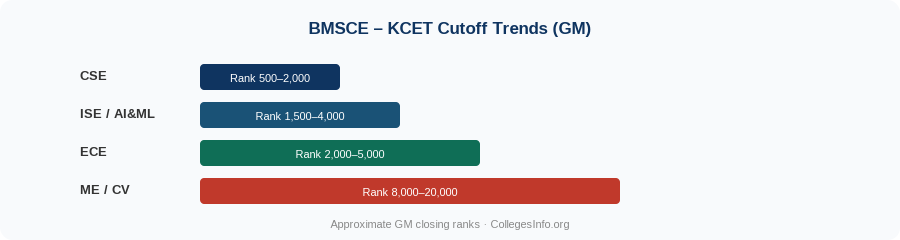
Read the two tables together before deciding what your rank can reach. A rank of 2,000 misses CSE under E048 in Round 1 by a whisker but clears Electronics and Communication under E003 comfortably. A rank of 5,000 has no CSE route in Round 1 but a realistic one by Round 3. If you are working out which colleges your rank opens up more broadly, the KCET rank predictor covers every Karnataka college, and the tier-wise guide to Karnataka engineering colleges by KCET rank sets BMSCE against the rest of the state.
What rank do reserved categories need at BMSCE?
Category ranks run well behind General Merit at the same college, and the gap widens down the branch list. For CSE under code E048 in Round 3 of KCET 2026, General Merit closed at 5,200 while 2A General closed at 7,073 and SC category A at 37,380.
| Branch | GM | 1G | 2AG | 2BG | 3AG | SC (SCA) |
|---|---|---|---|---|---|---|
| Computer Science and Engineering | 5,200 | 8,757 | 7,073 | 11,028 | - | 37,380 |
| CSE (Data Science) | 6,192 | 6,638 | 7,384 | 5,911 | 3,373 | 27,246 |
| CSE (IoT and Cyber Security) | 6,353 | 8,012 | 8,004 | 8,618 | 6,612 | 56,374 |
| AI and Data Science | 6,245 | 8,137 | 6,285 | - | 6,786 | 35,226 |
| Electronics and Communication | 4,165 | 8,110 | 8,538 | - | 6,201 | 64,237 |
| Mechanical Engineering | 14,534 | 19,423 | 19,178 | 22,685 | - | 81,117 |
A dash means no candidate from that category was allotted that branch in that round, not that the branch is closed to the category. KEA's own footnote defines the SC sub-categories as SCA, SCB, SCC at 80 per cent and SCC at 20 per cent. Figures above use SCA.
Which round should you accept a BMSCE seat in?
Waiting for a later round buys you a looser cutoff but costs you certainty. Across KCET 2026, BMSCE's General Merit closing rank for Computer Science moved from 1,920 in Round 1 to 5,200 in Round 3, a shift of about 2.7 times, per the Karnataka Examinations Authority round-wise documents.
That pattern holds across the branch list, and the size of the shift is what should drive the decision. Mechanical moved from 6,844 to 14,534 and Biotechnology from 5,022 to 16,903 under code E048 across the same three rounds, so the later rounds open those branches to a much wider rank band. Electronics and Communication under code E003 barely moved at all, from 1,049 to 1,856, which tells you demand there stays firm to the end and waiting gains you very little.
Two practical consequences. If your rank is comfortably inside the Round 1 figure for the branch you want, taking the seat early removes risk for no real gain. If your rank sits between the Round 1 and Round 3 figures, the later rounds are where your seat exists at all, and surrendering a held seat to chase it is the decision worth modelling carefully. KEA also publishes the seats left unallotted after Round 3, which is the clearest signal of where late movement is still possible.
One caveat on every rank in this guide: these are Rest of Karnataka seat-type figures. KEA publishes separate cut-off documents for the Hyderabad-Karnataka quota, whose closing ranks differ, so candidates eligible under Article 371J should read their own document rather than these numbers.
How much does BMSCE cost?
Management quota fees for 2026-27 run from Rs 4 lakh to Rs 15 lakh per year depending on branch, and BMSCE publishes the full branch-wise list on its own admissions page. Hostel charges are separate.
| Branch | Fee per year |
|---|---|
| Computer Science and Engineering | Rs 15,00,000 |
| Artificial Intelligence and Machine Learning | Rs 12,50,000 |
| AI and Data Science | Rs 12,00,000 |
| CSE (Data Science) | Rs 12,00,000 |
| CSE (IoT and Cyber Security including Blockchain) | Rs 12,00,000 |
| Computer Science and Business Systems | Rs 10,00,000 |
| Electronics and Communication | Rs 9,00,000 |
| Bio-Technology | Rs 7,00,000 |
| Civil / Electrical and Electronics / Industrial / Mechanical | Rs 6,00,000 |
| Chemical Engineering | Rs 4,00,000 |
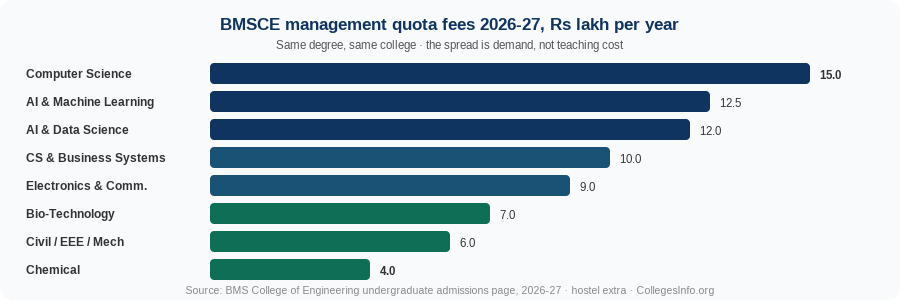
The spread matters more than the top figure. Chemical Engineering at Rs 4 lakh and CSE at Rs 15 lakh are the same degree from the same college, and the difference is demand, not teaching cost. Families who are set on BMSCE but not on CSE have a route that costs a quarter as much.
Fees for the KCET government-quota and COMEDK seats are set annually under the Karnataka government fee notification and the COMEDK consensual fee agreement rather than by the college, so check the current year's notification during counselling instead of relying on last year's figure. The hostel charge reported by current students runs about Rs 2,18,500 to Rs 2,24,000 a year including mess, which BMSCE does not publish centrally, so treat it as indicative. Given the Basavanagudi location, many Bangalore families keep their child as a day scholar and avoid it entirely.
How do you get into BMSCE?
There are three routes into the four-year B.E. and one into the three-year lateral entry programme. KCET and COMEDK are merit routes run by their own counselling authorities; management quota is a direct application to the college.
- KCET, through KEA counselling. Eligibility is a pass in 2nd PUC or equivalent with English as a language, Physics and Mathematics compulsory plus one optional subject, at 45 per cent aggregate for general merit and 40 per cent for SC, ST and OBC categories (Cat-I, 2A, 2B, 3A, 3B). Where Chemistry marks fall short of the aggregate, BMSCE allows Biotechnology, Biology, Computer Science or Electronics marks in its place. The KCET counselling process guide covers option entry, mock allotment and the choice between accepting, sliding and surrendering a seat.
- COMEDK UGET, through COMEDK counselling. A separate exam with its own rank list and its own counselling calendar. See the COMEDK counselling guide and the COMEDK colleges, cutoffs and fees guide if you are deciding whether to sit both.
- Management quota. BMSCE requires a qualifying score in one of KCET, COMEDK or JEE Main Paper-I, in its own words: entrance exams conducted by CET, COMED-K or JEE Paper-I are a must for admission under a management seat, and the candidate must qualify in that exam. Physics and Mathematics are compulsory, with the highest mark among Chemistry, Biology, Biotechnology, Computer Science or Electronics also counted. BMSCE publishes no percentage threshold for this route. Applications go to the Office of the Director (Admissions), Platinum Jubilee Block, Bull Temple Road. The wider management quota guide for Bangalore engineering colleges sets BMSCE's fees against comparable colleges.
- Lateral entry into the three-year B.E. for diploma holders, needing an aggregate of at least 45 per cent across the fifth and sixth semesters, or 40 per cent for SC, ST and Backward Classes of Karnataka candidates.
Note what JEE Main does and does not do here. It qualifies you to apply for a management seat; it does not produce a merit rank that KEA or COMEDK will act on. A strong JEE score with no KCET or COMEDK rank leaves only the paid route.
BMSCE does not publish a seat-share split between the three routes, and the figures circulating on aggregator sites disagree with each other, so this guide does not state one. The authoritative seat matrix for each year is published by KEA before option entry.
What are BMSCE placements actually like?
In 2024-25, 972 of 1,291 graduating students were placed and the median salary was Rs 10,00,000, per the figures BMSCE submitted to NIRF in 2026. Median is the useful number here because a handful of very large offers pull an average upwards without telling you what a typical graduate received.
| Graduating year | Students graduating | Students placed | Median salary | Higher studies |
|---|---|---|---|---|
| 2024-25 | 1,291 | 972 | Rs 10,00,000 | 79 |
| 2023-24 | 1,417 | 924 | Rs 8,50,000 | 100 |
| 2022-23 | 1,344 | 952 | Rs 9,00,000 | 125 |
That is a placement rate of about 75 per cent of the graduating cohort in 2024-25, with the median rising from Rs 8.5 lakh to Rs 10 lakh in a year. Recruiters who have hired on campus include Microsoft, Google, Amazon, J.P. Morgan, Cisco, Goldman Sachs, Oracle, Bosch, Deloitte, Infosys, TCS and Wipro.
Branch matters more than the college-wide figure. Computer Science and Information Science graduates cluster well above the median, while Mechanical and Civil sit below it - an honest reality that most college listing sites leave out. If you are weighing branch against brand, the comparison of CSE against AI, ML and data science as KCET choices is the more useful question than which college ranks higher.
How does BMSCE compare with RVCE, MSRIT and PES?
On KCET 2026 Round 1 General Merit for CSE, RVCE closes tighter than BMSCE, and BMSCE closes tighter than MSRIT. All four hold NAAC A++ or A+ grades, so accreditation does not separate them; cutoff, fee and location do.
Rather than repeat a comparison table that exists elsewhere on this site, the detailed head-to-heads are kept in one place each: RVCE against BMSCE, BMSCE against MSRIT, and the three-way RVCE, MSRIT and BMSCE comparison. Individual profiles are at RVCE Bangalore, MSRIT Bangalore, PES University Bangalore and DSCE Bangalore.
BMSCE's distinguishing claims are its 1946 founding and the alumni network that comes with eight decades, its central location, and autonomy since 2008, which lets it revise curriculum without waiting on VTU cycles. Its NAAC A++ at CGPA 3.56 is held by only a handful of Karnataka engineering colleges.
The accreditation record is worth reading as a trend rather than a badge. BMSCE scored A with a CGPA of 3.41 in its first NAAC cycle, then A++ at 3.83 in the second cycle running to March 2024, then A++ again at 3.56 in the third cycle valid to October 2031. Three consecutive cycles at or above A is a longer run of sustained assessment than most Karnataka engineering colleges can show, though the CGPA dipping from 3.83 to 3.56 between cycles is a detail no prospectus mentions and worth asking the department about on an open day.
What is the campus and hostel like?
The campus covers 15 acres in Basavanagudi with laboratories, smart classrooms, research incubation space and a central library of more than 1,00,000 books and e-journals. Eight hostel blocks serve boys and girls.
Being inside the city rather than on its edge changes day-to-day life: BMTC buses, the Lalbagh metro station 2 km away and autos from any part of Bangalore all serve the campus, and students reach internships in the central business district without losing two hours to commuting. For students coming from outside Bangalore, the guide to Bangalore colleges with hostel facilities for outstation students covers what to check before committing.
What scholarships does BMSCE offer?
BMSCE lists government scholarships routed through the Karnataka e-scholarship portal, institutional merit scholarships, and category scholarships for SC, ST and OBC students. Amounts and eligibility change each year, so the college's scholarship page is the figure of record rather than any third-party summary.
Students on the KCET government-quota route who also qualify for state fee concessions can end up paying considerably less than the published fee. Work this out before choosing between a government-quota seat at one college and a management seat at another.
Frequently Asked Questions
What KCET rank is needed for CSE at BMSCE?
Under General Merit, Computer Science closed at rank 1,920 in Round 1 of KCET 2026 and at
5,200 by Round 3, per the Karnataka Examinations Authority. A rank inside 2,000 is safe in
Round 1 and a rank near 5,000 becomes realistic in the later rounds.
Is BMSCE a government or a private college?
It is a private aided college, not a government one. It receives government aid towards
faculty salaries and fills seats under both government-quota and management-quota fee
structures.
Does BMSCE accept JEE Main scores?
Only as a qualifying exam for the management-quota route, where BMSCE accepts KCET, COMEDK
or JEE Main Paper-I. A JEE Main score does not create a merit rank for KEA or COMEDK
counselling, so it cannot win a government-quota or COMEDK seat.
What is the management quota fee at BMSCE?
For 2026-27 it runs from Rs 4,00,000 a year for Chemical Engineering to Rs 15,00,000 a year
for Computer Science, published branch-wise by BMSCE. Hostel charges are extra.
What is BMSCE's NAAC grade?
A++ with a CGPA of 3.56 on a four-point scale, valid from 30 October 2024 to 29 October
2031. This is BMSCE's third consecutive cycle at the A++ grade.
What is the median salary at BMSCE?
Rs 10,00,000 for the 2024-25 graduating batch, with 972 of 1,291 students placed, per
BMSCE's NIRF 2026 submission. The median for 2023-24 was Rs 8,50,000.
Why does BMSCE have two KCET college codes?
KEA lists BMSCE as E003 and E048, with its branches divided between them. Computer Science
and the AI programmes sit under E048, while Electrical and Electronics and Industrial
Engineering sit under E003, and Electronics and Communication appears under both at
different closing ranks.
Can diploma holders join BMSCE?
Yes, through lateral entry into the three-year B.E. programme. The requirement is an
aggregate of at least 45 per cent across the fifth and sixth diploma semesters, or 40 per
cent for SC, ST and Backward Classes of Karnataka candidates.
Which BMSCE branch is easiest to get into?
Civil Engineering, which closed at rank 36,018 under code E048 in Round 3 of KCET 2026
against 5,200 for Computer Science. Chemical Engineering is also the cheapest management
seat at Rs 4,00,000 a year.
Sources and corrections
Ranks on this page come from the Karnataka Examinations Authority UGCET-2026 round-wise allotment cut-off documents for engineering, Rest of Karnataka seat type, published at cetonline.karnataka.gov.in. Rounds 2 and 3 are KEA's provisional allotment documents. Fees, accreditation and eligibility come from BMSCE's undergraduate admissions page, and placement figures from the college's NIRF 2026 data submission under institute code IR-E-C-1262. Approval and affiliation details are with AICTE.
Cutoffs for 2027-28 are not published until KCET 2027 counselling runs. The 2026 figures above are the best available evidence base, and the 2027-28 bands should be read as expectations rather than cutoffs.
Written by L K Monu Borkala, publishing Karnataka education directories since 2006. Spotted a figure that has moved? Tell us and we will check it against the source.