Last Updated: September 7, 2026
Quick Facts: BSc Data Science in Bangalore
| Detail | Overview |
|---|---|
| Duration | 3 years, full-time (6 semesters) |
| Admission route | University-specific entrance test (CUET for Christ, university's own test for Jain/GITAM/others) or direct admission on 10+2 marks, depending on the institution |
| Typical eligibility | 10+2 with Mathematics as a compulsory subject, usually 50% aggregate (varies by college and category) |
| Typical fee range | Approximately ₹55,000 to ₹3,60,000 per year, depending on the institution and specialisation |
| Real colleges offering this exact programme in Bangalore | 10 verified institutions (2026) |
If you're hunting for a BSc Data Science seat in Bangalore, here's the number that matters most: there are around 10 institutions in the city running a standalone BSc Data Science programme under that exact name, not the 40-plus that some directories imply once you count every college that vaguely mentions "science" or "computer applications." That distinction isn't pedantic – it's the difference between a curriculum built for the job market you're trying to enter and a computer science degree with a couple of statistics electives bolted on. Bangalore's advantage isn't just that it's India's tech capital; it's that a handful of universities here have built dedicated data science faculties, industry tie-ups, and placement pipelines specifically for this degree, rather than treating it as an afterthought inside a broader BSc programme.
The Colleges: Who Actually Teaches BSc Data Science in Bangalore
Christ University
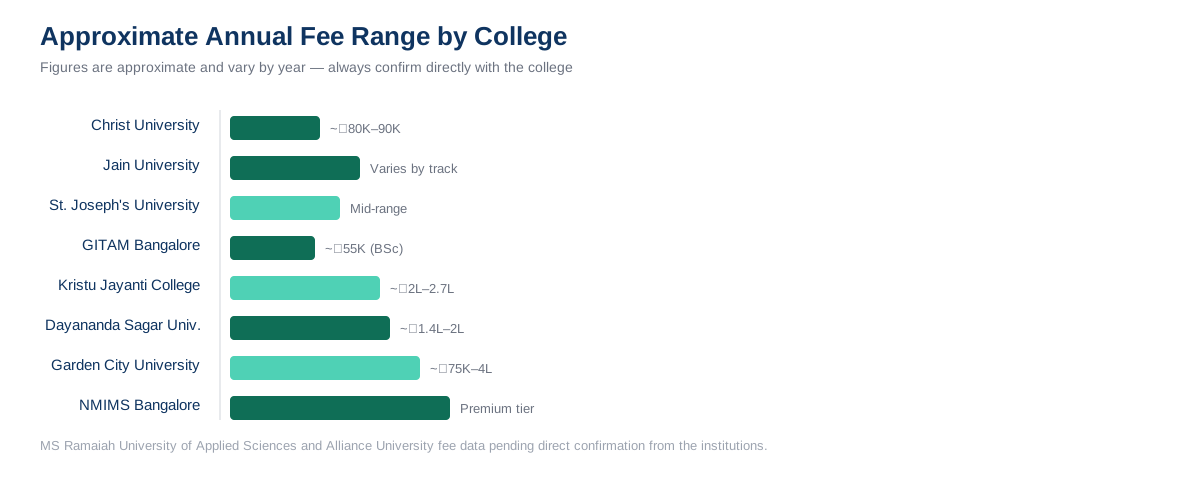
Christ University began as a college in 1969 and was declared a deemed-to-be university in 2008, and it's probably the single most recognised name among Bangalore students weighing a data-adjacent degree. Its BSc Data Science programme sits inside a university that's built its reputation on commerce and management education first, which shows up in the curriculum's leaning toward business applications of data – decision-making, forecasting, and analytics for finance and marketing sit alongside the core statistics and programming modules. Admission runs through the Christ University Entrance Test (CUET, the university's own exam, not to be confused with the national CUET), and the university holds a NAAC A+ grade. Annual fees for the programme run in the range of roughly ₹80,000-90,000, which is mid-tier for a deemed university in this city. What you're really paying for is Christ's placement machinery: its commerce and analytics graduates have gone into roles at consulting and BFSI firms, and the brand recognition alone opens doors during campus interviews that a lesser-known college's degree won't.
Jain University
Jain (Deemed-to-be University) was formally declared in 2009, though its roots as an educational trust go back further, and it holds a NAAC A grade with an increasingly strong presence in national rankings – it placed in the 60s for Universities in the NIRF 2025 list. What sets Jain apart for data science specifically is the breadth of its tech ecosystem: it runs B.Tech programmes in AI and Data Science alongside the BSc route, meaning the data science faculty and lab infrastructure serve multiple degree levels rather than existing as a single isolated programme. Jain's internship placements reportedly include stints at large technology employers, and its total course fees across programmes span a wide band, reflecting the range of specialisations on offer. Students who want a university where data science sits inside a tech-heavy institution, rather than a commerce-first one, tend to shortlist Jain alongside Christ. Jain's main campus sits in central Bangalore, which matters for day-scholars weighing commute time against a hostel booking – unlike some of the other names on this list, you're not trading city-centre access for the programme itself.
St. Joseph's University
This is the institution with by far the longest history on this list – St. Joseph's traces back to 1882, making it one of the oldest degree colleges in Karnataka, and it earned university status in 2021 through a Karnataka government act as a public-private-partnership institution under the UGC's RUSA 2.0 framework. That heritage matters less for data science specifically than the fact that St. Joseph's runs its BSc Computer Science with a Data Science specialisation (also offered as an Honours track) through a dedicated School of Information Technology, built around Python, R, SQL, statistical modelling, and machine learning coursework rather than treating data science as a bolt-on. Admission goes through the St. Joseph's University Entrance Test (SJUET), conducted across several Indian cities, not just Bangalore, which tells you something about how far this university's draw extends beyond Karnataka. Its NAAC accreditation as a college (A++ in its most recent cycle before the university transition) is one of the stronger grades on this list.
GITAM (Deemed to be University), Bangalore
GITAM's Bangalore campus was established in 2012 and holds a NAAC A++ grade, and it's structured around four schools, with the GITAM School of Science running the BSc Data Science track separately from the GITAM School of Technology's B.Tech offerings in AI/ML and Data Science. That separation is worth knowing about if you're comparing GITAM to the others on this list: a student choosing GITAM needs to be clear on whether they want the BSc (science-first, more theory and research orientation) or the B.Tech (engineering-first, considerably higher fees, in the ₹5.5-14 lakh range for the full programme). The BSc route is admitted through GITAM's own entrance test (GAT), and the campus sits in Doddaballapur, north Bangalore, close to the airport corridor rather than the city centre – a relevant commute consideration for day-scholars.
Kristu Jayanti College (Deemed to be University)
Kristu Jayanti holds an A++ NAAC grade as an autonomous institution and was ranked around 60th nationally in the NIRF 2024 College category, with particular strength in commerce and arts. Its data science offering runs through its Computer Science department rather than a standalone school, and the college has built in some notable specifics: a Bloomberg Terminal Lab (unusual for an undergraduate science programme in this city) and integrated professional certification pathways alongside the core degree, including options tied to global accounting bodies for students who blend data science with a commerce specialisation. Its location in Kothanur, close to Manyata Tech Park, puts it within easy reach of a major IT employment corridor, which the college leans into for its internship placements.
Dayananda Sagar University
Dayananda Sagar University carries the weight of a much older engineering trust behind it – the Dayananda Sagar group's flagship engineering college dates to 1979 – but DSU itself as a university is considerably younger, having been established to bring the group's various institutions under one accredited umbrella. Its BSc Data Science programme benefits from that trust's long-standing industry relationships in Bangalore's tech corridor, and recent internship placements reportedly include stints at large technology and consulting firms. Admission for science programmes typically runs through the university's own entrance route (DSAT) alongside acceptance of KCET and other national scores for some tracks. If a large, well-networked educational group with decades of placement relationships matters more to you than a standalone science-first identity, DSU is worth shortlisting.
Other Verified BSc Data Science Providers in Bangalore
Beyond the six profiled above, four more institutions in the city run genuine, verified BSc Data Science programmes. Rather than thin out the depth on the colleges above to cover these shallowly, here's a straight comparison. Worth noting upfront: MS Ramaiah University of Applied Sciences leans on a decades-old parent trust with an unusually strong footprint in health sciences alongside its technology faculties, which shows up in cross-disciplinary electives some students find useful for data science applied to healthcare analytics. NMIMS Bangalore is a smaller satellite of a Mumbai-headquartered institution best known for its MBA programme, so its BSc Data Science cohort sizes tend to be considerably smaller than the other names here – a genuine advantage if you want closer faculty attention, a genuine drawback if campus scale and peer network size matter to you. Alliance University's biggest differentiator is its international tie-up count, which BSc students can sometimes access through short exchange terms even though the flagship exchange programmes are typically built around its law and management schools. Garden City University's historical strength in physiotherapy and life sciences means its newer data science offering doesn't yet carry the same institutional track record as its established programmes, though its international student body (80+ countries represented on campus) is a distinctive feature none of the other nine colleges on this list can match.
| College | NAAC / Ranking Signal | Notable For |
|---|---|---|
| MS Ramaiah University of Applied Sciences | NIRF 101-150 band (Universities) | Part of the long-established Ramaiah group; strong applied-sciences orientation across health and technology faculties |
| NMIMS Bangalore | Strong national MBA rankings (parent brand) | Mumbai-origin institution with a business-and-analytics-heavy curriculum lean; smaller Bangalore campus footprint than the flagship city |
| Alliance University | NIRF 2025: #71 Management, #20 Law nationally | Broad multidisciplinary campus with heavy international tie-ups (80+ partner institutions) |
| Garden City University | NAAC A+ (highest grading cycle) | Historically stronger in physiotherapy and life sciences; global student body (80+ countries represented) |
Step-by-Step: How Admission Actually Works
1. Confirm you meet the base eligibility
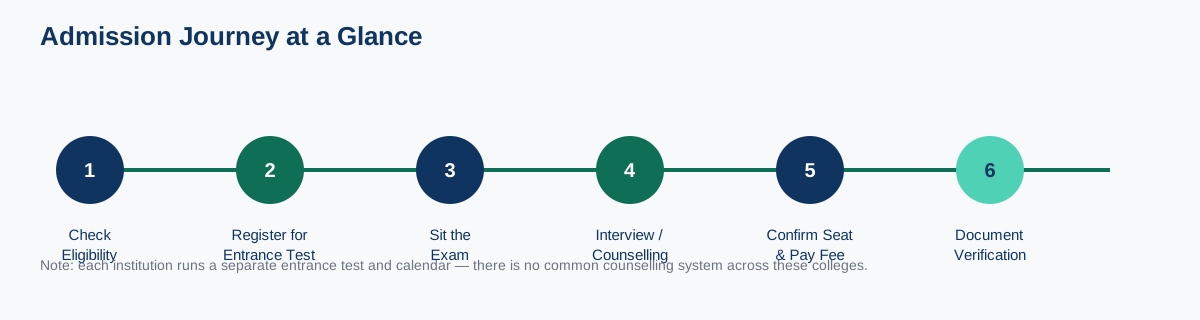
Every institution on this list requires a pass in 10+2 with Mathematics as a compulsory subject, generally with a 50% aggregate (some relax this for reserved categories). If your 12th-grade board didn't offer Mathematics, you're not eligible for this specific programme at any of these ten colleges – that's worth confirming before you invest time in anything else, since it's the one hard gate every one of them shares.
2. Decide whether you want a BSc or a B.Tech track
This matters more than it sounds. GITAM, Jain, and Dayananda Sagar University all offer both a BSc Data Science and a B.Tech in a Data Science-adjacent specialisation. The BSc is three years, more statistics-and-theory-heavy, and considerably cheaper. The B.Tech is four years, engineering-accredited, and priced substantially higher – GITAM's B.Tech Data Science route, for instance, runs into several lakhs more than its BSc equivalent across the full programme. Pick based on whether you want a science degree or an engineering one; they lead to different further-study and job-market framing later.
3. Check which entrance test each shortlisted college requires
Christ uses its own CUET. Jain accepts several routes depending on programme, commonly including JET and other institutional or national scores. GITAM runs GAT. St. Joseph's runs SJUET, held across multiple Indian cities. Dayananda Sagar University runs DSAT for some programmes alongside KCET acceptance. None of these overlap in dates by design, so check each one's exam calendar the moment applications open – colliding dates is the single most common reason students miss a shortlisted college entirely.
4. Register for each entrance exam separately
There's no common entrance test across these institutions the way KCET works for engineering. Budget a separate registration fee (typically ₹500-1,500 per test) and a separate exam-day commitment for each college you're serious about. If you're applying to three or four of these, that's three or four different test-prep timelines to track.
5. Gather your documents early
Every institution asks for the same core set: 10th and 12th mark sheets and certificates, transfer certificate, migration certificate, a passport-sized photograph set, and category certificates if applicable. International or NRI applicants face an additional document load – medical fitness certificates and, for some categories, additional identity verification. Start assembling these the moment your 12th board exams finish; delays here are administrative, not academic, and entirely avoidable.
6. Sit the entrance test(s)
Most of these institutional tests run multiple times a year rather than once (GITAM's GAT, for instance, is held across several cycles), which gives you a retake option if your first attempt goes poorly. Use that if it's available rather than settling for a weak first score when a second sitting could change your shortlist options.
7. Track your score against the previous cycle's cutoffs
Cutoffs for niche BSc programmes like this one aren't always published as prominently as they are for MBBS or engineering, since the seat count is small. Where a college doesn't publish a public cutoff, call the admissions office directly and ask for the previous year's closing score band for this specific programme, not the university's general cutoff.
8. Apply for merit-based direct admission where offered
Several of these institutions offer a direct-admission-on-marks route for candidates who score well enough on their 12th boards, bypassing the entrance test entirely. This isn't universal, so check each shortlisted college's admission page for this option before assuming you need to sit every entrance exam.
9. Attend the interview or counselling round, if required
Some of the entrance-test-based colleges add a short interview or group discussion round after the written test, particularly for programmes with limited seats. This is typically a fit-and-motivation conversation rather than a technical grilling at the BSc level – come prepared to explain why data science specifically, not just "I'm good at computers."
10. Confirm your seat and pay the initial fee
Once offered a seat, most institutions give a short window (often 7-10 days) to confirm with an initial payment, which can range from a token registration amount to a substantial first instalment depending on the college's fee structure. Missing this window typically forfeits the offer, so don't wait to see if a "better" option comes through elsewhere.
11. Submit original documents for verification
This is usually a physical, in-person step – bring originals of everything you submitted digitally, since colleges cross-check before finalising enrolment. Photocopies alone won't complete this step at any institution on this list.
12. Complete the fee payment for the first year
Fee structures vary widely across this list – from around ₹55,000 a year at the more affordable end to over ₹3 lakh a year at the premium end – and most institutions offer instalment options rather than requiring the full year upfront. Ask specifically about instalment schedules if the sticker price is a stretch; nearly all of these colleges have some flexibility here that isn't always advertised prominently.
13. Sort out hostel or accommodation, if needed
Several of these campuses – GITAM and Garden City in particular – sit outside the city core, which makes hostel accommodation a genuine practical consideration rather than an optional extra for outstation students. Apply for hostel seats alongside your academic admission, since hostel capacity is often more limited than academic seat capacity and fills on a first-come basis.
14. Attend orientation and register for your first semester
Orientation typically covers the academic calendar, elective choices (several of these programmes let you pick a specialisation track – business analytics versus machine learning versus applied statistics – from the second year onward), and introduces you to the specific software stack (Python, R, SQL, and visualisation tools like Tableau or Power BI) the programme will lean on.
What Comes After a BSc Data Science Degree
Most graduates from this specific degree don't stop at the bachelor's level, and the natural next steps are reasonably well-trodden. An MSc in Data Science, or an MCA for students who want to pivot toward core software development, is the most direct continuation, and several of the same institutions – Christ, Jain, and Dayananda Sagar University among them – run postgraduate programmes in the same field, which can mean continuity of faculty relationships and lab access if you stay put. An MBA with a data or business analytics specialisation is the other common route, particularly for students who realise partway through their BSc that they're more interested in the business application of data than the pure technical side. Industry certifications – in cloud platforms (AWS, Azure, Google Cloud), specific tools (Tableau, Power BI), or professional data science credentials – are increasingly treated as a parallel track rather than an either-or against further formal study; several graduates pursue these during their final year alongside placement preparation rather than waiting until after graduation. A smaller but growing number of graduates use the BSc as a springboard into a research-oriented path – an MSc followed by a PhD in computational statistics or applied machine learning – though this remains a minority route from an undergraduate cohort that's still largely oriented toward industry employment rather than academia. Whichever path you're weighing, it's worth deciding roughly by the end of your second year, since elective choices in the final year (a business analytics track versus a pure machine learning track, for instance) start to shape which postgraduate options feel like a natural continuation versus which ones require you to backfill gaps.
Career Paths and Jobs
For students who go straight into the workforce rather than continuing to a master's degree, Bangalore's own tech ecosystem is the most immediate advantage of studying here in the first place. Entry-level roles for BSc Data Science graduates in India typically fall under titles like data analyst, junior data scientist, business intelligence analyst, or data engineer trainee, with entry salaries that vary considerably by employer tier – placement data across these institutions suggests packages typically starting in the ₹3-6 lakh per annum range for fresh graduates at mainstream IT and analytics employers, with the higher end reserved for candidates from the stronger-placement institutions on this list and roles at consulting or BFSI firms specifically. Sectors actively hiring at this level include IT services and product companies, BFSI (banks, insurers, and fintech), e-commerce and retail analytics teams, and increasingly, healthcare and logistics firms building out their own data functions. The specific skills employers screen for at the fresher level are fairly consistent across these sectors: working proficiency in Python or R, comfort with SQL for querying real databases (not just textbook exercises), a foundational grasp of statistics rather than just machine learning buzzwords, and increasingly, familiarity with a visualisation tool like Tableau or Power BI, since most entry-level data roles involve communicating findings to non-technical stakeholders as much as building models. Graduates who supplement their degree with a portfolio of independent projects – even simple ones built on public datasets – tend to clear technical interview rounds more easily than those relying on coursework alone, since interviewers at this level are usually screening for applied problem-solving more than theoretical depth.
Opportunities abroad exist but come with real caveats worth stating plainly rather than glossing over: a BSc alone is rarely sufficient for a direct international data science role straight out of college – most graduates who go this route first complete a master's degree abroad (commonly in the UK, Ireland, Germany, or Australia) before entering the local job market, since visa sponsorship for entry-level roles without a local postgraduate qualification is uncommon. Students planning an international career path should treat the BSc as the foundation for that master's degree application, not as a standalone ticket to an overseas data science job.
BSc Data Science vs. Related Degrees
Data science isn't the only route into this field from Bangalore, and it's worth being clear-eyed about how it compares to the adjacent options. A straight BSc Computer Science gives you a broader software-engineering foundation with data science as one elective track among several, which suits students who aren't fully certain they want to specialise this early. A BCA (Bachelor of Computer Applications) is more application-development focused and generally has a lighter statistics and mathematics load, making it a reasonable alternative for students whose 12th-grade board didn't offer the depth of maths some data science programmes expect. A B.Tech in Computer Science Engineering with an AI & Data Science specialisation – offered by several colleges in this same city – is the engineering-accredited, four-year, considerably more expensive alternative, generally pursued by students who want the "B.Tech" credential specifically for certain employers or further engineering postgraduate study. The BSc Data Science route sits between these: more specialised than a general BSc CS, more theory-and-statistics-grounded than a BCA, and considerably more affordable and shorter than the B.Tech path.
Mistakes Applicants Keep Making
The single most common error is assuming every "science college in Bangalore" runs this specific programme – it doesn't, and colleges that don't actually offer a named BSc Data Science degree sometimes get recommended in generic listicles simply because they run a broader BSc programme with a data-adjacent elective. Verify the exact programme name on the college's own admissions page, not a summary aggregator. The second common mistake is picking a college purely on brand recognition without checking whether that specific campus runs the BSc or only the (considerably pricier) B.Tech version of a similar-sounding degree – GITAM and Jain both illustrate this trap. Third, students frequently miss entrance exam registration windows because they assume a common counselling system exists across these institutions the way it does for engineering via KCET; it doesn't, and each college runs its own separate calendar. Finally, don't underestimate the commute factor for the more peripherally located campuses (GITAM in Doddaballapur, Garden City further out) if you're planning to live at home rather than in a hostel – factor this in before, not after, accepting a seat. A fifth mistake worth flagging separately: assuming the cheapest option on this list is automatically the best value. A lower annual fee sometimes reflects a leaner programme with fewer industry tie-ups and a smaller placement cell, not just a more efficient institution – weigh the fee against the specific placement and internship data for the data science cohort at that college, not the university's overall reputation, before treating price alone as the deciding factor.
How We Help
Figuring out which of these ten colleges actually fits your board score, budget, and career direction – rather than just picking the most recognisable name – is exactly the kind of decision we help Karnataka students work through every admission cycle. We help you get the best admission to your preferred colleges without hassle. For personalised guidance on shortlisting, entrance exam prep timing, or comparing real fee and placement data across these institutions, WhatsApp us at +91 6363 330 233.
About This Guide
OneCity Technologies Pvt. Ltd began in 2006 publishing an annual print education directory for Karnataka students and parents. As demand grew, OneCity launched an education portal in 2019 to bring that same directory information online, and in 2025 relaunched as CollegesInfo.org – a comprehensive Karnataka college directory covering 1,500+ institutions across engineering, medical, management, arts, commerce, and more. Founder L K Monu Borkala brings 20+ years of business experience and 19 years of work across various education-sector services. CollegesInfo.org's content is built from publicly available KEA, NMC, AICTE, and university data, cross-checked against official sources wherever possible. CollegesInfo.org's admission assistance service helps students secure admission to colleges they are eligible for under that college's actual published criteria. We help you get the best admission to your preferred colleges without hassle.
About the Author
L K Monu Borkala is the Founder of OneCity Technologies Pvt Ltd and CollegesInfo.org, with over two decades of business experience and 19 years working across Karnataka's education sector.
Frequently Asked Questions
How many colleges in Bangalore actually offer BSc Data Science as a named degree?
Ten verified institutions currently run a standalone BSc Data Science programme in Bangalore: Christ University, Jain University, St. Joseph's University, GITAM, Kristu Jayanti College, Dayananda Sagar University, MS Ramaiah University of Applied Sciences, NMIMS Bangalore, Alliance University, and Garden City University. Many other colleges offer BSc programmes with data-related electives without running this specific named degree.
Is BSc Data Science better than BSc Computer Science for a data career?
Neither is universally "better" – BSc Data Science gives a more focused, statistics-and-analytics-heavy curriculum from year one, while BSc Computer Science gives broader software-engineering grounding with data science as one possible specialisation track. Choose based on whether you're already confident about specialising in data specifically.
Do I need Mathematics in 12th grade to apply?
Yes, at every institution on this list, Mathematics as a compulsory 12th-grade subject is a hard eligibility requirement, typically alongside a minimum 50% aggregate (with relaxations for reserved categories at some colleges).
What's the typical fee range for this programme in Bangalore?
Approximately ₹55,000 to ₹3,60,000 per year depending on the institution, with most of the colleges on this list falling in the ₹80,000-2,00,000 per year band. Always confirm the current year's exact figure directly with the college, since fees are revised annually.
Can I get a job abroad straight after this BSc?
Directly, it's uncommon – most students pursuing an international data science career complete a master's degree abroad first, since entry-level visa sponsorship without a local postgraduate qualification is rare in most target countries. Treat the BSc as preparation for that master's application rather than a standalone route overseas.
Is there a common entrance exam for all these colleges, like KCET for engineering?
No. Each institution runs its own separate entrance test (CUET for Christ, GAT for GITAM, SJUET for St. Joseph's, and so on), with separate registration, fees, and exam dates. You'll need to register and prepare for each one individually if you're applying to multiple colleges on this list.
What should I do if I don't get into any of these ten colleges?
Consider a BSc Computer Science with a data science elective track, or a BCA with an analytics specialisation, at a broader set of Bangalore colleges – both are reasonable adjacent routes into the same career direction, and several colleges offering these have strong placement records even without running the specifically-named data science degree. WhatsApp us at +91 6363 330 233 and we can help you compare realistic alternatives based on your actual scores.
Does the choice between BSc and B.Tech Data Science affect further study options later?
Yes, to some extent. A B.Tech generally opens a cleaner path into engineering-specific postgraduate programmes and certain public-sector or core-engineering roles that formally require an engineering degree, while a BSc keeps options more open across science, analytics, and management postgraduate routes without closing off any of them. Neither restricts you from an MSc in Data Science or an MBA – the difference shows up mainly if you're targeting a specific engineering-credentialed career path later.
How do I compare placement records across these ten colleges fairly?
Ask each shortlisted college directly for placement data specific to the BSc Data Science cohort – not the university's overall placement statistics, which are usually dominated by larger, more established programmes like B.Tech or MBA and can make a newer BSc programme's real outcomes look better or worse than they actually are. A college's overall placement brand doesn't always reflect the outcomes for this specific, often smaller, degree cohort.