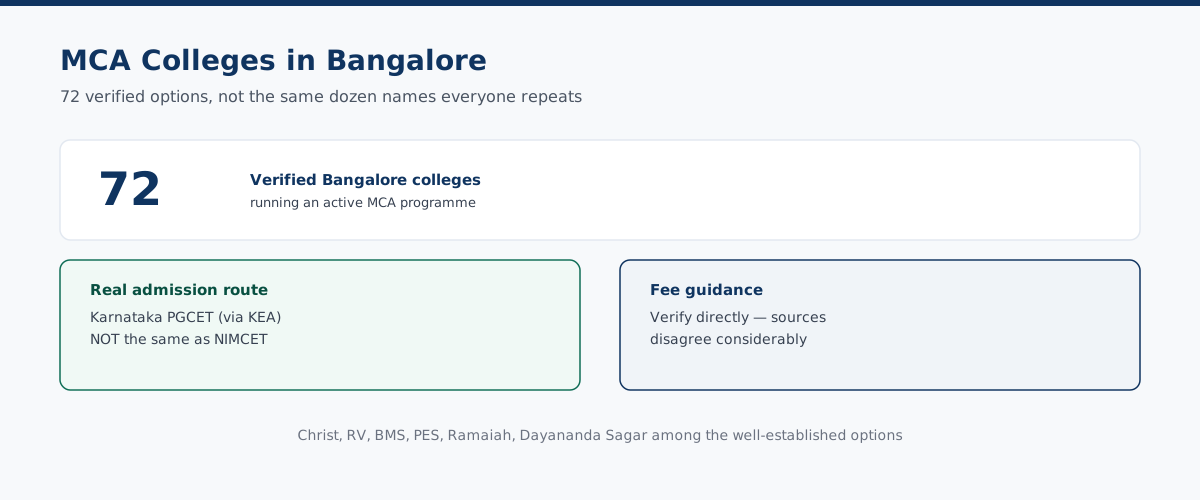
Bangalore offers MCA at 72 verified colleges — a figure most searches never actually confirm, since most existing lists online repeat the same dozen well-known names without checking how many institutions in the city actually run the programme. From established VTU-affiliated engineering colleges like RV College of Engineering and BMS College of Engineering to deemed and private universities like PES University, Dayananda Sagar College of Engineering, and Reva University, the real breadth of options is far larger than most students realise. This piece covers the genuine admission mechanism — Karnataka PGCET — plus which colleges are worth actually shortlisting, and honest fee guidance rather than borrowed numbers that don't agree with each other across the internet.
MCA in Bangalore — Quick Facts
| Verified MCA colleges in Bangalore | 72 (per our own database verification) |
|---|---|
| Primary admission route | Karnataka PGCET (via KEA), state-quota seats |
| Alternative route | KMAT Karnataka, commonly used for management-quota seats and by some private universities |
| Programme duration | 2 years, full-time |
| Not the same as | NIMCET — a separate national exam for NIT MCA seats, not applicable to Bangalore's VTU/private colleges |
| Fee range | Varies substantially by college and quota — verify current year directly, don't trust a single borrowed figure |
| Well-established options | RV College of Engineering, BMS College of Engineering, PES University, Ramaiah Institute of Technology, Dayananda Sagar College of Engineering, among dozens more |
The Real Admission Route — Karnataka PGCET, Not NIMCET
The single most common confusion students searching for "MCA colleges in Bangalore" run into is mixing up two entirely separate admission systems. Karnataka PGCET (Post-Graduate Common Entrance Test), conducted annually by the Karnataka Examinations Authority (KEA), is the genuine state-quota admission route for MCA at Bangalore's VTU-affiliated colleges and most private universities' government-quota seats. KMAT Karnataka runs as a parallel, commonly-accepted alternative, particularly relevant for management-quota seats and for private universities that also welcome non-Karnataka applicants through their own direct admission processes alongside PGCET.
This is distinct from NIMCET, the national entrance exam specifically for MCA seats at NITs and a small number of centrally-funded institutes — an entirely different exam, different eligibility window, and different set of institutes, covered in depth in our separate guide to NIMCET for students specifically targeting the NIT route. If you're researching Bangalore's own colleges — the RVs, BMSs, and PES Universities of the city — Karnataka PGCET is the exam that actually matters, not NIMCET.
72 Verified Colleges — the Real Scale of Options
Cross-referencing our own structured college-course database rather than relying on generic aggregator lists reveals a large number of Bangalore institutions running active MCA programmes — 72 in total, spanning long-established VTU-affiliated engineering colleges founded decades ago, newer private universities, and specialised technical institutes. This scale matters practically: it means a much wider range of PGCET ranks and budgets can realistically find a genuine, currently-running MCA seat in the city than the handful of headline names typically discussed suggest.
Karnataka's other cities offer meaningfully fewer options by comparison — our database shows roughly 12 verified MCA colleges in Mangalore, 7 in Mysore, 6 in Tumkur, 5 each in Kalaburagi and Belagavi, and progressively fewer in smaller cities — making Bangalore the state's deepest MCA market by a wide margin, not just its most talked-about one. This concentration reflects Bangalore's broader status as Karnataka's IT and technology hub: colleges cluster their postgraduate computing programmes where the recruiting industry itself is concentrated, which is precisely why a Bangalore MCA carries genuine local placement relevance that a similar degree from a smaller city may not offer to the same degree.
The MCA curriculum itself follows a broadly standardised structure across VTU-affiliated colleges in this list, covering advanced programming, database management systems, data structures and algorithms, software engineering principles, computer networks, and increasingly, electives in areas like cloud computing, data analytics, and mobile application development. Because the core curriculum is VTU-mandated and largely consistent across affiliated colleges, the genuine differentiators between the 72 options are less about curriculum content and much more about faculty quality, lab infrastructure, and — critically — each college's actual, documented placement track record specifically for MCA graduates, which varies considerably more than the syllabus does.
Well-Established Colleges Worth Shortlisting
| College | Established | What's verified |
|---|---|---|
| RV College of Engineering | 1963 | One of Bangalore's most recognised VTU-affiliated engineering colleges, running MCA alongside its established core engineering branches |
| BMS College of Engineering | 1946 | Among Karnataka's oldest private engineering colleges, MCA offered alongside its long-standing core departments |
| PES University | 1972 | Deemed university status with its own direct-admission route alongside PGCET-quota seats |
| Ramaiah Institute of Technology | 1962 | Long-established VTU-affiliated college with an old MCA programme lineage |
| Dayananda Sagar College of Engineering | 1979 | Part of the wider Dayananda Sagar Institutions group, MCA offered alongside its deemed-university sibling campus |
| Government SKSJTI | 1938 | One of Bangalore's oldest technical institutions, government-run with PGCET-only admission |
| Sir M Visvesvaraya Institute of Technology | 1986 | Established VTU-affiliated college with a documented, currently active MCA programme |
| Reva University | 2013 | Newer private university, MCA offered alongside its broader multi-disciplinary programme range |
This is a curated subset, not an exhaustive list — the full 72-college dataset includes many additional genuine options across every part of the city, from established names to newer institutions still building their placement track record. The right approach is matching your specific PGCET rank and budget against the right tier, rather than fixating only on the handful of names that dominate generic search results.
MCA vs Other Postgraduate Computing Routes
Students researching MCA in Bangalore are frequently also weighing it against alternative postgraduate computing paths, and it's worth being explicit about where MCA fits. Compared to an M.Tech in Computer Science (typically pursued by B.Tech/B.E. graduates through GATE), MCA is structured as a standalone postgraduate entry point specifically for students who completed a non-CS bachelor's degree — commonly a B.Sc, BCA, or B.Com graduate — wanting a genuine, structured route into software and IT careers without needing an undergraduate engineering degree first. This makes MCA a different proposition from M.Tech, not a lesser alternative to it: the two serve different starting points and, to a meaningful extent, different career tracks, with M.Tech graduates more commonly moving toward core R&D or specialised technical roles and MCA graduates entering broader software development and IT services roles.
Compared to an MBA in Information Technology or a general MBA, MCA is a technical degree rather than a management one — a distinction that matters for students who've been advised to "do an MBA" without a clear sense of whether they actually want a management career or a hands-on technical one. A student who enjoys programming and wants to build software professionally is generally better served by MCA; a student aiming at management, strategy, or business-leadership roles is better served by an MBA, even an IT-focused one. Treating the two as interchangeable postgraduate options, rather than different career directions, is a common and costly mistake at this decision point.
Honest Fee Guidance — Why We Won't Give You One Fixed Number
Search for a specific college's MCA fee and you'll find contradictory figures across different sites — sometimes for the exact same college and the exact same year, with differences large enough to matter for budgeting. This isn't a minor rounding discrepancy; it reflects real complexity in how fees are structured (tuition alone versus tuition plus mandatory charges, PGCET-quota versus management-quota versus non-Karnataka rates), which aggregator sites frequently collapse into a single misleading number. The honest, useful guidance is this: PGCET government-quota seats at established VTU-affiliated colleges are meaningfully less expensive than management-quota or direct-admission seats at private universities, and the gap between the cheapest and most expensive genuine option in this city is substantial. Confirm the exact, current-year, quota-specific figure directly with KEA or the specific college's admissions office before making any financial commitment — don't rely on a number pulled from a generic search result, including ones on other sites that look confident and specific.
Matching Your PGCET Rank to the Right Tier
With 72 verified colleges spanning a wide competitiveness range, the practical question for most applicants isn't "which college is best" in the abstract, but "which tier fits my actual PGCET rank and budget." Established colleges like RV, BMS, and PES University typically see stronger demand and correspondingly more competitive cutoffs for their MCA seats, reflecting their broader institutional reputation and stronger documented placement history. Mid-tier VTU-affiliated colleges with solid but less prominent reputations generally offer more accessible cutoffs while still providing genuine faculty quality and a real, if less extensive, placement network. Newer private universities and less prominent colleges among the 72 verified options typically show the most accessible cutoffs, suiting students whose PGCET rank doesn't reach the more established names, though it's worth researching each specific college's actual placement track record before committing, since newer institutions vary considerably in how much placement infrastructure they've built up.
The practical approach during KEA counselling is to list a genuine spread across these tiers in your option entry — not just your top aspirational choices — since PGCET seat allotment works through a structured rounds-based process where listing only the most competitive colleges risks ending up without any seat at all if your rank doesn't clear those specific cutoffs in the relevant round. A well-researched list spanning several tiers, in genuine preference order, gives you the best realistic chance of landing in a college that's both accessible at your rank and worth attending.
Admission Routes and Documents
| Route | Notes |
|---|---|
| Karnataka PGCET | Primary state-quota route via KEA; required for most government-seat admissions across the 72 verified colleges |
| KMAT Karnataka | Common alternative, particularly for management-quota seats |
| Direct/merit admission | Available at some private universities (e.g., PES University) for non-Karnataka applicants alongside PGCET-quota seats |
- Register for Karnataka PGCET (MBA/MCA stream) through KEA's official portal during the notification window, typically opening several months before the exam.
- Shortlist colleges from the verified list based on your realistic rank range and budget, rather than only the most-searched names.
- Appear for the exam, then participate in KEA's counselling process: document verification, option entry, and seat allotment across multiple rounds.
- On allotment, verify the college's current-year fee structure in writing before paying, and confirm eligibility requirements (typically a bachelor's degree with a minimum aggregate, often with a mathematics/statistics/computer science background requirement, sometimes satisfiable through a bridge course).
- Documents needed: bachelor's degree marks cards and certificate, PGCET/KMAT scorecard, transfer and conduct certificates, category and income certificates if claiming reservation or scholarship support, Aadhaar, and photographs.
Scholarships and Fee Support
For PGCET-quota seats at government and aided institutions, the Karnataka State Scholarship Portal (SSP) remains the primary channel for post-matric scholarships, offering substantial fee reimbursement for SC/ST students and graded support for OBC and minority categories — apply in the opening weeks of the academic year with certificates ready. Verify current PGCET exam dates and counselling schedules directly through KEA's official portal rather than a third-party aggregator, since exam dates and processes are occasionally revised. Education loans through the Vidya Lakshmi portal remain routinely available at nationalised banks across this fee range.
Career Math
MCA graduates from Bangalore's established colleges enter the city's dominant IT services and product-development industry directly, with the degree functioning as a genuine alternative entry route into software roles for students who didn't pursue a B.Tech/B.E. in Computer Science specifically. Placement strength varies considerably by college — established names like RV, BMS, PES, and Ramaiah Institute of Technology generally maintain stronger, more consistent placement records than newer or lesser-known institutions among the 72 verified options, reflecting years of accumulated recruiter relationships rather than any inherent quality difference in the MCA curriculum itself, which follows broadly similar VTU-mandated content across colleges. Students should weigh a college's specific, documented placement track record for MCA directly, rather than assuming a college's strong B.Tech reputation automatically extends to its MCA programme's outcomes.
Typical entry roles for MCA graduates in Bangalore span software developer and programmer analyst positions at IT services companies, application development roles at product companies, and increasingly, roles in testing, quality assurance, and technical support that serve as entry points into broader software careers. Graduates who build genuine specialisation during their degree — through electives in cloud computing, data analytics, or mobile development, backed by real projects and internships rather than coursework alone — generally access stronger initial offers than those who complete the degree without a clear technical specialisation. For students considering further study, an M.Tech in Computer Science or a specialised master's abroad remain genuine options after MCA, though most graduates enter the workforce directly given the degree's design as a terminal professional qualification for software careers. A smaller number of graduates use MCA as a stepping stone toward an MBA a few years into their career, particularly those who discover an interest in technology management or product roles after gaining initial hands-on development experience — a viable path, though one that generally works better after some real industry experience than as an immediate next step straight out of the MCA programme itself.
Mistakes Applicants Keep Making
- Confusing NIMCET with Karnataka PGCET — these are entirely separate exams for entirely separate sets of institutes; NIMCET has no bearing on admission to Bangalore's VTU-affiliated or private university MCA programmes, and preparing for the wrong exam wastes months of study time.
- Trusting a single aggregator's specific fee figure without cross-checking, when different sites frequently disagree substantially on the same college's actual cost — verify directly with KEA or the college instead, since acting on a wrong number can mean a genuine budgeting shortfall at admission time.
- Only considering the handful of most-searched college names when 72 verified options exist across the city, many offering a realistic seat at ranks and budgets the headline names don't accommodate — narrowing your search to only what shows up first in a generic search misses most of the genuine option space.
- Assuming a college's B.Tech reputation guarantees strong MCA placements, when the two programmes often have different recruiter relationships and outcomes at the same institution — always ask specifically about MCA placement data, not the college's overall placement brand.
- Skipping PGCET registration deadlines by assuming management quota or direct admission remains available indefinitely — quota seats fill through KEA's structured counselling rounds on a fixed timeline, and missing the registration window closes off the state-quota route entirely for that admission cycle.
- Treating MCA and MBA-IT as interchangeable postgraduate choices without weighing whether a technical or management career direction fits better — the two degrees lead to meaningfully different day-to-day work and career trajectories.
How We Help
Tell us your Karnataka PGCET or KMAT score and your budget, and we'll return a realistic shortlist checked against our verified database of every active Bangalore MCA college — not a copied list of the same dozen names every other site repeats. We help you get the best admission to your preferred colleges without hassle.
📱 Get your shortlist from the full 72-college list
Message +91 6363 330 233 with your PGCET/KMAT score and budget. We'll match you against colleges you're actually eligible for.
This piece deliberately took a different approach from most "MCA colleges in Bangalore" content available elsewhere: rather than repeating the same dozen headline names with borrowed, frequently-contradictory fee figures, it's built around what we could actually verify — a genuine 72-college count from our own structured database, a clear explanation of which admission exam actually applies here, and honest guidance on why any single fee number found online deserves scrutiny before you rely on it. We'd rather tell you what we've actually confirmed than pad this page with numbers that sound precise but don't hold up under a second source check.
About This Guide
Written and maintained by L K Monu Borkala. OneCity Technologies began in 2006 publishing an annual print education directory for Karnataka students and parents. As demand grew, OneCity launched an education portal in 2019 to bring that same directory information online, and in 2025 relaunched as CollegesInfo.org — a comprehensive Karnataka college directory covering 1,500+ institutions across engineering, medical, management, arts, commerce, and more. Founder L K Monu Borkala brings 20+ years of business experience and 19 years of work across various education-sector services. CollegesInfo.org's content is built from publicly available KEA, NMC, AICTE, and university data, cross-checked against official sources wherever possible. CollegesInfo.org's admission assistance service helps students secure admission to colleges they are eligible for under that college's actual published criteria. We help you get the best admission to your preferred colleges without hassle.
The 72-college count and city breakdown are drawn directly from CollegesInfo.org's own verified college-course database. Specific fee and cutoff figures vary significantly across sources and years; we've deliberately avoided repeating disputed aggregator numbers here — verify current figures directly with KEA or the specific college before applying. Spot something outdated? WhatsApp us and we'll correct it.
MCA Colleges in Bangalore — FAQs
How many colleges in Bangalore offer MCA?
72 colleges, verified in our own database — spanning established VTU-affiliated colleges, deemed universities, and private universities.
What is the real admission route?
Karnataka PGCET, conducted by KEA, is the primary state-quota route. KMAT Karnataka serves as an alternative, particularly for management-quota seats.
Is NIMCET the same as Karnataka PGCET?
No — NIMCET is a separate national exam specifically for NIT MCA seats and doesn't apply to Bangalore's VTU-affiliated or private college programmes.
What does MCA cost in Bangalore?
Varies substantially by college and quota, and different sites frequently disagree on exact figures for the same college — verify current-year numbers directly with KEA or the college.
Which colleges are the strongest options?
RV College of Engineering, BMS College of Engineering, PES University, Ramaiah Institute of Technology, and Dayananda Sagar College of Engineering are among the most established, alongside dozens of other verified options.
Does CollegesInfo charge for admission guidance?
Our admission assistance service helps students secure admission to colleges they're eligible for under that college's actual published criteria. WhatsApp us and we'll explain how we work before anything else.