Last Updated: September 7, 2026
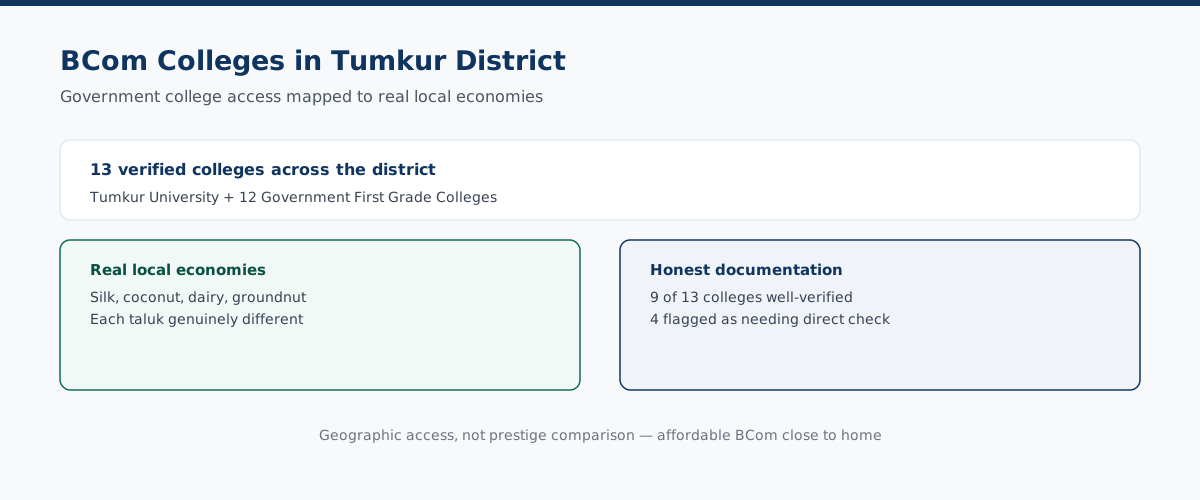
Tumkur district's genuine BCom story isn't about which single college is best – it's about geographic access spread across 13 government colleges, each tied to a real, specific local economy. Unlike Bangalore or Mysore, where a handful of named private and autonomous institutions dominate, Tumkur's BCom landscape runs largely through Tumkur University and its network of Government First Grade Colleges across the district's taluks – Tumkur, Tiptur, Kunigal, Gubbi, Sira, and more. Each college connects to its own local economic base – silk, coconut, dairy, groundnut – rather than repeating identical descriptions across the district. This piece maps that real geography, including which colleges have well-documented profiles and which don't yet.
BCom in Tumkur District – Quick Facts
| Verified BCom colleges in Tumkur district | 13 — primarily Government First Grade Colleges, plus Tumkur University |
|---|---|
| Affiliating university | Tumkur University (established 2004), also covering Chitradurga and Davanagere districts |
| Typical accreditation | NAAC B+ across most Government First Grade Colleges in this cluster |
| Typical fees | Rs 5,000-15,000 per year (government-regulated) |
| Admission route | PUC marks-based / direct admission through Tumkur University's affiliated-college process |
| Notable historical site | Sira taluk hosts the historic Sira Fort, a 17th-century Mysore Kingdom administrative centre |
| Documentation status | 9 of 13 colleges have detailed, verified profiles; 4 have thinner, still-being-completed listings |
Tumkur University – Why It Exists, and What It Affiliates
Tumkur University, established in 2004 and UGC-recognised, was created specifically to decentralise Karnataka's higher education access, reducing the geographic span that Bangalore University's affiliation zone previously had to cover. It now serves as the affiliating and teaching university for Tumkur, Chitradurga and Davanagere districts, running postgraduate, MPhil and PhD programmes at its main Tumkur city campus while affiliating more than 100 degree and professional colleges across its jurisdiction. This decentralisation matters concretely for BCom students specifically: postgraduate and professional education that once required travel to Bangalore or Mysore is now accessible from Tumkur, Chitradurga, Tiptur, Madhugiri and surrounding areas.
This kind of regional university creation reflects a broader pattern in Karnataka's higher education policy over the past two decades – recognising that a single large university covering an entire region eventually becomes impractical for both students and administrators, and that carving out regional universities improves access without necessarily lowering academic standards, provided the new institution maintains proper UGC recognition and builds out its own postgraduate and research capacity over time, which Tumkur University has done by now offering its own MPhil and PhD programmes directly.
Government College Access, Mapped to Real Local Economies
What makes Tumkur district's BCom cluster worth understanding in detail, rather than treating as a generic list of government colleges, is how specifically each institution connects to its own taluk's actual economic base. This isn't marketing language repeated identically across each college's profile – the specific industries named differ by location, reflecting real regional economic geography within a single district. Karnataka's coconut, silk, and dairy industries don't distribute evenly across the state; they concentrate in specific belts, and Tumkur district happens to sit at the intersection of several of these distinct agricultural and craft-industry zones, which is precisely why its various taluk colleges document such different local economic contexts rather than a single repeated description.
This geographic specificity also has a practical research implication: a student comparing two Tumkur district colleges shouldn't assume they're functionally identical simply because both are Government First Grade Colleges with similar NAAC grades and fee structures. The genuine differences lie in exactly the kind of local economic and geographic detail documented here – distance from Tumkur city or Bangalore, and the specific local industry base a student might want to connect their commerce education toward, whether through a final-year project, an internship, or simply an informed sense of what local career opportunities actually look like beyond the standard public-sector destinations.
| College | Taluk | Established | Local economic context |
|---|---|---|---|
| GFGC Tumkur | Tumkur (district HQ) | 1970 | Silk, coconut, engineering manufacturing; 70km from Bangalore |
| GFGC Tiptur | Tiptur | 1977 | Coconut processing and copra trade; 40km from Tumkur city |
| GFGC Kunigal | Kunigal | 1976 | Silk cocoon market and dairy; 35km from Tumkur city |
| GFGC Gubbi | Gubbi | 1977 | Silk and sericulture; 45km from Tumkur city |
| GFGC Sira | Sira | 1979 | Coconut, silk, groundnut; historic Sira Fort (17th century); 45km from Tumkur, 100km from Bangalore |
| GFGC Madhugiri | Madhugiri | 1974 | Government-regulated fees Rs 5,000-15,000/yr; SSP scholarship access confirmed |
| GFGC Pavagada | Pavagada | 1980 | Government-regulated fees Rs 5,000-15,000/yr |
| GFGC CN Halli | CN Halli | 1972 | Government-regulated fees Rs 5,000-15,000/yr |
Four additional colleges – Chikkanayakanahalli, Tumkur City, Koratagere, and Turuvekere – are genuine, active, Tumkur University-affiliated government colleges in this same district, but their specific profiles are still being completed on our end. Rather than fabricate local economic detail we haven't independently verified for these four, we're stating this plainly: confirm current fees, seats and specific programme details directly with these four colleges rather than assuming they match the pattern documented for the nine above.
Why This Geographic Spread Matters
For a student in Tiptur, Kunigal, Gubbi, or Sira, the practical alternative to a local government college isn't a more prestigious institution in the same town – it's relocating to Tumkur city or Bangalore entirely, with all the added cost and disruption that implies. This is precisely the gap Karnataka's Government First Grade College network is designed to close: affordable, local BCom access within each taluk, rather than concentrating higher education entirely in the district's biggest city. The specific local economic context each college documents – coconut in Tiptur, dairy in Kunigal, sericulture in Gubbi – also means BCom graduates from these colleges often have more immediately relevant local employment and small-business context than a generic degree earned far from home might provide.
This pattern repeats across Karnataka generally, not just in Tumkur district specifically – the state's Government First Grade College network exists precisely to prevent higher education access from concentrating entirely in Bangalore, Mysore and a handful of other large cities, instead distributing affordable degree options across taluk headquarters throughout the state. Understanding this broader policy context helps explain why a student researching "BCom colleges in Tumkur" finds a different pattern than the same search for Bangalore: it's not that Tumkur has fewer good options, it's that the entire model of provision is structured differently, prioritising geographic distribution over concentration in a small number of highly-ranked institutions.
For families weighing whether to send a student to a local taluk college versus relocating to Tumkur city or Bangalore, the calculation depends on individual circumstances: a student planning a career directly connected to their taluk's local economy, or one for whom the cost and disruption of relocation is a genuine constraint, is often well served by their nearest Government First Grade College. A student specifically targeting Bangalore's corporate commerce sector, chartered accountancy, or a career requiring the networking and internship access a larger city provides may find relocating, even for undergraduate study, a worthwhile trade-off despite the added cost and disruption involved.
Admission Routes and Documents
| Route | Notes |
|---|---|
| PUC marks-based / direct admission | Standard route across all Tumkur University-affiliated Government First Grade Colleges |
- Apply directly through your specific taluk's Government First Grade College during its admission window, based primarily on PUC marks.
- If open to relocating within the district, compare your home taluk's college against Tumkur city's main GFGC or Tumkur University itself, particularly if postgraduate study is part of your longer-term plan.
- Confirm current-year fees directly with your specific college, though the Rs 5,000-15,000 government-regulated range is consistent across most colleges in this cluster.
- Documents needed: Class 10 and 12 marks cards, transfer and conduct certificates, category and income certificates if claiming reservation or scholarship support, Aadhaar, and photographs.
Scholarships and Fee Support
Given the already-low government-regulated fee range across this cluster, the Karnataka State Scholarship Portal (SSP) makes BCom study at these colleges close to free for eligible SC/ST and OBC students, with graded support available for other categories – apply within the opening weeks of the academic year with certificates ready, a detail specifically confirmed for GFGC Madhugiri and applicable across this entire government-college cluster. NAAC accreditation status for any specific college can be independently verified through the National Assessment and Accreditation Council's official portal.
Because government-regulated fees across this entire cluster already sit in the Rs 5,000-15,000 per year range, the combined effect of SSP scholarship support for eligible categories can bring the genuine out-of-pocket cost of a BCom degree at these colleges down to a level that's difficult to match anywhere else in Karnataka's degree-college landscape, government or private. Families weighing the cost of relocating a student to Bangalore or Mysore for a private BCom programme, where fees typically run several times higher even before accounting for hostel or accommodation costs, should factor this genuine cost differential into their decision alongside the other considerations already discussed in this piece – for many families, the combination of geographic proximity and this scholarship-supported affordability makes a home-taluk Government First Grade College a difficult option to beat on pure financial terms, regardless of how it compares on institutional prestige.
Career Math
BCom graduates from Tumkur district's government colleges typically enter roles reflecting the network's own documented outcomes: KPSC administrative positions, school teaching, bank staff roles, and cooperative society management – common destinations for graduates from colleges explicitly built to serve rural and semi-urban taluk populations rather than feed directly into Bangalore's private corporate or IT sector. Students specifically targeting private-sector commerce careers, chartered accountancy, or corporate roles should weigh this genuine local-employment orientation against their own career goals, since a Tumkur district government college's documented outcomes skew toward public-sector and locally-relevant roles more than toward Bangalore's corporate commerce landscape.
That said, the specific local economic ties documented for several of these colleges – Tiptur's coconut and copra trade, Kunigal's dairy sector, Gubbi's sericulture – offer a genuine, less-discussed advantage: BCom graduates with an interest in agribusiness, cooperative management, or small-enterprise finance specifically relevant to these local industries may find more immediately applicable local opportunities than a generic Bangalore-based commerce degree would provide, precisely because their education happened within the same economic geography they're now entering.
Students weighing further study after BCom should note that Tumkur University itself, being the region's primary affiliating and postgraduate institution, offers a genuine, geographically convenient path into an MCom or related postgraduate commerce qualification without needing to relocate to Bangalore or Mysore for that specific step – a practical continuity advantage worth factoring in alongside the undergraduate college choice itself. Students planning specifically toward professional qualifications like CA, CMA or CS, covered in more depth in our dedicated guides to each of these three paths, should note that these professional bodies' own coaching and examination infrastructure is generally more concentrated in Bangalore, meaning a Tumkur-based BCom student pursuing one of these qualifications alongside their degree will likely need to factor in some degree of travel or online coaching access regardless of which specific college they attend locally.
It's also worth noting that the broader shift toward online and hybrid coaching for professional qualifications over recent years has narrowed the practical gap between studying BCom in a major city versus a taluk headquarters like those covered in this piece. A student at any of these Government First Grade Colleges pursuing CA or CMA alongside their degree today has considerably more remote access to quality coaching than would have been the case a decade ago, meaning the geographic disadvantage relative to Bangalore-based students, while still real, is smaller than it once was for students willing to commit to disciplined self-study alongside available online resources.
Mistakes Applicants Keep Making
- Assuming Tumkur district has no genuine BCom access simply because it lacks Bangalore or Mysore's named private colleges – 13 real, government-regulated, affordable options exist across the district's taluks, and dismissing them for lacking brand recognition overlooks functional, accessible education.
- Overlooking the specific local economic context each college documents, when this matters for students interested in agribusiness, cooperative finance, or small-enterprise commerce relevant to their home taluk's actual economy – a detail most students researching purely by college ranking never discover.
- Assuming all four less-documented colleges (Chikkanayakanahalli, Tumkur City, Koratagere, Turuvekere) mirror the well-documented nine in every specific detail, rather than verifying current fees and programme specifics directly with each institution before assuming continuity.
- Not considering Tumkur University itself for students specifically interested in postgraduate study after BCom, given its genuine role as the region's decentralised higher-education anchor, offering a geographically convenient continuation path many students overlook.
- Assuming government college outcomes match Bangalore's private corporate commerce landscape – this network's documented graduate outcomes skew toward public-sector and locally-relevant roles, worth weighing against individual career goals rather than assuming identical outcomes to a Bangalore commerce degree.
- Relocating unnecessarily to Tumkur city or Bangalore for a standard BCom when a comparable, more affordable, and more locally convenient option exists in the student's own taluk, without first researching whether their specific career goals actually require the larger city's resources.
How We Help
Tell us your home taluk and your PUC marks, and we'll return honest guidance on your closest genuine BCom option, checked against our verified database – including which of Tumkur district's colleges have well-documented profiles and which still need direct verification. We help you get the best admission to your preferred colleges without hassle.
📱 Get guidance on Tumkur district's BCom colleges
Message +91 6363 330 233 with your taluk and PUC marks. We'll help you understand your closest genuine option.
This piece deliberately took a different shape from our usual college-by-college comparison format: Tumkur district's genuine story isn't about ranking 13 similar government colleges against each other, but about mapping which taluks have which specific, verified local economic connections, and being transparent about which colleges' profiles are complete versus still being researched. We'd rather tell you clearly which four colleges need direct verification than pad this page with invented specifics to make the list look uniformly polished.
About This Guide
Written and maintained by L K Monu Borkala. OneCity Technologies began in 2006 publishing an annual print education directory for Karnataka students and parents. As demand grew, OneCity launched an education portal in 2019 to bring that same directory information online, and in 2025 relaunched as CollegesInfo.org – a comprehensive Karnataka college directory covering 1,500+ institutions across engineering, medical, management, arts, commerce, and more. Founder L K Monu Borkala brings 20+ years of business experience and 19 years of work across various education-sector services. CollegesInfo.org's content is built from publicly available KEA, NMC, AICTE, and university data, cross-checked against official sources wherever possible. CollegesInfo.org's admission assistance service helps students secure admission to colleges they are eligible for under that college's actual published criteria. We help you get the best admission to your preferred colleges without hassle.
College establishment years, accreditation status, and local economic context are drawn from CollegesInfo.org's own verified college database. Four colleges specifically noted in this piece have less complete published profiles; we've stated this rather than filling gaps with unverified assumptions. Fees and admission procedures change yearly – verify current figures directly with each institution before applying. Spot something outdated? WhatsApp us and we'll correct it.
BCom Colleges in Tumkur District – FAQs
How many BCom colleges exist in Tumkur district?
13 verified colleges, primarily Government First Grade Colleges across the district's taluks, plus Tumkur University itself.
What is Tumkur University's role?
Established 2004, it's the affiliating university for BCom and other degrees across Tumkur, Chitradurga and Davanagere districts, created to decentralise access away from Bangalore University's zone.
Do these colleges connect to real local industries?
Yes – Tumkur (silk/coconut/engineering), Tiptur (coconut/copra), Kunigal and Gubbi (silk/dairy/sericulture), Sira (coconut/silk/groundnut) each reflect different local economies.
Are all 13 colleges equally well-documented?
No – 9 have detailed, verified profiles; 4 (Chikkanayakanahalli, Tumkur City, Koratagere, Turuvekere) have thinner listings still being completed. All are genuine, active colleges regardless.
Does CollegesInfo charge for admission guidance?
Our admission assistance service helps students secure admission to colleges they're eligible for under that college's actual published criteria. WhatsApp us and we'll explain how we work before anything else.