Last Updated: August 26, 2026
Choosing what to do after your BSc can feel confusing. You finish three years of hard work, and suddenly everyone starts asking the same question - after BSc which course is best for you? The truth is, there is no single answer that fits every student, but there are clear paths that offer strong demand, good salaries, and long-term growth in India.
In simple terms, the best courses after a BSc degree are those that match your strengths, build on your core subjects, and connect you to industries that are actually hiring. Higher studies like MSc, MCA or MBA, and professional tracks like Data Science, clinical research, or government exams can all be powerful options if chosen thoughtfully.
This guide fromCollegesInfo.org is designed to make your next step easier. We will break down the main career options, explain what each course offers, share typical salary trends, and show who it is ideal for. By the end, you will have a clearer picture of which direction fits your goals instead of just following what friends or relatives suggest.
After BSc Which Course Is Best – How to Decide?
When students finish graduation, most of them first search “after BSc which course is best” on Google and get hundreds of different answers. Instead of starting with the course name, it is better to start with yourself - your interests, strengths, and the kind of life you want after five to ten years.
How do your interests match market demand?
Make a simple list of subjects and topics you enjoy - Biology, math, coding, business, psychology, environment, etc. Then check which industries in India are growing around those areas (IT, healthcare, analytics, finance, education, and the public sector). The best courses after degree bsc usually sit where your interest and real job demand meet.
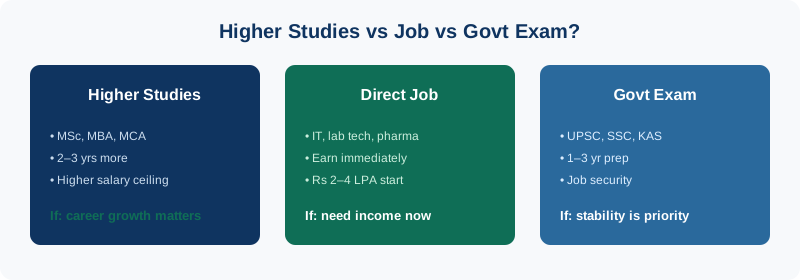
Are you looking for a job quickly or higher studies?
Ask yourself:
-
Do you want a job within 1–2 years?
-
Can your family support you for 2–3 more years of study?
-
Are you open to shifting cities for better institutes?
-
Do you prefer practical work or research and teaching?
-
Are you ready for the entrance exams again?
Quick 5-point decision checklist
-
Map: BSc specialisation → related master’s / professional courses
-
Check: fees, duration, and entrance exam needs
-
Compare: starting salary vs long-term growth (ROI)
-
Assess: your skills in maths, communication, coding, and lab work
-
Decide: higher studies now or a job and part-time course later
Simple comparison box
|
Priority |
Better choice types |
|
Fast job |
Short-term job-oriented courses, MCA, diplomas |
|
Deep subject focus |
MSc, research tracks |
|
High salary growth |
Data Science, MBA, tech roles |
|
Stability |
Govt exams, teaching |
|
Flexibility |
Online/hybrid higher study options |
Best Courses After a BSc Degree– Top Career Paths
MSc After BSc
For students who enjoy their subject and can imagine themselves in labs, universities, or research institutes, an MSc is one of the best courses after a BSc degree. When you ask, “after BSc which course is best? ” this is usually the first academic path people suggest. You deepen your knowledge in areas such as Physics, Chemistry, Mathematics, Computer Science, Biotechnology, Microbiology or Environmental Science.
This route keeps doors open for PhDs, research projects, teaching jobs, and roles in R&D based industries. If you are aiming for top institutes, prepare for entrance exams such as IIT JAM or CUET PG. A good MSc with projects and internships can lead to assistant professor tracks or specialist roles in pharma, analytics, or core labs.
MCA After BSc
For BSc students with a math or computer science background, MCA is a strong step into the IT industry. The course focuses on programming, databases, software engineering, networks, cloud, and sometimes cybersecurity or app development. Many tech companies in India treat MCA graduates at par with BTech for software roles.
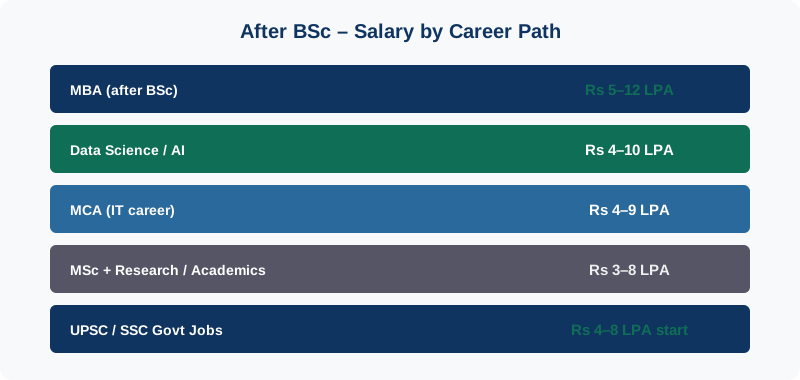
Typical starting salaries range from about 3.5 to 7 LPA, with growth as you gain experience in development, testing, DevOps, or product engineering. If you enjoy coding and logical problem solving, MCA gives you a clear, industry-linked path.
MBA After BSc
An MBA suits students who want to move from pure subject study into management and business roles. After a BSc, you can specialize in Marketing, Finance, HR, Operations, Healthcare, Analytics or General Management. Entrance exams like CAT, MAT, CMAT or state tests decide admission to good colleges.
A BSc plus MBA suits those who can connect technical understanding with business thinking – for example, careers in healthcare management, pharma sales, edtech, IT services, analytics consulting, or operations. Packages vary widely but can grow strongly with performance and networking.
Data Science & AI
Data Science and AI are popular options for BSc graduates who like math, statistics, and coding. Courses usually cover Python, SQL, statistics, machine learning, data visualization tools like Power BI or Tableau, and sometimes deep learning.
You can enter through a specialized MSc in Data Science, a PG diploma, an integrated BSc-MSc, or an industry-focused certification. Typical roles include data analyst, business analyst, junior data scientist, and ML engineer. Salaries for skilled professionals can grow quickly because companies in banking, e-commerce, healthcare, telecom, and startups need people who can turn data into decisions.
Medical & Paramedical Paths
If your BSc is in life sciences such as Zoology, Botany, Biochemistry, Biotechnology or Microbiology, several medical and paramedical routes are available. Options include MSc Medical Lab Technology, Clinical Research, Public Health, Hospital Administration, Nutrition & Dietetics, Radiology, or Physiotherapy-related programs, depending on eligibility.
These courses connect you to hospitals, diagnostic centers, pharma companies, research labs, NGOs, and government health projects. They suit students who want a healthcare-oriented career but do not follow the MBBS route.
Government Exams and Public Sector Roles
Many BSc graduates also prepare for government and public sector exams. Options include SSC CGL, State PSC, Banking, Insurance, Railways, defense, and scientific assistant roles in organizations like ISRO, DRDO or BARC.
This path demands discipline but offers stability and fixed pay scales.
Quick Overview Table – Popular Courses After BSc
|
Course |
Typical Duration |
Approx. Starting Salary (India) |
Best For |
|
MSc |
2 years |
3–6 LPA |
Research, teaching |
|
MCA |
2–3 years |
3.5–7 LPA |
IT and software |
|
MBA |
2 years |
4–10 LPA |
Management roles |
|
Data Science / AI PG |
1–2 years |
5–12 LPA |
Analytics and ML |
|
Medical / Paramedical |
2–3 years |
3–7 LPA |
Healthcare roles |
|
Govt / Public Sector |
Varies |
As per pay scale |
Stable government roles |
Pros and Cons Snapshot
Pros of doing a course after a BSc
-
Higher salary potential and better roles
-
Clearer career identity and specialised skills
Possible challenges
-
Entrance exams and competition
-
Need for steady hard work over extra years
BSc Courses After 12th – Foundation That Shapes Your Future
When students think about future careers, they often start directly with “after BSc which course is best?” But real planning actually begins much earlier - at the stage of BSc courses after 12th. The stream and combination you choose here will decide which master’s degrees, entrance exams, and job options open up later.
In India, most students from 12th Science move into BSc with specializations like Physics, Chemistry, Mathematics, Computer Science, Biotechnology, Microbiology, Zoology, Botany, Environmental Science, or combinations like PCM / CBZ. Commerce and Arts streams also have their own BCom, BA and BBA options, but for this guide we focus mainly on Science based BSc routes.
Your 12th subject choice already sends you towards certain career options after 12th science - medicine, engineering, research, IT, data, pharma, agriculture, design, or government exams. A well-chosen BSc builds a strong base in one cluster instead of keeping everything half open and half closed.
Across Karnataka and other Indian states, BSc admissions generally happen through college merit lists, state-level counselling, or university-level processes. Some central institutes and top universities conduct their own entrance tests or follow CUET. Knowing this early helps you decide whether you want to study in your home state or move to larger education hubs like Bangalore, Chennai, Pune, Hyderabad, or Delhi.
If you pick the right BSc specialization after 12th and stay consistent, the courses you can do after graduation - MSc, MCA, MBA, Data Science, paramedical, or government paths - will feel like natural next steps, not random choices.
Career Options After 12th Science – Long-Term Roadmap
When students and parents discuss future plans, they usually jump straight to engineering or MBBS. In reality, career options after 12th science are much wider, and the decision you make here shapes your BSc choice and the courses you can do later. It helps to see your path as a long-term roadmap, not just “which college this year.”
Broadly, you can see two main tracks - medical and non-medical. The medical side includes MBBS, BDS, BSc Nursing, Physiotherapy, Allied Health, and other clinical options. The non-medical side covers BSc in core sciences, Computer Science, BCA, integrated MSc, engineering, architecture, design, statistics, data, agriculture, and environmental sciences.
Some of the best career options after 12th today lie in emerging fields such as Data Science, AI, robotics, biotech, food technology, environmental management, and clinical research. Many of these begin with a strong BSc base and then move into focused master’s or professional courses.
If you treat 12th Science → BSc → higher studies as one continuous journey, it becomes easier to decide after BSc which course is best for you. Each step should build on the previous one instead of forcing a sudden change of direction.
High-Salary Career Options After BSc
For many students, the big question behind “after BSc which course is best?” is really about earning potential. The good news is that a strong BSc followed by the right master’s or professional course can lead to high-salary careers in India if you choose your path carefully.
Data Scientist / Analyst
With additional training in statistics, Python, and machine learning, BSc graduates can move into data roles. Entry-level data analysts may start around 4–6 LPA in India, but skilled data scientists in metro cities often grow to 12–20 LPA within a few years as they handle bigger projects and teams.
Clinical Research & Pharma
Students from life science backgrounds who complete specialized PG courses in clinical research, regulatory affairs, or pharma management can work with hospitals, CROs, and pharma companies. Starting salaries often range from 3 to 5 LPA, with senior roles crossing 10 LPA as experience and domain expertise increase.
Software Developer / IT Roles
BSc Computer Science plus an MCA or strong coding certifications can open software development and testing roles. Freshers may start around 3.5–7 LPA, but growth is rapid for those who keep upgrading skills and switching to better product or service companies.
Lecturer & Government Jobs
After an MSc and qualifying exams like NET, teaching in colleges offers stable pay and benefits. Similarly, clearing SSC, banking, PSU or scientific assistant exams brings secure government scales, regular increments, and pensions. These paths may demand effort now but usually reward consistency over time.
Short-Term Job-Oriented Courses After BSc
Not everyone wants to spend two or three more years in full-time study. Many students searching “after BSc which course is best” are actually looking for short-term, job-oriented options that can help them start earning faster. The good news is that a BSc gives you enough base to pick focused skill courses that are in demand across India.
Digital Marketing
For BSc graduates with decent communication and interest in online platforms, digital marketing is a strong option. Courses of 3–6 months can lead to roles in SEO, social media, performance marketing, content, and analytics for brands, agencies, and startups.
Medical Coding
Students from life science backgrounds can enter healthcare back-office roles through medical coding certifications. Many hospitals and international process companies hire trained coders for insurance and documentation work.
Cyber Security
If you have a Computer Science or math background, cybersecurity diplomas or PG programs can lead to security analyst roles, which are growing with digitalization and cyber risks.
UI/UX Design
Creative BSc graduates who enjoy design and user behavior can move into UI/UX with practical design courses. These focus on apps, websites, and product interfaces.
These courses do not replace a full master’s, but they can give you an early break into the industry.
Entrance Exams After BSc
Many students who ask, “after BSc which course is best? ” also want to know which entrance exams they should target next. The right exam usually depends on whether you want higher studies, management, technical specialization, or a government job.
IIT JAM and Similar PG Science Exams
If you want to continue in core science through an MSc in IITs, IISc, or top central universities, IIT JAM and similar PG entrances (like CUET PG) are the main route. These tests focus on your BSc subjects in depth.
CAT and Other Management Entrances
For students planning an MBA after a BSc, exams like CAT, MAT, CMAT, XAT and state-level tests open doors to good management institutes. This suits those who want to shift from pure science into business roles.
GATE and Technical Exams
Some interdisciplinary and tech-focused PG programs accept GATE scores, especially for Computer Science or related areas. If your BSc plus math/CS background is strong, this can be a path into advanced technical study.
SSC / Banking and Govt Exams
Many BSc graduates also sit for SSC CGL, Banking, Insurance and state PSC exams for stable government careers.
How CollegesInfo Helps You Choose the Right Course
When you are confused about which course is best, it helps to see all options in one place instead of jumping between random websites. That is exactly where CollegesInfo comes in.
OnCollegesInfo, you can explore different higher study paths like MSc, MCA, MBA, Data Science and paramedical courses, along with basic details on duration, eligibility, and career scope. This makes it easier to compare the best courses after degree BSc based on your background, budget, and eligibility.
You also get guidance articles, entrance exam updates, and practical tips on building a career after a BSc in India. Over time, you can use the site as a reference point whenever you review new options or plan the next step in your journey.
Conclusion
Choosing what to do after a BSc is not a one-line answer. The reply to “after BSc which course is best?” depends on your subject, interests, family support, and how many more years you can study.
If you enjoy your core subject, MSc and related higher studies fit well. If you want faster entry into the industry, MCA, MBA, Data Science, paramedical, or short skill courses may be better, while government and teaching exams offer stability.
FAQ – Best Courses After Degree BSc
1. After BSc which course is best for me?There is no single course that fits everyone. The best option depends on your BSc specialization, interest, and budget. First decide whether you want core subject depth (MSc), industry roles (MCA, MBA, Data Science), or government stability. 2. What are the best courses after degree BSc for a high salary?
For higher salary growth, strong options are Data Science and AI PG programs, MCA for IT, and MBA from a good institute. Clinical research and specialized healthcare PG courses can also give good packages over time. 3. Which BSc courses after 12th are best for future scope?
Popular bsc courses after 12th with good future scope include BSc Computer Science, BSc Biotechnology, BSc Microbiology, BSc Mathematics, BSc Statistics, and interdisciplinary BSc Data Science. Choose based on which subjects you actually like studying.
4. Is an MBA a good choice after a BSc?
Yes, if you are interested in management, marketing, finance, or operations and are ready for exams like CAT or state-level tests. A BSc plus an MBA works well in healthcare, pharma, IT services, and analytics roles.
Yes, especially if you had math or Computer Science and enjoy coding. MCA is one of the best courses after degree BSc for students who want software development or IT careers.
Frequently Asked Questions
What are the best courses after BSc in Karnataka?
Top options include MSc (for research/teaching), MBA (for management), MCA (for IT careers), B.Ed (for teaching), and professional certifications. MSc Biotechnology, MSc Data Science, and MBA are highest in demand for 2026-27.
Can BSc graduates do MBA in Karnataka?
Yes, BSc graduates are eligible for MBA admission through KMAT, CAT, MAT or PGCET. Many Bangalore MBA colleges actively admit BSc graduates, especially for specialisations like Pharmaceutical Management and Healthcare Management.
What is the salary after MSc in Karnataka?
MSc salaries vary by specialisation: MSc Computer Science Rs 4-7 LPA, MSc Biotechnology Rs 3-5 LPA, MSc Chemistry Rs 3-5 LPA, MSc Data Science Rs 6-12 LPA. Academic positions with NET qualification offer Rs 50,000-80,000 per month.
Need Admission Assistance?
Not sure which college suits your rank, category, or budget? WhatsApp our counsellors at +91 6363 330 233 – we help you get the best admission to your preferred colleges without hassle. We help Karnataka students and families with KCET counselling, NEET seat selection, management quota advice, and college shortlisting.
Chat on WhatsAppNeed help with admission?
CollegesInfo.org helps students secure admission to colleges they are eligible for under that college's actual published criteria. Chat with us on WhatsApp or explore admission assistance.