Written by L K Monu Borkala, Founder & Chief Strategist
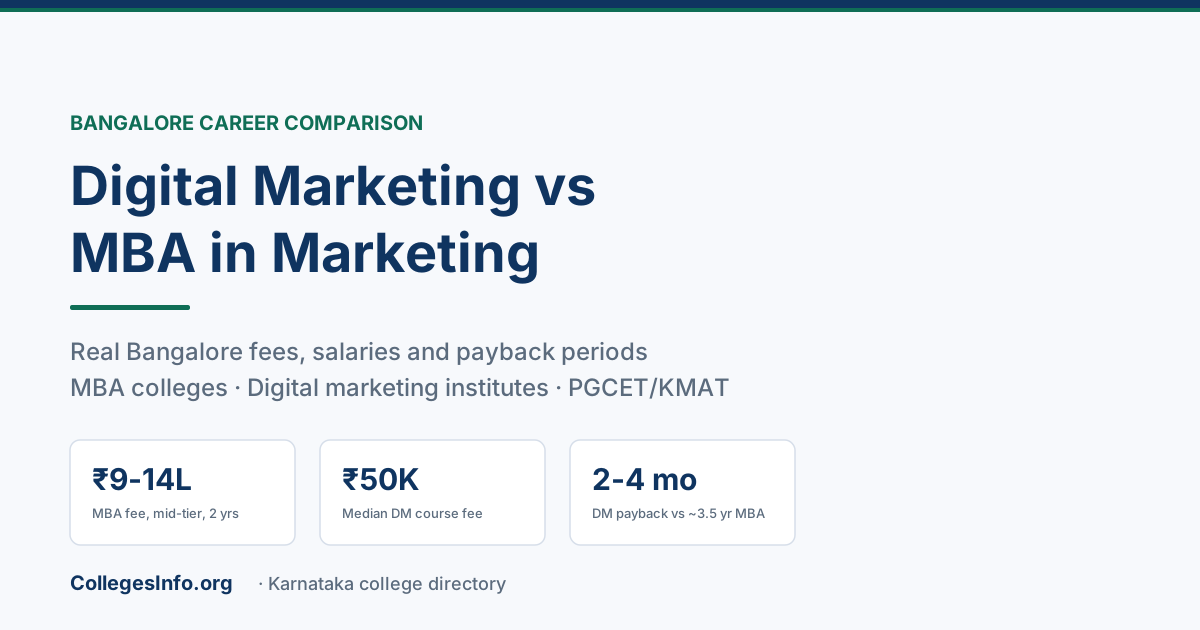
A mid-tier MBA in marketing in Bangalore costs ₹9 to 14 lakh and takes two years before the first salary arrives. A digital marketing course in the same city costs ₹35,000 to 75,000 and most graduates are earning within three months. Neither path is automatically the better bet; this guide runs the real Bangalore numbers on both.
MBA in Marketing vs a Digital Marketing Course: What Each Actually Is
An MBA in marketing is a two-year, full-time postgraduate management degree with marketing as one specialisation alongside finance, HR and operations. It is regulated by the All India Council for Technical Education, requires a bachelor's degree with at least 50% marks (45% for SC/ST candidates under Karnataka's PGCET rules), and is assessed through semester exams, a summer internship and a final project. A digital marketing course is a certificate or diploma programme, usually three to nine months, non-degree, and focused entirely on one function: SEO, paid ads, social media, analytics and content, taught by practitioners rather than academic faculty. There is no entrance exam and, at most Bangalore institutes, no eligibility bar beyond having finished Class 12 or a bachelor's degree.
The confusion between the two is understandable since both claim to lead into "marketing careers." What they actually prepare a candidate for is different enough that cost and payback need to be compared on their own terms, not assumed to be interchangeable.
Cost Comparison: What Each Path Actually Costs in Bangalore
Course fees are the visible cost, but they are not the full cost. An MBA also carries two years of forgone income, while a digital marketing course lets most students keep working, or start earning, almost immediately.
| Path & Tier | Course Fee | Duration | Forgone Income (approx.) |
|---|---|---|---|
| MBA – budget (Presidency, Jain, AIMS) | ₹5 – 11 lakh | 2 years, full-time | ₹5 – 12 lakh (at fresher-level pay) |
| MBA – mid-tier (Christ, IFIM, PES) | ₹9 – 14 lakh | 2 years, full-time | ₹5 – 12 lakh |
| MBA – premium (IIM-B, ISB) | ₹23 – 42 lakh | 1 – 2 years, full-time | ₹5 – 12 lakh |
| Digital marketing – budget | ₹16,000 – 30,000 | 3 – 4 months | Usually none; often done alongside a job |
| Digital marketing – mid-range (most Bangalore institutes) | ₹35,000 – 75,000 | 4 – 6 months | Usually none |
| Digital marketing – premium (agency-style, portfolio-led) | ₹1,44,000 – 2,50,000 | 6 – 9 months | Usually none |
Median digital marketing course fee across the 20 institutes reviewed for CollegesInfo's Bangalore institute guide works out to roughly ₹50,000 to 65,000. That is less than a single semester's tuition at most mid-tier MBA colleges, before the forgone-income gap is even counted.
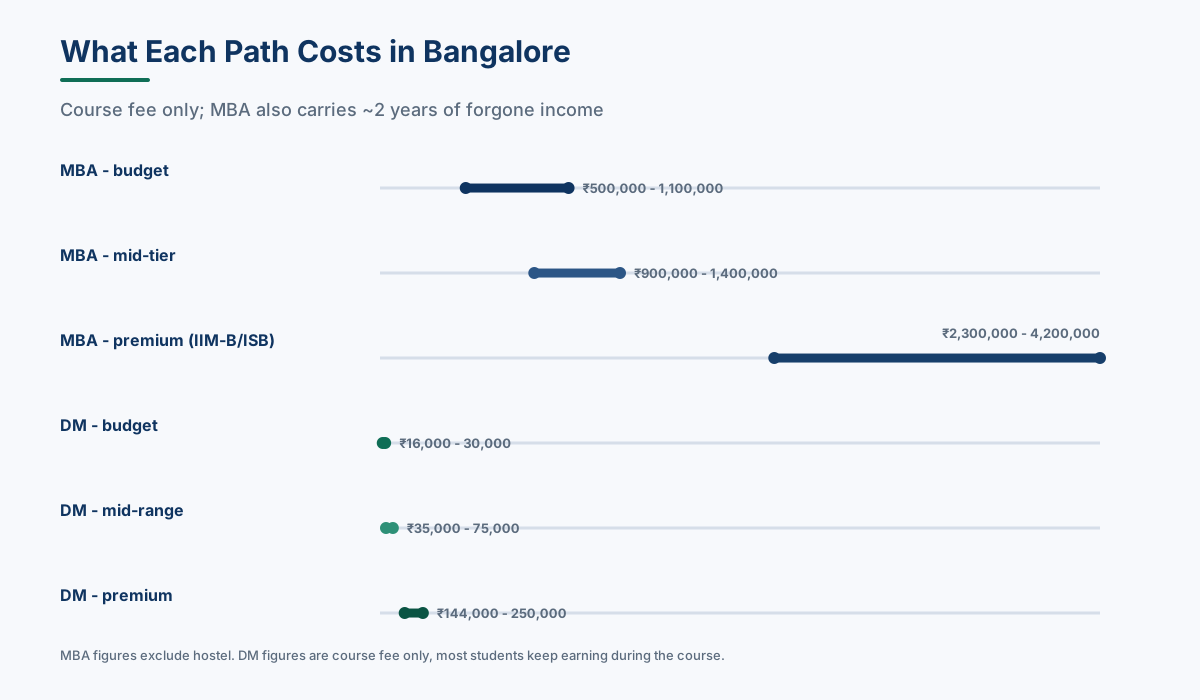
Fee ranges only; MBA figures exclude hostel, and forgone income assumes a ₹2.5–6 lakh fresher-level salary the candidate would otherwise have earned.
Salary and Payback Period: How Long Each Path Takes to Earn Back Its Cost
An MBA in marketing from a mid-tier Bangalore college lands a median salary of roughly ₹6 to 10 lakh a year, per CollegesInfo's MBA-ROI analysis, with Amazon, Flipkart and HUL among the recruiters. Christ University and MS Ramaiah graduates both showed roughly an 18-month payback period against their course fee; IIM Bangalore's much higher fee pays back in about a year because of the salary premium a top-tier brand commands.
Digital marketing pays less at entry and more at the top, spread over a longer curve. CollegesInfo's Bangalore salary data, sourced from AmbitionBox and Glassdoor reports through mid-2026, shows a wider spread than an MBA's single entry-point figure:
| Experience | Digital Marketing Salary (LPA) | Comparable MBA-Marketing Stage |
|---|---|---|
| Fresher (0–1 yr) | ₹2.5 – 6 | Still enrolled, no income |
| Junior (1–3 yrs) | ₹5 – 10 | Graduating, entry salary ₹6 – 10 |
| Mid-level (3–5 yrs) | ₹8 – 15 | 2–3 years post-MBA |
| Senior (5–8 yrs) | ₹15 – 25 | Manager-level post-MBA |
| Leadership (8+ yrs) | ₹25 – 60+ | Senior manager/AVP post-MBA |
A performance marketing or analytics specialist with two to four years of experience already earns ₹7 to 14 lakh, close to what an MBA graduate earns on day one, but for a course that cost a fraction as much and started paying back within months.
1. The MBA path pays back in roughly a year to eighteen months
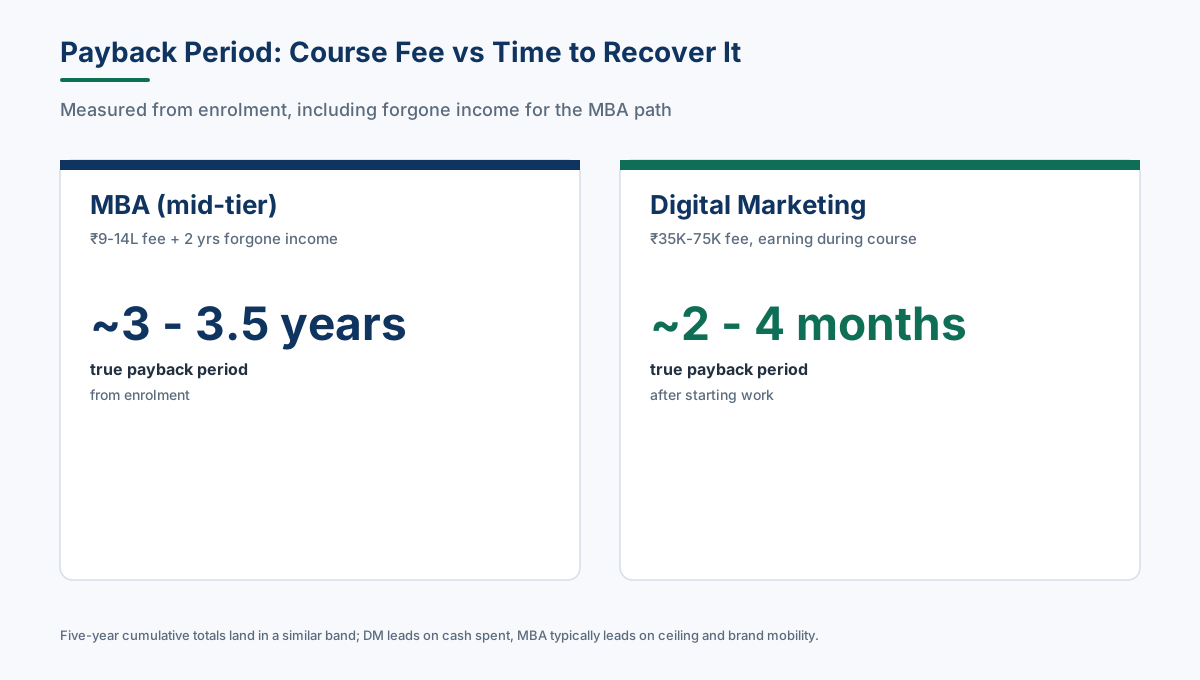
That number looks attractive in isolation, but it starts counting only after two years of tuition and forgone income have already been spent. The true break-even point, measured from enrolment rather than graduation, is closer to three to three-and-a-half years for most mid-tier colleges.
2. The digital marketing path starts paying back almost immediately
A ₹50,000 course fee against a ₹2.5 to 6 lakh fresher salary means the course cost is typically recovered inside the first two to four months of employment, since most students are not giving up an existing income to take it.
3. The five-year total tells a closer story than either path alone admits
Add up fees, forgone income and cumulative earnings over five years and a mid-tier MBA graduate and a digital marketing specialist who reached a performance-marketing or analytics role land within a similar band, with the digital marketing path ahead on cash spent but the MBA graduate typically ahead on ceiling and brand-name mobility.
Career Ceiling: Where Each Track Can Realistically Lead
An MBA in marketing opens brand-management and general-management tracks at large FMCG, e-commerce and consulting firms, roles that often require the MBA credential itself as a filter, regardless of ability. It also transfers more easily into unrelated functions, since the degree signals general management competence rather than one specific skill.
Digital marketing has a narrower entry filter but a comparably high ceiling within its own lane: head-of-digital, marketing director and CMO-track roles pay ₹15 to 60 lakh-plus by year eight or beyond, per the salary table above. The path there runs through demonstrated results, not credentials, which cuts both ways: it rewards people who can show real campaign numbers and penalises those who cannot, regardless of which course they took.

Admission Process: PGCET/KMAT for MBA vs Enrolling in a Digital Marketing Course
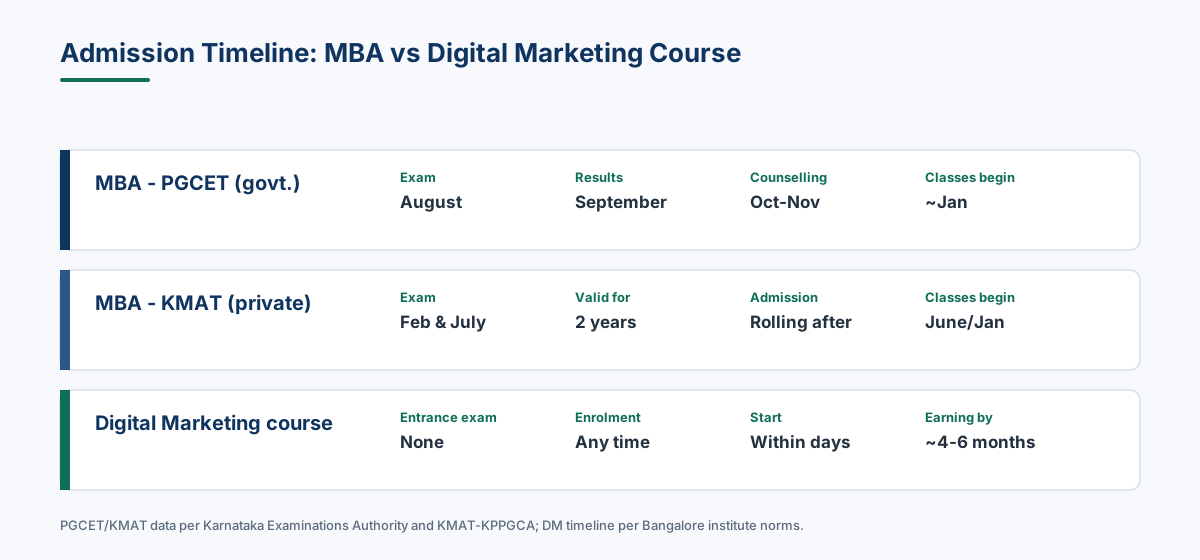
Getting into an MBA programme in Karnataka runs through one of two routes. Government-quota seats go through the Karnataka Examinations Authority's PGCET, held in August with results in September and counselling in October-November. Private-college seats mostly accept KMAT, run twice a year in February and July by the Karnataka Private Post Graduate Colleges Association, with scores valid for two years. Full detail on both routes is in CollegesInfo's Karnataka MBA admission guide.
A digital marketing course has no equivalent gatekeeping. Most Bangalore institutes admit on payment of the fee, sometimes preceded by a short counselling call to confirm the right batch or specialisation track. That removes a full admission cycle from the timeline, which is part of why the digital marketing path can start earning within the same year a decision is made, while an MBA decision made today would not produce a graduate until roughly two-and-a-half years from now, counting the PGCET/KMAT cycle itself.
Who Should Choose Which: A Decision Framework
Three questions decide this better than a generic pros-and-cons list.
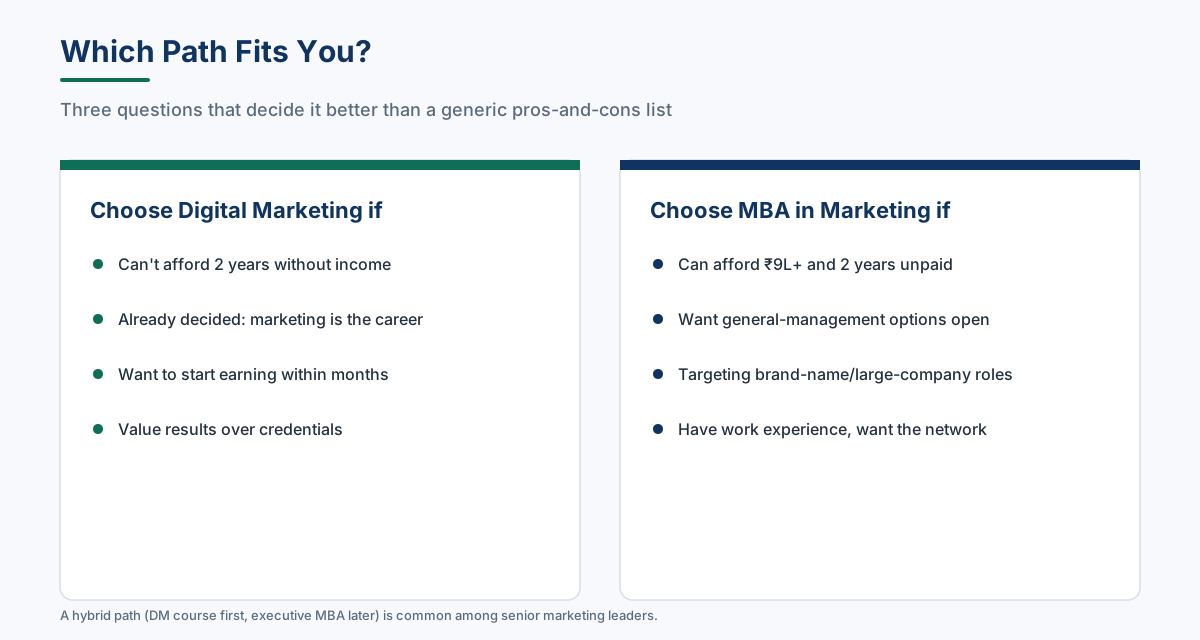
Can you afford two years without income, on top of ₹9 lakh or more in fees? If not, the MBA route is not realistically open regardless of preference, and a digital marketing course that lets you keep earning is the only path that fits the budget. Those who do want to pursue direct MBA admission guidance can start there.
Do you want to stay inside marketing specifically, or keep general-management options open? An MBA is the better bet for someone who might pivot into finance, operations or a completely different function later, or who is targeting a large-company brand-management track that filters by degree. A digital marketing course is the better bet for someone who has already decided marketing, and specifically performance or growth marketing, is the career.
Do you already have two to three years of work experience? Working professionals often get more value from an executive or part-time MBA taken later, once a digital marketing or general marketing role has already established a track record; jumping straight into a full-time MBA at that stage means giving up an existing salary that a fresher wouldn't have had to forgo. CollegesInfo's career-switch guide covers this working-professional route in detail.
Can You Do Both? The Hybrid Path
A growing number of candidates do a digital marketing course first, spend two to three years building a results track record in an agency or in-house team, and then apply to an executive MBA once an employer is willing to co-fund it or once the salary jump justifies the cost without quitting outright. This sequencing captures the fast, low-cost entry that digital marketing offers while keeping the general-management ceiling an MBA provides open for later. It is a longer road than either path taken alone, but it is the one that shows up most often among people who end up in senior marketing leadership roles by their late thirties, per hiring patterns CollegesInfo's freshers' hiring guide tracks across Bangalore companies.
Students still deciding on a stream straight after school should also read digital marketing as a career after 12th and compare it against Karnataka's BBA and MBA college options before committing to either track. For a narrower comparison within digital marketing itself, CollegesInfo's SEO course guide and Google Ads/PPC training guide break down the two highest-paying specialisations named in the salary table above.
Those ready to enrol in a practitioner-taught digital marketing course can review OneCity Academy's Rajajinagar programme, or get admission guidance for an MBA seat if the management-degree route fits the budget and timeline better.
Frequently Asked Questions About Digital Marketing vs MBA in Marketing
Is a digital marketing course better than an MBA in marketing?
Neither is better in every case. A digital marketing course costs far less and pays back faster, and suits someone set on a marketing-specific career. An MBA costs more and takes longer to pay back but opens general-management roles and brand-name mobility a certificate course cannot.
How much does an MBA in marketing cost in Bangalore compared to a digital marketing course?
Mid-tier MBA colleges such as Christ, IFIM and PES charge roughly ₹9 to 14 lakh over two years. A digital marketing course at most Bangalore institutes costs ₹35,000 to 75,000 over four to six months, with a median around ₹50,000 to 65,000 across the 20 institutes CollegesInfo reviewed.
What is the salary difference between MBA marketing graduates and digital marketing professionals?
MBA marketing graduates from mid-tier Bangalore colleges earn a median of ₹6 to 10 lakh at entry. Digital marketing freshers start lower, at ₹2.5 to 6 lakh, but specialists with two to four years of experience in performance marketing or analytics already earn ₹7 to 14 lakh, and senior digital marketing leaders can reach ₹15 to 60 lakh-plus.
Which has a faster payback period, MBA or digital marketing course?
Digital marketing pays back faster in absolute terms, typically within two to four months of starting work, since the fee is small and most students keep earning during the course. An MBA's course fee alone pays back in roughly a year to eighteen months post-graduation, but counting the two years of tuition and forgone income, the true break-even is closer to three to three-and-a-half years from enrolment.
Do I need to take PGCET or KMAT for a digital marketing course?
No. PGCET and KMAT are entrance exams required only for MBA admission in Karnataka. Digital marketing courses have no equivalent entrance exam; most Bangalore institutes admit directly on payment of the course fee.
Can I do a digital marketing course and an MBA later?
Yes, and it is a common sequencing. Many professionals complete a digital marketing course first, build two to three years of results-based experience, and then pursue an executive or part-time MBA once an employer co-funds it or the expected salary jump justifies the cost without quitting a job.
About the Author
OneCity Technologies Pvt. Ltd began in 2006 publishing an annual print education directory for Karnataka students and parents. As demand grew, OneCity launched an education portal in 2019 to bring that same directory information online, and in 2025 relaunched as CollegesInfo.org — a comprehensive Karnataka college directory covering 1,500+ institutions across engineering, medical, management, arts, commerce, and more. Founder L K Monu Borkala brings 20+ years of business experience and 19 years of work across various education-sector services. CollegesInfo.org's content is built from publicly available KEA, NMC, AICTE, and university data, cross-checked against official sources wherever possible. CollegesInfo.org's admission assistance service helps students secure admission to colleges they are eligible for under that college's actual published criteria. We help you get the best admission to your preferred colleges without hassle.
Not sure whether an MBA or a digital marketing course fits your budget and goals?
Our admission assistance team can walk you through both paths and the real costs involved.
This article is for informational purposes only. Consult the college or institute directly before making admission decisions.