An education loan for engineering, medical or management studies in Karnataka typically costs 8.65% to 13.5% interest depending on the bank and loan amount, with loans up to Rs 7.5 lakh usually collateral-free. This guide covers the actual banks, rates, government schemes and documents – not a generic overview, but the specific numbers a Karnataka family needs before walking into a branch.
Why This Decision Deserves More Than a Bank Visit
Most families take an education loan the way they take most financial decisions under time pressure – whichever bank is nearest, or whichever branch manager a relative recommends. That approach usually costs an extra 2 to 3 percentage points of interest over the life of the loan, which on a Rs 15 lakh engineering or medical loan adds up to lakhs of rupees in extra interest over 10 to 15 years.
The good news is that Karnataka students have more options than most families realise, including a government scheme launched specifically to remove the two biggest obstacles – collateral and guarantors – for students at recognised institutions. Whether you're financing a seat at a top engineering college in Karnataka, an MBBS seat, or an MBA or BBA programme, the loan mechanics below apply the same way – only the amount changes.
The Real Interest Rates, Bank by Bank
| Bank / Scheme | Interest Rate | Collateral-Free Limit | Best For |
|---|---|---|---|
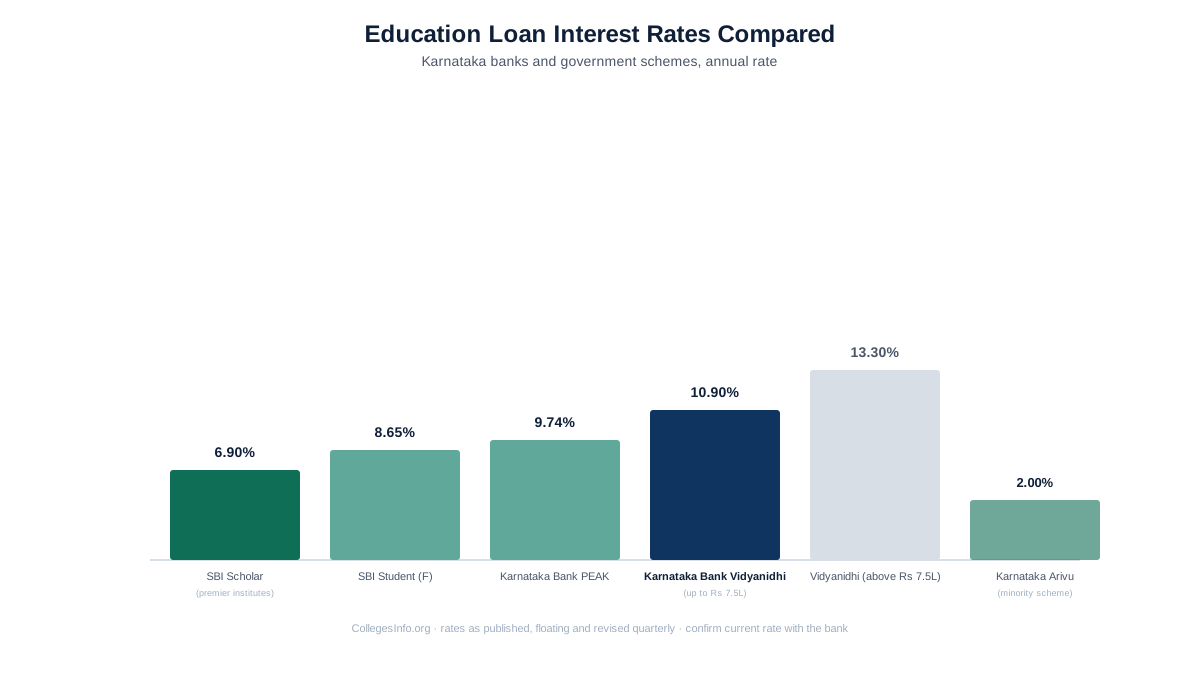
| SBI Student Loan Scheme | 8.9% (male) / 8.65% (female) | Up to Rs 50 lakh | Most students, widest branch network |
| SBI Scholar Loan (IIT/IIM/NIT/AIIMS-tier) | 6.90%–7.65% | Higher ceiling, often no collateral | Students at a small list of premier institutes only |
| Karnataka Bank Vidyanidhi (up to Rs 7.5L) | 10.90%–11.10% | Up to Rs 4 lakh with no margin | Karnataka-domiciled students, local relationship banking |
| Karnataka Bank Vidyanidhi (above Rs 7.5L) | 12.60%–13.30% | Collateral required above Rs 7.5L | Larger loan amounts with security to offer |
| Karnataka Bank KBL PEAK | From 9.74% | Up to Rs 2 crore | Larger loans, flexible repayment up to 15 years |
| PM Vidyalaxmi Scheme (govt-backed) | Standard bank rate, minus 3% subvention if eligible | Fully collateral-free, guarantor-free | Students at ~860 listed top institutions, family income under Rs 8 lakh |
| Karnataka Arivu Scheme (minority students) | 2% flat | Rs 50,000–5,00,000/year | Minority-category students in professional courses |
Rates shown are as published by each lender at the time of writing and are revised quarterly, since most education loans in India are priced on a floating rate linked to the bank's MCLR. Girls get a 0.5% concession at Karnataka Bank and SBI. Confirm the exact current rate directly with the bank before applying.
PM Vidyalaxmi: The Scheme Most Families Don't Know About
Approved by the Union Cabinet and rolled out as a central portal, PM Vidyalaxmi is the best-kept secret in Indian education financing for the right student. If you've secured admission to one of roughly 860 listed Quality Higher Education Institutions – which includes most NIRF-ranked government colleges and several private ones – the loan is fully collateral-free and guarantor-free, with a 75% government credit guarantee protecting the bank for loans up to Rs 7.5 lakh. Families with annual income under Rs 8 lakh get an additional 3% interest subvention during the moratorium period.
The catch is real: not every college in Karnataka is on the QHEI list, and not every course qualifies. Before assuming eligibility, check your specific college against the current list at the PM Vidyalaxmi portal – this is worth doing before you approach any bank, since it changes which scheme is actually your best option.
Collateral, Margin and Moratorium – What These Words Actually Mean
Collateral is security pledged against the loan – property, fixed deposits, or insurance policies. Most banks don't require it below Rs 7.5 lakh. Above that threshold, expect to pledge property or a fixed deposit worth roughly the loan amount.
Margin is the portion of total cost you pay upfront, out of pocket, before the loan covers the rest. Below Rs 4 lakh, most banks charge zero margin. Between Rs 4 lakh and Rs 7.5 lakh, expect a 5% margin for study in India. Above Rs 7.5 lakh, margin requirements vary by bank and scheme.
Moratorium is the grace period before EMI payments start – typically the full course duration plus 6 months to 1 year. Interest still accrues during this period unless you choose to service it, and paying the interest during moratorium (even a small amount) often earns a 0.5% to 1% rate rebate at several banks, which is worth doing if the family can manage it.
Documents You'll Actually Need
- Completed loan application form and passport-size photographs
- Identity and address proof – Aadhaar, PAN card
- Admission letter or offer letter from the institution, and the official fee structure
- Class 10, Class 12 and (for postgraduate loans) graduation mark sheets
- Income proof of the co-applicant – salary slips, IT returns, or bank statements for the last 2–3 years
- Collateral documents, if the loan amount requires them – property papers or FD receipts
- For study abroad specifically: passport, visa documents, and forex requirement estimates
Co-applicant is mandatory for minors regardless of loan amount, and mandatory for all loans above Rs 75 lakh under PM Vidyalaxmi's larger variants. If reserved-category fee concessions also apply to your admission, keep your KCET or COMEDK verification documents handy too, since banks sometimes ask for the same income certificate used for admission fee concessions as supporting income proof.
The Application Route That Actually Saves Time
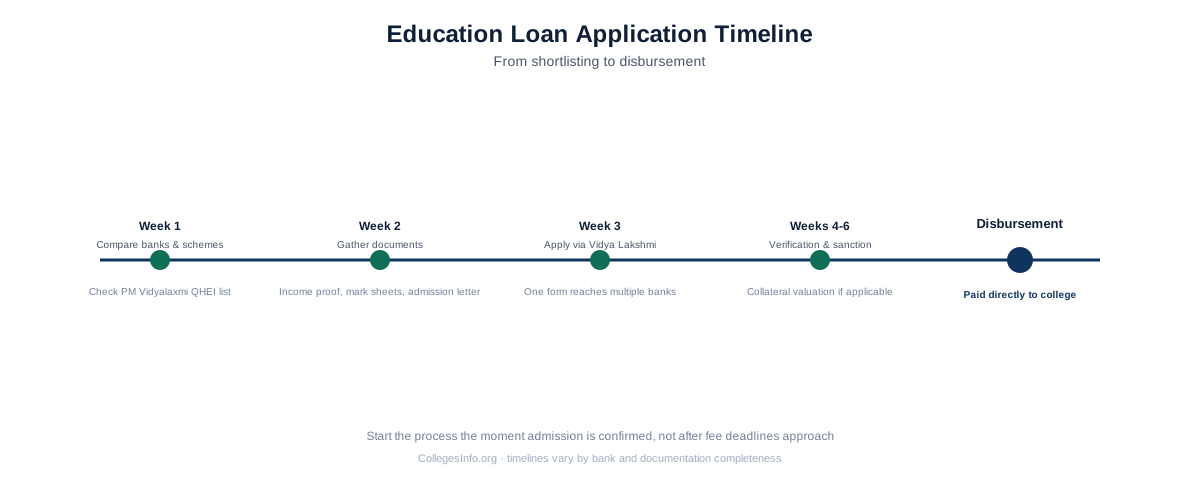
Applying to one bank at a time, branch by branch, is the slow way. The Vidya Lakshmi portal (vidyalakshmi.co.in) lets you submit a single application that reaches multiple banks simultaneously, including SBI, Karnataka Bank, PNB, Canara Bank and others – free, with no middleman fee. For PM Vidyalaxmi specifically, the application routes through the dedicated PM-Vidyalaxmi portal, a separate but related system.
What education loans actually cover, beyond tuition: hostel and mess charges, exam fees, books and a personal computer (capped at 20% of tuition), study tours or thesis expenses, refundable caution deposits, and even commuting costs from hostel to college in some cases. Many families underestimate their loan need by budgeting tuition alone and then scrambling for these costs separately.
A Realistic Example
A Bengaluru family whose child gets a management quota engineering seat at Rs 4 lakh a year (Rs 16 lakh over four years) has three real paths. At Karnataka Bank's standard Vidyanidhi rate near 13%, with collateral pledged for the amount above Rs 7.5 lakh, the total interest over a 10-year repayment works out significantly higher than the principal itself if the family only pays the EMI after moratorium. Servicing the interest during the 4-year moratorium, even partially, meaningfully reduces this. If the same college happens to be on the PM Vidyalaxmi QHEI list and the family income is under Rs 8 lakh, the same loan becomes collateral-free with a 3% subvention – a materially better deal for the identical seat. This is exactly why checking the QHEI list before applying anywhere else is worth the ten minutes it takes.
Families choosing between a management quota engineering seat in Bangalore and a government-quota seat elsewhere in Karnataka should run this loan math for both scenarios before deciding, since a cheaper college with a smaller loan and a shorter repayment tail is sometimes the better financial outcome even against a more prestigious but pricier option.
How Banks Actually Assess Your Application
Understanding the underwriting logic behind an education loan application saves families from being surprised mid-process. Banks assess three things primarily: the co-applicant's income stability (salaried applicants generally move faster than self-employed ones, since income documentation is simpler to verify), the co-applicant's existing debt-to-income ratio (an existing home loan EMI reduces how much additional loan a bank will comfortably sanction), and the co-applicant's credit score, typically expected above 700 for the best available rate.
A co-applicant with a thin or damaged credit history doesn't automatically disqualify the family – it usually means a higher interest rate, a lower collateral-free ceiling, or a requirement for additional security. If the primary co-applicant (usually a parent) has credit issues, banks sometimes accept a second co-applicant, such as a working sibling or an uncle, provided the relationship and financial capacity are documented clearly.
A Worked EMI Example
| Loan Amount | Rate | Tenure | Approx. Monthly EMI (post-moratorium) | Total Interest Paid |
|---|---|---|---|---|
| Rs 10 lakh | 9.5% | 10 years | Rs 12,950 | Rs 5.54 lakh |
| Rs 10 lakh | 11.5% | 10 years | Rs 14,000 | Rs 6.80 lakh |
| Rs 15 lakh | 9.5% | 12 years | Rs 17,650 | Rs 10.42 lakh |
| Rs 20 lakh | 11.5% | 12 years | Rs 24,940 | Rs 15.93 lakh |
These figures are indicative, calculated on standard reducing-balance EMI formulas and excluding any interest paid during moratorium, which would reduce the post-moratorium EMI and total interest further. Every major bank publishes its own EMI calculator – run your specific numbers before assuming any table, including this one, matches your exact situation.
Regional and Cooperative Bank Options Worth Checking
Beyond SBI and Karnataka Bank, Canara Bank (headquartered in Bengaluru) and Union Bank of India both run education loan schemes with competitive rates for Karnataka students, and both participate in the Vidya Lakshmi portal. Canara Bank's Vidya Turant scheme, in particular, is worth a direct comparison for students at NIRF-ranked institutions, since its rate structure sometimes undercuts the larger public banks for mid-sized loan amounts. District cooperative banks and some credit societies also run smaller education loan products, typically at higher rates but with faster, more personal processing for families already banking with them – useful as a bridge loan while a larger bank application is in process, though rarely the best long-term rate.
Study-Abroad Loans From Karnataka: What Changes
Students pursuing study abroad options, including the growing MBBS abroad route, face a different loan calculus. Margin requirements jump to 15% for overseas study versus 0-5% domestically, loan ceilings rise substantially (SBI's Global Ed-Vantage scheme covers up to Rs 3 crore), and interest rates for the same bank typically run 1-2 percentage points higher for abroad study than for an equivalent domestic course, reflecting the higher risk banks assign to recovering a loan if a student doesn't return to India. Foreign exchange fluctuation is an additional risk families rarely price in upfront – a loan sanctioned in rupees against a tuition fee quoted in dollars or euros can leave a funding gap if the rupee weakens between sanction and actual fee payment dates.
If Repayment Becomes Difficult
Missing an EMI is not the end of the road, but it needs to be handled proactively, not silently. Public sector banks generally have a structured process for loan restructuring – extending tenure, temporarily reducing EMI, or granting an additional moratorium extension in genuine hardship cases – but this requires the family to approach the bank before default, not after several missed payments. A loan account marked as a non-performing asset (NPA) affects both the student's and co-applicant's future credit access significantly, including for something as basic as a credit card or a future personal loan, so treating early communication with the bank as the first response to a cash-flow problem, not the last resort, protects the family's financial standing considerably.
Co-Applicant Selection: Why It Matters More Than Families Expect
Most families default to the father as co-applicant without weighing the alternatives, but the choice affects the loan terms on offer. Banks assess the co-applicant's income stability and existing debt load, not just their relationship to the student, and a working mother, an elder sibling with a stable salary, or even a grandparent with a pension and clean credit history can sometimes secure better terms than the family's default choice. This matters most in households where one parent is self-employed with variable income and the other draws a fixed salary – the salaried co-applicant's income documentation is simpler to verify and typically moves the application faster, even if the self-employed parent's actual income is higher.
A second, less obvious consideration: once someone becomes a co-applicant, the loan appears on their credit report and affects their own future borrowing capacity for as long as the education loan is outstanding, typically 10 to 15 years. Families with more than one child likely to need an education loan in the coming years should discuss this upfront, since the same co-applicant's debt-to-income ratio has to absorb multiple loans if the timing overlaps, and a bank may sanction a smaller amount or ask for additional security on a second loan if the first is still substantially outstanding.
Which Financing Route Suits Your Situation
| Your situation | Best starting point |
|---|---|
| Admission at a college on the PM Vidyalaxmi QHEI list, family income under Rs 8 lakh | Apply through PM Vidyalaxmi first – collateral-free with a rate subvention |
| Loan need under Rs 4 lakh, any recognised college | Any bank's standard scheme; no margin required at this level regardless of scheme |
| Minority-category student in a professional course | Check Karnataka Arivu Scheme first – 2% flat rate is unbeatable if eligible |
| Loan above Rs 20 lakh, willing to offer collateral | Compare Karnataka Bank KBL PEAK against SBI's standard scheme directly, since larger amounts see the biggest rate spread between lenders |
| Studying abroad, family income moderate | Start with SBI Global Ed-Vantage or GyanDhan-style comparison across multiple banks; margin and FX risk need separate planning |
Whichever route fits, cross-check it against your actual college choice – a family evaluating RVCE versus MSRIT versus BMSCE, for instance, is also implicitly choosing among three different fee structures, and the loan comparison should happen alongside the college comparison, not after the seat is already locked in.
Scholarships and Loans Work Together, Not Instead of Each Other
Families sometimes treat the scholarship search and the loan search as separate, sequential tasks – apply for scholarships first, and only look at loans if that falls short. It's more efficient to run both in parallel. Karnataka's state scholarship schemes and the SSP portal application process both take weeks to process, and a confirmed scholarship amount reduces the loan principal you need to borrow, which in turn reduces the collateral or margin requirement – sometimes enough to shift a family from the collateral-required bracket into the collateral-free one. Students weighing a mid-rank KCET engineering seat against a costlier option specifically for financing reasons should read that comparison, since it walks through exactly this loan-versus-college-choice trade-off with real numbers.
A Note on Interest Rate Resets
Most education loans in India are priced on a floating rate linked to the bank's external benchmark, usually the Reserve Bank of India's repo rate, meaning the interest rate on an existing loan can rise or fall over the loan's life, not just at sanction. Families should ask specifically how often the bank resets the rate (commonly every three or six months) and request a copy of the amortisation schedule showing how EMI or tenure adjusts when the benchmark moves. A loan that looked affordable at sanction can become materially more expensive over a 10-year term if rates rise, and building a small buffer into the family's monthly budget for this possibility is more realistic than assuming the sanctioned rate holds for the full tenure.
Frequently Asked Questions
1. Do I need collateral for a Rs 10 lakh education loan in Karnataka?
Above Rs 7.5 lakh, most banks require collateral or a guarantor, unless the loan qualifies under PM Vidyalaxmi's collateral-free provision for listed institutions, which extends up to Rs 7.5 lakh with a government credit guarantee, or higher under specific bank schemes for premier institutes.
2. Is the interest rate the same for engineering, medical and management courses?
Rates are generally set by loan amount and collateral status rather than course type, though a few banks price professional courses (medicine, management) slightly differently. Always ask for the course-specific rate rather than assuming a general figure applies.
3. What happens if my child doesn't get a job right after graduating?
The moratorium period (course duration plus 6 months to 1 year) is designed for exactly this. If a job doesn't come through by the end of moratorium, contact the bank before missing an EMI – most public sector banks have restructuring options rather than immediate default classification, but this requires proactively reaching out, not waiting.
4. Can I switch banks partway through if I find a better rate?
Yes, through a balance transfer, though this involves fresh processing and sometimes a small fee. It's worth comparing rates again once the student is in a stronger academic position (better CGPA, cleared backlogs, or a placement offer), since some banks re-price based on updated risk profile.
5. Does taking an education loan affect the co-applicant's future loan eligibility?
Yes – an education loan appears on the co-applicant's credit report like any other loan and factors into their debt-to-income ratio for future borrowing (a home loan, for instance) until it's repaid or transferred.
6. Is there a tax benefit on education loan interest?
Yes, under Section 80E of the Income Tax Act, the co-applicant can claim a deduction on the interest paid (not the principal) for up to 8 years from the year repayment starts, with no upper limit on the deduction amount. Confirm current provisions with a tax advisor since rules are revised in each budget cycle.
7. Can two siblings both take education loans from the same bank simultaneously?
Yes, though the bank will assess the co-applicant's total repayment capacity across both loans combined, not each loan in isolation. Families with two children entering higher education close together should discuss this with the bank upfront rather than assuming each application is evaluated independently.
8. Does a scholarship reduce how much loan I can take?
Most banks ask you to disclose any confirmed scholarship and will factor it into the loan amount sanctioned, since the loan is meant to cover the funding gap, not duplicate money already committed. Karnataka's SSP-administered scholarships and central schemes should be disclosed at application, and confirmed scholarship amounts are typically netted against the sanctioned loan.
This article is for informational purposes only. Confirm current interest rates, eligibility and terms directly with the bank or scheme before applying.
OneCity Technologies Pvt. Ltd began in 2006 publishing an annual print education directory for Karnataka students and parents. As demand grew, OneCity launched an education portal in 2019 to bring that same directory information online, and in 2025 relaunched as CollegesInfo.org – a comprehensive Karnataka college directory covering 1,500+ institutions across engineering, medical, management, arts, commerce, and more. Founder L K Monu Borkala brings 20+ years of business experience and 19 years of work across various education-sector services. CollegesInfo.org's content is built from publicly available KEA, NMC, AICTE, and university data, cross-checked against official sources wherever possible. CollegesInfo.org's admission assistance service helps students secure admission to colleges they are eligible for under that college's actual published criteria. We help you get the best admission to your preferred colleges without hassle.
WhatsApp +91 6363 330 233 for admission guidance on colleges, courses and the financing questions that come with them.
Need help with admission?
CollegesInfo.org helps students secure admission to colleges they are eligible for under that college's actual published criteria. Chat with us on WhatsApp or explore admission assistance.