MBBS Colleges in Karnataka 2026-27
71 colleges offering MBBS — compare fees, eligibility & placements
About MBBS
MBBS (Bachelor of Medicine and Bachelor of Surgery) is a 5.5-year undergraduate medical degree — 4.5 years of academic study plus a mandatory 1-year rotating internship — required to practise as a doctor in India. It remains the single most sought-after professional course among Karnataka's science stream students, and admission runs entirely through one national exam: NEET UG.
Published: April 2026 | Updated: July 2026
NEET UG — The Only Route to MBBS
Unlike engineering, where KCET, COMEDK, and JEE Main all offer separate pathways, MBBS admission in India has exactly one entrance exam: NEET UG, conducted by the National Testing Agency (NTA). There is no institutional or management-quota bypass around NEET — every MBBS seat in the country, government or private, is filled using a NEET rank.
Who Regulates MBBS Education in India
Medical education in India is regulated by the National Medical Commission (NMC), a statutory body established under the National Medical Commission Act, 2019, which replaced the older Medical Council of India (MCI) in 2020. NMC sets the curriculum standards, approves new medical colleges and seat increases, and maintains the National Medical Register of licensed doctors. If you come across older articles or forum posts referencing "MCI approval," that terminology is outdated — NMC recognition is what actually matters for any medical college today.
NEET UG Eligibility and Exam Pattern
- Eligibility: Passed 10+2 with Physics, Chemistry, Biology/Biotechnology, and English, with a minimum aggregate typically around 50% for General category (45% for OBC, 40% for SC/ST/PwD, though exact percentages can be revised — confirm current-year criteria on the NTA's official notification)
- Age: Minimum 17 years at the time of admission; there is currently no upper age limit following a Supreme Court ruling that removed the previous cap
- Exam pattern: A single pen-and-paper exam covering Physics, Chemistry, and Biology (Botany + Zoology), objective/multiple-choice format
- Attempts: No official cap on the number of attempts, subject to the age eligibility criteria in force for that year
Karnataka MBBS Admission Structure
Once NEET results are declared, Karnataka's MBBS seats are filled through two parallel counselling tracks:
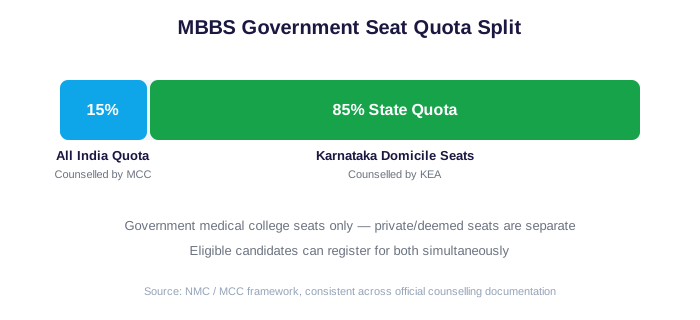
- All-India Quota (15%): Government college seats reserved for the national merit list, counselled by MCC (Medical Counselling Committee)
- State Quota (85% + private colleges): Karnataka-domicile seats at government colleges plus all private/deemed college seats, counselled by KEA
Government college fees in Karnataka are heavily subsidised — typically Rs 15,000-50,000 per year — while private and deemed university MBBS seats range from roughly Rs 5-25 lakh per year depending on the institution.
How Many MBBS Seats Does India — and Karnataka — Actually Have?
Estimates for the total number of MBBS seats nationally vary meaningfully across sources — figures ranging from roughly 1.08 lakh to 1.3 lakh appear depending on when the source was published and whether newly-approved colleges are included, so treat any single precise national figure with some caution and always verify the current year's number directly on the NMC or MCC website before making decisions based on it. What's consistently agreed across sources: roughly 15% of government seats nationally go through the All India Quota, the remaining 85% through state quotas, and Karnataka is consistently ranked among the top 3-5 states by total MBBS seat count in India, alongside states like Maharashtra, Tamil Nadu, and Uttar Pradesh.
Category-Wise Reservation in NEET Counselling
Reservation in government MBBS seats follows a consistent national framework, applied both in AIQ and (with some state-specific variation) in state quota counselling:
| Category | Reservation |
|---|---|
| Scheduled Caste (SC) | 15% |
| Scheduled Tribe (ST) | 7.5% |
| Other Backward Classes (OBC) | 27% |
| Economically Weaker Section (EWS) | 10% |
| Persons with Disabilities (PwD) | 5% (horizontal, across categories) |
This is the central AIQ framework. Karnataka's own state quota reservation matrix has additional category subdivisions specific to the state — always check the current KEA counselling brochure for exact state-quota percentages rather than assuming the AIQ figures apply identically.
Course Structure
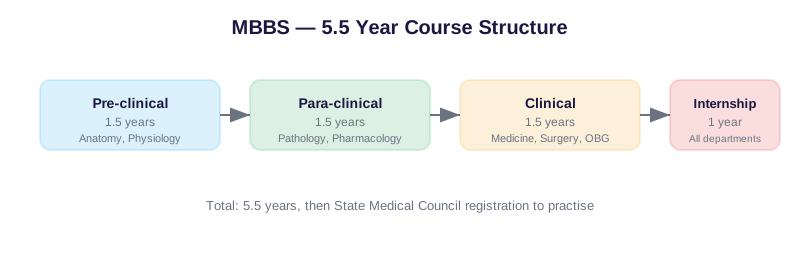
| Phase | Duration | Focus |
|---|---|---|
| Pre-clinical | 1.5 years | Anatomy, Physiology, Biochemistry |
| Para-clinical | 1.5 years | Pathology, Pharmacology, Microbiology, Forensic Medicine |
| Clinical | 1.5 years | Medicine, Surgery, Obstetrics & Gynaecology, Paediatrics |
| Internship | 1 year | Mandatory rotating clinical internship, all departments |
Government vs Private vs Deemed University — What the Fee Actually Buys
All three college types award an identical, NMC-recognised MBBS degree with the same legal standing to practise — the degree certificate doesn't distinguish where you studied once you're registered with the state medical council. What differs is cost, competition level, and campus experience:
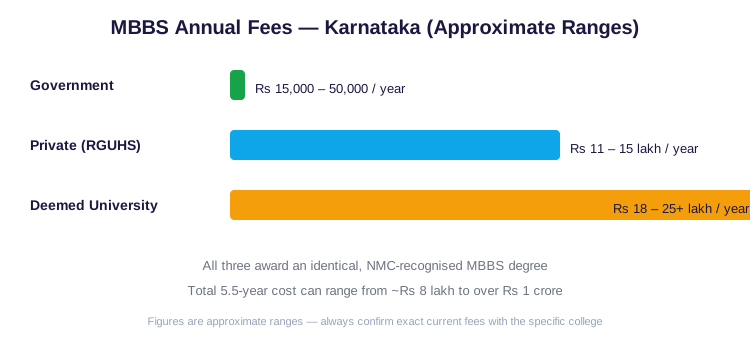
- Government colleges: Lowest fees (Rs 15,000-50,000/year), highest NEET score requirement, seats filled via AIQ/state quota merit only
- Private (RGUHS-affiliated) colleges: Moderate-to-high fees (roughly Rs 11-15 lakh/year in management quota), somewhat more accessible cutoffs than government colleges
- Deemed universities: Highest fees (often Rs 18-25 lakh/year or more), typically the most accessible cutoffs of the three, but with the highest total cost of the degree by a significant margin
Given how large the fee gap can be — potentially exceeding Rs 1 crore in total cost between a government seat and a deemed university seat — it's worth thoroughly exploring every government and All India Quota option realistically available to your rank before committing to a high-fee private or deemed seat. Our education loan calculator can help you plan financing if a higher-fee option ends up being the right fit for your situation.
Step-by-Step: How NEET Counselling Actually Works
- Appear for and clear NEET UG with a qualifying score for your category
- Register separately for AIQ (via MCC) and Karnataka state quota (via KEA) — these are two distinct registration processes, and you can register for both simultaneously since they don't overlap in seat pools
- Document verification — marksheets, NEET scorecard, category/domicile certificates as applicable
- Choice filling — rank colleges and quota types in genuine order of preference across both AIQ and state quota lists
- Seat allotment happens in multiple rounds (typically Round 1, Round 2, a mop-up round, and sometimes a stray vacancy round) — don't assume your final outcome is decided in Round 1 alone
- Report to the allotted college within the specified deadline with original documents to confirm admission
A genuinely common mistake: assuming AIQ and state quota are mutually exclusive or that registering for one forfeits the other. You can and generally should register for both, since they draw from separate seat pools — but you can't hold seats in both simultaneously once allotted, so understand the acceptance/upgrade rules for each before Round 1 results are out.
After MBBS — Career Paths
MBBS graduates can register with the state medical council and practise as general physicians, or pursue further specialisation:
- MD/MS (Postgraduate): 3-year specialisation via NEET PG, in non-surgical (MD) or surgical (MS) fields
- Government service: Karnataka Health Department postings, PHC/district hospital roles
- Private practice or hospital employment: Immediate practice after internship and state registration
Starting salaries for fresh MBBS graduates typically range from Rs 5-10 LPA, with specialists (post-MD/MS) earning significantly more depending on specialisation and practice setting.
Documents Required for NEET Counselling
- NEET UG admit card and scorecard (original and photocopies)
- 10th and 12th marksheets and passing certificates
- Transfer certificate and migration certificate
- Category certificate (SC/ST/OBC/EWS), issued by a competent authority, if claiming reservation
- Domicile/residence certificate for Karnataka state quota eligibility
- Income certificate, if applicable for fee concession eligibility
- Passport-size photographs and valid photo ID (Aadhaar or equivalent)
- For NRI quota: passport, visa, and sponsor/relationship documentation as applicable
Keep both originals and multiple sets of attested photocopies ready well before counselling begins — document verification at this stage is strict, and a single missing certificate can delay your reporting or, in the worst case, cost you an allotted seat within the reporting deadline.
Common Mistakes Applicants Make
- Registering for only one of AIQ or state quota — most eligible candidates should register for both to maximize genuine options, not just the one that seems more familiar
- Filling too few choices in the preference list — a short list increases the risk of an unfilled seat if cutoffs shift unexpectedly; filling every realistic option costs nothing extra
- Assuming a deemed university's higher fee automatically means better outcomes — verify actual placement/practice-readiness outcomes and NMC recognition status rather than assuming price correlates with quality
- Not checking category-specific cutoffs separately — OBC, SC, ST, and EWS candidates often have meaningfully more accessible options than the General Merit cutoff figures most guides quote
- Paying any amount to an agent claiming guaranteed seat access — legitimate admission happens only through official NEET counselling (AIQ via MCC, state quota via KEA) or, for management quota specifically, directly with the college's admissions office against a written offer
MBBS vs Other Medical and Allied Health Degrees
Students who don't clear NEET at a rank sufficient for their preferred MBBS option sometimes assume there's no alternative path into healthcare. That's not accurate — several genuine alternatives exist, each with a different scope of practice:
| Degree | Duration | Scope of Practice |
|---|---|---|
| MBBS | 5.5 years | Full allopathic medical practice, all specializations via further PG study |
| BDS | 5 years | Dental practice specifically, not general medicine |
| BAMS | 5.5 years | Ayurvedic medicine practice, NCISM-regulated |
| BHMS | 5.5 years | Homeopathic medicine practice, NCH-regulated |
| BSc Nursing | 4 years | Nursing practice, hospital and community health roles |
All of these require NEET-UG (the same single exam covers admission to MBBS, BDS, and the AYUSH degrees together), so a NEET attempt keeps every one of these doors open simultaneously — you're not required to decide between them before the exam, only when filling counselling choices afterward.
The Internship Year — What It Actually Involves
The final 1-year rotating internship is a mandatory, paid (in most government institutions) clinical training period, not an optional add-on. Interns rotate through major departments — Medicine, Surgery, Obstetrics & Gynaecology, Paediatrics, Orthopaedics, and Community Medicine among others — typically spending 2-4 weeks to a couple of months in each, under the supervision of senior residents and faculty. This year is when theoretical training translates into actual clinical competence, and NMC requires its satisfactory completion before permanent registration as a licensed doctor is granted. Skipping or inadequately completing internship postings is not an option if you intend to register and practise.
NEET Preparation — A Realistic Timeline
Most successful NEET candidates begin serious, structured preparation at the start of 11th grade, running roughly 18-24 months of consistent study through the exam date, rather than a short intensive burst in the final months before the exam. Biology typically carries the highest weightage in the exam and is often the most scoring section relative to preparation time invested, followed by Chemistry, with Physics generally considered the most time-intensive per mark scored by most aspirants. Regardless of which coaching approach or self-study method you choose, consistent practice with previous years' question papers and full-length mock tests under timed conditions is considered one of the most reliable predictors of exam-day performance improvement, more so than accumulating additional reference material alone.
What to Check Before Choosing a Medical College
Beyond NEET cutoff and fees, a few things are worth verifying directly rather than assuming: current NMC recognition status (a college can lose recognition, so don't rely on an old brochure), the attached teaching hospital's actual bed capacity and patient volume (since clinical exposure during your training depends heavily on this), and faculty-to-student ratios in clinical departments. For private and deemed colleges specifically, ask for the exact, itemized fee structure in writing before paying any amount — hostel, mess, and "development" fees are sometimes quoted separately from tuition and can add up to a meaningfully different total than the headline tuition figure suggests.
NRI Quota — A Separate, Smaller Pathway
Most private and deemed medical colleges reserve a small percentage of seats (commonly around 15% of the management quota allocation, though this varies by institution) specifically for NRI candidates or their sponsored relatives. NRI quota still requires a valid NEET-UG score to be eligible, but typically comes with a different — usually higher — fee structure, often payable in foreign currency or requiring specific sponsorship documentation proving the NRI relationship. If you're exploring this route, request the exact eligibility criteria and fee structure directly from the college's admissions office in writing, since NRI quota terms vary more between institutions than standard management quota terms do.
Choosing Between AIQ and State Quota Strategically
Since you can register for both AIQ and Karnataka state quota simultaneously, the real strategic question isn't which one to pick, but how to rank your preferences within each. A common, reasonable approach: place your most aspirational government college choices at the top of both lists, since AIQ can sometimes offer access to strong government colleges in other states that might have a slightly more favorable cutoff for your specific rank than the equivalent Karnataka option, purely due to regional variation in applicant volume. Don't assume your home state option is automatically your best option just because it's more familiar — compare actual closing ranks across both lists for colleges you'd genuinely be willing to attend.
MBBS Abroad — A Brief, Honest Comparison
Some families consider MBBS abroad (commonly Russia, Georgia, the Philippines, or Central Asian countries) as an alternative when domestic NEET-based options don't work out for their rank or budget. A few honest points worth knowing before going this route: you still need to clear NEET-UG to be eligible to practise in India after an abroad MBBS, since the Foreign Medical Graduate Examination (FMGE) — now integrated into the NEXT exam framework under NMC's newer regulations — is mandatory for any foreign MBBS graduate wanting to practise in India, and pass rates on this screening exam have historically been a genuine concern rather than a formality. Total costs abroad can sometimes be lower than a high-fee private or deemed university seat in India, but the combined cost of the abroad degree plus adequate FMGE/NEXT preparation, and the genuine risk of not clearing that screening exam, needs to be weighed carefully rather than treated as an automatic cost-saving shortcut. This is a decision worth discussing with a knowledgeable advisor who can walk through your specific NEET score, budget, and risk tolerance rather than deciding based on an agent's marketing pitch alone.
State Medical Council Registration — The Final Step
Completing MBBS and the internship year doesn't automatically make you a licensed practitioner — the final required step is registering with your State Medical Council (in Karnataka's case, the Karnataka Medical Council), which issues the registration number you'll need for every subsequent professional activity, from prescribing medication to applying for postgraduate seats. This registration also gets recorded in the National Medical Register maintained by NMC, which serves as the national database of all licensed medical practitioners in India. Processing this registration promptly after internship completion avoids unnecessary delays if you're planning to immediately pursue NEET PG or start practising.
Frequently Asked Questions
Can I get MBBS admission without NEET?
No. NEET UG is mandatory for every MBBS seat in India — government, private, deemed university, and even NRI quota seats all require a valid NEET score.
What NEET score is needed for a government MBBS seat in Karnataka?
This varies by college and year, but competitive government colleges in Bangalore and Mysuru typically require NEET scores in the 550+ range for General Merit. District-level government colleges and reserved categories have more accessible cutoffs. Always verify current-year cutoffs directly with KEA.
How much does private MBBS cost in Karnataka?
Private RGUHS-affiliated colleges typically charge Rs 11-15 lakh per year in management quota, while deemed universities can range from Rs 18-25 lakh per year. Total 5.5-year cost varies enormously — from around Rs 8 lakh at a government college to over Rs 1 crore at some private deemed universities.
What is the difference between MD and MS after MBBS?
MD (Doctor of Medicine) covers non-surgical specialities like General Medicine, Paediatrics, Dermatology, and Psychiatry. MS (Master of Surgery) covers surgical specialities like General Surgery, Orthopaedics, and ENT. Both are 3-year postgraduate programmes entered via NEET PG.
What replaced the Medical Council of India (MCI)?
The National Medical Commission (NMC), established under the NMC Act, 2019, took over MCI's regulatory functions in 2020. Any reference to "MCI approval" for a college today is outdated terminology — NMC recognition is what matters now.
Can I register for both AIQ and Karnataka state quota counselling?
Yes. These are separate registration processes drawing from different seat pools, and most eligible candidates register for both to maximize their options. You can't hold seats in both simultaneously once allotted, so understand each system's acceptance rules before results are announced.
Is there an age limit for NEET UG?
The minimum age is 17 at the time of admission. There is currently no upper age limit following a Supreme Court ruling, though it's worth confirming this hasn't changed for the specific year you're applying, since eligibility rules are occasionally revised.
Do government and private MBBS degrees carry different value?
No — both are NMC-recognised MBBS degrees with identical legal standing to practise medicine and register with the state medical council. The difference is in cost, competitiveness of admission, and campus/clinical exposure, not in the qualification itself.
What happens during the internship year if I don't complete it properly?
NMC requires satisfactory completion of all internship rotations before granting permanent registration. Incomplete or unsatisfactory internship postings can delay your registration as a licensed doctor, so treat this final year with the same seriousness as the academic years before it.
Is NRI quota a way to bypass NEET?
No. NRI quota still requires a valid NEET-UG score for eligibility — it changes the fee structure and sponsorship documentation required, not the entrance exam requirement itself.
Confused about NEET counselling or MBBS college options in Karnataka? WhatsApp +91 6363 330 233 with your NEET score and category. We help you get the best admission to your preferred colleges without hassle.
Related Guides
- Browse all Medical colleges in Karnataka
- NEET 2026 Complete Guide for Karnataka Students
- NEET Cutoff for Karnataka Medical Colleges
- Karnataka Private MBBS Colleges — Fees and Cutoffs
- Management Quota MBBS Karnataka — Real Fees
- What to Do After NEET Result — Action Plan
- Government MBBS Colleges Karnataka — Cutoff and Seats
- KCET Rank Predictor (for students also considering KCET-based streams)
- MD/MS — Postgraduate Medical Specialisation
- Education Loan Calculator
Official Sources: National Medical Commission (NMC) | Medical Counselling Committee (MCC)
71 Colleges Offering MBBS in Karnataka
Alva's Ayurveda Medical College
KLE Ayurveda Medical College
BMCRI (Bangalore Medical College & Research Institute)
MS Ramaiah Medical College
St John's Medical College
Kempegowda Institute of Medical Sciences
Mysore Medical College & Research Institute
JSS Medical College Mysore
Kasturba Medical College Mangalore
Father Muller Medical College
Karnataka Institute of Medical Sciences Hubli
Hassan Institute of Medical Sciences
SDM College of Medical Sciences Dharwad
Kasturba Medical College Manipal
Raichur Institute of Medical Sciences
SDM College of Ayurveda & Hospital Hassan
Father Muller Homoeopathic Medical College
Government Ayurveda Medical College
Government Ayurveda Medical College & Hospital, Mysuru
Taranath Government Ayurvedic Medical College
Sri Kalabyraveshwara Swamy Ayurvedic Medical College
Vydehi Institute of Medical Sciences
Dr BR Ambedkar Medical College
RajaRajeswari Medical College & Hospital
BGS Global Institute of Medical Sciences
The Oxford Medical College
Sapthagiri Institute of Medical Sciences
MVJ Medical College & Research Hospital
ESI-PGIMSR Rajajinagar
Bowring & Lady Curzon Medical College
Bangalore Baptist Hospital College of Nursing
Yenepoya Medical College
KS Hegde Medical Academy (KSHEMA)
AJ Institute of Medical Sciences
JN Medical College Belgaum (KLE)
JJM Medical College Davangere
BLDEA's Medical College Vijayapur
Mahadevappa Rampure Medical College
SIMS (Shimoga Institute of Medical Sciences)
Vijayanagar Institute of Medical Sciences Bellary
BIMS (Belgaum Institute of Medical Sciences)
Gulbarga Institute of Medical Sciences
Adichunchanagiri Institute of Medical Sciences
KVG Medical College Sullia
Subbaiah Institute of Medical Sciences Shimoga
Mandya Institute of Medical Sciences
Kodagu Institute of Medical Sciences
Bidar Institute of Medical Sciences
Chikkaballapur Institute of Medical Sciences
Govt Ayurveda Medical College Mysuru
Taranath Govt Ayurvedic Medical College Ballari
JSS Ayurveda Medical College Mysuru
Sri Sri College of Ayurvedic Science Bangalore
Sharada Ayurveda Medical College Mangalore
DGM Ayurveda Medical College Gadag
BVVS Ayurveda Medical College Bagalkot
National Institute of Ayurveda Ramanathapura
Govt Homoeopathic Medical College Bangalore
KLE Homoeopathic Medical College Belagavi
SJG Ayurvedic Medical College Koppal
Bapuji Homoeopathic Medical College Davangere
Sri Dharmasthala Manjunatheshwara Ayurveda College Udupi
Sri Siddhartha Medical College Tumkur
Basaveshwara Medical College Chitradurga
Navodaya Medical College Raichur
Karwar Institute of Medical Sciences
Chamarajanagar Institute of Medical Sciences
Koppal Institute of Medical Sciences
Gadag Institute of Medical Sciences
Haveri Institute of Medical Sciences
Yadgir Institute of Medical Sciences
Related Medical Courses
BAMS
BHMS
BSc MLT
BSc Optometry
BPT
MD / MS
BSc Radiology
BSc Cardiac Technology
BSc Anaesthesia Technology
BSc Dialysis Technology
BMLT
Need Help With MBBS Admissions?
Free expert guidance for MBBS colleges in Karnataka 2026-27
💬 WhatsApp Admission Guidance