Quick Facts: BSc Food Technology in Karnataka
| Degree names you'll see | BSc Food Technology, B.Tech Food Science and Technology, BSc (Hons) Food, Nutrition and Dietetics |
|---|---|
| Duration | 3 years (BSc) or 4 years (B.Tech-style food technology degrees at agricultural universities) |
| Anchor institutions | University of Agricultural Sciences, Bengaluru (GKVK) and University of Agricultural Sciences, Dharwad |
| Entrance routes | KCET, ICAR AIEEA, direct merit for private colleges |
| Typical annual fees | Approximately Rs 10,000–30,000/year at government agricultural universities; higher at private institutions |
| Where it's concentrated | Bengaluru (GKVK campus) and Dharwad, with smaller programmes at a few private colleges |
If you're looking for a BSc Food Technology seat in Karnataka, the honest starting point is this: it's a much smaller, more concentrated field here than biotechnology or microbiology. The two real anchors are both agricultural universities – University of Agricultural Sciences, Bengaluru (UAS Bengaluru, at the GKVK campus) and University of Agricultural Sciences, Dharwad (UAS Dharwad) – rather than a wide spread of private colleges. That's not a bad thing; it just means your college shortlist for this specific degree is shorter and more specific than for more general science degrees, similar to how Environmental Science is concentrated at a handful of dedicated university departments rather than spread across dozens of colleges.
What Food Technology Actually Covers
Food technology sits at the intersection of food science, microbiology, and engineering. You're studying how raw agricultural produce – grains, milk, fruit, meat, fish – gets processed, preserved, packaged, and turned into something that's safe, shelf-stable, and commercially viable. UAS Dharwad's own programme description breaks this down into distinct areas: food processing and value addition to grains, pulses, oilseeds, fruits, vegetables, spices, milk, meat and fish; food engineering, which applies engineering principles to processing machinery; food and industrial microbiology, covering fermentation and food safety; and food science and nutrition, covering chemistry and food analysis techniques. It's an applied, industry-facing degree – not a pure lab-science track like microbiology or biotechnology tend to be.
Why Karnataka Specifically
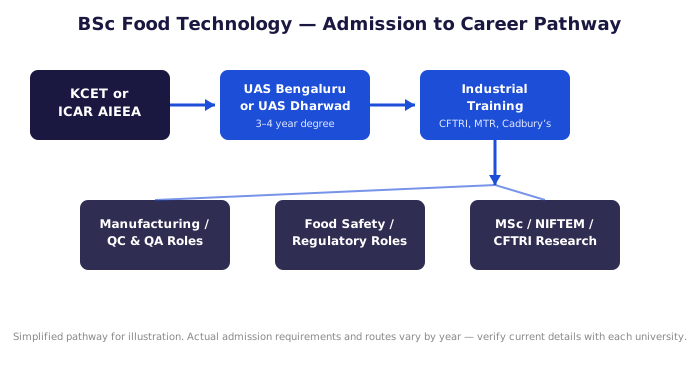
Karnataka has a real, structural reason to have strong food technology programmes: it's home to CFTRI (Central Food Technological Research Institute) in Mysuru, one of India's most important food research institutions, and a genuine cluster of food processing companies – Cadbury's, MTR Foods, Unibic Biscuits, Maiya's Foods, United Breweries, and CAMPCO among them. UAS Bengaluru's own Food Science and Technology Department page names these exact companies as the sites where its students complete their eighth-semester industrial training, which tells you the placement pipeline here isn't hypothetical – it's built directly into the curriculum.
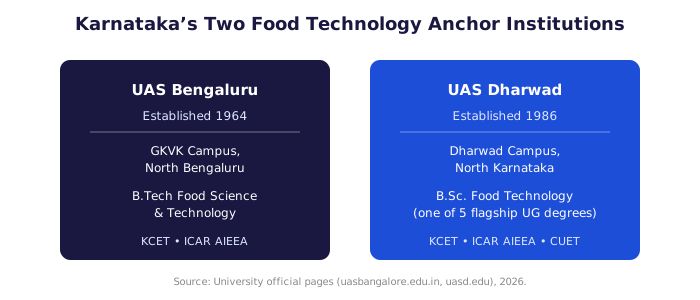
UAS Bengaluru was established in 1964 as Karnataka's first agricultural university, and its Food Science and Technology Department runs alongside its better-known agriculture and biotechnology programmes at the GKVK campus in Bengaluru. UAS Dharwad was carved out of UAS Bengaluru in 1986, covering seven districts of north Karnataka – Dharwad, Belagavi, Gadag, Haveri, Uttara Kannada, Bagalkot and Vijayapura – and lists B.Sc. (Food Technology) as one of just five undergraduate degree programmes offered across its network of colleges, alongside Agriculture, Agricultural Marketing, Forestry, and Home Science. That's a meaningful signal: food technology isn't a minor elective bolted onto a broader science degree here, it's one of a small, deliberate set of flagship programmes.
Comparing Your Main Options
| Institution | City | Established | Degree on offer | Entry route |
|---|---|---|---|---|
| University of Agricultural Sciences, Bengaluru (GKVK) | Bengaluru | 1964 | B.Tech Food Science & Technology; BSc (Hons) Food, Nutrition and Dietetics | KCET, ICAR AIEEA |
| University of Agricultural Sciences, Dharwad | Dharwad | 1986 | B.Sc. (Food Technology) | KCET, ICAR AIEEA, CUET |
A quick word on the degree-naming confusion, because it trips a lot of applicants up: some Karnataka agricultural universities describe this programme as a "B.Tech" and others as a "B.Sc." depending on how the specific campus structures its four-year curriculum. Don't assume the name tells you the whole story – check the specific college's own current prospectus for the exact nomenclature and credit structure for the year you're applying, since these details do get revised.
Admission: KCET and ICAR AIEEA, Not NEET
Food technology admissions in Karnataka run through two main channels. Karnataka domicile students typically use KCET (Karnataka Common Entrance Test) scores through KEA's counselling process, the same system used for engineering and most other technical degrees in the state – you can check your likely rank range using our KCET rank predictor once results are out. Students applying more broadly, including from outside Karnataka, can also go through ICAR AIEEA (the All India Entrance Examination for Admission conducted by the National Testing Agency for agricultural universities), which several UAS Dharwad-affiliated programmes explicitly accept. Some sources also reference CUET as an emerging additional route for certain agriculture-adjacent BSc programmes, though KCET remains the primary state-quota pathway. Eligibility generally requires a minimum of 45-50% aggregate in your PUC or equivalent Class 12 exam with Physics, Chemistry, and Biology or Mathematics, with relaxations for reserved categories – but always confirm the exact percentage and subject combination directly with the specific university for the year you're applying, since these thresholds do shift. Unlike Genetics-combination degrees, which use direct merit rather than an entrance exam, food technology's KCET/ICAR AIEEA route means your entrance exam performance matters here.
What Studying Food Technology Actually Looks Like
Because this is an applied, industry-facing degree, the four-year structure (at the agricultural universities offering it as a longer programme) typically front-loads foundational science – chemistry, microbiology, basic engineering principles – before moving into food-specific processing, packaging, and quality control coursework in the later years. The in-plant training component matters more here than in most science degrees: UAS Bengaluru's programme structure explicitly builds in eighth-semester industrial placements at named food companies, which means your practical exposure to actual manufacturing environments happens before you graduate, not after.
If you're deciding between food technology and a related field like BSc Microbiology, the difference comes down to focus: microbiology is a pure lab-science degree covering the biology of microorganisms broadly, while food technology channels that same microbiological grounding into a specifically industrial, product-oriented direction – you're working toward a career in food manufacturing and quality assurance, not a general research-science track. Similarly, compared to BSc Biotechnology, food technology is narrower and more applied – biotechnology graduates spread across pharma, agriculture, and research; food technology graduates go overwhelmingly into food manufacturing, quality control, and food safety roles specifically.
NEP 2020 and the Four-Year Structure
Under the National Education Policy 2020's four-year undergraduate framework, several Karnataka universities – including the agricultural universities offering food technology – have moved toward an Honours degree structure with multiple exit points: a certificate after one year, a diploma after two, a degree after three, and an Honours degree (with a research component) after four years, provided you maintain the required credit load and CGPA. For a food technology student specifically, the fourth-year Honours track is where the in-plant industrial training and any research project work tends to concentrate, so if graduate-level food science work (an MSc or MTech in food technology, food science, or food engineering) is on your radar, staying on for the Honours year is generally the more useful path.
Funding Your Degree
If you're an SC, ST, OBC, or minority-category student, Karnataka's State Scholarship Portal (SSP) – covered in detail in our SSP scholarship guide – explicitly includes science and technology degrees like food technology under its post-matric scholarship schemes. Government agricultural universities also tend to have meaningfully lower fees than private science colleges to begin with, so between subsidised tuition and scholarship eligibility, the government-university route is worth prioritising if cost is a major factor in your decision.
Career Paths and Realistic Salary Ranges
Food technology graduates in Karnataka move into a wide set of roles: quality control and quality assurance positions at food manufacturing companies, food safety and regulatory compliance roles (including FSSAI-adjacent positions), production and process engineering roles within food plants, and research or product development roles at companies developing new food products. Some also move into food safety auditing, packaging technology, or further postgraduate study toward food science research.
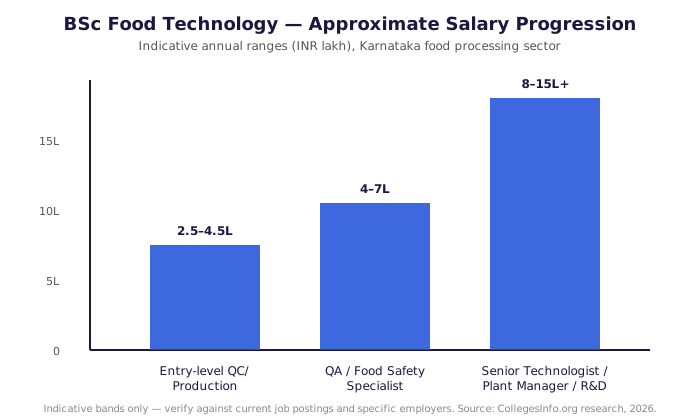
Salary ranges vary considerably by role, company, and experience level, so treat these as approximate bands rather than fixed figures: entry-level quality control or production roles at food manufacturing companies typically start in the range of roughly Rs 2.5-4.5 lakh per year, with quality assurance and food safety specialists in the Rs 4-7 lakh range as they gain a few years of experience, and senior food technologist, plant manager, or R&D roles moving into the Rs 8-15+ lakh range at established companies. These figures should be treated as indicative and cross-checked against current job postings and placement data for the specific companies you're targeting, since food industry compensation varies significantly by company size and region.
Certifications Worth Knowing About
Beyond the degree itself, a few certifications carry real weight in the Indian food industry: FSSAI's Food Safety Supervisor certification, HACCP (Hazard Analysis and Critical Control Points) certification, and ISO 22000 food safety management training are commonly sought by employers, particularly for quality assurance and regulatory roles. Many food technology graduates pick these up during or shortly after their degree, since they signal direct, practical competence in food safety compliance – the area where Indian food manufacturing companies face the most regulatory scrutiny.
A Quick Word on Location
Because your realistic options for this specific degree are concentrated in Bengaluru and Dharwad, location planning matters more here than for broader science degrees with dozens of college choices. If you're from north Karnataka – Belagavi, Gadag, Haveri, Uttara Kannada, Bagalkot, or Vijayapura – UAS Dharwad's jurisdiction covers your home region directly, which can mean real savings on hostel and living costs versus relocating to Bengaluru. If you're aiming specifically for the industrial training exposure at Bengaluru's food processing companies, though, UAS Bengaluru's GKVK campus puts you closer to that specific placement pipeline.
Karnataka's Food Processing Landscape, Beyond the Big Names
It's worth going a layer deeper than just naming Cadbury's and MTR, because Karnataka's food processing base is shaped heavily by its agricultural geography, and that matters for where food technology graduates actually find work. Kodagu and Chikkamagaluru's coffee industry, the state's large coconut and areca growing regions, spice production around the Western Ghats, and Karnataka's substantial dairy cooperative network (Nandini, run by KMF – the Karnataka Milk Federation) all generate demand for food processing, quality control, and food safety expertise that goes well beyond the handful of large FMCG names most people think of first. A food technology graduate working in Karnataka isn't limited to packaged snacks and beverages – dairy processing, spice export quality control, and coffee processing are all realistic, distinct career tracks within the same degree.
CFTRI in Mysuru deserves a specific mention here, separate from its role as an industrial training site. As one of India's premier food research institutions under the CSIR (Council of Scientific and Industrial Research) umbrella, CFTRI runs its own postgraduate and research programmes and regularly absorbs food technology graduates into research assistant and junior research fellow roles, in addition to being a site where food technology from UAS Bengaluru complete practical training. If a research career in food science interests you beyond industry roles, CFTRI is worth researching directly as a postgraduate destination once you've finished your undergraduate degree.
What the Coursework Actually Looks Like, Year by Year
Since food technology is a less familiar degree than biotechnology or engineering to a lot of applicants and parents, it's worth laying out roughly what four years of this actually involves, based on how UAS Dharwad and UAS Bengaluru structure their programmes. The first year tends to cover foundational sciences shared across agricultural science degrees – general chemistry, biology, basic mathematics, and an introduction to agricultural sciences broadly, since these universities admit students into a shared first-year structure before specialisation deepens. The second year introduces food-specific microbiology, food chemistry, and the basics of unit operations in food processing – the engineering principles behind how processing equipment actually works. The third year moves into food engineering proper (processing machinery, thermal processing, preservation techniques), food quality and safety systems, and packaging technology. The fourth year, where NEP's Honours structure applies, concentrates the in-plant industrial training, a research or capstone project, and more specialised electives – bakery and confectionery technology, dairy technology, or fermentation technology, depending on what a specific college offers as electives that year.
Lab work is a significant part of the degree throughout, more so than a typical arts-adjacent BSc – expect regular practical sessions in food analysis, microbiological testing of food samples, and increasingly, hands-on time with small-scale processing equipment (dryers, pasteurisation units, extrusion equipment) as you move into the later years. If you're choosing between colleges, it's worth asking directly about the state of their food processing lab equipment and how recently it's been updated, since this is one area where older programmes can lag behind on practical exposure even if their theoretical coursework is solid.
Who Should Actually Choose This Degree
Food technology suits students who want an applied science degree with a clear industry destination, rather than an open-ended pure-science track that could lead toward research, teaching, or a dozen other directions. If you like the idea of understanding both the science and the practical mechanics of how food gets made safely at scale – and you're comfortable with a career that's more manufacturing- and quality-control-oriented than lab-research-oriented – this is a strong fit. If your real interest is broader biological research, drug development, or genetics specifically, biotechnology or a dedicated life-sciences degree will serve you better; food technology's curriculum is deliberately narrower and more industry-facing than either of those.
It's also worth being honest about scale: this is a smaller field in Karnataka than engineering, medicine, or even biotechnology, in terms of both college options and total seat count. That's not a downside if the career path fits you – smaller fields with concentrated, genuine industry demand can offer better job security than oversaturated ones – but it does mean less flexibility if you later decide the field isn't for you, since there are fewer lateral options within the exact same specialisation compared to a broader degree.
Entrepreneurship and the Food Startup Angle
One path that doesn't get discussed enough in most college guides: Karnataka's food processing sector, and Bengaluru specifically, has a genuine and growing food startup ecosystem – packaged snacks, health foods, ready-to-eat products, and specialty beverage companies have launched out of Bengaluru at a meaningful pace over the past decade. A food technology degree gives you the product-development and food-safety-compliance grounding that a lot of food entrepreneurs end up needing to hire for, or need themselves if they're founding a company. If entrepreneurship interests you alongside or instead of a traditional industry job, food technology is one of the more directly useful degrees for that specific path, since you'll graduate understanding both the regulatory side (FSSAI compliance, labelling requirements) and the practical production side of getting a food product to market safely.
Comparing Food Technology to India's Broader Food Science Landscape
Karnataka's food technology programmes sit within a much larger national picture – food technology and food science degrees exist across India at institutions ranging from other agricultural universities to dedicated food science institutes and even some IITs offering food engineering specialisations at the postgraduate level. What makes Karnataka's version of this degree distinct isn't necessarily the breadth of options – it's narrower here than in some other states – but the direct pipeline into a specific, real industrial cluster (CFTRI, the Bengaluru food processing companies, and Karnataka's agricultural produce base) that gives graduates from UAS Bengaluru and UAS Dharwad a fairly concentrated, well-understood set of local employers to target right out of undergraduate study.
Government Support for Food Processing – Why This Matters for Your Career
It's worth knowing that food processing carries specific government policy attention in India right now, which translates into real career tailwinds for food technology graduates. The Ministry of Food Processing Industries runs the PMFME scheme (PM Formalisation of Micro Food Processing Enterprises), which supports small and micro food processing units with credit-linked subsidies, and the broader Production Linked Incentive (PLI) scheme for food processing has pushed larger companies to expand manufacturing capacity across India, Karnataka included. For a food technology graduate, this policy push translates into steady hiring demand across both large-scale manufacturing and the micro-enterprise formalisation space – government-linked food safety auditing and compliance roles are a genuine, if less commonly discussed, career avenue alongside private-sector manufacturing jobs.
Campus Life at GKVK and Dharwad
Both UAS Bengaluru's GKVK campus and UAS Dharwad's main campus are large, agriculture-focused campuses rather than compact urban college buildings – GKVK sits on a substantial campus in north Bengaluru with its own farms, research stations, and hostel blocks, while UAS Dharwad's campus sits on the Dharwad-Belagavi road with space for its own experimental fields. If you're coming from a purely urban schooling background, it's worth knowing this is a different kind of campus environment than a city-centre engineering or arts college – you'll be on a large, semi-rural campus with agricultural research infrastructure around you, which some students find a real draw and others find takes adjustment. Both universities provide hostel accommodation for outstation students, and given the relatively small cohort sizes in food technology specifically compared to mainstream agriculture programmes, class sizes tend to be smaller and more manageable than in bigger-enrolment science degrees.
Before You Enrol: A Quick Verification Checklist
Because this is a narrower field with fewer colleges to compare, it's worth doing a bit of direct verification before you commit, rather than relying on any single source (including this one) for your final decision. Confirm directly with the university: the exact current degree nomenclature (B.Sc. versus B.Tech) and credit structure for the admission year you're applying in, since these details are revised periodically under NEP transitions; the specific entrance exam(s) accepted for that year (KCET, ICAR AIEEA, or both) and the application deadlines, which shift annually; current fee structures, since government university fees can be revised between academic years; and the current status of industrial training tie-ups if placement exposure is a priority for you, since company partnerships can change over time. None of this information should be taken as fixed simply because it's accurate as of when this guide was written – always cross-check against the university's own current admission notification before applying.
After Your Degree: Postgraduate and Research Pathways
If you want to go further than an undergraduate food technology degree, Karnataka and the wider country both offer real next steps worth knowing about before you finish your BSc. Within Karnataka, both UAS Bengaluru and UAS Dharwad run MSc and PhD programmes in food science and related specialisations, so continuing at the same institution is a simple option if you've built relationships with faculty there already. CFTRI in Mysuru, beyond its role as a training and employment destination, is affiliated with the Academy of Scientific and Innovative Research (AcSIR) for PhD-level work, making it a genuine postgraduate research destination for food technology graduates who want to stay within Karnataka for advanced study.
Outside the state, NIFTEM (National Institute of Food Technology Entrepreneurship and Management, with campuses in Kundli, Haryana and Tanjavur, Tamil Nadu) is India's dedicated national institute for food technology education and is a well-regarded postgraduate destination for BSc Food Technology graduates from anywhere in the country, including Karnataka. If a career that combines food science with business or entrepreneurship training specifically appeals to you – rather than a pure research-science postgraduate track – NIFTEM's stated focus on entrepreneurship and management alongside food technology makes it worth researching directly as you plan your final undergraduate year.
Frequently Asked Questions
Is NEET required for BSc Food Technology in Karnataka?
No. NEET is reserved for MBBS, BDS, BAMS, and BHMS admissions. Food technology admissions in Karnataka go through KCET or ICAR AIEEA, not NEET.
Which is better: BSc Food Technology at UAS Bengaluru or UAS Dharwad?
It depends mainly on location and which specific degree structure (B.Tech-style Food Science and Technology versus B.Sc. Food Technology) fits your plans. UAS Bengaluru gives you proximity to Bengaluru's food processing industry cluster and its named industrial training partners; UAS Dharwad serves north Karnataka directly and may mean lower relocation costs if you're from that region.
Can I do an MSc or research career after BSc Food Technology?
Yes. Food technology graduates commonly move into MSc or MTech programmes in food science, food technology, or food engineering, either at the same agricultural universities or elsewhere, particularly if they complete the four-year NEP Honours track with a research component.
Do private colleges in Karnataka offer BSc Food Technology?
A small number do, though the field is dominated by the two agricultural universities rather than a wide private-college spread. If a private college near you claims to offer this degree, verify its university affiliation and accreditation directly before applying, since this is a narrower field than biotechnology or microbiology with less standardised private-sector coverage.
What's the difference between Food Technology and Food Science and Nutrition?
Food technology leans toward processing, engineering, and manufacturing – turning raw produce into safe, packaged products at scale. Food science and nutrition leans more toward the chemistry, nutritional content, and dietary implications of food. Some Karnataka programmes bundle both under one degree name, so check the actual syllabus rather than relying on the title alone.
Is KCET rank important for getting a food technology seat?
Yes, for KCET-route admission to UAS Bengaluru or UAS Dharwad's food technology programmes, your KCET rank matters through KEA's centralised counselling process, the same as it would for other technical degrees at these universities. ICAR AIEEA is a separate route with its own ranking and counselling process for those applying that way instead.
What if I don't get a seat at UAS Bengaluru or UAS Dharwad?
Given how few institutions offer this specific degree in Karnataka, it's worth having a backup plan in mind. Some students in this position choose a closely related degree instead – BSc Biotechnology, BSc Microbiology, or a general BSc in Agriculture with a food-science-adjacent elective track – and pursue an MSc in Food Technology or Food Science later, once postgraduate options open up more broadly across India. Others look at ICAR AIEEA's all-India counselling process specifically, since it can open doors to food technology seats at agricultural universities outside Karnataka if in-state options don't work out in a given admission cycle.
Is food technology a realistic option for women students in Karnataka?
Yes – food science and technology programmes at Indian agricultural universities generally see solid representation of women students, more so than some other applied engineering-adjacent fields, partly because the field spans both lab-based and quality-control roles that many students and families see as accessible career paths. Both UAS Bengaluru and UAS Dharwad provide women's hostel accommodation for outstation students, which is worth confirming directly with the admissions office if that's a deciding factor in your college choice.
For admission guidance on BSc Food Technology or related science programmes in Karnataka, WhatsApp +91 6363 330 233. We help you get the best admission to your preferred colleges without hassle.
Last Updated: September 7, 2026
Need help with admission?
CollegesInfo.org helps students secure admission to colleges they are eligible for under that college's actual published criteria. Chat with us on WhatsApp or explore admission assistance.