Quick Facts: BSc Environmental Science in Karnataka
| Duration | 3 years, with related NEP four-year Honours options at several universities |
|---|---|
| Universities offering it | Bangalore University, University of Mysore, Kuvempu University, Karnataka State Open University, St. Joseph's University |
| Entrance routes | Direct merit-based admission on PUC marks through affiliated colleges; no dedicated entrance exam |
| Typical annual fees | Meaningfully lower at government-affiliated colleges than private science colleges; varies by affiliated institution |
| Where it's concentrated | Bengaluru and Mysuru, with additional departments in Shimoga (Kuvempu University) and through Karnataka State Open University's distance-learning network |
Unlike food technology (concentrated at two agricultural universities) or genetics (almost always bundled into a combination degree), environmental science in Karnataka is offered as its own dedicated department at several established universities – Bangalore University, University of Mysore, Kuvempu University, and others. That gives you real breadth of choice, though the field's practical, regulatory-facing character means the specific university and its research and civic engagement track record matter more here than in a lot of other science degrees.
What Environmental Science Actually Covers
Environmental science coursework spans ecosystems and biodiversity, natural resource management, pollution monitoring and control, environmental chemistry, climate systems, and increasingly, environmental law, policy, and impact assessment. It's an interdisciplinary field, drawing from biology, chemistry, geology, and social science together, which is part of why it attracts students who want a science degree with a direct, visible connection to real-world policy and regulatory work rather than a purely lab-based research track.
Bangalore University's Department: A Real Civic Track Record
Bangalore University's Department of Environmental Science, established in 1992, is worth knowing about in some detail because its own official page lists an unusual level of civic and regulatory engagement for an academic department. Faculty members serve on the advisory boards of environmental journals, sit on Karnataka's Lake Rejuvenation Committee, are members of a committee constituted by the High Court of Karnataka in Bengaluru to monitor illegal encroachment, and serve on the Environment Clearance Committee under the Ministry of Environment, Forest and Climate Change (MoEF&CC). That's not just academic credentialing – it means students in this specific department are, at least indirectly, connected to faculty who are actively involved in the real environmental governance decisions affecting Bengaluru and Karnataka, which is a distinctive feature compared to a purely classroom-based science degree elsewhere.
The department's own page also confirms students get research exposure built into the programme structure – fourth-semester students are introduced to the research field for dissertation work on environmental aspects, meaning practical, applied research isn't reserved only for postgraduate study here.
Comparing Your Main Options
| University | City | Department notes | Distinctive strength |
|---|---|---|---|
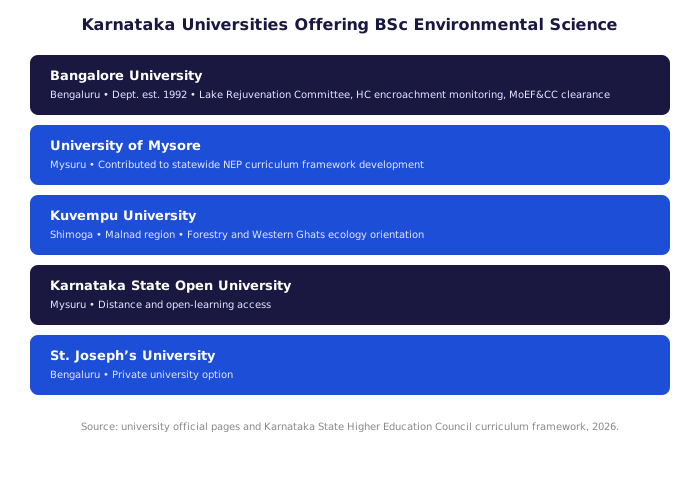
| Bangalore University | Bengaluru | Dept. established 1992 | Faculty serve on Lake Rejuvenation Committee, Karnataka High Court encroachment monitoring, MoEF&CC clearance committee |
| University of Mysore | Mysuru | Established environmental science teaching faculty | Part of Karnataka's official NEP curriculum framework development for the subject |
| Kuvempu University | Shimoga | Active environmental science faculty | Serves the Malnad region's distinct ecological and forestry context |
| Karnataka State Open University | Mysuru | Distance and open-learning environmental science faculty | Distance-learning access for students who can't relocate |
| St. Joseph's University | Bengaluru | Dedicated environmental science faculty | Private university option alongside the public university departments |
One useful document surfaced during research for this guide: a curriculum and credit framework PDF for the undergraduate environmental science programme, compiled with input from Karnataka's State Higher Education Council and department heads across Bangalore University, University of Mysore, Karnataka State Open University, and Kuvempu University. This confirms environmental science's NEP-era undergraduate structure is being coordinated across these universities rather than each one running an entirely independent, disconnected syllabus – worth knowing if you're comparing how transferable your credits or knowledge base might be if you needed to move between institutions.
Admission: Direct Merit, University-Level Process
Admission to BSc Environmental Science programmes in Karnataka runs through direct merit based on PUC or Class 12 marks, through each university's affiliated colleges, rather than a dedicated statewide entrance exam. Since these are largely government university departments and their affiliated colleges, admission processes tend to follow standard government college merit-list timelines rather than the rolling, college-specific autonomous admission cycles you'd see for a private college genetics-combination degree. Confirm the specific affiliated college and its cutoff process directly with the university, since environmental science seats are often distributed across several affiliated colleges rather than concentrated at one central campus.
NEP 2020's Curriculum Framework for This Subject
The curriculum framework document referenced above lays out a detailed NEP-era structure: two core subjects taught with practicals across the first two years, with two theory and two practical papers in each core subject by the third year, and a system where students exiting after securing a set number of credits (46, per the framework, when combined with work-based vocational or internship credits) receive a UG Certificate in their chosen disciplines. This is a more granular, publicly documented curriculum structure than most Karnataka science degrees have publicly available, which itself reflects the multi-university coordination behind this specific subject's NEP rollout.
What Studying Environmental Science Looks Like
Expect a genuine mix of lab-based environmental chemistry and pollution analysis, fieldwork (water and soil sampling, biodiversity surveys, and site visits relevant to local environmental issues), and increasingly, policy and impact-assessment coursework as you move through the degree. Because faculty at departments like Bangalore University's are directly involved in real regulatory committees, some programmes offer genuine exposure to live environmental governance processes – not guaranteed at every affiliated college, but worth asking about directly if hands-on civic and regulatory exposure is part of why you're choosing this degree.
If you're deciding between environmental science and a related field like BSc Biotechnology, the distinction is direction: biotechnology channels toward industrial and pharmaceutical applications of biological science, while environmental science channels toward ecological, regulatory, and sustainability-focused careers – different destinations even though both share foundational biology and chemistry coursework. Compared to studying Food Technology, environmental science is broader in scope (covering ecosystems, policy, and pollution broadly) rather than the specifically industrial food-processing focus of that degree.
Funding Your Degree
If you're an SC, ST, OBC, or minority-category student, Karnataka's State Scholarship Portal (SSP) – covered in our SSP scholarship guide – covers science degrees broadly, and since environmental science is predominantly taught at government universities and their affiliated colleges here, fees tend to be meaningfully lower to begin with compared to private-college science degrees, making the combination of low base fees and scholarship eligibility a strong value proposition for cost-conscious students.
Career Paths and Realistic Salary Ranges
Environmental science graduates in Karnataka move into roles at state Pollution Control Boards, environmental consultancy firms conducting impact assessments for infrastructure and industrial projects, NGOs working on conservation and sustainability, corporate sustainability and ESG compliance roles (a growing area as Indian companies face increasing environmental reporting requirements), government forestry and wildlife departments, and further postgraduate study toward an MSc in Environmental Science, Environmental Management, or a specialised area like climate science or environmental law.
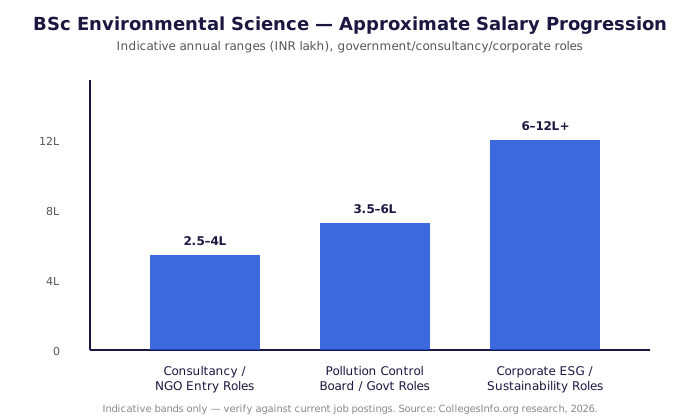
Salary ranges vary considerably by sector, so treat these as approximate bands: entry-level roles at environmental consultancies or NGOs typically start around Rs 2.5-4 lakh per year, Pollution Control Board and government environmental roles in the Rs 3.5-6 lakh range depending on the specific position and state pay scales, and corporate sustainability or ESG compliance roles at larger companies moving into the Rs 6-12+ lakh range for experienced professionals, particularly with a relevant postgraduate qualification. These figures should be cross-checked against current job postings and government pay scale notifications for the specific sector you're targeting.
Postgraduate Pathways
An MSc in Environmental Science, Environmental Management, or increasingly specialised areas like Climate Science or Environmental Law is the natural next step for students who want to deepen their expertise after a BSc. Bangalore University, University of Mysore, and Kuvempu University all offer postgraduate environmental science programmes that BSc graduates from their own or other affiliated colleges commonly move into, and given the departments' documented research and civic engagement, students with strong undergraduate performance can realistically move into genuine environmental research or policy-adjacent postgraduate work rather than a purely theoretical academic track.
A Quick Word on Choosing Between Universities
Because environmental science is available at multiple universities here, your choice should factor in more than just proximity. Bangalore University's department brings direct regulatory and civic committee involvement relevant to urban environmental issues – useful if urban pollution, water resources, or city-level environmental governance interests you specifically. Kuvempu University, based in Shimoga, sits in Karnataka's Malnad region, giving it a natural orientation toward forestry, biodiversity, and Western Ghats ecological issues that an urban-Bengaluru programme won't have the same direct access to. University of Mysore similarly benefits from its regional context. If your specific environmental interest leans toward a particular ecological or regulatory context, it's worth weighing that fit alongside more conventional factors like fees and campus facilities. Students weighing a civic-facing professional field more broadly might also compare architecture, which shares environmental science's grounding in urban planning and the built environment, even though the two lead to very different careers.
Government Programmes That Shape This Career Path
Environmental science graduates in India benefit from an active policy environment right now, which is worth understanding as career context rather than abstract background. The National Action Plan on Climate Change and its associated state-level Karnataka State Action Plan on Climate Change both create ongoing demand for environmental professionals in government and consultancy roles. The National Green Tribunal (NGT) and state Pollution Control Boards like the Karnataka State Pollution Control Board regularly require environmental impact assessment expertise for infrastructure and industrial project clearances, which is where many environmental science graduates find their first substantial professional roles – either working directly for the regulatory bodies or for the private consultancies that prepare assessments on behalf of project developers. Corporate ESG (Environmental, Social and Governance) reporting requirements have also expanded significantly for Indian companies in recent years, creating a new category of corporate sustainability roles that didn't exist in the same form a decade ago, and that increasingly recruit environmental science graduates directly.
Fieldwork and Lab Facilities Worth Asking About
Because environmental science is an applied, fieldwork-heavy discipline, it's worth asking specific questions about practical exposure before choosing a college, rather than assuming all affiliated colleges offer comparable fieldwork opportunities. Ask whether the programme includes water and soil sampling fieldwork, biodiversity survey trips, or visits to operational treatment facilities and monitoring stations – these vary considerably between affiliated colleges even within the same university's department. If GIS (Geographic Information Systems) and remote sensing are part of the syllabus, ask whether the college has dedicated computer lab access for this coursework, since these tools are increasingly central to modern environmental assessment work and useful skills for job-hunting afterward.
Who Should Actually Choose This Degree
Environmental science suits students who want a science degree with a direct, visible connection to policy, regulation, and real-world civic issues – pollution, conservation, climate policy, urban environmental governance – rather than a purely lab-based research track or an industrial manufacturing destination. If you're drawn to fieldwork, want to understand how environmental regulation and enforcement actually works in India, and are comfortable with a career that spans government, NGO, and corporate sustainability roles rather than one narrow industry, this is a strong fit. If your primary interest is laboratory research specifically, or a more narrowly industrial or clinical career destination, a biotechnology, microbiology, or genetics-combination degree may suit you better.
Campus Environment Across These Universities
Because this degree is spread across several university departments rather than concentrated at a couple of private colleges, campus environments vary considerably. Bangalore University's environmental science teaching happens across its affiliated college network in Bengaluru, giving you an urban campus experience with direct access to the city's environmental issues as a genuine study subject. Kuvempu University's Shimoga campus sits in Karnataka's Malnad region, offering a very different, forest-and-hill-country campus environment more directly connected to biodiversity and forestry fieldwork. If campus setting and the kind of environmental issues you'll be studying up close matter to your decision – urban pollution and water resources versus forest ecology and biodiversity – that's arguably a more meaningful differentiator here than it would be for most other science degrees.
Before You Enrol: A Quick Verification Checklist
Given how much variation exists across universities and their affiliated colleges for this degree, confirm a few specifics directly before committing: which specific affiliated college you'd actually be attending (since university departments coordinate curriculum but teaching happens at affiliated colleges), the exact fieldwork and lab facilities available at that specific college rather than assuming university-level facilities apply everywhere, current cutoff and application timelines for the year you're applying, and whether the NEP four-year Honours track with its research component is available at your specific affiliated college if postgraduate research is part of your longer-term plan. None of this should be assumed simply because it's accurate for the university's flagship department – verify at the specific college level.
Karnataka-Specific Environmental Issues Shaping This Field
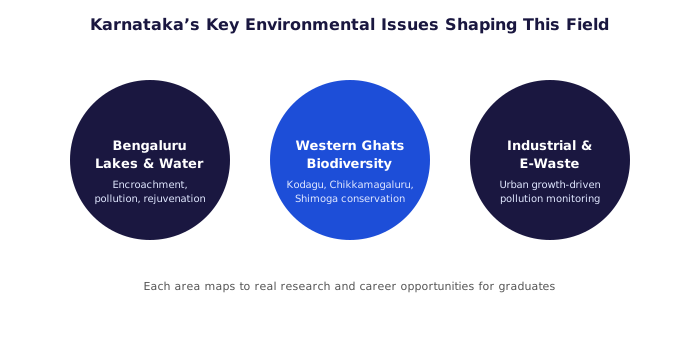
Part of what makes environmental science a grounded degree in Karnataka is the state's own distinct set of environmental challenges, which directly shape the research and career opportunities available to graduates. Bengaluru's lake ecosystem crisis – decades of encroachment, pollution, and the loss of the city's historic interconnected lake network – is precisely the kind of issue Bangalore University's own faculty committee involvement addresses directly, and it's a well-documented, ongoing area of both research and civic action that environmental science graduates in the city can contribute to. The Western Ghats, running along Karnataka's western edge through districts like Kodagu, Chikkamagaluru, and Shimoga, is one of the world's biodiversity hotspots and a major focus for conservation research, particularly relevant to Kuvempu University's location and orientation. Karnataka's rapid urbanisation and industrial growth, particularly around Bengaluru, has also generated substantial e-waste management and industrial pollution challenges that create ongoing demand for environmental compliance and monitoring expertise. Understanding these specific, local environmental issues – not just generic global environmental science concepts – is useful both for your coursework and for demonstrating real regional knowledge in job interviews after you graduate.
Karnataka's Environmental Science Education in the National Picture
Environmental science as a dedicated undergraduate department, rather than a combination or bundled degree, is actually less universal across India than you might expect – many states teach environmental studies only as a compulsory component within other science degrees rather than offering it as its own standalone BSc. Karnataka's position, with dedicated departments across multiple established universities plus a documented, coordinated NEP curriculum framework, puts it in a stronger position than many states for students who want environmental science as their primary undergraduate focus rather than a secondary component of a different degree. That said, for students considering options beyond Karnataka, note that some other states offer environmental science through more specialised institutes – dedicated environmental research universities or institutes affiliated with national bodies – which can offer deeper specialisation than a general university science department, if you're willing to relocate and that level of specialisation matters more to you than staying within Karnataka's own university network.
Frequently Asked Questions
Is there an entrance exam for BSc Environmental Science in Karnataka?
No. Admission is through direct merit based on PUC or Class 12 marks, through each university's affiliated colleges – there's no dedicated statewide entrance exam for this subject.
Which Karnataka university has the strongest environmental science programme?
It depends on your specific interest. Bangalore University's department has documented direct civic and regulatory engagement (Lake Rejuvenation Committee, court-mandated encroachment monitoring, MoEF&CC clearance committee membership), which suits students interested in urban environmental governance. Kuvempu University's Shimoga location suits students more interested in forestry and Western Ghats ecology specifically.
Can I study environmental science through distance learning in Karnataka?
Yes, Karnataka State Open University offers environmental science through its distance and open-learning structure, which is worth considering if relocating for a full-time on-campus programme isn't practical for you.
What career options exist beyond teaching and research?
A wide range: Pollution Control Board roles, environmental consultancy and impact assessment work, NGO conservation roles, corporate sustainability and ESG compliance positions, and government forestry and wildlife department roles, alongside the more traditional research and teaching paths.
Is environmental science a good degree if I'm interested in climate change work specifically?
Yes, though for a career specifically focused on climate science or climate policy, most students find a BSc in environmental science followed by a specialised postgraduate qualification (an MSc in Climate Science or Environmental Management, for instance) gives a more targeted foundation than the undergraduate degree alone.
Do I need a strong Physics or Mathematics background for this degree?
Not as much as for engineering or pure physical science degrees – environmental science leans more on Biology and Chemistry foundations, though some quantitative coursework (environmental statistics, GIS and remote sensing basics at some colleges) does come up, particularly in the later years.
Which Karnataka environmental issues are graduates most likely to work on?
Bengaluru's lake and water resource management, Western Ghats biodiversity conservation, and industrial and e-waste pollution monitoring are the three most active areas, reflecting the state's own environmental challenges and the research focus of its main environmental science departments.
Can I switch from environmental science to a completely different field after graduating?
Yes, reasonably well – the degree's interdisciplinary foundation in biology, chemistry, and basic policy work gives graduates a reasonably flexible base to move into general science teaching, environmental journalism, science communication, or further postgraduate study in an adjacent field if a purely environmental career doesn't end up being the right fit.
For admission guidance on BSc Environmental Science or related science programmes in Karnataka, WhatsApp +91 6363 330 233. We help you get the best admission to your preferred colleges without hassle.
Last Updated: September 7, 2026
Need help with admission?
CollegesInfo.org helps students secure admission to colleges they are eligible for under that college's actual published criteria. Chat with us on WhatsApp or explore admission assistance.