Last Updated: September 7, 2026
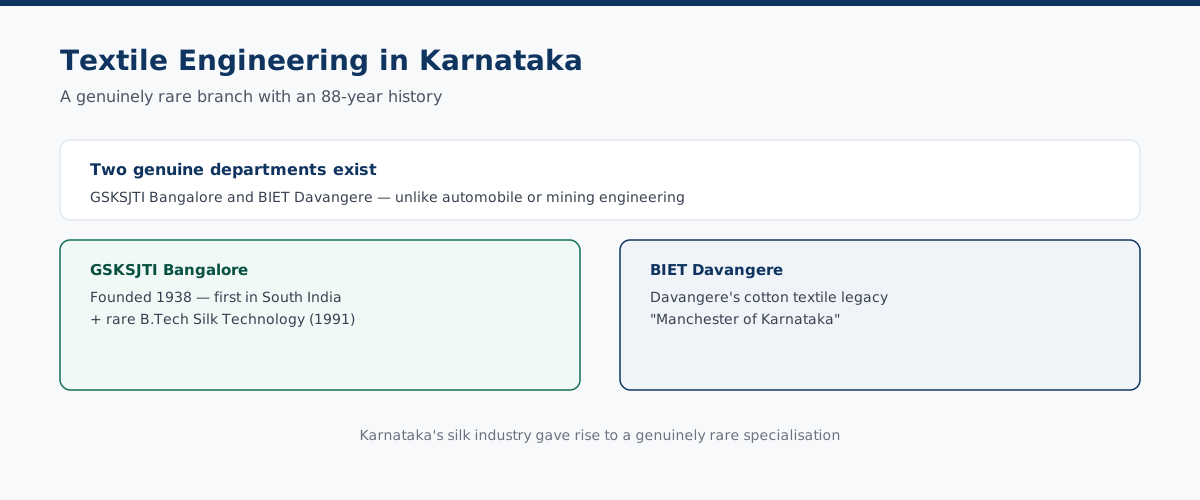
Unlike automobile or mining engineering, Textile Engineering is a real, long-established branch in Karnataka – not an employment-context mention dressed up as a degree. Government Sri Krishnarajendra Silver Jubilee Technological Institute (GSKSJTI) in Bangalore has run dedicated textile education since 1938, making it the first institution of its kind in South India, and it added a rare B.Tech in Silk Technology in 1991 that ties directly to Karnataka's status as India's leading mulberry silk producer. Bapuji Institute of Engineering and Technology (BIET) in Davangere runs a genuine second Department of Textile Technology, connected to Davangere's historic identity as the "Manchester of Karnataka" for its cotton textile industry. This is the honest, differentiated picture: where these programmes actually exist, what makes Silk Technology worth knowing about, and what a real career in this field looks like.
Looking at the bigger picture? Our guide to the best engineering colleges in Karnataka compares KCET tier-wise cutoffs, COMEDK options, and real fee data across Bengaluru, Mangalore, Mysore, and north Karnataka for 2027.
Textile Engineering in Karnataka – Quick Facts
| Colleges with genuine Textile Technology departments | Two – GSKSJTI Bangalore and BIET Davangere |
|---|---|
| GSKSJTI founded | 1938 – first dedicated textile institution in South India |
| Rare specialisation available | B.Tech Silk Technology at GSKSJTI, running since 1991 |
| Admission route | KCET (GSKSJTI: strictly KCET, no management quota) and COMEDK for BIET's private-quota seats |
| Fee range | ~Rs 55,000-1.6 lakh (GSKSJTI, government fee level, varies by programme) · private-college band at BIET Davangere |
| Regional industry context | Karnataka's historic silk industry (Ramanagara/Mysuru region) and Davangere's cotton textile legacy |
| Career destination | India's textile and apparel manufacturing sector – spinning, weaving, processing, quality control, production management |
GSKSJTI Bangalore – India's First Dedicated Textile Institute in the South
Government Sri Krishnarajendra Silver Jubilee Technological Institute was established in 1938 by two of Mysore State's most consequential administrators, Sir Mirza Ismail and Sir M. Visvesvaraya, to commemorate 25 years of Maharaja Nalwadi Krishnarajendra Wodeyar's reign – and its founding purpose was explicit: training personnel for the organised textile industry. This makes it the first institution of its kind in South India, predating most of Karnataka's general engineering colleges by decades. Its academic offering evolved with the industry: a B.Sc. in Textiles began in 1946, converted into a full B.Tech in Textiles in 1973, and an M.Tech in Textiles has run continuously since 1970. In 1991, the institute added something rare among Indian engineering programmes – a dedicated B.Tech in Silk Technology.
GSKSJTI operates under Karnataka's Department of Technical Education as a government institution, affiliated to VTU, and admission runs strictly through KCET rank – there is no management quota route here, which keeps the fee at government levels across its programmes. Recent KCET cutoff data for the institute overall has ranged widely depending on branch, with popular branches like Computer Science understandably closing at far more competitive ranks than the institute's textile and silk branches, which – being lower-demand specialised programmes – typically remain accessible to a broader range of KCET scores. Student and alumni reports describe above-average placement outcomes specifically in the textile and silk branches, even where the institute's general engineering branches see more mixed placement results – a pattern that makes sense once you understand these graduates enter a specialised, less crowded segment of the job market than a generic Mechanical or Civil graduate does.
The curriculum at this level covers ground well beyond what a general Mechanical or Chemical Engineering elective would touch: yarn and fabric manufacturing technology, textile chemical processing and dyeing, textile testing and quality control, weaving and knitting technology, and increasingly, technical textiles – the fast-growing category covering industrial, medical and protective-equipment fabrics rather than traditional apparel. The M.Tech in Textiles, running continuously since 1970, gives GSKSJTI genuine research depth in this field as well, producing faculty and specialists who go on to lead textile departments elsewhere, including at BIET Davangere, illustrating the direct institutional lineage between Karnataka's two textile-education centres.
Why This Matters – India's Textile Industry Is Enormous
It's worth stating plainly why a niche-sounding branch like this deserves serious consideration rather than a shrug: India's textile and apparel industry is one of the country's largest employment generators and export earners, spanning cotton, silk, wool, synthetic fibres and the rapidly growing technical textiles segment. Unlike automobile or mining engineering – where Karnataka's specific industry is real but the matching degree mostly isn't – textile engineering in Karnataka benefits from both a genuine, large national industry and two institutions that have built real academic infrastructure around serving it, in some cases for the better part of a century. A GSKSJTI or BIET Davangere graduate isn't entering a speculative or shrinking field; they're entering one of India's structurally important manufacturing sectors with genuine long-term demand for engineers who understand fibre science, textile chemistry and manufacturing process control specifically, skills a generalist Mechanical or Chemical Engineering graduate would need years of on-the-job exposure to build from scratch.
Why Silk Technology Specifically Exists Here
Silk Technology is not a generic textile-engineering elective – it's a dedicated specialisation covering silk fibre processing, reeling, weaving and finishing, distinct from cotton or synthetic textile processes. Karnataka has been India's largest producer of mulberry silk for generations, with the industry historically centred around Ramanagara and the broader Mysuru region – Ramanagara's silk cocoon market remains one of Asia's largest. GSKSJTI's decision to launch a dedicated B.Tech in Silk Technology in 1991 reflects exactly the kind of match this cluster of Engineering Niche articles keeps looking for and rarely finding: a degree programme that exists because a real, large, regional industry needs it, not a branch name copied from a national curriculum template without local relevance. A student graduating with Silk Technology from GSKSJTI enters one of the few specialised silk-industry engineering pipelines in the country, feeding directly into Karnataka's own reeling and weaving units as well as national silk manufacturing and export businesses.
BIET Davangere – Textile Technology in the "Manchester of Karnataka"
Bapuji Institute of Engineering and Technology in Davangere runs a genuine, separate Department of Textile Technology, an autonomous institute affiliated to VTU, holding AICTE approval, NAAC 'A' grade accreditation, and NBA accreditation for multiple programmes. The department's institutional memory runs deep – its current professor and department head completed his own B.Tech in Textile Technology at GSKSJTI Bangalore in 1990 before eventually joining BIET, illustrating the direct lineage between Karnataka's two textile-education institutions. Davangere's identity as central Karnataka's "Manchester of Karnataka" – a nickname earned through its historically significant cotton textile industry – gives BIET's Textile Technology graduates a genuine regional industry base, distinct from GSKSJTI's more silk-and-organised-textile-industry orientation in Bangalore. Together, the two institutions cover Karnataka's two major historic textile traditions: Bangalore's organised mill and silk industry, and Davangere's cotton-processing legacy.
The Two Institutions, Compared
Choosing between GSKSJTI and BIET Davangere isn't really an either-or decision most students face – the two institutions serve somewhat different regional and specialisation profiles, and a student's choice will usually come down to which specific branch (plain Textile Technology versus the rarer Silk Technology) and which admission route (strict KCET-only versus KCET/COMEDK) fits their situation. GSKSJTI's Bangalore location, government fee structure, and unique Silk Technology offering make it the stronger pick for students specifically drawn to the silk industry or wanting the lowest-cost route into textile engineering. BIET Davangere's private autonomous status, NAAC 'A' and NBA accreditation, and direct connection to Davangere's cotton-processing industrial base make it the stronger pick for students who want a broader-based private engineering college experience with Textile Technology as one strong department among several, rather than GSKSJTI's more singularly textile-and-silk-focused institutional identity.
| Institution | City | Established | Programmes | Admission |
|---|---|---|---|---|
| GSKSJTI | Bangalore | 1938 (textile focus since founding) | B.Tech Textile Technology, B.Tech Silk Technology, M.Tech Textile Technology | KCET only, no management quota, government fee |
| BIET Davangere | Davangere | Department established mid-20th century, autonomous VTU-affiliated institute | B.Tech Textile Technology, alongside BIET's broader engineering programmes | KCET/COMEDK, private-college fee band |
Admission Routes and Fees
GSKSJTI's route is the simpler of the two to describe: KCET rank determines admission, full stop, with no management or private quota to navigate – a genuine advantage for students whose families want to avoid the fee-negotiation complexity that surrounds many private engineering colleges. Fees across GSKSJTI's programmes have been reported in the roughly Rs 55,000-1.6 lakh range depending on the specific course, consistent with government-institute fee levels generally. BIET Davangere, as a private autonomous institute, follows the standard KCET/COMEDK dual-route pattern common to VTU-affiliated private colleges, with fees in the private-college band – confirm the current year's exact figure directly with the institute before applying, since both colleges revise fees periodically.
What a Real Career Looks Like
Textile Technology and Silk Technology graduates from these two institutions enter India's textile and apparel manufacturing sector in production, quality control, process engineering and manufacturing management roles – a very different career shape from IT-sector engineering but a substantial one, given India's position as one of the world's largest textile and apparel producers. Silk Technology graduates specifically find roles in silk reeling and weaving units, quality testing labs, and silk-industry manufacturing and export businesses, with Karnataka's own Ramanagara-centred silk industry providing local opportunities alongside national-level silk and textile manufacturing hubs. Textile Technology graduates more broadly find opportunities across India's major textile manufacturing states – Tamil Nadu's Coimbatore-Tiruppur textile belt, Gujarat and Maharashtra's textile and garment manufacturing hubs – in addition to Karnataka's own Davangere-centred cotton processing base and Bangalore's organised textile sector. Starting compensation in textile manufacturing roles tends to track core-manufacturing-sector norms generally, rewarding candidates who combine the specialised technical training with genuine process and quality-control aptitude, rather than the software-sector salary bands that dominate general engineering branch comparisons.
One growth area worth flagging specifically: technical textiles – fabrics engineered for industrial, medical, automotive, agricultural and protective-equipment applications rather than traditional apparel – has been a policy and investment priority for India's textile sector in recent years, creating a newer career lane for textile engineering graduates beyond the traditional apparel-and-garment path. A student graduating from either GSKSJTI or BIET Davangere today enters a field with both a century-old traditional apparel-manufacturing base and a newer, growing technical-textiles segment, giving these graduates more career optionality than the field's "niche branch" reputation might suggest.
Further Study – the M.Tech Route
GSKSJTI's M.Tech in Textiles, running continuously since 1970, gives graduates of either institution a genuine, long-established postgraduate pathway within the same specialisation, unlike many niche undergraduate branches where no matching postgraduate programme exists locally. This matters for students weighing whether to specialise further after a B.Tech: an M.Tech in Textiles at an institution with over five decades of continuous programme history carries real academic depth, research infrastructure and faculty expertise built up over that time, rather than being a recently bolted-on postgraduate option. Students aiming at research, teaching, or senior technical roles in textile manufacturing and quality assurance should weigh this route seriously, particularly given how few Indian institutions outside the major textile-producing states offer equivalent depth in textile-specific postgraduate education.
It's also worth noting what distinguishes this piece from others in this Engineering Niche series covering automobile and mining engineering in Karnataka: those branches don't exist as standalone degrees at the state's major colleges, despite aggregator sites listing them as if they do. Textile Engineering runs the opposite direction – a real, historically deep, currently operating pair of institutions exist, and the honest correction needed here is simply that too few students searching for this branch actually find them, buried under generic engineering college search results that never surface these two specialised, historically significant institutions prominently. The same honest-verification approach applies to two newer additions to this series – Instrumentation Engineering and Robotics and AI Engineering – both real branches at different stages of institutional maturity.Documents and Application Process
- Register for KCET in its notification window; COMEDK registration runs in parallel if targeting BIET Davangere's private-quota seats.
- After KCET results, participate in KEA counselling: verify documents, enter your college and branch preferences (list GSKSJTI's Textile or Silk Technology, and/or BIET Davangere's Textile Technology, explicitly among your choices if targeting this field), and track the seat allotment rounds.
- On allotment, confirm the exact branch name on your allotment order matches the programme you intended – GSKSJTI runs Textile Technology and Silk Technology as separate branches with separate seats.
- Documents needed: Class 10 and 12 marks cards, KCET scorecard, transfer and conduct certificates, migration certificate for non-Karnataka boards, category and income certificates for reservation or scholarship claims, Aadhaar, and photographs.
Need help with admission?
Textile Engineering in Karnataka – FAQs
Which Karnataka colleges offer Textile Engineering?
Two institutions run real, distinct Textile Technology departments: GSKSJTI Bangalore and BIET Davangere. Both are genuine, long-established departments, unlike many other niche engineering branches where the industry exists but the degree doesn't.
Is GSKSJTI Bangalore's Textile programme old and established?
Yes – founded 1938, the first institution of its kind in South India. B.Sc. Textiles began 1946, became a B.Tech in 1973, M.Tech has run since 1970, and B.Tech Silk Technology was added in 1991.
What is Silk Technology, and why does Karnataka offer it?
A specialised branch covering silk fibre processing, reeling, weaving and finishing. Karnataka has historically been India's largest mulberry silk producer, centred around Ramanagara – exactly why GSKSJTI built a dedicated Silk Technology programme in 1991.
How do I get admission to these programmes?
Both are KCET-accessible. GSKSJTI admits strictly through KCET rank with no management quota; BIET Davangere uses the standard KCET/COMEDK routes. Textile and Silk Technology typically show more accessible cutoffs than CSE or ECE at the same institutes.
What does Textile Technology cost at these colleges?
GSKSJTI's government fees run roughly Rs 55,000-1.6 lakh depending on the programme. BIET Davangere charges a private-college fee band. Confirm current figures directly with each institution.
What careers do these graduates actually get?
India's textile and apparel manufacturing sector – spinning, weaving, processing, quality control and production management, plus silk-specific reeling and weaving roles for Silk Technology graduates, across Karnataka's own textile base and national hubs in Tamil Nadu, Gujarat and Maharashtra.
Does CollegesInfo charge for admission guidance?
Our admission assistance service helps students secure admission to colleges they're eligible for under that college's actual published criteria. WhatsApp us and we'll explain how we work before anything else.