Last Updated: September 7, 2026
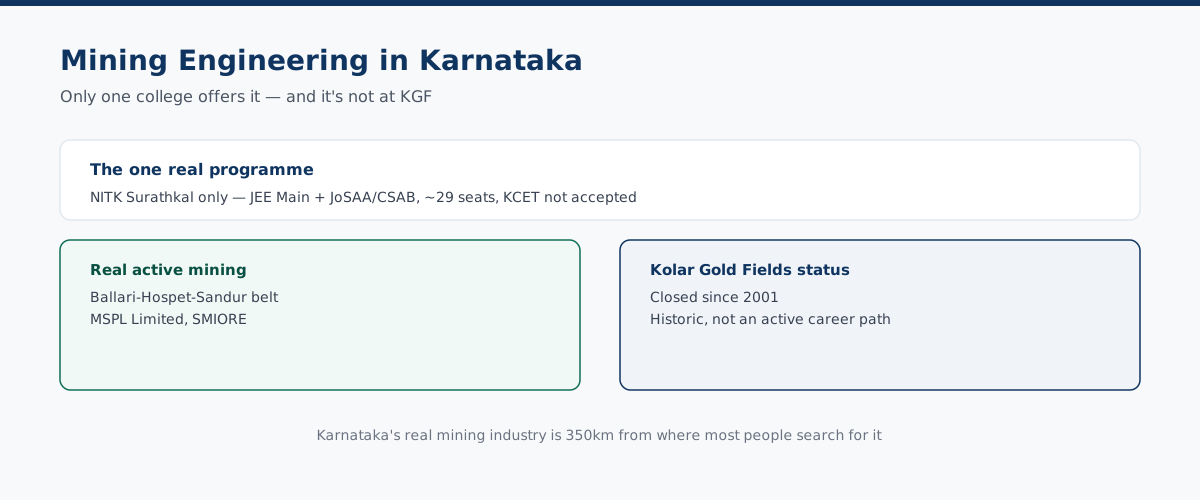
Karnataka has exactly one college offering a genuine B.Tech in Mining Engineering: NITK Surathkal. And it isn't accessible through KCET – admission runs entirely through JEE Main and JoSAA counselling, a fact that trips up a surprising number of Karnataka students who assume a Karnataka-based National Institute of Technology would take the state's own entrance exam. Beyond NITK, "mining" shows up across several engineering colleges' placement and industry-connect sections, but always as an employment sector for Civil, Mechanical or Metallurgical graduates, never as its own department. And the place most people associate with Karnataka mining – Kolar Gold Fields – hasn't had an active gold mine since 2001. This piece maps the real picture: NITK's actual programme, where Karnataka's mining industry operates today, and the honest alternative path if NITK isn't reachable for you.
Looking at the bigger picture? Our guide to the best engineering colleges in Karnataka compares KCET tier-wise cutoffs, COMEDK options, and real fee data across Bengaluru, Mangalore, Mysore, and north Karnataka for 2027.
Mining Engineering in Karnataka – Quick Facts
| Colleges with a genuine B.Tech Mining Engineering programme | One – NITK Surathkal |
|---|---|
| Admission route | JEE Main followed by JoSAA/CSAB counselling – KCET is not accepted |
| Approximate seats | ~29 |
| Approximate first-year fee | ~Rs 1.6 lakh (verify current year on JoSAA/NITK's own site) |
| Alternative path | Civil, Mechanical or Metallurgical Engineering with mining-industry placement links, via KCET/COMEDK |
| Karnataka's active mining region | Ballari-Hospet-Sandur iron ore belt, north Karnataka – NOT Kolar Gold Fields |
| Key active employers there | MSPL Limited (Baldota Group), Sandur Manganese and Iron Ores Limited (SMIORE) |
| Kolar Gold Fields status | Closed since 2001 – historically significant, not an active mining career destination |
The One Real Mining Engineering Programme – NITK Surathkal
NITK Surathkal, one of India's premier National Institutes of Technology, runs the only standalone B.Tech Mining Engineering programme at a Karnataka engineering college, alongside its more famous branches like Computer Science, Electronics and Mechanical Engineering. The programme takes roughly 29 students a year into a 4-year B.Tech, and – this is the detail that catches out the most students – admission has nothing to do with KCET. NITK, as a centrally-funded National Institute of Technology, accepts only JEE Main scores, processed through the Joint Seat Allocation Authority (JoSAA) for the main rounds and the Central Seat Allocation Board (CSAB) for subsequent special and spot rounds. A strong KCET rank counts for nothing here; if NITK Mining Engineering is your goal, your preparation target is JEE Main, not KCET.
Recent JoSAA rounds have shown General category closing ranks for Mining Engineering at NITK landing in the high-20,000s to low-30,000s, though this shifts round to round and year to year – treat any specific number as a rough historical reference, not a target to plan around, and check the live JoSAA seat matrix and cutoff data during the actual counselling window. Reported first-year fees run around Rs 1.6 lakh, again worth confirming on NITK's own site or the JoSAA portal for the current cycle. NITK's overall placement record is strong – the institute's headline branches report placement rates in the 93-99% range with recruiters like Microsoft, Amazon and Goldman Sachs – though Mining Engineering as a smaller, specialised branch will have its own distinct recruiter profile centred on mining, minerals and core infrastructure companies rather than the software-heavy recruiters associated with NITK's CSE and IT batches.
What the Mining Engineering Curriculum Actually Covers
A B.Tech Mining Engineering programme at a National Institute of Technology level covers ground that a generic Civil or Mechanical degree doesn't touch. Core subjects typically include mine planning and design, rock mechanics and geomechanics, mine ventilation and environmental engineering, surface and underground mining methods, mineral processing and beneficiation, mine surveying, and mining machinery. Later years bring in specialised electives covering areas like mine safety and legislation, mine economics, and increasingly, digital and automation technologies being adopted across the mining sector – remote sensing for exploration, GPS-based fleet management for haul trucks, and sensor-based safety monitoring in underground operations. This is meaningfully different training from what a Civil or Mechanical Engineering graduate picks up through a mining-adjacent internship or elective, which is exactly why NITK's dedicated programme exists as a distinct qualification rather than something absorbed into another branch, unlike the automobile or automotive situation discussed elsewhere on this site.
It's also worth understanding that Mining Engineering as a discipline isn't a Karnataka-specific or even primarily Karnataka-relevant qualification – NITK's Mining Engineering graduates compete nationally for roles at Coal India and its subsidiaries, NMDC, Hindustan Zinc, Vedanta's mining operations, and infrastructure and cement companies with captive mining operations across states with much larger mining sectors than Karnataka, including Jharkhand, Odisha, Chhattisgarh and Rajasthan. A Karnataka student choosing this branch should go in expecting a national, not a Karnataka-centred, career geography – which is a different proposition from, say, choosing Mechanical Engineering at a Bengaluru college for its access to the city's IT and automotive industry right on the doorstep.
Why Kolar Gold Fields Isn't the Answer
Search "mining engineering Karnataka" and Kolar Gold Fields comes up constantly – understandably, since KGF was once the world's second-deepest gold mine and produced the majority of India's gold output through much of the 20th century, and the town has recently gained fresh cultural visibility through a well-known Kannada film franchise bearing its name. The honest fact students need before making any career decision around it: the gold mines at KGF closed permanently on 28 February 2001. The mines were operated by the public sector Bharat Gold Mines Limited (BGML), and after 121 years of continuous extraction, escalating costs at depths beyond 3,000 metres made the operation commercially unviable, and the Union government ordered closure under the Industrial Disputes Act. Roughly 3,800 workers lost their jobs in the closure. Periodic proposals to revive mining at KGF – including a 2016 expression of interest and government exploration studies citing an estimated $2.1 billion in remaining deposits – have not resulted in mining operations actually resuming as of this writing.
None of this means KGF is irrelevant to an engineering education decision – Dr T Thimmaiah Institute of Technology is located in KGF town and carries the area's mining heritage as part of its institutional identity – but it does mean no student should choose a college, or a career direction, on the assumption that active gold-mining employment exists there today. It doesn't, and hasn't for over two decades.
Where Karnataka's Mining Industry Actually Operates
The real, currently active mining industry in Karnataka sits roughly 350 kilometres northeast of KGF, in the Ballari-Hospet-Sandur iron ore belt of north Karnataka. Two verifiable, currently operating companies anchor it:
MSPL Limited, the flagship company of the Baldota Group, has mined iron ore in the Sandur-Hospet region since 1961. It currently holds active mining leases including the Karadikolla, Swamimalai and Iyli Gurunath iron ore mines, runs mechanised operations using hydraulic excavators and dumpers, and operates a beneficiation and pelletisation plant with capacity in the range of 1.2-1.4 million tonnes per annum, expanding toward roughly 4 MTPA. MSPL was the first private Indian company licensed to export high-grade iron ore (64%+ iron content) and remains one of India's larger private iron ore producers.
Sandur Manganese and Iron Ores Limited (SMIORE), the flagship of the Karnataka-based Sandur Group, incorporated in 1954, mines low-phosphorous manganese and iron ore in the same Hosapete-Ballari region and additionally manufactures ferro-alloys at its Vyasankere plant near Hospet. SMIORE is publicly listed and ranks among India's larger manganese ore producers.
Alongside these two named operators, the region hosts additional iron ore leases held by companies including NMDC and several smaller operators, making the Ballari-Hospet-Sandur belt Karnataka's genuine, currently active centre of mining employment – not KGF, and not a place most aggregator "mining colleges" content ever mentions correctly.
The Alternative Path – Civil, Mechanical or Metallurgical Engineering
If NITK Surathkal's JEE Main route isn't reachable for you, Karnataka's mining-adjacent industry is still a legitimate career target – just through a different degree. Ballari Institute of Technology and Management, located in the heart of the Ballari-Hospet-Sandur belt, documents graduate employment across Mechanical, Electrical, Civil, Metallurgical and Instrumentation disciplines specifically in mining technology, rock mechanics and geotechnical engineering roles tied to the region's iron ore operations. This is the honest equivalent of what the automotive-sector pattern looks like for Mechanical Engineering elsewhere in the state: no separate "Mining Engineering" branch at the KCET-accessible level, but a genuine, documented industry absorbing Civil and Metallurgical graduates who studied in or near the mining belt and who, ideally, sought out relevant electives, internships or final-year projects connected to geotechnical or mining-adjacent engineering.
A second, distinct angle exists at Mysuru: BEML (Bharat Earth Movers Limited) manufactures the bulldozers, dumpers and heavy earth-moving equipment used in mining operations like those at Ballari-Hospet-Sandur, at its Mysuru plant. This is equipment manufacturing, not mining operations – a different business entirely – and it recruits Mechanical, Electrical and Electronics engineers for design and manufacturing roles rather than Mining Engineering graduates specifically. Still, for a student interested in the mining-equipment side of the industry rather than mine operations themselves, BEML represents a genuine, verifiable local employer worth knowing about.
Mechanical/Civil/Metallurgical Colleges With Documented Mining-Industry Links
| College | City | What's verified |
|---|---|---|
| Ballari Institute of Technology and Management | Ballari | Graduate employment across Mechanical, Electrical, Civil, Metallurgical and Instrumentation in mining technology, rock mechanics and geotechnical engineering tied to the Ballari-Hospet-Sandur iron ore belt |
| Basaveshwar Engineering College | Bagalkot | Civil and Mechanical graduates find employment context in the district's granite mining and stone industry – a distinct mineral sector from iron ore |
| Navodaya Institute of Technology | Raichur | Graduates find access to Raichur's thermal power and mining-sector employment |
| Vidyavardhaka College of Engineering | Mysuru | Mechanical, Electrical and Electronics graduates recruited by BEML, which manufactures mining equipment at its Mysuru plant |
None of these run a Mining Engineering department – they're Civil, Mechanical or Metallurgical colleges with a verifiable connection to mining or mining-equipment employment, which is the honest and useful distinction this page exists to draw.
Admission Routes at a Glance
| Target | Route | Notes |
|---|---|---|
| NITK Surathkal, B.Tech Mining Engineering | JEE Main → JoSAA/CSAB | KCET not accepted; ~29 seats; check current-year cutoff on JoSAA |
| Civil/Mechanical/Metallurgical at KCET-accessible colleges | KCET, COMEDK, management quota | Standard Karnataka engineering admission machinery; target colleges with documented mining-belt links |
Documents and Application Process
- For NITK: register for JEE Main in the notification window, appear for the exam, then register on the JoSAA portal after results for choice filling and seat allotment across multiple rounds; unfilled seats may go to CSAB special rounds afterward.
- For the Civil/Mechanical/Metallurgical alternative: register for KCET (or COMEDK for private-quota seats) in its own notification window, and shortlist colleges specifically for documented mining-belt placement links rather than general reputation alone.
- On JoSAA/KEA allotment, verify your seat's exact branch name and college before paying any fee, and get the current fee structure in writing.
- Documents needed either route: Class 10 and 12 marks cards, the relevant entrance scorecard (JEE Main or KCET/COMEDK), transfer and conduct certificates, migration certificate for non-Karnataka boards, category and income certificates if claiming reservation, Aadhaar, and photographs.
Need help with admission?
Mining Engineering in Karnataka – FAQs
Which Karnataka colleges offer Mining Engineering?
Only NITK Surathkal offers a genuine B.Tech Mining Engineering programme, with around 29 seats. No other engineering college in the state runs a standalone Mining Engineering department; colleges near mining belts mention it as an employment context for Civil, Mechanical or Metallurgical graduates.
Can I get into NITK's Mining Engineering programme through KCET?
No. NITK's B.Tech admissions run entirely through JEE Main, JoSAA and CSAB. KCET scores aren't accepted at NITK for any branch – a common misconception since NITK is Karnataka-based.
Is Kolar Gold Fields still an active mining career destination?
No. The gold mines closed permanently in 2001 after 121 years of operation, when extraction costs at extreme depth made them commercially unviable. Revival proposals have surfaced periodically but operations haven't resumed.
Where is Karnataka's actual active mining industry?
The Ballari-Hospet-Sandur iron ore belt in north Karnataka. MSPL Limited (Baldota Group, since 1961) and Sandur Manganese and Iron Ores Limited run active, mechanised mining and processing operations there.
What should I study if I want mining-industry work but can't get into NITK?
Civil, Mechanical or Metallurgical Engineering, ideally at a college with documented links to the Ballari-Hospet-Sandur belt, such as Ballari Institute of Technology and Management – these graduates enter mining-adjacent geotechnical and operations-support roles without a dedicated Mining Engineering degree.
What does NITK's Mining Engineering programme cost, and what rank do I need?
Recent figures suggest first-year fees around Rs 1.6 lakh, with General category closing ranks historically in the high-20,000s to low-30,000s on JEE Main, though this shifts yearly – check JoSAA directly for the current cycle.
Does BEML in Mysuru hire Mining Engineering graduates?
BEML manufactures mining equipment at its Mysuru plant – a different business from operating mines – and mainly recruits Mechanical, Electrical and Electronics engineers for design and manufacturing, not Mining Engineering graduates specifically.
Does CollegesInfo charge for admission guidance?
Our admission assistance service helps students secure admission to colleges they're eligible for under that college's actual published criteria. WhatsApp us and we'll explain how we work before anything else.