If you've searched this question and found conflicting answers, you're not imagining it – the actual regulatory status of NEET for BPT admission has shifted more than once, and different sources online are simply reporting different snapshots of an unsettled situation. Here's the honest picture as it stands, what's confirmed, what isn't, and what to actually do about your preparation while this settles.
Why This Question Doesn't Have a Clean Answer Yet
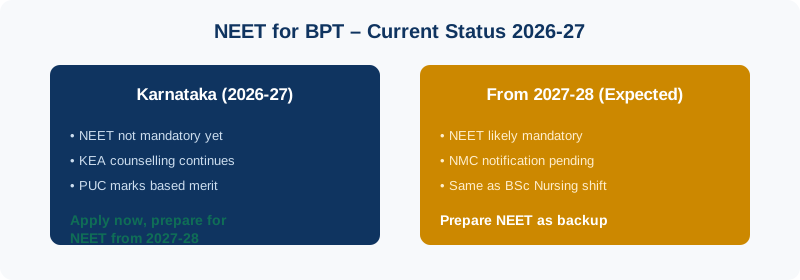
Physiotherapy (BPT) admission in Karnataka currently runs through KCET and KEA counselling – not NEET. But the National Commission for Allied and Healthcare Professions (NCAHP), which gained regulatory authority over physiotherapy education under the NCAHP Act, 2021, has at different points announced plans to make NEET-UG mandatory for BPT admission nationally. One announcement targeted the 2026-27 academic session specifically. Other, more recent reports point to a formal deferral of that requirement to 2027-28 instead. Both claims have appeared in reasonably credible coverage, which is exactly why you're finding contradictory answers – the policy itself has moved, and different articles were written at different points in that movement.
This is a case where the honest answer is "it depends on when you're asking and which announcement was most recent" rather than a clean yes or no. Treat any single article – including this one – as a snapshot, not a permanent fact, and build a habit of checking the primary sources directly as your admission season approaches.
What's Actually Confirmed Right Now
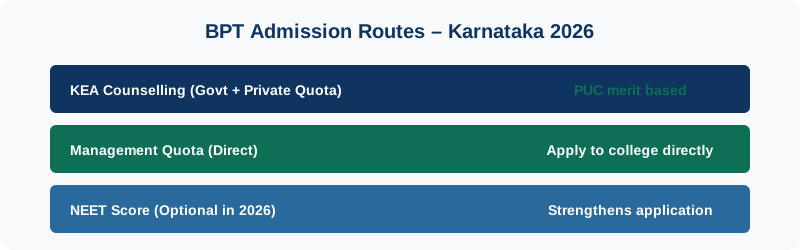
For the 2026-27 admission cycle, government-quota BPT seats in Karnataka are being allotted through KCET and KEA counselling, exactly like most other professional courses in the state. This is the current, operating reality – not a projection. Private and management-quota BPT seats are typically filled directly by colleges based on 10+2 PCB marks, though there's a broader trend toward more of this moving through KEA's centralized process over time, consistent with how other quota categories have consolidated in recent years.
Separately and consistently across sources: Karnataka's Allied and Healthcare Professions Council has been flagged as an early mover in implementing NCAHP's newer curriculum and regulatory standards compared to other states. This doesn't tell you exactly when NEET becomes mandatory, but it does suggest Karnataka is likely to be among the states where any national NEET-for-BPT mandate gets implemented relatively promptly once NCAHP finalizes the timeline, rather than a state likely to lag or resist the change.
What's Unconfirmed
The exact year NEET-UG becomes mandatory for BPT admission nationally, including in Karnataka, is not settled. You'll find claims of both 2026-27 and 2027-28 in circulation, and neither should be treated as final without checking the most current NCAHP notification yourself. This kind of shifting timeline isn't unusual for major regulatory changes in Indian professional education – we've covered a comparable pattern recently with the National Dental Commission's rollout of NExT-Dental for BDS graduates, where the exact implementation window is similarly described as "within three years" rather than a fixed date.
How to Actually Handle This as a Student Right Now
Given the genuine uncertainty (see our National Dental Commission piece for a similar regulatory transition), here's a practical approach rather than a guess dressed up as certainty:
- If you're appearing for admission in 2026-27, prepare for KCET as your primary route, since that's the confirmed current process. Don't let NEET uncertainty distract from KCET preparation, which is your actual, confirmed pathway right now.
- If you have any flexibility in your NEET-UG preparation (for instance, you're also targeting NEET for a different course like BAMS or BHMS), maintaining that preparation as a hedge costs you little and protects you if the NEET requirement arrives sooner than expected for your specific admission year.
- Check directly with KEA and NCAHP before finalizing your plan, ideally a few months before your actual admission season rather than relying on any article's snapshot, including this one. KEA's own notifications for the year will state definitively which exam governs that cycle's counselling.
- Don't panic-switch your preparation strategy based on a single headline. Given how many times this specific policy has been reported with conflicting details, wait for an official KEA or NCAHP notification specific to your admission year before making a significant preparation decision.
Why NCAHP Wants NEET for BPT in the First Place
The broader logic behind bringing BPT under NEET-UG mirrors the reasoning already applied to other health science admissions like BDSnce admissions in India: a single, standardized, nationally-proctored entrance exam is harder to manipulate at the local level than a patchwork of state-specific processes, and it allows for more direct comparison of candidates across states for All India Quota-style seat allocation, similar to how MBBS, BDS, and the AYUSH degrees already work. NCAHP's broader mandate under its 2021 Act includes standardizing allied healthcare education more generally, and pulling BPT admission into the NEET framework fits that same standardization goal, even though the exact timeline for doing so has proven harder to pin down than the policy intention itself.
How Other Courses Made This Same Transition
BPT wouldn't be the first Karnataka health science course to move from a state exam to NEET-UG. BAMS, BHMS, BUMS, and BNYS all made this same transition in past years, moving from a mix of state-level and management-quota-direct admission toward mandatory NEET-UG qualification for every seat, including management quota. In each of those cases, the transition wasn't instant – there was typically a multi-year runway between the policy decision and full implementation, during which state counselling authorities and colleges adjusted their processes, seat-matrix reporting, and internal systems to work with NEET-UG data rather than a state-specific exam's rank list.
If BPT follows the same pattern, expect a similar multi-year adjustment period once the mandate does take effect, rather than an abrupt overnight switch mid-admission-cycle. This is also part of why the "will it be 2026-27 or 2027-28" uncertainty matters less in practice than it might seem – even once a firm date is announced, there's likely to be a lead-in period during which both the current KCET-based system and preparations for the NEET-based system exist side by side, giving affected students reasonable notice rather than a sudden rule change.
What Happens If the Policy Changes Mid-Admission-Cycle
A reasonable worry: what if you're mid-way through preparing (check our KCET documents checklist if you're at that stage) for KCET-based BPT admission and NCAHP announces an earlier-than-expected NEET mandate? Based on how comparable transitions have unfolded for other courses, regulatory changes of this kind are typically announced with enough lead time to apply to the *next* admission cycle rather than retroactively altering an already-underway one. Admission cycles that have already begun (results declared, counselling in progress) are generally allowed to complete under the rules they started with. If you're already deep into a KCET-based BPT application process when any announcement comes, the safest assumption is that your current cycle continues under its existing rules, while any new requirement applies starting from the following year's admissions – though this is a reasonable expectation based on precedent, not a guarantee, so continue checking official KEA communications specific to your exact admission timeline.
What Changes for Karnataka Students If NEET Does Become Mandatory
If and when NEET-UG does become the entrance requirement for BPT, the likely practical shift – similar to how Homeopathy admission already works – based on how this transition has worked for other courses – would involve Karnataka's BPT seats moving into a counselling structure similar to the AYUSH pattern: KEA handling the majority state-quota allocation using NEET-UG scores, with a smaller All India Quota portion handled through a central counselling body. This isn't confirmed as the exact model that will apply to BPT specifically, but it's the pattern NCAHP has generally followed for allied healthcare courses it has brought under centralized admission, so it's a reasonable structure to anticipate rather than a certainty to plan around exclusively.
One practical implication worth considering now, regardless of exact timing: Karnataka's 73 physiotherapy colleges currently compete for KCET-qualified applicants within a KCET-specific applicant pool. If admission shifts to NEET-UG, the applicant pool broadens to everyone who takes NEET nationally, which could meaningfully change competition dynamics for popular Bangalore and Mangalore colleges. Students currently a few years out from BPT admission (still in school, for instance) may want to factor this into long-term planning, even though it's not an immediate concern for this year's applicants.
How This Compares to Other Recent Regulatory Uncertainty
If this kind of shifting-timeline regulatory uncertainty feels familiar – browse our full Karnataka stream directory for other examples – it's because it's become a genuine pattern across India's allied and AYUSH healthcare education reforms in recent years. We've covered a comparable situation with the National Dental Commission's rollout of NExT-Dental for BDS graduates, where the implementation window is similarly described only as "within three years" rather than a fixed date. In both cases, the underlying reform intent is clear and unlikely to reverse, but the exact operational timeline keeps shifting as the responsible commission works through the practical realities of implementation – coordinating with state counselling authorities, building the administrative infrastructure for a new admission model, and managing the transition for colleges and students already partway through the old system.
The practical takeaway that applies across all of these situations: when a regulatory body announces intent to standardize an admission process nationally, treat the intent as real and worth preparing for eventually, while treating any specific date attached to it as provisional until you see it repeated consistently across multiple recent, official sources – ideally the regulator's own notifications rather than secondary reporting.
Frequently Asked Questions
Is NEET currently required for BPT admission in Karnataka?
No, not currently. For the 2026-27 cycle, government-quota BPT seats in Karnataka are allotted through KCET and KEA counselling, not NEET-UG.
Why do different websites give different answers about NEET and BPT?
Because the actual regulatory position has shifted more than once. NCAHP has at different points signaled both a 2026-27 implementation and a deferral to 2027-28. Articles written at different times reflect different snapshots of an evolving situation, not necessarily errors on their part.
Should I prepare for NEET-UG just in case, alongside KCET?
If you have the bandwidth and are already preparing for NEET for another course (like BAMS or BHMS), maintaining that preparation costs little and hedges against an earlier-than-expected NEET mandate for BPT. If BPT is your sole focus, prioritizing KCET preparation makes sense since that's the confirmed current pathway.
Where can I check the current official status?
Check directly with KEA (kea.kar.nic.in) for Karnataka-specific counselling requirements for your admission year, and NCAHP (ncahp.abdm.gov.in) for the national regulatory position. Official notifications for your specific admission cycle are more reliable than general articles, including this one.
Does this uncertainty affect the quality of BPT education itself?
No. The admission exam requirement (KCET vs NEET) is a separate question from curriculum quality and college accreditation. Karnataka's physiotherapy colleges' NAAC accreditation, RGUHS affiliation, and clinical training standards are unaffected by which entrance exam ultimately governs admission.
Has a similar admission-exam transition happened for other courses in India?
Yes. NEET-UG became mandatory for BAMS, BHMS, BUMS, and BNYS admission in past years, following a comparable pattern of national standardization. NCAHP's push to bring BPT under NEET follows the same broader logic applied to those AYUSH courses.
Compare Karnataka's physiotherapy colleges, fees, and current admission process in our full physiotherapy stream guide.
This is an unsettled regulatory area – confirm the current-year requirement directly with KEA and NCAHP before finalizing your preparation strategy. Last updated: July 2026. Have a correction? Write to reach@collegesinfo.org.
Need help with admission?
CollegesInfo.org helps students secure admission to colleges they are eligible for under that college's actual published criteria. Chat with us on WhatsApp or explore admission assistance.