Energy Engineering and Smart Agritech colleges in Karnataka represent VTU's two newest branch codes, added since 2022. Unlike several other recently-introduced specialisations, both already have confirmed, real undergraduate seats: a government gazette notification lists actual KEA-notified intake for Smart Agritech, and a state university's own page confirms a live B.Tech in Energy Engineering.
Looking at the bigger picture? Our guide to the best engineering colleges in Karnataka compares KCET tier-wise cutoffs, COMEDK options, and real fee data across Bengaluru, Mangalore, Mysore, and north Karnataka for 2027.
Why Energy Engineering and Smart Agritech Colleges in Karnataka Are Worth Watching Now
VTU's updated stream-wise programme document lists twenty programmes now sitting inside the Mechanical Engineering stream, and two of them, Energy Engineering, code ER, and Smart Agritech, code SA, do not appear in earlier editions of the same document at all. Both are recent additions, arriving as India's renewable energy sector and precision agriculture technology have grown into genuine hiring categories rather than niche research interests.
What makes these two branches different from several other recently-added or long-standing thin codes already documented on this site, including Silk Technology and Construction Technology and Management, is that both Energy Engineering and Smart Agritech already have confirmed, real undergraduate presence, verified directly from a government notification and a university's own page rather than left as codes existing only on paper.
| Branch | Code | Confirmed evidence |
|---|---|---|
| Energy Engineering | ER | Sharnbasva University's own live programme page |
| Smart Agritech | SA | Government of Karnataka gazette seat matrix, 30 notified seats |
Both pieces of evidence sit well above the standard this site applies before naming a college for any specialised branch: a government notification and a university's own current, actively marketed programme page, rather than an aggregator's undated listing or a forum answer naming colleges from memory.
3 Things That Set These Two New Branches Apart
1. A government gazette notification confirms real seats for Smart Agritech
A Government of Karnataka education department notification, published directly on VTU's own website, lists the official KEA seat matrix for the 2023-24 admission cycle. Inside that gazette, Smart Agritech appears with a confirmed intake of 30 seats at Alva's Institute of Engineering and Technology, Moodbidri, alongside a separate 60-seat Agriculture Engineering intake at the same college, broken down across the specific reservation categories, KEA government quota, COMEDK and management quota shares that govern every notified engineering seat in the state. This is not a portal estimate. It is the same class of primary government document that determines actual seat allotment.
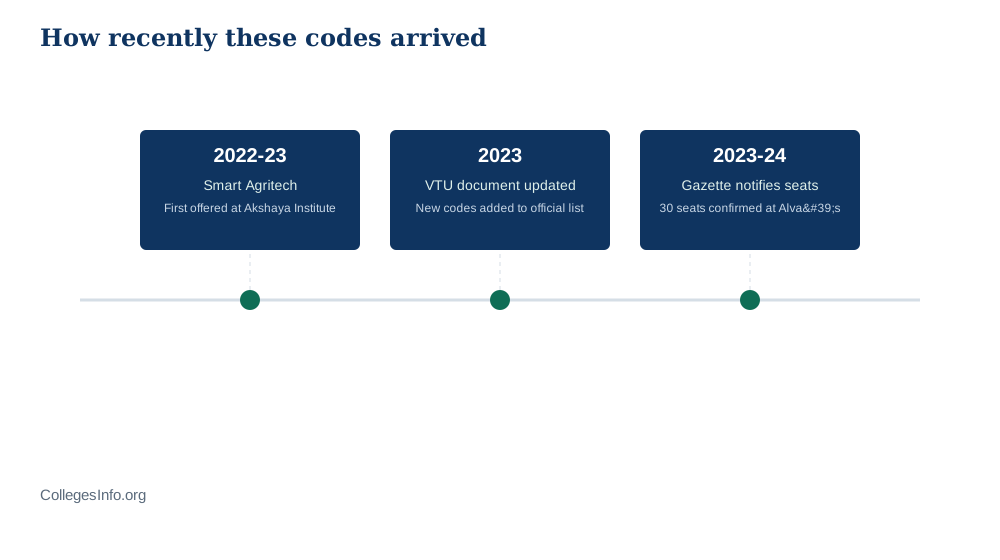
The existence of this specific gazette entry also tells a broader story about how new engineering branches actually enter Karnataka's system. A branch does not become real simply because VTU adds a code to its programme list; it becomes real when the state's fee regulatory and seat allotment machinery formally notifies intake against that code at a specific, named college. The gap between a code appearing on paper and a code appearing in a government gazette with an actual seat count is exactly the gap that has left branches like Silk Technology and Construction Technology sitting on paper for years without a confirmed undergraduate seat ever materialising. Smart Agritech has already cleared that gap, at least at one college, within roughly a year of its earliest confirmed classroom intake.
2. A named college claims to be the first mover, dated and documented
Akshaya Institute of Technology, Tumakuru, states on its own official COMEDK profile that it began offering Agriculture Engineering and Smart Agritech from the 2022-23 academic year, describing Smart Agritech specifically as the first of its kind in Karnataka with placement potential in multinational companies and entrepreneurship. A college naming its own launch year for a specific branch, on a platform where colleges self-report their programme details, is a stronger signal than an aggregator's undated listing.
3. Energy Engineering already has a confirmed live B.Tech, though not where every aggregator claims
Sharnbasva University, Kalaburagi, a state university established under a dedicated Government of Karnataka Act in 2017, runs its own dedicated page confirming a B.Tech in Energy Engineering inside its Faculty of Engineering and Technology, admitted through KCET, JEE Main and the university's own entrance route, followed by KEA centralised counselling. This is a genuine, current, actively marketed programme, not a stale listing.
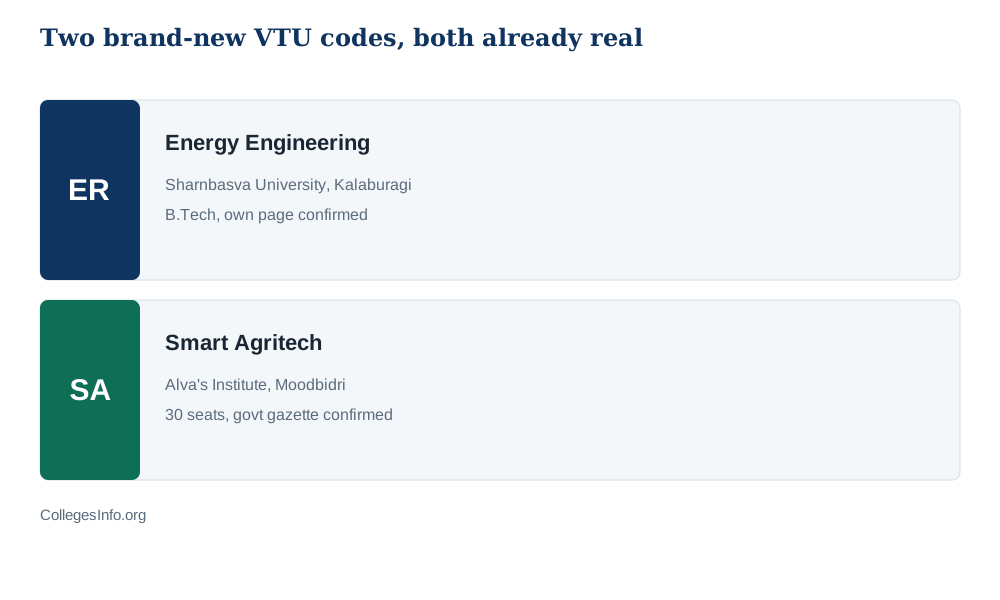
Both branches already have confirmed real seats, unlike several older thin codes on this site.
2 Karnataka Colleges Confirmed From Primary Sources
Alva's Institute of Engineering and Technology, Moodbidri, Dakshina Kannada
Confirmed directly from the Government of Karnataka's own gazette seat-matrix notification for the 2023-24 cycle, this college holds a notified 30-seat Smart Agritech intake, with the full category-wise breakdown, government quota, COMEDK and management shares, published in the same document. This is a Civil-adjacent Mechanical stream code sitting alongside the college's separately notified 60-seat Agriculture Engineering intake.
Sharnbasva University, Kalaburagi
Sharnbasva University's own page confirms a B.Tech in Energy Engineering inside its Faculty of Engineering and Technology, alongside Computer Science, Artificial Intelligence, Electrical, Electronics, Mechanical, Civil and Computer Science and Design. The university states its programme prepares students for renewable energy systems, energy management, power generation, sustainability and emerging energy technologies, admitted via merit and KCET, JEE Main, NATA or the university's own entrance examination, followed by KEA centralised counselling. Sharnbasva University was established under the Sharnbasva University Act by the Government of Karnataka in 2017 and holds UGC, AICTE, NAAC and NBA recognition.
A Naming Confusion Already Emerging for Energy Engineering
One large aggregator's filtered listing for "B.E./B.Tech Energy Engineering colleges in Karnataka" names Atria University, Bengaluru, alongside Sharnbasva University. Atria Institute of Technology, an entirely separate, longer-established VTU-affiliated college in Bengaluru founded in 2000, does not list Energy Engineering among its own confirmed current specialisations, which run to Civil, Mechanical, Computer Science, Electronics and Communication, Information Science, Computer Science and Design, Artificial Intelligence and Machine Learning, and Data Science. "Atria University" and "Atria Institute of Technology" appear to be related but distinct institutions carrying a shared brand name, exactly the kind of confusion that has already misled candidates researching other branches on this site. A candidate should verify directly which specific "Atria" institution actually runs an Energy Engineering seat before assuming the two names refer to the same place.
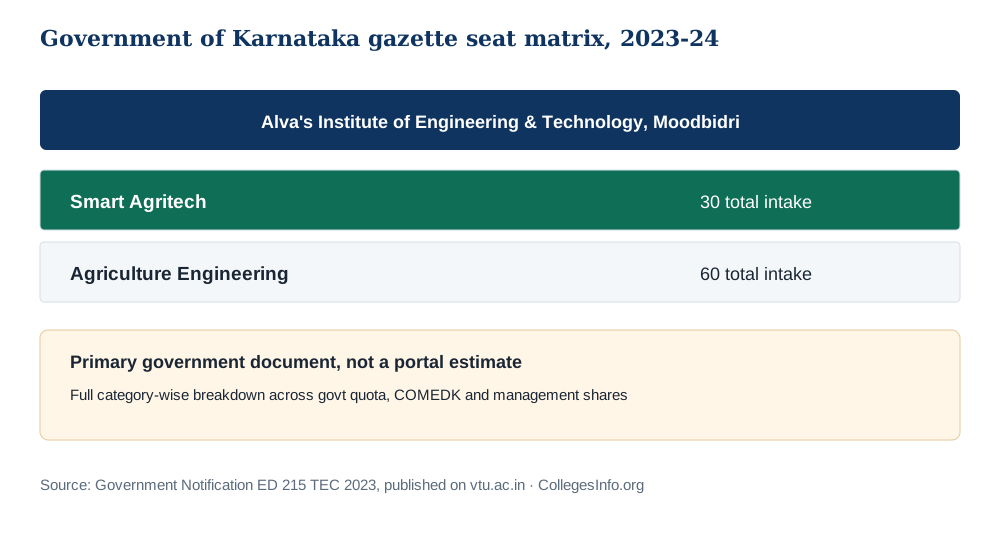
A primary government document, not a portal estimate, confirming real notified seats.
A Related Diploma That Answers a Different Search
Two Karnataka government polytechnics, Government Polytechnic Nagamangala and Government Polytechnic Srirangapatna, both in Mandya district, offer a diploma titled Alternate Energy Technologies, not Energy Engineering. This is a three-year diploma programme, admitted after 10th standard rather than PUC, sitting at a different qualification level and under a different specific name from Sharnbasva University's B.Tech. A candidate searching broadly for "energy courses in Karnataka" can land on either the diploma or the degree without immediately realising they represent different qualification levels under different specific titles.
What These Programmes Actually Cover
Sharnbasva University's own description of its Energy Engineering programme names renewable energy systems, energy management, power generation, sustainability and emerging energy technologies as its core focus areas, framing the degree around the global shift toward cleaner and smarter energy sources. Akshaya Institute of Technology's own description of Smart Agritech points toward multinational company placement and entrepreneurship potential, suggesting a curriculum built around precision agriculture technology, sensors, data-driven farming systems and related smart-systems applications layered onto an agricultural engineering base, though neither college's page available in this research breaks down a full semester-by-semester syllabus.
What both descriptions do reveal is intent: Sharnbasva University frames its programme around the global transition to cleaner energy sources, while Akshaya Institute of Technology frames Smart Agritech around multinational placement and entrepreneurship potential. Neither framing is unusual for a newly-launched specialised branch, since colleges introducing a first-of-its-kind programme typically lead with the market opportunity the branch is designed to capture, rather than a granular curriculum breakdown that would only mean something to a candidate already convinced the field itself is worth pursuing.
Both programmes sit at the intersection of an established engineering discipline and a fast-growing applied sector: Energy Engineering pulls from Electrical, Mechanical and Civil fundamentals applied to power and sustainability; Smart Agritech pulls from Agricultural Engineering fundamentals applied to sensor networks, automation and data systems. This positions both branches closer to Mechatronics in structure, an established discipline reframed around a specific applied direction, than to a branch built from scratch.
Eligibility and Admission Routes
Both confirmed programmes follow standard Karnataka engineering eligibility patterns. Sharnbasva University's B.Tech route admits via merit combined with KCET, JEE Main, NATA or the university's own entrance test, followed by KEA centralised counselling, matching the pattern already documented across other specialised branches on this site including cyber security engineering and biomedical engineering. Alva's Institute's Smart Agritech seats, confirmed through the government gazette notification, follow the standard KEA-notified seat allotment process governing every engineering branch in the state, with the same category-wise reservation structure applied uniformly across government quota, COMEDK and management shares.
Because both branches remain new, a candidate should verify current-year seat availability directly against the KEA counselling portal for the specific admission cycle rather than assuming seat counts from the 2023-24 gazette carry forward unchanged, since intake for newly launched branches can change meaningfully year to year as demand and institutional capacity become clearer.
Why VTU Keeps Adding New Codes to an Already Crowded Stream
Energy Engineering and Smart Agritech joining the Mechanical stream brings the total count of programmes in that one stream to twenty, a pace of addition already discussed in the context of Automation and Robotics, Robotics and Automation, and Robotics and Artificial Intelligence sitting as three nearly identical adjacent codes inside the same stream. Unlike that cluster, where genuine confusion between near-identical names has already surfaced, Energy Engineering and Smart Agritech carry names distinct enough from every other Mechanical-stream code that direct naming confusion is less likely, though the newer Atria-branding overlap for Energy Engineering shows the same pattern can still emerge through institutional naming rather than branch naming.
| Programme added | Approximate timing | Confirmed status |
|---|---|---|
| Smart Agritech | First offered 2022-23 | Real notified seats confirmed |
| Energy Engineering | Added to VTU's list by 2023 | Live B.Tech confirmed at one university |
| Robotics and Artificial Intelligence | Brand new since 2022-23 | Covered separately, thin presence |
VTU's own AICTE-governed approval structure allows this pace of addition because each new specialisation can be introduced as its own code without requiring the university to first retire an older, overlapping one. That structural flexibility is precisely what has produced twenty separate programmes competing for attention inside one stream.
Candidates who want a new branch and its confirmed institution verified before applying anywhere can start from our MBA admission assistance page.
The practical lesson for a candidate evaluating any newly-introduced branch code, whether at VTU or at a state university like Sharnbasva, is the same discipline applied throughout this site's research: a government gazette notification or a college's own current department page outranks any aggregator estimate, and a branch's newness does not by itself mean thin or unconfirmed presence, as both Energy Engineering and Smart Agritech demonstrate here.
Where This Fits Inside VTU's Own Updated Documentation
Both codes appear in VTU's own updated stream-wise programme document, dated 2023, which does not appear in earlier editions of the same reference. This confirms the codes are recent enough that older cached versions of VTU's programme list, still circulating on various third-party sites and PDFs, would not show them at all, which likely explains why some aggregators still miss both branches entirely while others list them inconsistently.
A candidate cross-checking any Mechanical-stream branch against an older, cached copy of VTU's programme document risks missing newly launched additions altogether, in either direction: assuming a code does not exist because an outdated reference does not list it, or assuming a code is thin and unconfirmed simply because it is new, when in Smart Agritech's and Energy Engineering's specific cases, real evidence already exists.
Career Destinations in Both Fields
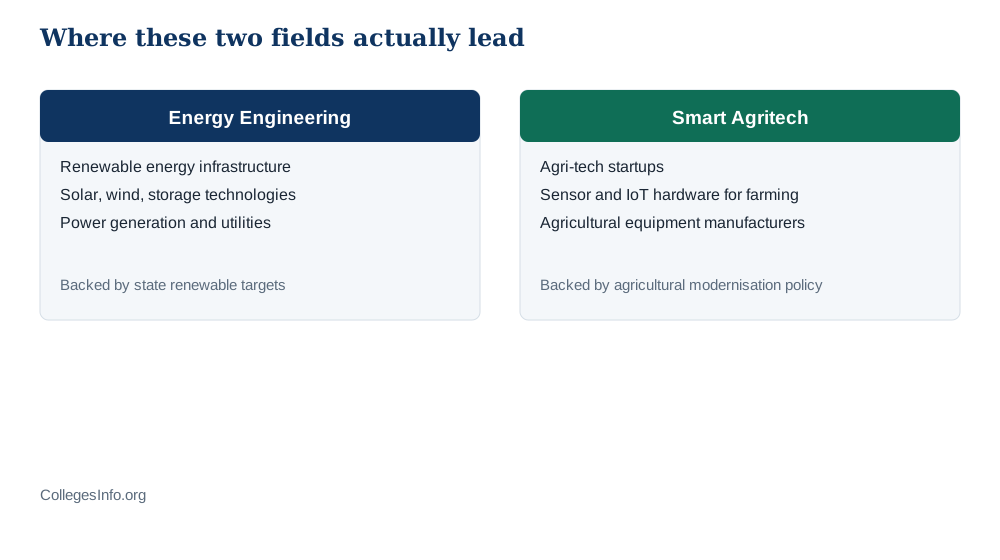
Energy Engineering graduates in Karnataka enter a state with genuine renewable energy infrastructure growth, spanning solar, wind and emerging storage technologies, alongside traditional power sector roles in generation, transmission and distribution utilities. Smart Agritech graduates enter a smaller but growing precision agriculture technology sector, spanning agri-tech startups, sensor and IoT hardware companies serving agriculture, and larger agricultural equipment manufacturers building smart-systems capability into traditional machinery.
Neither field yet carries the scale of Karnataka's largest engineering branches, but both sit inside sectors with clear government policy support, renewable energy targets and agricultural modernisation programmes respectively, that suggest genuine long-term demand rather than a passing specialisation trend.
What Happens if a Candidate Cannot Get Either Seat Directly
Given how new both branches are, seat availability will likely remain limited for several admission cycles, concentrated at the two confirmed institutions and possibly a handful of others not independently verified in this research. A candidate who cannot secure a direct Energy Engineering or Smart Agritech seat has a reasonable alternative: a standard Electrical, Mechanical or Agricultural Engineering undergraduate degree, followed by specialisation at the postgraduate stage once these newer fields develop dedicated M.Tech programmes at more institutions, mirroring the same postgraduate-first logic already documented for Environmental Engineering and other specialised branches on this site.
This approach also protects against the specific risk this article has documented: a candidate locking into an unconfirmed seat at a similarly-named but different institution, such as the Atria naming overlap, or discovering after enrolment that what looked like a degree-level Energy Engineering seat was actually the differently-named Alternate Energy Technologies diploma. A strong foundation in the parent discipline, verified at an established institution, keeps genuine specialisation options open as both of these new fields mature and more colleges build out dedicated programmes with their own confirmed department pages.
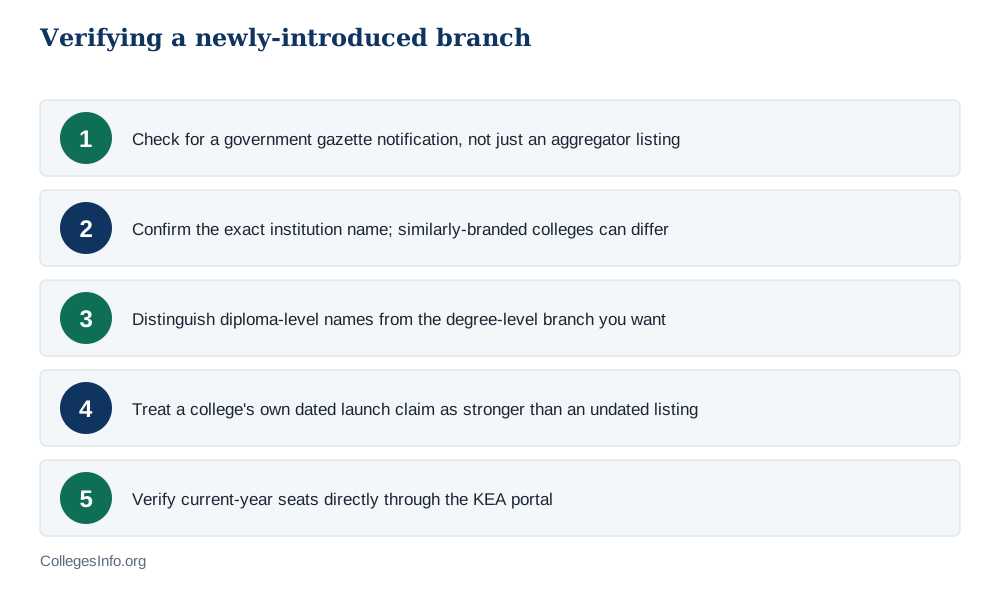
How to Verify a Newly-Introduced Branch Before Applying
- Check whether a government gazette notification or seat-matrix document, not just an aggregator listing, confirms actual notified intake for the branch at the specific college you are considering.
- Confirm the exact institution name carefully, since similarly-branded institutions, such as the Atria naming overlap documented here, can carry entirely different confirmed programmes.
- Distinguish diploma-level programmes carrying a different specific name, such as Alternate Energy Technologies, from the degree-level branch you are actually searching for.
- Treat a college's own dated claim about when it launched a new branch as a stronger signal than an undated aggregator listing.
- Verify current-year seat availability directly through the KEA portal for the live admission cycle, since intake for newly launched branches can change meaningfully year to year.
The same verification applies when comparing undergraduate and postgraduate routes into either field, and our admission assistance service page covers that path.
The Postgraduate and Research Route
Because both branches remain new, dedicated postgraduate programmes have not yet appeared widely across Karnataka's universities. A candidate specifically interested in energy systems or precision agriculture technology at the research level currently has a stronger route through the parent disciplines: an M.Tech in Power Systems or Renewable Energy for Energy Engineering-adjacent interests, or an M.Tech in Agricultural Engineering with a focus on automation and instrumentation for Smart Agritech-adjacent interests, admitted through GATE or Karnataka PGCET at established departments rather than waiting for a dedicated postgraduate programme under either exact new branch name to appear.
Frequently Asked Questions
Is Energy Engineering a real undergraduate branch in Karnataka?
Yes. Sharnbasva University, Kalaburagi, confirms a live B.Tech in Energy Engineering on its own official page, admitted through KCET, JEE Main or the university's own entrance test, followed by KEA centralised counselling.
Is Smart Agritech a real VTU branch code with actual seats?
Yes. A Government of Karnataka gazette notification, published on VTU's own website for the 2023-24 admission cycle, confirms a notified 30-seat Smart Agritech intake at Alva's Institute of Engineering and Technology, Moodbidri.
Which college was first to offer Smart Agritech in Karnataka?
Akshaya Institute of Technology, Tumakuru, states on its own COMEDK profile that it began offering Smart Agritech from the 2022-23 academic year, describing it as the first of its kind in Karnataka.
Does Atria Institute of Technology offer Energy Engineering?
Not confirmed. Atria Institute of Technology's own current course list does not include Energy Engineering. An aggregator's listing instead names "Atria University," which appears to be a related but distinct institution, and this naming overlap should be verified directly before assuming the two are the same.
What is the difference between Energy Engineering and the Alternate Energy Technologies diploma?
Energy Engineering, confirmed at Sharnbasva University, is a four-year B.Tech admitted after PUC. Alternate Energy Technologies, offered at Government Polytechnic Nagamangala and Government Polytechnic Srirangapatna, is a three-year diploma admitted after 10th standard, a different qualification level under a different specific name.
What career paths do these two new branches lead to?
Energy Engineering graduates enter Karnataka's renewable energy, power generation and utility sectors. Smart Agritech graduates enter the precision agriculture technology sector, spanning agri-tech startups, sensor and IoT hardware, and agricultural equipment manufacturers building smart-systems capability.
How many VTU Mechanical-stream programmes exist now that these two are included?
VTU's updated stream-wise programme document lists twenty programmes inside the Mechanical Engineering stream, with Energy Engineering and Smart Agritech among the most recent additions.
Should I choose a new branch like this over an established one?
Not automatically. Both Energy Engineering and Smart Agritech carry genuine, confirmed evidence of real seats, but each currently exists at essentially one verified institution in this research. An established branch at a well-regarded college generally offers more predictable placement outcomes, more graduated batches to reference, and a longer track record than a programme in its second or third intake year. A candidate drawn to either field for genuine reasons, rather than novelty alone, should weigh institutional maturity at the specific college offering the new branch against the appeal of the specialisation itself.
This article is for informational purposes only. Consult the college directly before making admission decisions.
About the author
OneCity Technologies Pvt. Ltd began in 2006 publishing an annual print education directory for Karnataka students and parents. As demand grew, OneCity launched an education portal in 2019 to bring that same directory information online, and in 2025 relaunched as CollegesInfo.org, a comprehensive Karnataka college directory covering 1,500+ institutions across engineering, medical, management, arts, commerce, and more. Founder L K Monu Borkala brings 20+ years of business experience and 19 years of work across various education-sector services. CollegesInfo.org's content is built from publicly available KEA, NMC, AICTE, and university data, cross-checked against official sources wherever possible. CollegesInfo.org's admission assistance service helps students secure admission to colleges they are eligible for under that college's actual published criteria. We help you get the best admission to your preferred colleges without hassle.
Need help with admission?
CollegesInfo.org helps students secure admission to colleges they are eligible for under that college's actual published criteria. Chat with us on WhatsApp or explore admission assistance.
Considering one of Karnataka's newest engineering branches?
We help you get the best admission to your preferred colleges without hassle.