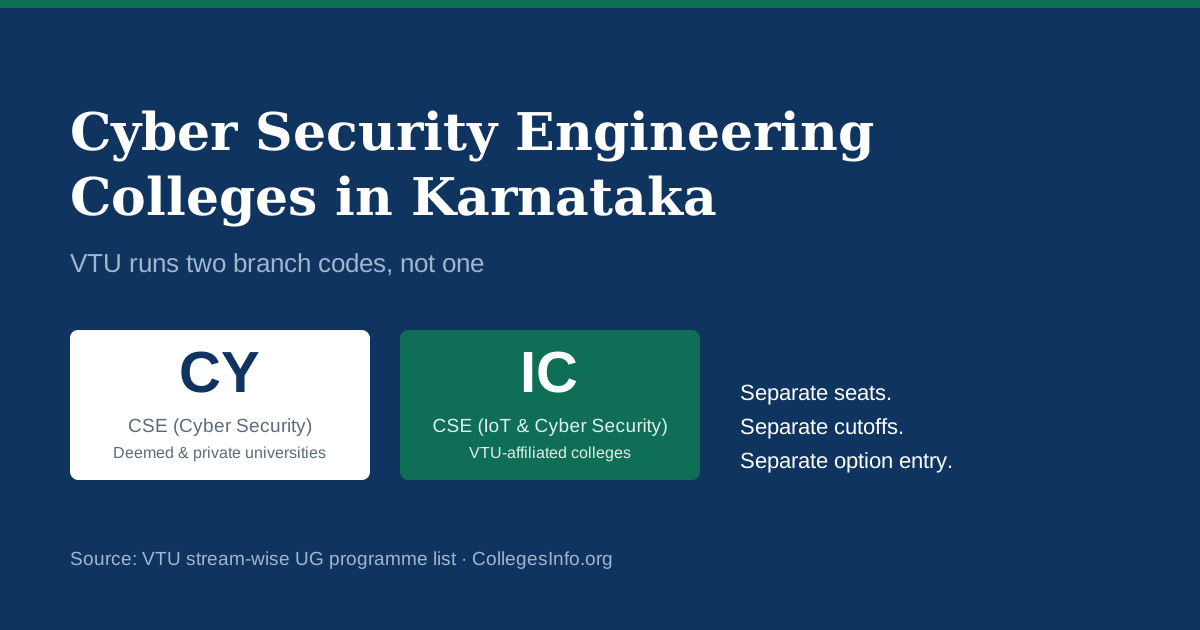
Cyber security engineering colleges in Karnataka run two officially distinct branches, not one. VTU lists CSE (Cyber Security) under code CY and CSE (IoT and Cyber Security including Block Chain Technology) under code IC. They are separate seats with separate cutoffs. Selecting the wrong code at KEA option entry costs the seat.
Looking at the bigger picture? Our guide to the best engineering colleges in Karnataka compares KCET tier-wise cutoffs, COMEDK options, and real fee data across Bengaluru, Mangalore, Mysore, and north Karnataka for 2027.
The Two Cyber Security Branches VTU Actually Runs
Open VTU's stream-wise UG programme list, the document that decides which first and second semester scheme a student follows, and the Computer Science & Engineering stream contains sixteen programmes. Two of them carry cyber security in the name. They are not the same degree, they are not taught by the same departments, and they do not fill at the same ranks.
| Course code | Programme name, as VTU prints it |
|---|---|
| CY | CSE (Cyber Security) |
| IC | CSE (IoT & Cyber Security including Block Chain Technology) |
| CD | CSE (Data Science) |
| CI | CSE (Artificial Intelligence & Machine Learning) |
| CA | CSE (Artificial Intelligence) |
| CS | Computer Science & Engineering |
| IS | Information Science & Engineering |
Something else sits in that same official list. Entry number nine, Computer Science & Engineering (IoT), is printed with the course code column blank. VTU's own document leaves it empty. It is a small thing on a single PDF, but it says something about how quickly these branch names were added to the CSE stream and how loosely the paperwork has kept pace since.
The practical consequence appears at KEA's option entry screen. A candidate who has decided on cyber security, and types CY against a college that only runs IC, gets nothing from that choice. The option is skipped during allotment. Nobody writes to explain why. This is the same trap that catches students choosing between CSE, AI and ML, and Data Science at KCET, with one difference that makes it worse: both cyber security branches share the keyword the student is searching for.
3 Reasons the Branch Code Decides Your Seat, Not the College Name
1. Allotment runs on code, not on intent
The VTU branch code is the one field that decides whether an option is considered at all. KEA allots against a college-plus-branch pair. There is no fuzzy matching and no human reading your list to work out what you meant. If the college code is correct and the branch code is not offered at that college, the entry sits in your list as dead weight while better-ranked candidates move past you.
2. The two branches sit in different seat pools
IC branches were approved in a wave starting with the 2021-22 academic year, most of them at a standard intake of 60 seats per college. CY is rarer among VTU-affiliated colleges and far more common at deemed and private universities, many of which admit outside KEA counselling altogether through their own tests.
3. Closing ranks diverge from plain CSE
Because IC exists at more colleges while carrying a longer and less recognisable name, its closing ranks tend to settle apart from the CSE band that students actually benchmark against. Anyone screening only the KCET cutoff analysis for core branches will misjudge both codes. The category picture matters as much, since Karnataka publishes eight separate lists and the gaps between them are wide, as laid out in the category-wise closing rank breakdown.
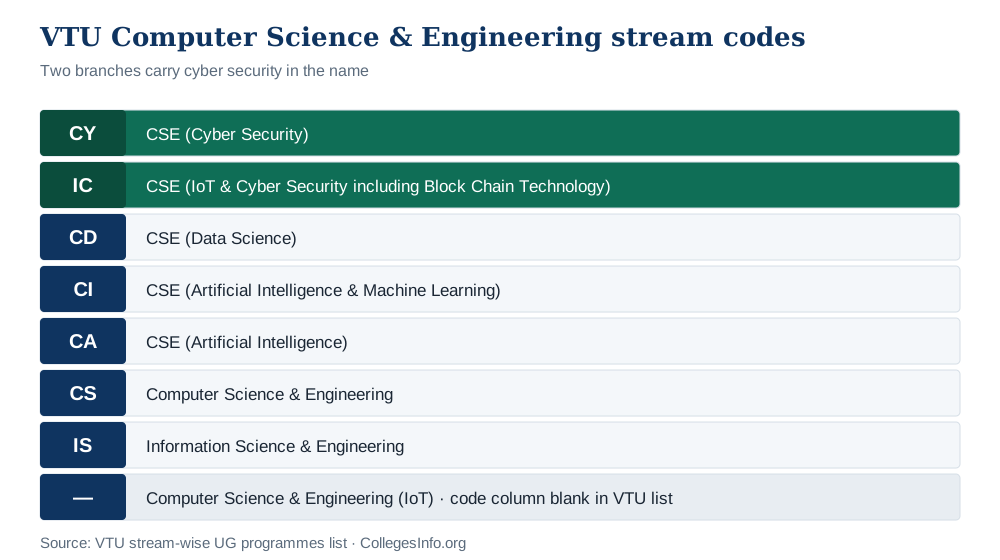
VTU's own programme list leaves the course-code column blank at entry nine.
CY vs IC: What Actually Differs
| CSE (Cyber Security), code CY | CSE (IoT & Cyber Security with Blockchain), code IC | |
|---|---|---|
| Core focus | Security as the primary discipline: cryptography, network defence, digital forensics | A three-way split across IoT, security and blockchain |
| Typical provider | Deemed and private universities, often admitting through their own tests | VTU-affiliated and autonomous engineering colleges |
| Standard intake | Varies by university | 60 seats per college |
| Approval wave | Programme-specific, governed by a separate VTU scheme circular | Began academic year 2021-22 |
| VTU syllabus document | Circular on the scheme and syllabus for B.E. in Cyber Security | CSE (IoT & CS with BCT), dated 23 May 2021 |
| Main admission routes | KCET, COMEDK, JEE Main, university-level tests | KCET and COMEDK |
VTU has published a dedicated circular covering the scheme and syllabus for B.E. in Cyber Security, which is what makes CY a recognised standalone programme rather than an informal specialisation label pinned onto a CSE degree. That circular sits on the university's own circulars and notifications page alongside its affiliation and regulation documents.
The IC branch has a documented origin date, which is rarer than it sounds. Mangalore Institute of Technology & Engineering, an autonomous institute under Rajalaxmi Education Trust affiliated to VTU and approved by AICTE, states on its own department page that CSE (IoT & Cyber Security including Blockchain Technology) started in the academic year 2021-22 with an intake capacity of 60 seats. A college publishing its own start date is a firmer citation than any ranking list.
4 Karnataka Colleges Confirmed From Their Own Official Pages
Aggregator listings for this branch are unusually unreliable, so this section is restricted to colleges whose own websites carry the programme. Everything we could not confirm that way is listed at the end of this article as unverified rather than presented here as fact.
1. Mangalore Institute of Technology & Engineering, Moodbidri
MITE runs the IC branch and dates it precisely to 2021-22 with 60 seats. Autonomous status under VTU means the institute sets its own examination scheme within the university's framework, which usually translates into faster syllabus revision in a field that changes quickly. For candidates weighing the coastal belt against Bangalore, the wider regional picture is covered in our guide to engineering colleges across Mangalore.
2. Dayananda Sagar College of Engineering, Bangalore
DSCE lists Computer Science & Engineering (Internet of Things and Cyber Security Including Block Chain Technology) among its branches on its own site. The college is AICTE-approved, VTU-affiliated, holds Government of Karnataka approval for autonomy, and admits through CET and COMEDK. Its published minimum is a pass in PUC, CBSE, ICSE or equivalent with Physics and Mathematics as compulsory subjects and 45% aggregate. The full institutional record is in our DSCE Bangalore profile.
3. Alliance University, Bangalore
Alliance runs B.Tech CSE Cyber Security, a CY-type programme. Its published eligibility asks for Class 12 with Physics, Mathematics and Chemistry along with Biology or Computer Science as compulsory subjects, at 50% aggregate, with a 5% relaxation for SC and ST candidates. Admission accepts JEE Main, JEE Advanced, K-CET, COMEDK, AUEET or another state-level engineering entrance. The university describes hands-on ethical hacking, penetration testing and vulnerability assessment work using Wireshark, Metasploit, Nmap and Kali Linux, alongside capture-the-flag competitions and threat simulations. It also lists diploma and B.Sc lateral entry routes at 50% aggregate.
4. Jain (Deemed-to-be University), Bangalore
Jain's Faculty of Engineering and Technology offers B.Tech CSE with Cyber Security and Digital Forensics. Its lateral-entry routes are documented in unusual detail: a three-year or two-year diploma at 45%, with 40% for reserved-category candidates; a B.Sc from a UGC-recognised university at 45%, again 40% for reserved categories, provided the candidate passed 10+2 with Mathematics; or a B.Voc and three-year D.Voc route in the same or an allied sector, with the university offering bridge courses in Mathematics, Physics and engineering drawing for students arriving from mixed backgrounds.
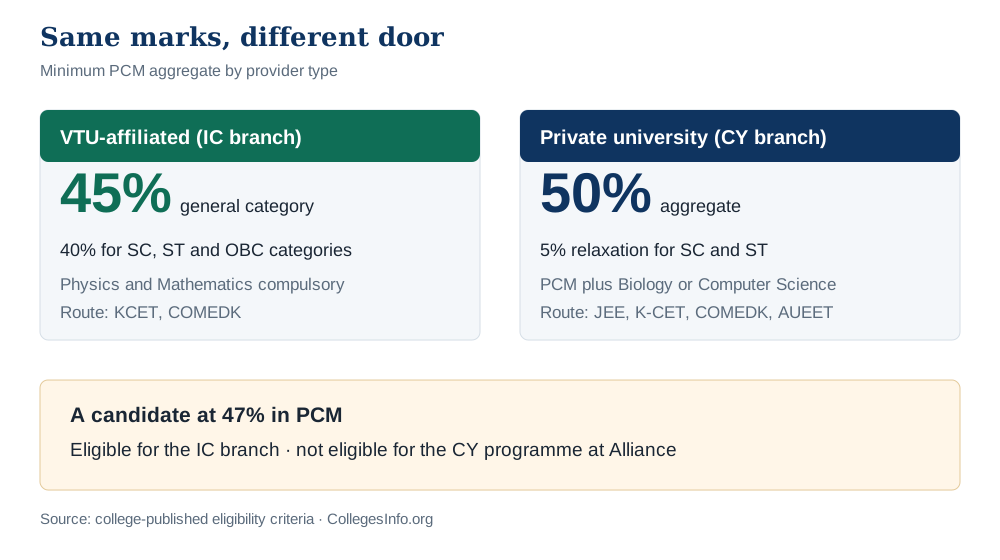
A candidate at 47% in PCM clears one route and fails the other on the same marks.
Eligibility: 45% or 50%? It Depends Who Runs the College
Here is where two candidates holding identical marksheets receive different answers, for reasons that have nothing to do with merit.
| Provider type | Minimum aggregate | Subject requirement | Route |
|---|---|---|---|
| VTU-affiliated, such as DSCE | 45% general, 40% SC, ST and OBC categories | Physics and Mathematics compulsory, plus Chemistry, Biotechnology, Biology, Computer Science or Electronics | KCET, COMEDK |
| Deemed or private university, such as Alliance | 50% aggregate, 5% relaxation for SC and ST | PCM plus Biology or Computer Science | JEE Main, JEE Advanced, K-CET, COMEDK, AUEET |
| Lateral entry, such as Jain | 45% general, 40% reserved | Diploma, or B.Sc with Mathematics at 10+2, or B.Voc with bridge courses | Direct lateral admission to the third year |
A student sitting at 47% in PCM is eligible at a VTU-affiliated college running IC and ineligible at Alliance for CY. Same student, same marks, different door. That five-point gap is the single most useful thing to establish before building an option list, and almost no ranking page mentions it exists.
How KEA Builds the Rank That Decides Your Allotment
Candidates coming through the state route should understand how the number itself is produced. KEA calculates a composite merit score using half the KCET marks, out of 180 across Physics, Chemistry and Mathematics, and half the Class 12 PCM percentage. Strong board marks pull a weak exam score upward, and the reverse is equally true: a good KCET paper sitting on top of a poor board result produces a worse rank than students expect.
That weighting matters more in a small branch than a large one. Plain CSE at a major Bangalore college absorbs hundreds of seats across categories, so a few hundred ranks either way rarely changes the outcome. A 60-seat IC branch behaves differently. A handful of ranks can separate allotment from rejection, especially in the later rounds once accept, slide and surrender decisions start moving seats back into the pool.
What Cyber Security Actually Costs in Karnataka
Fees under the government quota at VTU-affiliated private colleges are notified each year by the Karnataka government and the state's fee regulatory mechanism. The college does not set them. Management-quota and COMEDK-quota fees are separate and considerably higher, and deemed universities operate outside that structure entirely.
Because current-year figures are published per college, per quota, and revised annually, this guide does not print rupee amounts pulled from third-party listings. We checked several and they disagreed with each other by a factor of two on the same programme at the same college. Publishing any of them as fact would be guessing with a confident tone.
What can be stated plainly: government-quota seats at aided and government institutions remain the cheapest route into any engineering branch in the state, which is why the government engineering colleges in Bangalore are worth working through before committing to a private-university cyber security seat at several times the cost. The branch premium on a fashionable specialisation is real. It is not a quality guarantee.
How Many Cyber Security Engineering Colleges in Karnataka Are There? Nobody Agrees
Three of the largest education portals were checked on the same day in July 2026. Shiksha reports 79 cyber security colleges in Karnataka, split as 64 private, three government and one public-private. Careers360's Karnataka cyber security listing shows 73. Collegedunia counts 53, but files the subject under Computer Applications rather than Engineering, which sweeps in BCA and MCA programmes that a KCET candidate cannot apply to.
These are not rounding differences. Each portal defines a cyber security college differently. Some count a BCA carrying a security elective. Others count only AICTE-approved B.E. and B.Tech branches. Others fold postgraduate programmes into the same total. Shiksha separately notes 26 BCA-with-cyber-security colleges in Bangalore alone, all of them private, which explains a fair part of the inflation in the headline number.
For a KCET candidate the only count that carries weight is how many colleges run CY or IC and appear in the seat matrix KEA publishes for the current year at the official counselling portal. That document supersedes every portal figure above.
What You Actually Study in the IC Branch
The IoT and cyber security blockchain branch is the one most KCET candidates actually end up looking at, so it deserves a closer read. The name is doing a lot of work. CSE (IoT & Cyber Security including Block Chain Technology) is one degree covering three subject areas that industry treats as distinct career tracks. VTU's own framing for the programme describes familiarising students with the functional and operational aspects of IoT, cyber security and blockchain together, on the reasoning that graduates should be able to adopt new technologies safely across domains.
Students should read that plainly. Four years split three ways produces broader exposure and shallower depth than a single-focus degree. That suits a candidate who does not yet know which of the three they want. It suits a candidate certain about security operations less well, since the security portion competes for timetable space with two other fast-moving subjects.
The counterweight is that all VTU B.E. students carry the same AICTE Activity Point requirement, which sits outside academic grades. Regular four-year entrants must earn 100 activity points and lateral-entry students 75, reflected on the eighth-semester grade card. Those points are earned through internships, competitions and technical activity spread across the degree, and in a security-adjacent branch they are the natural place to build the specialist depth the timetable cannot provide.
5 Certifications That Carry More Weight Than the Branch Name
Hiring in security is unusually certification-driven compared with the rest of engineering. A graduate from either branch is judged substantially on what sits alongside the degree.
- CompTIA Security+ is the common entry-level baseline, vendor-neutral and widely accepted as proof of foundational competence.
- CEH from EC-Council covers ethical hacking methodology and is frequently named in Indian job listings for junior offensive-security roles.
- OSCP from Offensive Security is a hands-on practical examination, harder to pass and correspondingly more respected for penetration-testing work.
- CISSP from ISC2 targets experienced practitioners and requires documented work experience, so it belongs to a later career stage rather than final year.
- Cisco networking certifications remain useful because a large share of defensive security work is network work wearing a different label.
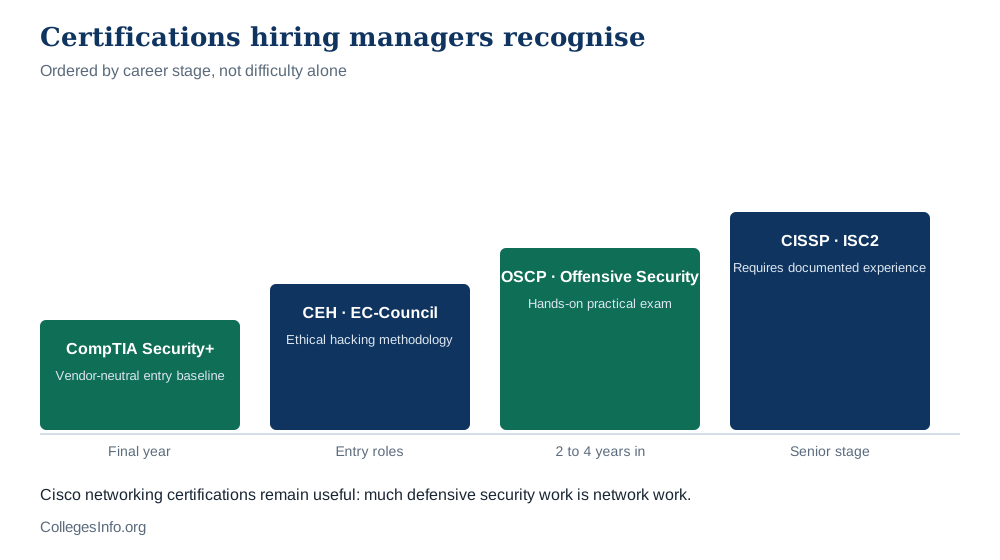
CISSP requires documented work experience, so it belongs to a later career stage.
Alliance University explicitly builds global certifications and capture-the-flag competition into its programme description, which is a reasonable signal to look for when comparing colleges. Where a college does not mention certification support anywhere in its own material, assume the student funds and schedules it independently.
Where Cyber Security Graduates Work in Bangalore
Most cyber security colleges in Bangalore feed the same local market, so it helps to know who is hiring. Bangalore's demand comes from four distinguishable employer types, and they hire differently. Banking and financial-services security operations centres run shift-based monitoring roles that absorb large graduate intakes. IT services firms staff client security engagements and tend to recruit through campus drives at volume. Product companies hire smaller numbers into application-security and infrastructure-security teams, usually with a higher technical bar. Specialist consultancies and audit practices recruit for compliance, governance and forensic work, where communication skills matter as much as tooling.
None of those four cares whether the transcript says CY or IC. They care about demonstrable work. That is worth holding in mind while agonising over branch codes, and it is the same conclusion reached in our comparison of BSc Data Science options in Bangalore, where the degree title again mattered less than the portfolio behind it.
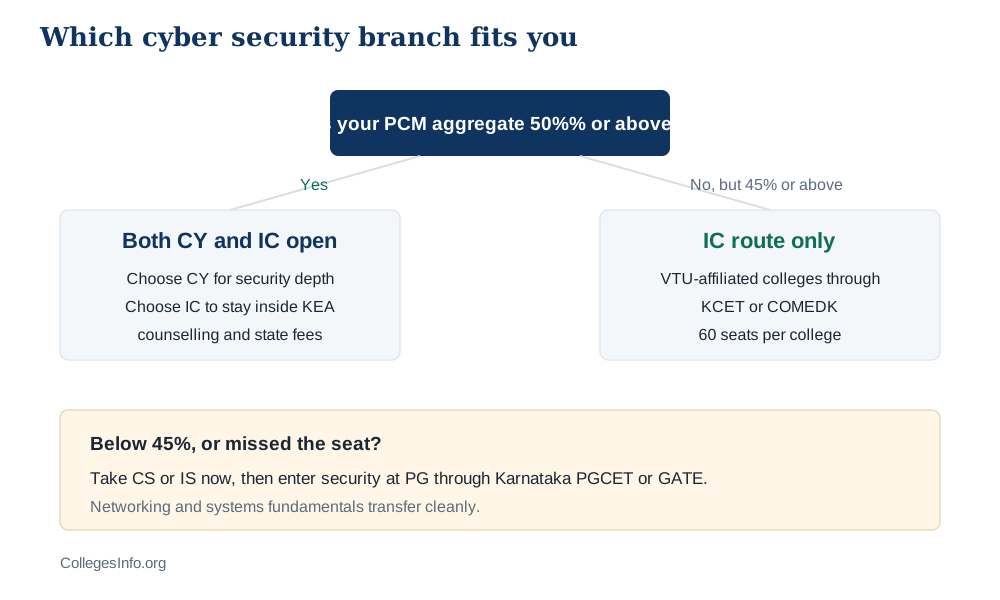
Choosing Between CY, IC, CD and CI
Four adjacent branch codes now compete for the same student. A workable way to separate them:
- CY suits a candidate who wants security as the discipline itself, is comfortable with a private or deemed university route, and clears the 50% bar.
- IC suits a candidate coming through KCET who wants security exposure inside a VTU degree and accepts a syllabus split three ways.
- CD and CI remain the higher-demand codes, with correspondingly tighter closing ranks and a deeper existing hiring pipeline.
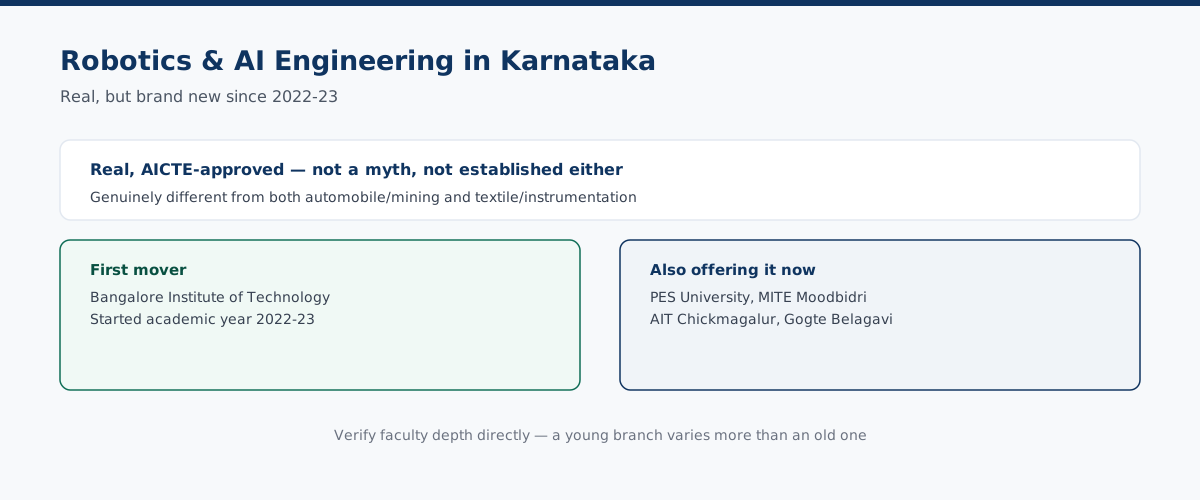
The wider pattern deserves naming. Karnataka has spent five years adding named specialisations to the CSE stream faster than industry has built separate hiring pipelines for them. The same story is visible in the robotics and AI branches introduced since 2022-23. Older branches moved the other way and contracted: instrumentation engineering narrowed to a handful of departments, and automobile engineering largely folded back into mechanical. A branch code that exists in 2026 may not exist as a distinct code by 2032, and the degree certificate outlives the trend that created it.
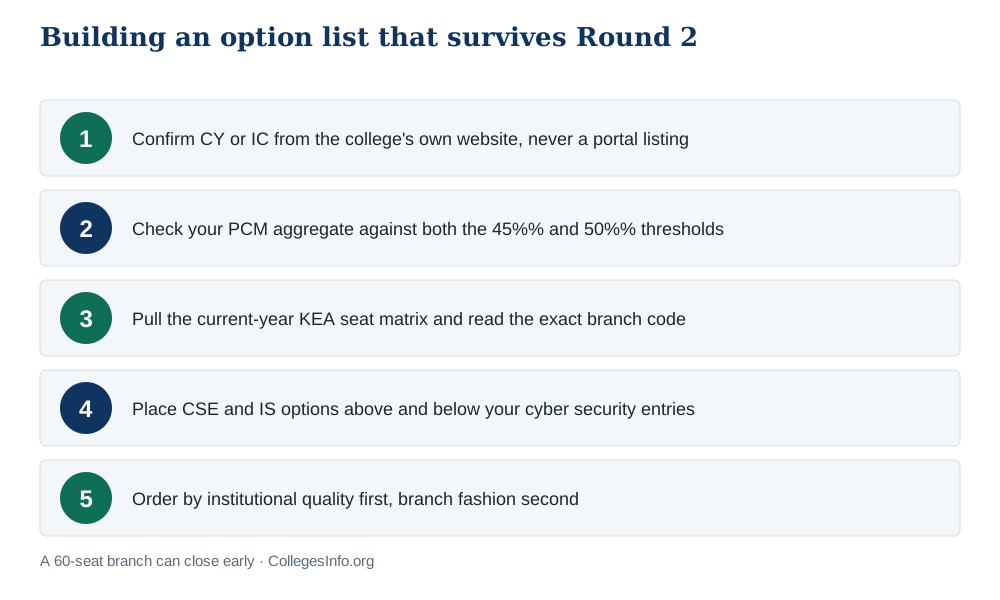
How to Build an Option List That Survives Round 2
A practical sequence for a candidate targeting cyber security this cycle:
- Confirm, from each college's own website rather than a portal, whether it runs CY or IC. Do not assume a college with a security-sounding lab runs either.
- Check your PCM aggregate against the 45% and 50% thresholds before spending time on universities you cannot enter.
- Pull the current-year seat matrix from KEA and note the exact branch code printed against each college code.
- Place plain CSE and IS options above and below your cyber security entries rather than filling the list with one branch, since a 60-seat branch can close early.
- Keep institutional quality ahead of branch fashion when ordering, using the top engineering colleges in Karnataka and the B.Tech rankings by NIRF and cutoff as the ordering spine.
Candidates who would rather have the branch eligibility and document set checked before locking an option list can start from our MBA admission assistance page.
Colleges change branch offerings between years. A college that ran IC in 2023 may have dropped it, and a college that never ran it may have added it. Last year's list is a starting hypothesis, not an answer.
The Postgraduate Route If You Miss a UG Seat
Missing a cyber security seat at undergraduate level is not the end of the path. Security is one of the fields where postgraduate entry works cleanly, because the discipline is built on networking and systems fundamentals that a plain CSE or Information Science degree already supplies. M.Tech admission in Karnataka runs through Karnataka PGCET and GATE, and MCA entry runs through PGCET, which means a candidate who takes CS or IS now keeps every specialisation option open later.
The same check applies at postgraduate level, and our admission assistance service page covers that route.
There is a case for treating that as the stronger plan rather than the fallback. A CSE degree from a well-regarded college plus certifications plus a security-focused M.Tech generally reads better to an employer than an IC degree from a weaker college. Branch fashion changes. Institutional reputation moves slowly, which is the same reason the established Bangalore engineering institutions keep their placement standing across cycles regardless of which specialisations they add.
Frequently Asked Questions
Is B.E. Cyber Security a real degree in Karnataka or just a CSE specialisation?
Both exist. VTU has issued a separate circular for the scheme and syllabus of B.E. in Cyber Security, and separately lists CSE (Cyber Security) under code CY and CSE (IoT & Cyber Security including Block Chain Technology) under code IC in its stream-wise UG programme document.
What is the VTU course code for cyber security?
CY for CSE (Cyber Security) and IC for CSE (IoT & Cyber Security including Block Chain Technology). These are separate codes for separate branches and cannot be used interchangeably during KEA option entry.
Which entrance exams are accepted for cyber security engineering colleges in Karnataka?
KCET and COMEDK cover the VTU-affiliated colleges. Deemed and private universities additionally accept JEE Main, JEE Advanced and their own tests, such as Alliance University's AUEET.
What percentage do I need in Class 12 for cyber security engineering in Karnataka?
VTU-affiliated colleges generally require 45% aggregate for general category and 40% for SC, ST and OBC categories, with Physics and Mathematics compulsory. Private universities such as Alliance require 50% aggregate, with a 5% relaxation for SC and ST candidates.
When did the IoT and cyber security blockchain branch start in Karnataka?
The VTU syllabus document for CSE (IoT & CS with BCT) is dated 23 May 2021, and MITE Moodbidri states that its own programme began in the academic year 2021-22 with an intake capacity of 60 seats.
Can I join cyber security engineering after a diploma?
Yes, through lateral entry to the third year. Jain University publishes routes for a three-year or two-year diploma at 45% general and 40% reserved, a B.Sc with Mathematics at 10+2 level, and a B.Voc or three-year D.Voc in the same or an allied sector with bridge courses provided.
How many cyber security colleges are there in Karnataka?
Published counts range from 53 to 79 depending on whether the portal includes BCA, MCA and postgraduate programmes in the total. The only reliable figure for a KCET candidate is the current-year KEA seat matrix at option entry.
Is CY or IC better for placements?
Employers hiring for security roles in Bangalore weigh demonstrable practical work and certifications more heavily than the branch printed on the transcript. Institutional reputation and the student's own project record tend to decide outcomes ahead of the branch code.
This article is for informational purposes only. Consult the college directly before making admission decisions.
About the author
OneCity Technologies Pvt. Ltd began in 2006 publishing an annual print education directory for Karnataka students and parents. As demand grew, OneCity launched an education portal in 2019 to bring that same directory information online, and in 2025 relaunched as CollegesInfo.org, a comprehensive Karnataka college directory covering 1,500+ institutions across engineering, medical, management, arts, commerce, and more. Founder L K Monu Borkala brings 20+ years of business experience and 19 years of work across various education-sector services. CollegesInfo.org's content is built from publicly available KEA, NMC, AICTE, and university data, cross-checked against official sources wherever possible. CollegesInfo.org's admission assistance service helps students secure admission to colleges they are eligible for under that college's actual published criteria. We help you get the best admission to your preferred colleges without hassle.
Need help with admission?
CollegesInfo.org helps students secure admission to colleges they are eligible for under that college's actual published criteria. Chat with us on WhatsApp or explore admission assistance.
Planning your option entry for a cyber security seat?
We help you get the best admission to your preferred colleges without hassle.