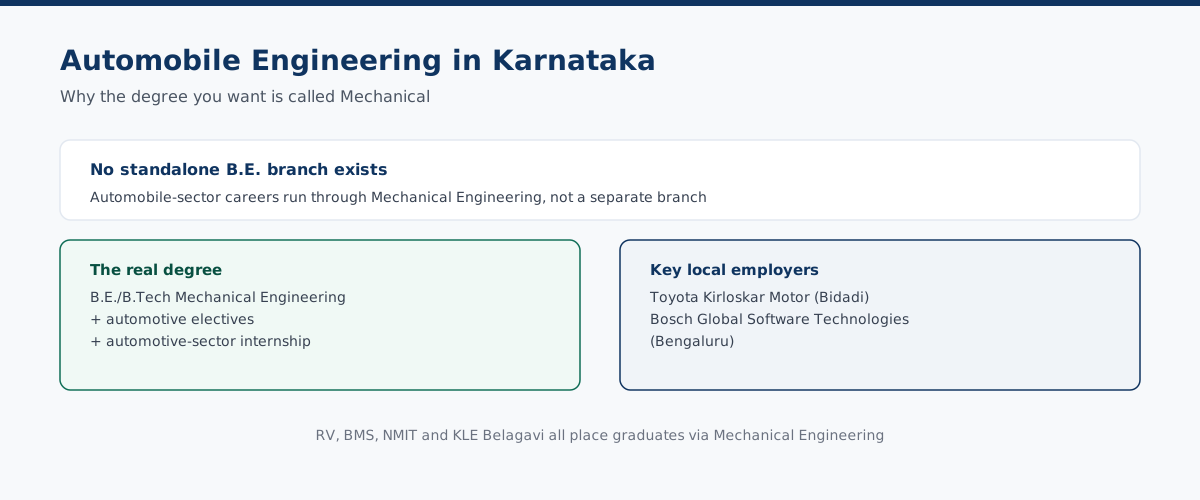
If you're searching for "Automobile Engineering colleges in Karnataka," the honest answer is that the branch you're picturing barely exists here as a standalone AICTE-approved B.E./B.Tech programme. None of the state's major engineering colleges — not RV College of Engineering, not BMS College of Engineering, not Nitte Meenakshi Institute of Technology, not KLE's Belagavi campus — run a separate Automobile Engineering department. What they do have is something arguably more useful: Mechanical Engineering departments that place graduates directly into Karnataka's large automobile industry, built around Toyota Kirloskar Motor's Bidadi plant and Bosch's automotive software operations in Bengaluru. This piece explains why the branch name confuses so many applicants, what to study instead, which colleges' placement records actually back an automotive career, and the diploma-level alternative that does carry the Automobile Engineering name.
Automobile Engineering in Karnataka — Quick Facts
| Standalone B.E. branch? | Not at Karnataka's major colleges — automobile-sector careers run through Mechanical Engineering |
|---|---|
| Real degree to pursue | B.E./B.Tech Mechanical Engineering, with automotive electives and an automotive-sector internship |
| Diploma-level option | Automobile Engineering exists as a named diploma programme at the polytechnic level, separate from the B.E. route |
| Admission routes | KCET, COMEDK, JEE Main (for VTU-affiliated colleges), management quota |
| Fee range | Approx. Rs 25,000-1 lakh/yr (government quota) · Rs 1-3 lakh/yr (private, non-quota) |
| Key local employers | Toyota Kirloskar Motor (Bidadi), Bosch/Bosch Global Software Technologies (Bengaluru), component and auto-ancillary manufacturers |
| Colleges with verified automobile-sector placement | RV College of Engineering, BMS College of Engineering, Nitte Meenakshi Institute of Technology, KLE Dr MSS CET Belagavi |
| Season | KCET counselling June-August; COMEDK and management quota run parallel windows |
Why "Automobile Engineering" Misleads Applicants Here
Every year, students search for Automobile Engineering colleges in Karnataka and land on aggregator websites listing branded engineering colleges as if they run a dedicated department for it. Cross-checking directly against these colleges' own published information tells a different story: the word "automobile" appears in their placement and industry-connect sections, describing which sector their Mechanical Engineering graduates get hired into — not the name of a department they enrol in. RV College of Engineering's placement cell explicitly lists automobile alongside software, hardware, VLSI, manufacturing and consulting as recruiting sectors for its graduates; the branches that actually feed those automobile-sector offers are Mechanical and, to a lesser extent, allied engineering streams. BMS College of Engineering's Mechanical and Civil branches see participation from automobile and infrastructure employers specifically. The pattern repeats at Nitte Meenakshi Institute of Technology and at KLE's Dr MSS College of Engineering and Technology in Belagavi, where Mechanical graduates find roles in the city's foundry and automobile manufacturing cluster.
None of this means Automobile Engineering as a subject doesn't exist — it means it exists as a specialisation inside Mechanical Engineering, not as its own AICTE-sanctioned branch at these institutions. A small number of private colleges do advertise a branch under an "Automotive Engineering" label; if you find one, verify its current AICTE approval and VTU affiliation status for that specific branch name directly with the college before applying, since branch names on marketing pages sometimes lag behind what's actually sanctioned in a given academic year.
The Real Local Industry Behind This Confusion
The confusion exists precisely because Karnataka's automobile industry is large enough to justify a dedicated branch — it just isn't organised that way in the state's engineering education system. Two anchors define it:
Toyota Kirloskar Motor has manufactured vehicles at its Bidadi plant, in Ramanagara district near Bengaluru, since the joint venture began in 1997 between Toyota Motor Corporation (89%) and the Kirloskar Group (11%). The plant employs roughly 7,000 people directly and produced over 3.3 lakh units in 2025, alongside a dedicated auto-parts subsidiary and a Toyota-run technical training institute in Bidadi that has scaled its student capacity from 200 to 1,200 places to build a local skilled workforce.
Bosch runs what is now branded Bosch Global Software Technologies (formerly Robert Bosch Engineering and Business Solutions) out of Bengaluru — the largest automotive software centre Bosch operates anywhere outside Germany, employing approximately 35,000 engineers as of recent counts and targeting 38,000 by 2027. The centre works on driver-assistance systems, anti-lock braking, electronic stability programs, and increasingly on EV software and connected-vehicle platforms, alongside Bosch's separate manufacturing operations in the state that trace back to the 1950s.
Between these two anchors and the auto-ancillary manufacturers that supply them, Karnataka's automobile sector is a real, substantial employer — it simply draws its engineering talent from Mechanical Engineering departments rather than a dedicated Automobile Engineering one, which is exactly why the four colleges above show up in automobile-sector placement lines despite having no branch by that name.
Beyond the two named anchors, Bengaluru and its surrounding industrial belt host a wider layer of auto-component and ancillary manufacturers — supplying everything from precision-machined parts to electronics and chassis systems into the Toyota Kirloskar and broader national supply chain. This ancillary layer is where a meaningful share of Mechanical Engineering graduates in the automotive track actually land their first roles, often as a stepping stone toward larger anchor employers a few years into their career. It's a less visible part of the industry than Toyota Kirloskar or Bosch's name recognition, but it's where entry-level hiring volume sits, and it's worth asking any shortlisted college specifically whether their placement cell has documented tie-ups with this supplier layer, not just the two big names.
What to Actually Study — Mechanical Engineering with an Automotive Track
VTU's Mechanical Engineering curriculum includes elective subjects in later semesters covering internal combustion engines, automotive systems, vehicle dynamics and related vehicle-engineering topics. A student aiming at Karnataka's automobile industry should treat these electives as their de facto Automobile Engineering specialisation, and pair them with two things that matter more than the elective list itself: an internship at an automotive company or its supplier, and a final-year project tied to vehicle systems rather than a generic mechanical topic. Recruiters at companies like Toyota Kirloskar and Bosch evaluate Mechanical graduates on exactly this evidence — coursework plus a demonstrated project or internship in the automotive domain — not on whether their degree certificate says "Automobile" anywhere on it.
This also means the college choice question shifts. Instead of hunting for a branch that doesn't exist, the real questions become: does this Mechanical Engineering department offer the automotive electives; does its placement cell have a documented track record with Toyota Kirloskar, Bosch, or the auto-ancillary cluster; and does it support automotive-focused final-year projects and internships. On all three counts, the four colleges below have documented, verifiable answers.
Mechanical Engineering Colleges With Verified Automobile-Sector Placement
| College | City | What's verified |
|---|---|---|
| RV College of Engineering | Bengaluru | Placement cell explicitly names automobile as a recruiting sector alongside software, hardware, VLSI, manufacturing and consulting |
| BMS College of Engineering | Bengaluru | Mechanical and Civil branches see participation from automobile and infrastructure employers specifically |
| Nitte Meenakshi Institute of Technology | Bengaluru | Mechanical graduates placed in manufacturing and automobile-sector firms |
| KLE Dr MSS College of Engineering and Technology | Belagavi | Mechanical graduates find roles in Belagavi's foundry and automobile manufacturing cluster; KLE Society's alumni network across Karnataka and Maharashtra adds informal referral access |
These four aren't the only Mechanical Engineering colleges in the state producing automotive-sector graduates — they're simply the ones whose own published placement information explicitly and verifiably names the automobile sector, which is the honest bar for inclusion here rather than repeating an unverified list copied across aggregator sites.
Admission Routes and What Mechanical Engineering Costs
Mechanical Engineering at VTU-affiliated colleges runs through the same admission machinery as every other engineering branch in Karnataka. KCET remains the primary state-quota route, filling government and a share of private-college seats by rank through KEA counselling from June through August. COMEDK runs a parallel entrance for private, non-quota seats across the state, useful for students who miss KCET's cutoff at their target college but still want a Karnataka-based Mechanical Engineering seat. JEE Main scores are accepted by some VTU-affiliated colleges for a share of seats, and management quota fills the remainder directly through the college at its own published fee.
| Route | Typical fee/yr | Notes |
|---|---|---|
| KCET government quota | ~Rs 25,000-1 lakh | Rank-dependent; cutoffs shift annually, check the current year's KEA list |
| COMEDK / private quota | ~Rs 1-3 lakh | Entrance-based, separate from KCET counselling |
| Management quota | College's published fee | Pay only the college's declared structure, directly, against a receipt |
Whichever route you take, the branch you're applying for at any of the four colleges above is Mechanical Engineering — there's no separate application code or branch name to look for, and no reason to assume a college that doesn't list "Automobile Engineering" in its course list is somehow missing something. It simply isn't a distinct branch here.
The Diploma-Level Alternative
Automobile Engineering does exist as a named programme at the diploma level, run by several polytechnics in Karnataka under AICTE approval and recognition from the state's Department of Technical Education. This is a materially different qualification from a Mechanical Engineering B.E. — it trains students directly in vehicle design fundamentals, component manufacture, assembly and safety testing, aimed at technician-level and applied-engineering roles in vehicle servicing, quality control and workshop-level automotive work, typically over a 3-year diploma format. If your interest in automobiles is hands-on and applied rather than design-and-R&D focused, the diploma route delivers the branch name you were searching for, at a different career level and a different starting point than a Mechanical Engineering degree. Weigh the two by career destination: diploma for technician and applied maintenance-engineering roles reachable sooner, Mechanical B.E. for design, R&D and the engineering-track roles that companies like Toyota Kirloskar and Bosch recruit degree-holders into.
The EV Shift — What It Actually Means for This Career Path
Karnataka's automobile industry is not standing still, and the shift toward electric and hybrid vehicles changes what "automotive Mechanical Engineering" means in practice without changing the branch you need to study. Bosch's Bengaluru automotive software centre has explicitly named EV software and ADAS (advanced driver-assistance systems) AI as its fastest-growing engineering areas, alongside generative AI for engineering tools and cybersecurity for connected vehicles — meaning the roles opening up fastest at one of the state's two anchor employers increasingly sit at the intersection of mechanical systems and software, not purely mechanical design in the traditional sense. This matters directly for a student choosing electives: a Mechanical Engineering student who pairs the standard automotive electives (IC engines, vehicle dynamics, automotive systems) with even basic exposure to embedded systems, sensors, or control systems coursework is positioning for exactly the roles Bosch and similar employers are actively expanding. It does not mean IC-engine knowledge has become irrelevant — India's vehicle fleet remains overwhelmingly combustion-based and will for years, and Toyota Kirloskar's Bidadi plant continues large-scale conventional and hybrid manufacturing — but it does mean a student who treats "automotive electives" as a checkbox rather than a genuine specialisation, and ignores the software-adjacent skills increasingly valued alongside them, is underselling their own employability in exactly the growth areas these companies have publicly flagged.
Practically, this means: if your college offers any elective touching sensors, embedded C programming, or control systems alongside the standard automotive Mechanical electives, take it. If your final-year project can incorporate any EV-adjacent angle — battery thermal management, a hybrid powertrain component, a basic ADAS sensor simulation — it will read as more current to recruiters than a purely conventional IC-engine project, without requiring you to abandon Mechanical Engineering as your base degree.
Documents and Application Process
- Register for KCET (or COMEDK, if targeting the private-quota route) in the notification window, typically opening several months before the exam.
- Shortlist Mechanical Engineering colleges specifically for their automobile-sector placement record — the four profiled above are a verified starting point, not an exhaustive list.
- After results, participate in KEA counselling: document verification, option entry (list more colleges than feels necessary, in genuine preference order), and seat allotment.
- On allotment, verify the college's current published fee structure in writing before paying, and confirm the seat is specifically Mechanical Engineering, not a differently named branch.
- Documents needed: Class 10 and 12 marks cards, KCET/COMEDK scorecard, transfer and conduct certificates, migration certificate for non-Karnataka boards, category and income certificates if claiming reservation or scholarship support, Aadhaar, and photographs.
✅ One non-negotiable rule
Pay admission fees directly to the college, against an official receipt. This applies regardless of which quota or route you're admitted through.
Career Math — What a Mechanical Graduate in the Automotive Track Can Expect
Fresh Mechanical Engineering graduates entering Karnataka's automobile-sector companies typically see starting offers in the range of Rs 3.5-6 lakh a year at established manufacturers and their direct suppliers, with Bosch's software-heavy automotive roles often paying toward the higher end of that band or above it for graduates with strong project and internship evidence in embedded systems or automotive software. Toyota Kirloskar's own technical training pipeline (the TTTI programme referenced above) also creates a distinct, skills-first entry route for students who complete its structured training alongside their formal degree. As with any core engineering placement, the gap between median and top offers tracks demonstrated automotive-specific skills — electives actually taken, internships actually completed, and projects that show real engagement with vehicle systems — far more than the branding on the degree certificate.
Mistakes Applicants Keep Making
- Searching only for "Automobile Engineering" and skipping strong Mechanical Engineering colleges because their course list doesn't use that exact phrase — exactly the mistake this piece is written to prevent.
- Trusting aggregator "top Automobile Engineering colleges in Karnataka" lists without checking the college's own current AICTE-approved branch list, since these lists routinely repeat unverified branch names year after year.
- Ignoring the diploma route entirely when a hands-on, applied automotive career is actually the better fit than a four-year Mechanical Engineering degree.
- Picking Mechanical Engineering without ever selecting the automotive electives or seeking an automotive-sector internship, then wondering why an automobile-industry offer doesn't materialise at placement time. The elective list and the internship are the entire difference between a generic Mechanical graduate and one who reads as automotive-ready to a recruiter.
- Assuming any Mechanical Engineering college works equally well for an automotive career, rather than checking specifically for a documented automobile-sector placement record like the four colleges profiled here. Placement strength varies enormously by department and by which specific employers a college's placement cell has cultivated over years, not just by the college's overall brand reputation.
- Overlooking the auto-ancillary supplier layer while focusing only on Toyota Kirloskar and Bosch by name — a large share of genuine entry-level hiring volume sits with component and ancillary manufacturers that don't carry the same brand recognition but offer a real first step into the industry.
How We Help
Tell us your KCET/COMEDK score or rank, your budget, and that you're targeting Mechanical Engineering with an automotive-industry goal, and we'll return a realistic shortlist of colleges you're eligible for under their published criteria, with their actual placement track record checked against our database of every active Karnataka college — not a copied aggregator list. We'll also flag if a college you're considering has no verifiable automobile-sector placement history, rather than letting you assume it does because a listing site said so. We help you get the best admission to your preferred colleges without hassle.
📱 Get your shortlist checked against real placement data
Message +91 6363 330 233 with your rank and budget. We reply with colleges whose placement claims we've actually verified.
About This Guide
Written and maintained by L K Monu Borkala. OneCity Technologies began in 2006 publishing an annual print education directory for Karnataka students and parents. As demand grew, OneCity launched an education portal in 2019 to bring that same directory information online, and in 2025 relaunched as CollegesInfo.org — a comprehensive Karnataka college directory covering 1,500+ institutions across engineering, medical, management, arts, commerce, and more. Founder L K Monu Borkala brings 20+ years of business experience and 19 years of work across various education-sector services. CollegesInfo.org's content is built from publicly available KEA, NMC, AICTE, and university data, cross-checked against official sources wherever possible. CollegesInfo.org's admission assistance service helps students secure admission to colleges they are eligible for under that college's actual published criteria. We help you get the best admission to your preferred colleges without hassle.
Industry facts in this piece are sourced from Toyota Kirloskar Motor's own published information and Wikipedia's sourced company profile, and from Bosch's official press materials on its Bengaluru automotive software operations. College placement claims are drawn from each institution's own published information as reflected in CollegesInfo.org's college database. Verify current fees, cutoffs and branch approvals directly with KEA and the individual college before applying — this page will be corrected if anything here goes out of date.
Automobile Engineering in Karnataka — FAQs
Does any Karnataka college offer a B.E. in Automobile Engineering?
Not as a standalone AICTE-approved branch at the state's major engineering colleges. RV College of Engineering, BMS College of Engineering, Nitte Meenakshi Institute of Technology and KLE's Belagavi campus all place graduates into the automobile sector, but through Mechanical Engineering, not a separate department. A handful of smaller private colleges advertise an "Automotive Engineering" label — verify current AICTE approval for that exact branch before applying.
So how do I actually get into Karnataka's automobile industry?
Through Mechanical Engineering. Toyota Kirloskar Motor, Bosch's automotive software centre, and the state's component manufacturers overwhelmingly recruit Mechanical Engineering graduates, then train them into automotive-specific roles. Automotive electives plus a relevant internship matter far more than chasing a branch name that barely exists here.
Is a diploma in Automobile Engineering different from the B.E. route?
Yes — it exists as a named diploma programme at several polytechnics, distinct from B.E./B.Tech level. Diploma trains technicians for hands-on maintenance and testing roles; a Mechanical B.E. with automotive focus targets design and R&D roles at companies like Toyota Kirloskar and Bosch.
Why does Karnataka's automobile industry matter for a Mechanical Engineering student?
Toyota Kirloskar Motor has manufactured vehicles at Bidadi since 1997, with roughly 7,000 employees and over 3 lakh units produced in 2025. Bosch's Bengaluru operation is the largest automotive software centre Bosch runs outside Germany, employing around 35,000 engineers and targeting 38,000 by 2027 — a genuine, large employer base for Mechanical graduates.
What KCET rank do I need for Mechanical Engineering at a college with strong automobile-sector placement?
It varies by college, category and year. RV College of Engineering and BMS College of Engineering sit among Bangalore's most competitive Mechanical Engineering options; Nitte Meenakshi Institute of Technology and KLE's Belagavi campus generally open at more accessible ranks. Check the current year's KEA cutoff list rather than a fixed number.
What does Mechanical Engineering cost in Karnataka?
Government-quota KCET seats typically run Rs 25,000-1 lakh a year. Private colleges outside quota range roughly Rs 1-3 lakh a year, and management quota costs more, set by the college's own published structure. Confirm the current fee directly with the college before paying.
Are there automotive-specific electives within the Mechanical Engineering syllabus?
Yes. VTU's Mechanical Engineering curriculum includes electives covering IC engines, automotive systems, and vehicle dynamics, typically in later semesters. Picking these, plus a relevant internship, is how a Mechanical student builds a genuine automotive specialisation.
Does CollegesInfo charge for admission guidance?
Our admission assistance service helps students secure admission to colleges they are eligible for under that college's actual published criteria. WhatsApp us and we'll explain how we work before anything else.