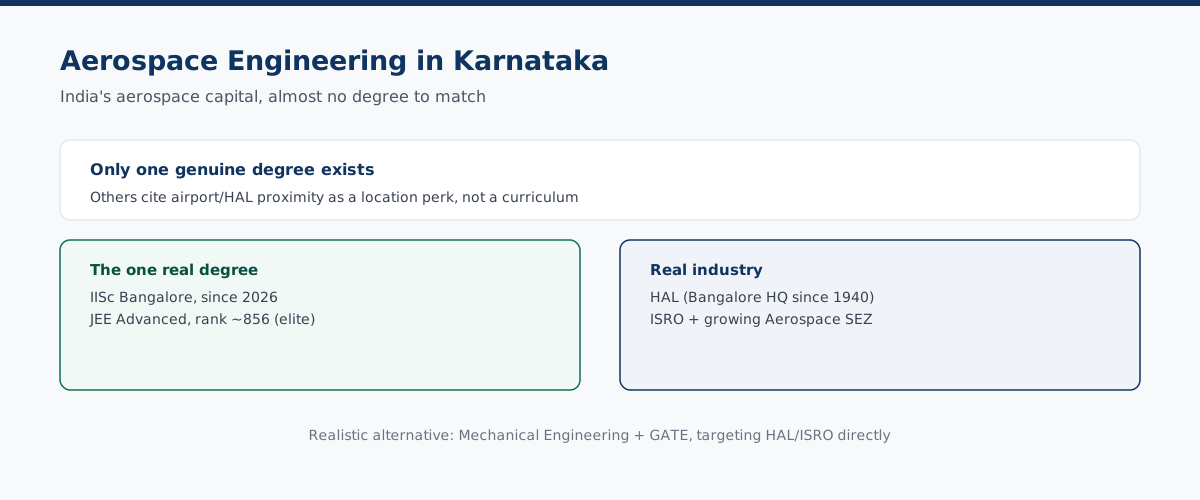
Bangalore is one of India's most important aerospace and defence manufacturing hubs — and Aerospace Engineering as a standalone degree is almost entirely absent from Karnataka's engineering colleges as a result of that same fact. Hindustan Aeronautics Limited (HAL), headquartered in Bangalore since 1940, builds India's indigenous Tejas fighter jet and employs over 24,000 people. ISRO maintains a major presence in the city. A new Aerospace SEZ is developing near Kempegowda International Airport. Yet search for "Aerospace Engineering colleges in Karnataka" and you'll find a long list of universities — Reva University, CMR University, Presidency University, BMS Institute of Technology — that mention aerospace only as a location advantage, describing proximity to the industry rather than a degree they actually teach. The one genuine exception just arrived in 2026, and it's extraordinarily hard to get into.

Aerospace Engineering in Karnataka — Quick Facts
| Genuine standalone B.Tech Aerospace Engineering | One college — IISc Bangalore, launched 2026 |
|---|---|
| Admission route | JEE Advanced → JoSAA/CSAB — KCET not accepted |
| Approximate closing rank (Round 1, 2026) | ~856 — extraordinarily competitive |
| Real local industry anchors | HAL (Bangalore HQ since 1940, 24,000+ employees), ISRO, growing Aerospace SEZ near the airport |
| Colleges citing aerospace as a location advantage only | Reva University, CMR University, Presidency University, BMS Institute of Technology, among others |
| Realistic alternative path | Mechanical Engineering via KCET/COMEDK, targeting HAL/ISRO/defence-sector recruitment specifically |
IISc Bangalore — the One Genuine Programme, and It's Brand New
Indian Institute of Science (IISc) Bangalore, one of India's most prestigious research institutions, introduced Aerospace Engineering as a B.Tech specialisation starting in the 2026 academic year — new, not an established decades-old department like the automotive and textile examples covered elsewhere in this Engineering Niche series. Admission runs through JEE Advanced followed by JoSAA and CSAB counselling; KCET has no role here whatsoever. The Round 1 closing rank for this new programme landed around 856 in its first admission cycle — a figure that places it among the most competitive engineering seats in the entire country, comparable to top branches at the most selective IITs, not a typical Karnataka engineering admission by any measure.
IISc's broader academic reputation gives this new programme genuine credibility despite its youth: the institute is consistently ranked among India's top research universities, with deep existing strength in mechanics, materials science, and computational engineering — disciplines directly relevant to aerospace engineering's core content of aerodynamics, structural analysis, propulsion, and flight mechanics. Students admitted to this programme gain access to IISc's broader research ecosystem and faculty expertise built up over decades in adjacent fields, even though the Aerospace Engineering label itself is new — a different situation from a newly-founded college launching a programme with no surrounding institutional depth to draw on.
This matters enormously for how students should read this piece: IISc's Aerospace Engineering programme is real, genuine, and academically serious, but it is realistically reachable only by a tiny fraction of India's strongest JEE Advanced performers. For the overwhelming majority of Karnataka engineering aspirants, this specific door simply isn't going to open, regardless of how much they want an aerospace-labelled degree — which is exactly why understanding the honest alternative path matters more here than in almost any other branch covered in this series.
Why So Many Colleges Mention Aerospace Without Teaching It
The pattern across Karnataka's newer private universities is remarkably consistent, and it's worth naming directly. Reva University's own materials describe its north Bangalore location as being "near the international airport, HAL's aerospace facilities, and the emerging Aerospace SEZ" — a genuine, accurate geographic fact, but a description of neighbourhood, not curriculum. CMR University similarly cites proximity to "the aerospace, defence, and IT employment cluster that defines north Bangalore's engineering job market." Presidency University's Yelahanka campus is described as being in "an area rapidly developing with the expansion of Bangalore's aerospace and technology sectors." BMS Institute of Technology's own materials note its Yelahanka location "provides access to Kempegowda International Airport and several technology and aerospace industry clusters."
None of these four descriptions claims the college actually teaches Aerospace Engineering as a branch — read carefully, they're all making a real estate and employment-proximity argument, not an academic one. This is a subtler version of the automobile and mining engineering pattern covered elsewhere in this series: the difference here is that these colleges aren't even implying they teach the branch, they're simply highlighting genuine geographic proximity to a real industry cluster as a marketing point. Applicants who skim past the careful wording and assume "mentions aerospace" equals "teaches aerospace" are the ones who end up disappointed after enrolment.
It's worth noting why this specific marketing pattern has become so common in exactly this corridor of north Bangalore: the area around Yelahanka and Kempegowda International Airport has transformed over the past decade from a relatively quiet outskirts zone into one of the city's fastest-growing educational and employment corridors, precisely because of the airport's expansion, HAL's continued operations, and the newer Aerospace SEZ development. Multiple universities established or expanded campuses in this specific geography during this growth window, and it makes complete sense that their marketing would lean on this real locational advantage — the issue is purely that a location advantage and a curriculum offering are two different claims, and prospective students need to read college materials carefully enough to tell which one is actually being made.
The Real Industry Behind the Confusion
Hindustan Aeronautics Limited (HAL) has been headquartered in Bangalore since its founding in 1940, making it one of the oldest continuously operating aerospace and defence manufacturers anywhere in the world. HAL designs, builds, and maintains India's indigenous Tejas Light Combat Aircraft alongside helicopters, trainer aircraft, and aero engines, operating 11 R&D centres and 21 manufacturing divisions nationally, with revenue of approximately Rs 33,542 crore and over 24,000 employees as of recent reporting. Its client base includes the Indian Air Force, Army, Navy, DRDO, and ISRO directly. Alongside HAL, ISRO maintains a significant Bangalore presence, and the city's Aerospace SEZ near Kempegowda International Airport continues expanding, drawing in component manufacturers and aerospace-adjacent technology firms.
This is precisely why so many colleges near the airport corridor lean on "aerospace" in their marketing — the industry cluster is completely real and significant, arguably one of the most concentrated aerospace and defence manufacturing zones in the country. The confusion for applicants arises purely from the gap between this very real industrial geography and the near-total absence of a matching academic degree at the undergraduate level accessible through Karnataka's standard admission routes.
Scholarships and Fee Support
At IISc's centrally-funded fee levels, the standard institute fee-waiver framework applies for SC/ST students and income-based concessions for economically weaker categories, processed automatically through the JEE Advanced/JoSAA admission system. For students pursuing the Mechanical Engineering alternative at KCET-accessible private colleges, the Karnataka State Scholarship Portal (SSP) remains the primary channel for post-matric scholarships, offering substantial fee reimbursement for SC/ST students and graded support for OBC and minority categories — apply in the opening weeks of the academic year with certificates ready. Education loans through the Vidya Lakshmi portal are routinely available at nationalised banks for either route's fee levels.
The Realistic Alternative — Mechanical Engineering Toward HAL and ISRO
For the vast majority of Karnataka engineering aspirants who won't clear IISc's JEE Advanced threshold, the honest path into aerospace-adjacent careers runs through Mechanical Engineering, mirroring the pattern this site has documented for automobile engineering. HAL and ISRO recruit substantial numbers of engineers nationally through GATE-based recruitment for entry-level engineering positions, alongside campus placement drives at select colleges with documented recruitment relationships. A student aiming at HAL or ISRO should treat a Mechanical Engineering degree, GATE preparation starting from the second or third year, and any available aerospace-adjacent or defence-sector internship or project work as their real preparation strategy — not a search for a branch name that barely exists at the undergraduate level in this state.
RV College of Engineering's own alumni network includes graduates who've built careers in aerospace specifically, though this reflects aerospace as a career destination for its Mechanical and allied-branch graduates rather than a dedicated Aerospace Engineering department at the college — the same honest distinction that runs throughout this piece.
This piece sits alongside the automobile, mining, textile, instrumentation, robotics, chemical, and industrial engineering pieces in this same Engineering Niche series, and aerospace occupies a distinct position among them: unlike automobile and mining, where the industry is real but no matching degree exists anywhere in the state, aerospace has exactly one real, brand-new, extraordinarily elite exception at IISc — making the honest guidance here neither "this branch is pure fiction" nor "this branch is widely accessible," but something more specific: real, but reachable by only a handful of India's strongest students each year, with a well-established alternative route existing for everyone else.
Admission Routes at a Glance
| Target | Route | Notes |
|---|---|---|
| IISc Bangalore, B.Tech Aerospace Engineering | JEE Advanced → JoSAA/CSAB | KCET not accepted; ~856 closing rank (2026, Round 1) — extraordinarily competitive |
| Mechanical Engineering at KCET-accessible colleges, targeting HAL/ISRO | KCET, COMEDK, management quota | Standard Karnataka engineering admission; verify each college's actual documented placement links to HAL/ISRO/defence sector directly |
Documents and Application Process
- For IISc: register for JEE Main, qualify for JEE Advanced, then register on the JoSAA portal for choice filling and seat allotment; unfilled seats may proceed to CSAB special rounds.
- For the Mechanical Engineering alternative: register for KCET (and COMEDK if targeting private-quota seats) in the respective notification windows, shortlisting colleges specifically for documented HAL/ISRO/defence-sector placement history rather than mere geographic proximity to the airport corridor.
- On allotment through either route, verify your exact branch name and confirm the current fee structure in writing before paying.
- Documents needed: Class 10 and 12 marks cards, the relevant entrance scorecard (JEE Advanced or KCET/COMEDK), transfer and conduct certificates, migration certificate for non-Karnataka boards, category and income certificates for reservation or scholarship claims, Aadhaar, and photographs.
Career Math
IISc's Aerospace Engineering graduates, once the programme produces its first batches, will enter an elite tier of the Indian aerospace and defence sector, backed by IISc's research reputation and direct proximity to HAL and ISRO's Bangalore operations — though with no graduated batches yet, actual placement outcomes remain unknown and worth verifying directly with the institute as the programme matures. Given IISc's broader placement track record across its established departments, expectations for strong research and industry outcomes are reasonable, though students should treat this as an informed expectation rather than a documented fact until the programme's first cohort actually graduates and enters the job market.
For the much larger population of students pursuing the Mechanical Engineering alternative, entry into HAL or ISRO specifically tends to run through GATE-qualified recruitment or documented campus placement relationships, with core public-sector engineering compensation and long-term stability comparable to the PSU pathway described for Chemical Engineering elsewhere on this site. This route rewards the same kind of early, deliberate preparation: starting GATE preparation from the second or third year rather than treating it as an afterthought, and actively seeking internships or final-year projects with genuine aerospace or defence-manufacturing relevance rather than generic mechanical engineering topics.
Students who chase aerospace-adjacent private-sector component manufacturing and MRO (maintenance, repair, overhaul) roles in the growing Aerospace SEZ ecosystem find a third, less discussed but expanding option, worth researching directly given how recently this cluster has been developing. This private-sector route typically offers different compensation and stability trade-offs compared to the PSU pathway through HAL and ISRO, generally with faster hiring processes but less of the long-term job security that public-sector aerospace employment traditionally offers — a genuine trade-off worth weighing based on individual priorities rather than assuming one path is universally superior to the other.
Mistakes Applicants Keep Making
- Assuming a college that mentions "aerospace" in its marketing teaches Aerospace Engineering — read the specific wording carefully; multiple Bangalore universities describe proximity to the industry, not a curriculum they offer, and the distinction between the two claims matters for admission decisions.
- Assuming IISc's new Aerospace Engineering programme is realistically reachable without an exceptionally strong JEE Advanced performance — a closing rank around 856 places it among the most competitive seats in the country, and treating it as a realistic backup option rather than a genuine stretch goal sets up disappointment.
- Overlooking the Mechanical Engineering + GATE + HAL/ISRO pathway entirely because it doesn't carry an "Aerospace Engineering" branch name, when it's the realistic route for the vast majority of aspirants who won't clear IISc's threshold.
- Assuming any college near Kempegowda International Airport has a documented HAL or ISRO placement pipeline just because of geographic proximity — verify actual, specific, documented placement history directly rather than inferring it from a location description, since proximity alone doesn't guarantee a recruitment relationship exists.
- Treating this branch identically to the automobile and mining engineering pattern without noting the key difference: here, one genuine, brand-new, extremely elite option does exist at IISc, unlike branches where no real degree exists anywhere in the state at all.
- Giving up on an aerospace-adjacent career entirely after learning the branch barely exists at the undergraduate level, rather than recognising that Mechanical Engineering plus deliberate GATE preparation and HAL/ISRO-focused internships remains a viable, well-trodden path into the same industry.
How We Help
Tell us your JEE Advanced score if IISc is realistically in range, or your KCET/COMEDK score and genuine interest in HAL, ISRO, or the defence-manufacturing sector if you're on the Mechanical Engineering path, and we'll return an honest shortlist checked against our database of every active Karnataka college — including which colleges' "aerospace" mentions are genuine curriculum versus location marketing. We help you get the best admission to your preferred colleges without hassle.
📱 Get an honest read on your aerospace career options
Message +91 6363 330 233 with your JEE or KCET score. We'll tell you whether IISc or the Mechanical Engineering route fits your situation.
About This Guide
Written and maintained by L K Monu Borkala. OneCity Technologies began in 2006 publishing an annual print education directory for Karnataka students and parents. As demand grew, OneCity launched an education portal in 2019 to bring that same directory information online, and in 2025 relaunched as CollegesInfo.org — a comprehensive Karnataka college directory covering 1,500+ institutions across engineering, medical, management, arts, commerce, and more. Founder L K Monu Borkala brings 20+ years of business experience and 19 years of work across various education-sector services. CollegesInfo.org's content is built from publicly available KEA, NMC, AICTE, and university data, cross-checked against official sources wherever possible. CollegesInfo.org's admission assistance service helps students secure admission to colleges they are eligible for under that college's actual published criteria. We help you get the best admission to your preferred colleges without hassle.
HAL's company history and scale are sourced from Wikipedia's documented company profile. IISc's Aerospace Engineering programme details reflect information held in CollegesInfo.org's own college database. Fees, cutoffs and programme availability change yearly, especially for a newly launched programme — verify current details directly with each institution before applying. Spot something outdated? WhatsApp us and we'll correct it.
Aerospace Engineering in Karnataka — FAQs
Does any Karnataka college offer a real B.Tech in Aerospace Engineering?
Only one — IISc Bangalore, starting 2026, admitted via JEE Advanced with an extremely competitive closing rank around 856. No other Karnataka college offers a comparably genuine, standalone programme.
Why do so many Bangalore colleges mention aerospace if the degree barely exists?
Bangalore is a major aerospace hub, home to HAL and a significant ISRO presence. Colleges like Reva, CMR, Presidency and BMS Institute cite this as a location advantage, describing proximity to the industry, not a degree they teach.
What is HAL, and how big is it really?
A public sector aerospace and defence company headquartered in Bangalore since 1940, building India's Tejas fighter jet, with 24,000+ employees and roughly Rs 33,542 crore revenue in 2025.
If I can't get into IISc, how do I target an aerospace career from Karnataka?
Through Mechanical Engineering, aiming specifically at HAL, ISRO, or the wider defence manufacturing sector — similar to the automobile engineering pattern on this site — typically via GATE-based recruitment.
What rank do I need for aerospace-adjacent careers via Mechanical Engineering?
Depends entirely on the college's actual documented placement links to HAL, ISRO or defence employers, which varies significantly — verify directly rather than assuming from airport proximity.
Does CollegesInfo charge for admission guidance?
Our admission assistance service helps students secure admission to colleges they're eligible for under that college's actual published criteria. WhatsApp us and we'll explain how we work before anything else.