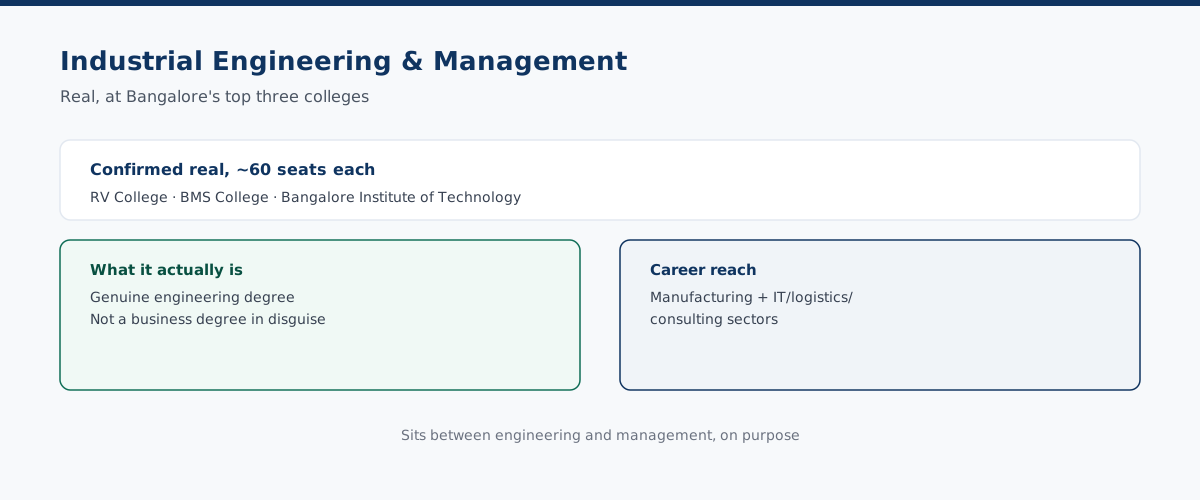
Industrial Engineering and Management is a genuine, real branch offered at three of Bangalore's most established engineering colleges — not a niche name that barely exists, and not a management degree wearing an engineering label. RV College of Engineering, BMS College of Engineering, and Bangalore Institute of Technology each run a full four-year B.E. Industrial Engineering and Management programme with a published intake of roughly 60 seats. What confuses most applicants isn't whether it's real — it clearly is — but what it actually trains you for: a deliberate middle ground between deep technical engineering and pure business management, focused on making industrial processes, supply chains, and operations run efficiently. This piece covers what the curriculum involves, where it's offered, and the honest career picture for graduates.
Industrial Engineering and Management in Karnataka — Quick Facts
| Branch status | real, offered at three established Bangalore colleges |
|---|---|
| Confirmed colleges | RV College of Engineering, BMS College of Engineering, Bangalore Institute of Technology |
| Typical intake | ~60 seats per college |
| Admission route | KCET, COMEDK, management quota — standard Karnataka engineering admission machinery |
| What it actually is | A deliberate blend of core engineering and management — not a business degree, not a deep-technical branch either |
| Core focus areas | Production planning, operations research, quality management, supply chain and logistics, work-study methods |
| Career destinations | Manufacturing operations, supply chain/logistics, quality assurance, process improvement, project management |
Where This Branch Is Offered
RV College of Engineering lists B.E. Industrial Engineering and Management explicitly among its course offerings, alongside its Chemical Engineering programme, with a published intake of 60 students over a 4-year degree. BMS College of Engineering runs the same programme at the same intake level, positioned alongside its Telecommunication Engineering branch in the college's course catalogue. Bangalore Institute of Technology completes the trio, listing the branch alongside Information Science and Engineering at a matching 60-seat intake. All three are well-regarded, established Bangalore engineering colleges — this isn't a branch confined to obscure or thinly-resourced institutions, which matters given how often niche-sounding branch names in this Engineering Niche series turn out to be marketing labels rather than real degrees.
A handful of other Karnataka colleges reference Industrial Engineering and Management in passing — usually as employment context for Mechanical or Civil Engineering graduates working in logistics, warehousing, or manufacturing zones, similar to the automobile and mining engineering pattern covered elsewhere on this site — but RV College, BMS College, and Bangalore Institute of Technology stand out as the three offering it as a genuine, distinct, admission-code-bearing branch with its own seat allocation.
What Industrial Engineering and Management Actually Teaches
The branch occupies a deliberate middle ground that trips up a lot of applicants who expect it to resemble either a standard engineering degree or a business qualification. Core coursework includes production planning and control, operations research, quality management and statistical process control, supply chain and logistics management, and classical industrial engineering methods like work study and time-and-motion analysis — the discipline of measuring and improving how efficiently people, machines, and processes work together. This is quantitative, technical coursework, not a watered-down business curriculum: operations research alone involves serious mathematical modelling and optimisation techniques applied to real logistics, scheduling, and resource-allocation problems, consistent with AICTE-mandated curriculum standards for the branch nationally.
What makes it distinct from Mechanical Engineering, which covers some overlapping ground, is the consistent management and systems-level lens applied throughout: where a Mechanical Engineering student might design a component or system, an Industrial Engineering and Management student is trained to analyse and optimise how an entire production line, supply chain, or service operation functions as a whole. Later years typically add electives in areas like project management, industrial safety, and increasingly, data-driven process optimisation — reflecting how the discipline has absorbed more analytics and data-science-adjacent tools into its traditionally more manual, work-study-based methods over the past decade.
A typical four-year structure moves from shared engineering fundamentals in the first year (mathematics, physics, basic mechanical and electrical concepts common to most branches) toward increasingly specialised coursework: second-year subjects often cover engineering economics, manufacturing processes, and introductory operations research; third year deepens into supply chain management, quality engineering, and human factors/ergonomics; and the final year typically includes a major project, an industrial internship, and electives allowing students to specialise toward either the more technical operations-research side or the more management-oriented process-improvement side of the discipline. This progression matters for a student weighing the degree against Mechanical Engineering: the first two years share meaningful overlap, but the specialisation diverges from the third year onward.
Is This an Engineering Degree or a Management Degree?
an engineering degree, not a management degree in disguise — a distinction worth stating plainly since the "Management" in the name misleads some applicants in both directions. It's a four-year B.E. programme with real technical prerequisites, quantitative coursework, and an engineering degree classification, distinct from an MBA, which is a separate postgraduate management qualification that many Industrial Engineering and Management graduates go on to pursue after some years of work experience or directly after their undergraduate degree, the same way Mechanical or Computer Science graduates might. Students expecting either a "soft," business-school-style four years, or conversely a purely technical degree with no management content at all, will find the actual curriculum sits deliberately and usefully between those two expectations.
Real Karnataka Industry Context
Bangalore's genuine manufacturing base gives Industrial Engineering and Management graduates a real local industry to target, distinct from a purely theoretical career path. The city's manufacturing and industrial employers — including Toyota Kirloskar Motor's Bidadi operations and Bosch's manufacturing facilities, both covered in more depth in this site's automobile engineering coverage — require exactly the production planning, quality management, and process optimisation skills this branch trains for, alongside the more design-and-build focus of Mechanical Engineering graduates at the same companies. Beyond pure manufacturing, Bangalore's status as a major IT services and corporate hub creates a second, distinct career avenue: operations and process-improvement roles within IT services companies, logistics and e-commerce operations, and management consulting firms, all of which value the systems-thinking and process-optimisation training this degree provides, applied to service and knowledge-work contexts rather than a factory floor.
This dual relevance — real manufacturing employers plus a large services and IT sector actively seeking process and operations expertise — is arguably unique to Bangalore among Karnataka's cities, and it's worth students explicitly weighing which direction interests them more when choosing internships and final-year projects. A student targeting Toyota Kirloskar or Bosch benefits from manufacturing-floor internships and production-focused final-year projects; a student targeting Bangalore's IT services or e-commerce operations sector benefits more from projects involving data analysis, process mapping for service operations, or supply chain analytics using software tools rather than physical shop-floor methods. Both are genuine, well-supported career directions from the same base degree, which is precisely the flexibility that distinguishes Industrial Engineering and Management from more narrowly-focused branches.
Industrial Engineering and Management vs Mechanical Engineering
Given the overlapping early-year coursework and the fact that both branches often place graduates into similar manufacturing companies, it's worth being explicit about how the two differ, since applicants frequently conflate them. Mechanical Engineering trains students in the design, analysis, and manufacture of physical components and systems — thermodynamics, machine design, fluid mechanics, and manufacturing processes form its technical core. Industrial Engineering and Management instead trains students to analyse and optimise the systems and processes surrounding production — how efficiently a factory floor runs, how a supply chain is structured, how quality is measured and controlled, and how work is organised across people and machines. A useful way to frame the distinction: a Mechanical Engineering graduate might be the one designing a new production machine, while an Industrial Engineering and Management graduate is more likely to be the one determining how that machine fits into an efficient overall production line, staffing schedule, and quality control system. Both roles are necessary in the same manufacturing operation, and both branches recruit into overlapping companies, but the day-to-day work and underlying skill set differ meaningfully — a distinction worth understanding clearly before choosing between the two rather than assuming they're interchangeable variations of the same thing.
Admission Routes and Documents
| Route | Notes |
|---|---|
| KCET | Primary state-quota route for all three confirmed colleges' Industrial Engineering and Management seats |
| COMEDK | Parallel private-quota entrance, useful if KCET rank doesn't reach your target college's cutoff for this branch |
| Management quota | Available at all three colleges at their own published fee structure |
- Register for KCET (and COMEDK if targeting private-quota seats) in the respective notification windows.
- Shortlist among RV College, BMS College, and Bangalore Institute of Technology specifically, verifying current-year seat availability and cutoff data directly since this branch's demand and cutoff pattern shifts differently from CSE or ECE at the same colleges.
- During KEA counselling, list Industrial Engineering and Management explicitly and in genuine priority order among your branch preferences.
- Documents needed: Class 10 and 12 marks cards, KCET/COMEDK scorecard, transfer and conduct certificates, migration certificate for non-Karnataka boards, category and income certificates for reservation or scholarship claims, Aadhaar, and photographs.
Scholarships and Fee Support
At the private-college fee levels these three colleges operate at, the Karnataka State Scholarship Portal (SSP) provides fee reimbursement for SC/ST students and graded support for OBC and minority categories — apply in the opening weeks of the academic year with certificates ready. Education loans through the Vidya Lakshmi portal remain routinely available at nationalised banks for engineering programmes at this fee level, with the strong institutional reputation of all three colleges generally supporting simple loan approval.
Career Math
Industrial Engineering and Management graduates enter a broad range of roles compared to more narrowly-defined engineering branches, spanning production and operations management, quality assurance, supply chain and logistics coordination, and process improvement roles across manufacturing, logistics, IT services, and consulting sectors. Entry-level compensation for this branch nationally has been reported in a roughly Rs 3.6-5 lakh per annum range at the fresher level, broadly comparable to other core engineering branches, with the degree's cross-industry applicability functioning as a genuine advantage: graduates aren't limited to a single sector's hiring cycles the way a more narrowly-specialised branch might be. Many graduates pursue an M.Tech or MBA after some years of work experience specifically to deepen either the technical operations-research side or the management side of their training, a common and well-supported next step for this branch compared to some others.
The branch's cross-industry applicability plays out differently depending on which sector a graduate targets. In manufacturing-heavy roles at companies like Toyota Kirloskar or Bosch's Bengaluru operations, Industrial Engineering and Management graduates typically work alongside Mechanical Engineering graduates but focus specifically on production planning, quality systems, and process efficiency rather than component design. In logistics and e-commerce operations — a growing sector given Bengaluru's status as a major e-commerce and quick-commerce hub — graduates apply the same supply chain and operations-research training to warehouse design, delivery network optimisation, and inventory management. In IT services and consulting firms, graduates often move into business analyst, process consultant, or operations-management tracks, applying systems-thinking training to organisational rather than physical production processes. This range means a graduate's actual career trajectory depends heavily on which internships and electives they pursued during the degree, more so than for some more narrowly-defined branches.
Further Study — Postgraduate Pathways
This branch supports two distinct postgraduate directions, reflecting its dual engineering-and-management character. Graduates who want to deepen the technical, quantitative side typically pursue an M.Tech in Industrial Engineering, Operations Research, or a related specialisation, strengthening their analytical and systems-engineering credentials for roles in advanced manufacturing, supply chain analytics, or research and consulting roles requiring deeper technical expertise. Graduates who want to build on the management side more commonly pursue an MBA, often after a few years of work experience, using their engineering-plus-operations background as a genuine differentiator in MBA admissions and, later, in general management or operations-leadership career tracks. This dual postgraduate pathway — well-supported in both directions — is itself a distinguishing feature of Industrial Engineering and Management compared to more narrowly-technical branches, where the natural postgraduate direction is less ambiguous.
Mistakes Applicants Keep Making
- Assuming "Management" in the name means a watered-down or non-technical degree — the curriculum includes quantitative coursework in operations research and statistical methods, not a business-school-lite substitute for real engineering. Students who choose it expecting an easier ride often find the operations-research and statistics components more mathematically demanding than they anticipated.
- Confusing this branch with an MBA or expecting management-degree-style teaching from day one, rather than understanding it as a four-year engineering degree that happens to include management and systems-thinking coursework alongside technical fundamentals. The two qualifications serve different purposes and sit at different points in a career.
- Overlooking it as an accessible-cutoff option at colleges as strong as RV, BMS, and BIT, where the branch's typically lower search visibility compared to CSE or ECE often translates into a more reachable rank for the same institutional quality, faculty access, and placement cell support.
- Choosing electives passively rather than deliberately — a student aiming at manufacturing-sector roles benefits from different electives than one aiming at IT-services or consulting-sector operations roles, and treating the choice as an afterthought wastes the degree's genuine flexibility rather than using it as a deliberate specialisation tool.
- Assuming it only applies to factory-floor manufacturing careers, when the same systems-thinking and process-optimisation training applies just as to logistics, e-commerce, IT services operations, and consulting — sectors many applicants don't initially associate with this branch, and consequently under-research when job-hunting.
- Treating the postgraduate decision as automatic rather than a genuine fork — this branch supports both M.Tech-style technical deepening and MBA-style management progression equally well, and deciding early which direction interests you shapes which electives and internships are worth prioritising during the undergraduate years.
How We Help
Tell us your KCET/COMEDK score and whether manufacturing, logistics, or a broader operations/consulting career interests you more, and we'll return a realistic shortlist checked against our database of every active Karnataka college — including honest notes on which colleges' Industrial Engineering and Management programmes are established versus which "industrial engineering" mentions elsewhere are just employment-context references for other branches. We help you get the best admission to your preferred colleges without hassle.
📱 Find out if this branch fits your goals
Message +91 6363 330 233 with your KCET rank. We'll tell you which of the three confirmed colleges fits your situation.
About This Guide
Written and maintained by L K Monu Borkala. OneCity Technologies began in 2006 publishing an annual print education directory for Karnataka students and parents. As demand grew, OneCity launched an education portal in 2019 to bring that same directory information online, and in 2025 relaunched as CollegesInfo.org — a comprehensive Karnataka college directory covering 1,500+ institutions across engineering, medical, management, arts, commerce, and more. Founder L K Monu Borkala brings 20+ years of business experience and 19 years of work across various education-sector services. CollegesInfo.org's content is built from publicly available KEA, NMC, AICTE, and university data, cross-checked against official sources wherever possible. CollegesInfo.org's admission assistance service helps students secure admission to colleges they are eligible for under that college's actual published criteria. We help you get the best admission to your preferred colleges without hassle.
College branch, seat and admission details reflect each institution's own published information as held in CollegesInfo.org's database. Career and salary information reflects generally reported industry patterns for this branch nationally; verify current fees, cutoffs and placement data directly with each college and KEA before applying. Spot something outdated? WhatsApp us and we'll correct it.
Industrial Engineering and Management in Karnataka — FAQs
Which Karnataka colleges offer this branch?
RV College of Engineering, BMS College of Engineering, and Bangalore Institute of Technology all run real B.E. Industrial Engineering and Management programmes with roughly 60 seats each — established, well-regarded colleges, not obscure offerings.
What is Industrial Engineering and Management actually about?
It sits between core engineering and management, covering production planning, operations research, quality management, supply chain and logistics, and work-study methods — about making industrial processes and systems run efficiently.
Is it the same as an MBA?
No — it's a four-year undergraduate engineering degree with genuine technical coursework in operations research and statistics, layered with management subjects. An MBA is a separate postgraduate qualification many graduates pursue later.
What KCET rank do I need at RV, BMS or BIT?
Varies by year and category; as a smaller, less-searched branch it often shows more accessible cutoffs than CSE or ECE at the same colleges. Check current-year KEA data directly.
What jobs do graduates get?
Production and operations management, quality assurance, supply chain/logistics, process improvement, and project management roles across manufacturing, logistics, IT services, and consulting.
Does CollegesInfo charge for admission guidance?
Our admission assistance service helps students secure admission to colleges they're eligible for under that college's actual published criteria. WhatsApp us and we'll explain how we work before anything else.