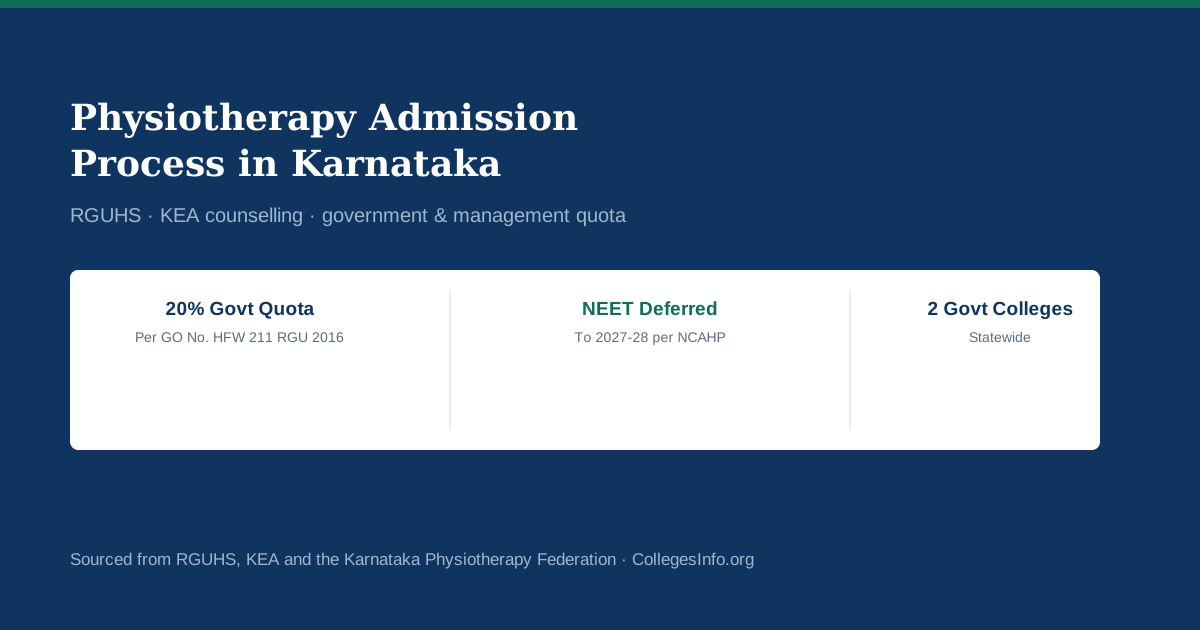
Physiotherapy admission in Karnataka runs through Rajiv Gandhi University of Health Sciences (RGUHS), with 20 percent of seats at each affiliated college reserved for government quota under a specific 2016 government order. Only two purely government physiotherapy colleges exist statewide. The exact entrance mechanism for the current admission cycle is worth confirming directly with KEA, since this is an area under real regulatory change, one this guide covers in detail below rather than glossing over with a confident but potentially wrong assertion.
Why This Guide Verifies Rather Than Assumes the Entrance Mechanism
Search for "physiotherapy admission Karnataka" and sources disagree on a fundamental point: whether Bachelor of Physiotherapy (BPT) government-quota admission requires an entrance exam at all. The Karnataka State Physiotherapy Federation's own published admission notices, reproduced consistently across multiple academic years through 2024-25, state plainly that merit ranking is based on 10+2 Physics-Chemistry-Biology percentage directly, not on NEET, CET, or any other exam. Several more recent sources describe a shift toward KCET-based admission for the current cycle. Both cannot be true at once for the same admission category, and this guide treats that conflict directly rather than picking whichever claim sounds more authoritative. This same discipline of checking a claim against RGUHS's own published records, rather than assuming an aggregator summary is correct, has surfaced repeatedly across this site's other Karnataka course guides.
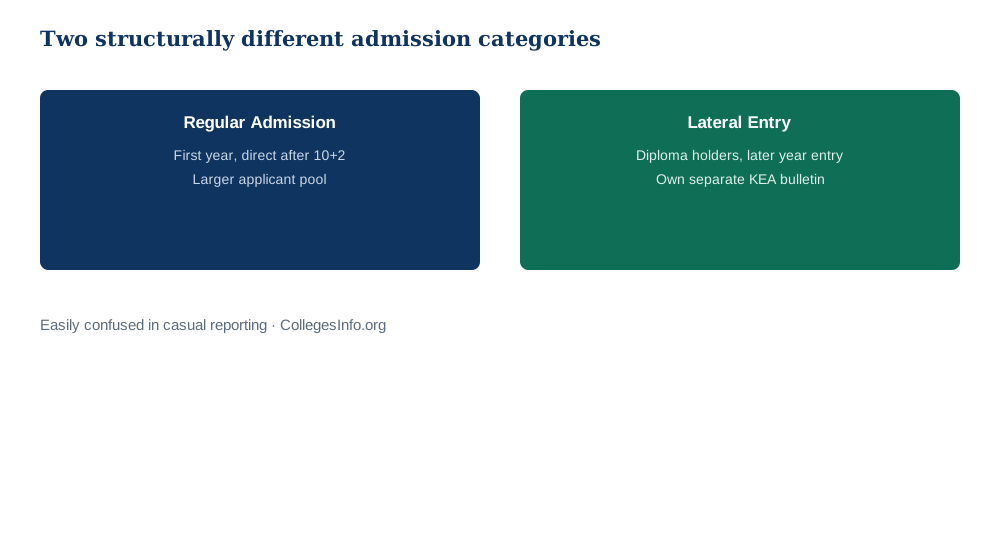
Complicating this further, Karnataka's Examinations Authority separately runs a distinct "Bachelor of Physiotherapy (Lateral Entry)" admission bulletin, a different category entirely for diploma holders entering directly into a later year, easily confused with regular first-year BPT admission in casual reporting. Given this genuine complexity, the responsible position is to confirm what is solidly established, flag what is actively changing, and direct candidates to verify the exact current-year mechanism directly with KEA before assuming either the historical or a newly-claimed process applies, rather than repeating whichever version happens to appear first in a search result, a habit worth resisting given how much is practically at stake for the candidate making this decision.
What Is Solidly Confirmed
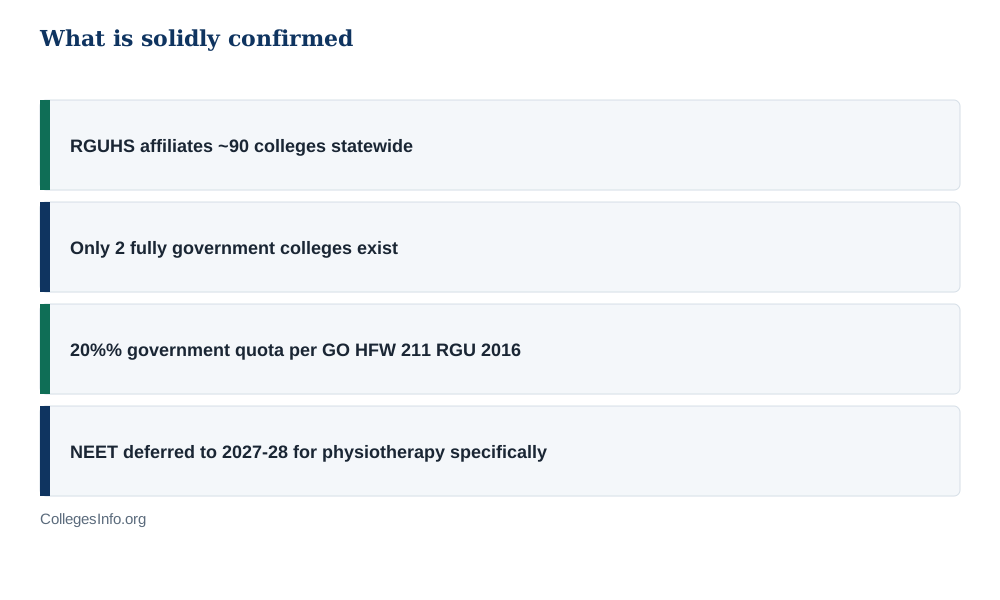
1. RGUHS is the affiliating university for nearly every physiotherapy college in the state
Rajiv Gandhi University of Health Sciences (RGUHS) affiliates nearly 90 physiotherapy colleges across Karnataka, publishing its own list of affiliated institutions directly on its official site. A small number of colleges instead affiliate to specific state private universities, such as JSS Science and Technology University for its own physiotherapy programme, but RGUHS governs the overwhelming majority.
2. Only two purely government physiotherapy colleges exist in Karnataka
Confirmed directly by the Karnataka State Physiotherapy Federation: Bangalore Medical College's Department of Physiotherapy, and Sanjay Gandhi Institute of Trauma and Orthopaedics, also in Bangalore. Every other confirmed physiotherapy college in the state, including well-known names like MS Ramaiah, St John's and RV College of Physiotherapy, is a private institution with a government-quota carve-out rather than a fully government-run college.
3. Twenty percent of seats at every affiliated college are government quota
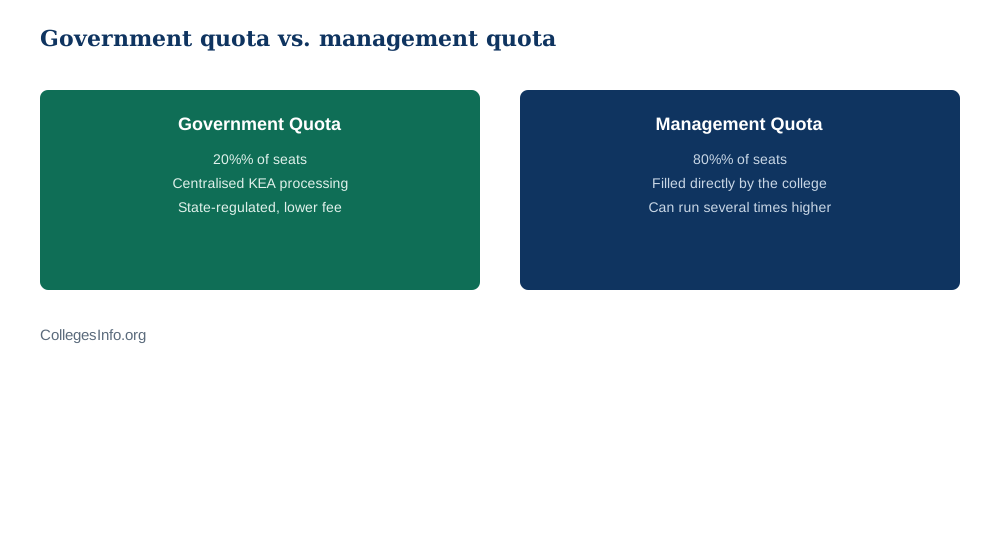
This is set by a specific Government of Karnataka order, GO No. HFW 211 RGU 2016, applying uniformly to physiotherapy colleges affiliated to RGUHS and to those under state private universities. The remaining 80 percent of seats run as management quota, filled directly by the specific college rather than through centralised counselling.
4. NEET has been formally deferred for physiotherapy admission until 2027-28
Karnataka initially signalled that NEET would become mandatory for BPT admission from 2026-27, but the National Commission for Allied and Healthcare Professions (NCAHP) issued a formal deferral, pushing the NEET requirement to 2027-28. Candidates applying for the 2026-27 academic year do not need a NEET score for physiotherapy admission, a practically useful distinction from medical and dental admission, which have required NEET for years.
| Fact | Status |
|---|---|
| Government quota share | 20% per college, per GO No. HFW 211 RGU 2016 |
| Purely government colleges | 2 statewide (both in Bangalore) |
| Affiliating university | RGUHS (nearly 90 colleges), a few under state private universities |
| NEET requirement | Deferred to 2027-28 per NCAHP |
| Entrance exam for regular first-year admission | Unclear for current cycle - verify with KEA directly |
The Historical Process, Confirmed Through Multiple Years
The Karnataka State Physiotherapy Federation's own admission page reproduces government-quota BPT notices spanning 2017 through 2024-25, and the eligibility and merit-ranking language is consistent across every year shown: candidates need a minimum 40 percent aggregate in Physics, Chemistry and Biology at 10+2 level, and merit ranking runs on that PCB percentage directly, explicitly stated as not based on NEET, CET, or any other exam. This process moved from RGUHS's own administration to the Karnataka Examinations Authority (KEA) starting with the 2018 admission cycle, a structural change worth knowing about if researching older admission cycles for historical comparison, since sources describing pre-2018 admission mechanics may reference RGUHS-run processes that no longer apply under the current KEA-administered system.
Candidates who want their specific physiotherapy college fit checked before applying anywhere can start from our MBA admission assistance page.
Whether this exact mechanism, pure PCB percentage merit with no entrance test, still applies for the current 2026-27 cycle, or whether a newer KCET-linked process has replaced it, is the specific point this guide could not resolve with full confidence given the conflicting sources. A candidate should treat this as the single most important detail to confirm directly on KEA's official website before making any assumption about how their government-quota rank will actually be calculated.
How to Verify This Yourself Before Applying
Given the genuine conflict this research found between historical, repeated, official-looking notices and more recent aggregator claims, a candidate should not rely on any single third-party summary, including this one, without a final direct check, particularly given how much a wrong assumption about the entrance mechanism could cost in misdirected preparation time. Confirm the current year's exact admission mechanism directly on KEA's own official portal rather than an aggregator's paraphrase, since KEA's own notification is the only source with genuine authority over how the current cycle's merit rank is actually calculated. Where a source claims a specific KCET cutoff rank for a physiotherapy seat, check whether that source is actually describing BPT specifically or has conflated it with the separately KCET-governed BSc Nursing admission process, since these two allied health streams get bundled together constantly in generic admission guides despite running on entirely different mechanisms historically.
Why This Conflict Matters More Than It Might Seem
A candidate who prepares under the wrong assumption about the admission mechanism risks a distinctly costly mistake, one that compounds across an entire academic year rather than a single missed deadline. If the current cycle actually runs on pure PCB percentage merit and a candidate spends months preparing for a KCET-style entrance test instead, that preparation time is largely wasted for this specific admission purpose, though it may still support broader academic readiness. Conversely, if the current cycle has actually shifted to a KCET-linked process and a candidate assumes the older, exam-free mechanism still applies, they risk missing the actual registration window or preparation timeline entirely, a mistake that could cost an entire admission cycle.
This is precisely why this guide declines to assert either mechanism with confidence and instead directs candidates to KEA's own current notification as the only source carrying genuine authority over the correct answer for this specific admission cycle. A ten-minute check against the official notification protects against a mistake that could otherwise cost months of misdirected preparation or, worse, a missed admission cycle entirely, a disproportionate cost relative to the small effort a direct verification actually requires.
Candidates weighing physiotherapy against other Karnataka streams can browse the full Karnataka college directory, compare specific institutions using the college comparison tool, or review the wider Karnataka entrance exam directory to understand how physiotherapy's admission process compares with KCET-governed engineering or NEET-governed medical admission before committing to a specific stream.
Regular Admission vs. Lateral Entry: A Structurally Different Process
Karnataka Examinations Authority runs a separate, distinct admission bulletin specifically titled "Bachelor of Physiotherapy (Lateral Entry)," confirmed directly through an official 2025-26 information bulletin. This category exists for candidates holding a relevant diploma qualification who enter directly into a later year of the BPT programme rather than starting from the first year after 10+2, a meaningfully different pathway with its own separate calendar, eligibility criteria and application process from regular first-year admission.
This distinction matters because casual reporting on physiotherapy admission frequently blurs the two categories together, describing lateral-entry mechanics as if they applied to the much larger pool of regular first-year applicants, or vice versa. A candidate should confirm which specific bulletin and admission category applies to their situation, diploma-holder lateral entry or standard first-year entry after 10+2, before assuming any specific eligibility percentage, document requirement or timeline applies to their own application.
After Admission: Council Registration and Practice Rights
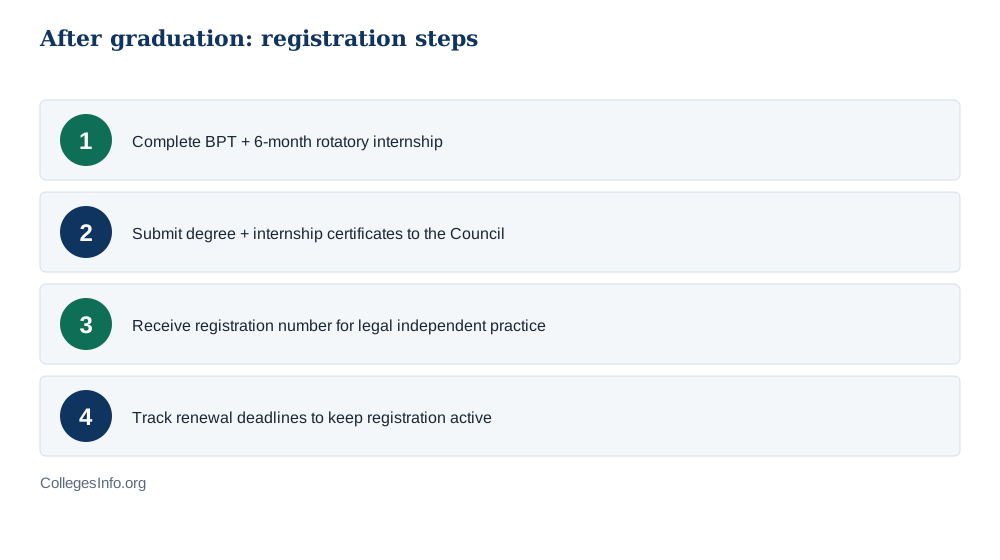
Completing BPT and the compulsory six-month rotatory internship is not the final step toward independent practice. Registration with the Karnataka Physiotherapy Council, or the applicable state physiotherapy council, is required before a graduate can legally practise independently, whether in a private clinic, hospital employment, or any other physiotherapy role requiring professional registration. This registration process typically requires the BPT degree certificate, internship completion certificate, academic mark sheets for every year of the programme, identity documents and a registration fee, submitted directly to the council, with processing timelines that can vary depending on application volume and the specific council's current administrative capacity, another detail worth confirming directly rather than assuming a fixed turnaround applies.
Registration is not automatically permanent; renewal is periodic, and a candidate should track renewal deadlines directly to avoid a lapse in active registration status, which can complicate employment eligibility, particularly for government physiotherapist positions where valid, current council registration is typically mandatory at the time of joining rather than something confirmed only once at initial hiring, a distinction that catches some graduates off guard years into their career.
| Stage | What it requires |
|---|---|
| BPT degree completion | 4 years academic study |
| Rotatory internship | 6 months compulsory clinical postings |
| Council registration | Degree + internship certificates, mark sheets, ID, fee |
| Renewal | Periodic, must be tracked independently |
Government Quota vs. Management Quota: What Actually Differs
Beyond the admission mechanism itself, government quota and management quota seats differ in several practical ways worth understanding before applying. Government quota seats run through centralised KEA processing, with a fixed, government-regulated fee structure historically set at a modest annual rate, several times lower than typical management-quota fees at the same college. Management quota seats are filled directly by each college, generally on a merit or first-come basis, with fees set independently by the institution within regulatory limits, and can run to several times the government-quota rate for an identical BPT seat at the same institution.
This gap matters for financial planning specifically: a candidate should confirm which quota they are realistically likely to secure before budgeting around either figure, since assuming the lower government-quota rate applies universally, when a candidate is actually more likely to land a management-quota seat, risks a significant financial planning error over the full four-and-a-half-year programme. Candidates researching specific Bangalore physiotherapy options can browse our Bangalore physiotherapy colleges guide, verified against RGUHS's own affiliated-college records, for a city-specific list before applying this admission process to a shortlist.
Step-by-Step: What the Admission Process Actually Involves
Regardless of the exact entrance mechanism for a given year, the broader admission sequence for government-quota physiotherapy seats in Karnataka follows a consistent structure. First, a formal notification is issued, historically through the Directorate of Medical Education and processed via KEA, opening an online registration and application window, typically for a period of one to two weeks. Second, candidates submit their application along with the prescribed fee, with document verification, covering 10th and 12th mark sheets, category certificates where applicable, and Karnataka domicile proof, confirmed either at this stage or during a later verification step depending on the specific year's process. Category certificates specifically, covering SC, ST, OBC, Kannada Medium, rural and Hyderabad-Karnataka region status where applicable, must generally be issued well in advance of the application window, since these are typically verified against government revenue department records rather than accepted at face value, and a certificate obtained too close to the application deadline risks not clearing verification in time.
Third, a merit list or rank is generated according to that year's confirmed mechanism, followed by option entry, where candidates list preferred colleges in priority order. Fourth, seat allotment is announced, typically across one to three rounds, with candidates required to accept their allotment and report to the allotted college with original documents within a specified window. Between rounds, a mock allotment is typically published first, giving candidates visibility into their likely outcome before the round's final results lock in, allowing time to reconsider preference ordering if the projected allotment differs meaningfully from what a candidate expected, a practically useful window that many candidates overlook in the rush of counselling season. Missing this window typically forfeits the seat to the next candidate on the merit list, making this a distinctly time-critical stage of the process.
The same verification discipline applies when comparing government and management quota routes, and our admission assistance service page covers that path.
Eligibility Requirements
Standard eligibility for BPT admission in Karnataka requires 10+2 completion with Physics, Chemistry and Biology as mandatory subjects, with a minimum aggregate that has historically sat around 40 to 45 percent depending on the specific year's notification and category. Reserved categories typically receive a relaxed minimum percentage requirement. Candidates should confirm the current year's exact percentage threshold directly against that year's KEA notification rather than assuming a fixed figure carries over unchanged, since minimum eligibility percentages have shifted modestly across different admission cycles, and even a small discrepancy here can determine whether a candidate meets the baseline eligibility bar at all.
Scholarships and Financial Planning for Government and Management Quota
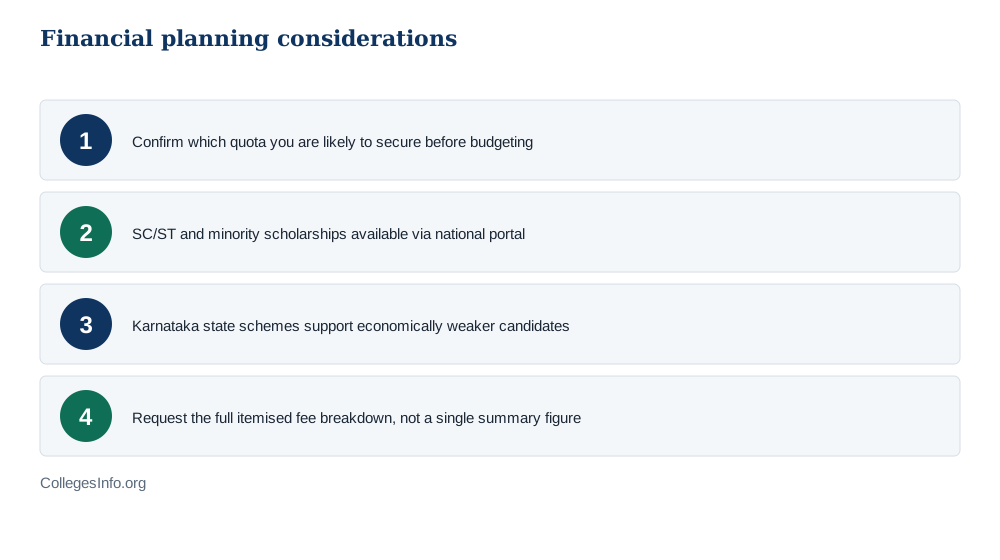
Government-quota BPT fees have historically run at a modest, state-regulated rate, several times lower than typical management-quota fees at the same college for an identical degree. Beyond this baseline affordability, candidates from SC, ST and minority communities can access central government scholarship schemes covering tuition and maintenance costs for professional programmes including BPT, applied through the national scholarships portal. Karnataka's own state scholarship schemes additionally support economically weaker general-category candidates at government and aided institutions.
A candidate's realistic financial planning should start from confirming which quota, and therefore which fee structure, they are actually likely to secure, rather than assuming the lower government-quota figure applies universally. For a management-quota seat specifically, requesting the full itemised fee breakdown directly from the college, rather than relying on an aggregator's summary figure, avoids a significant budgeting surprise partway through a four-and-a-half-year commitment.
Frequently Asked Questions
Is NEET required for physiotherapy admission in Karnataka?
Not for the 2026-27 academic year. NCAHP formally deferred the NEET requirement for physiotherapy admission to 2027-28, meaning current-cycle candidates do not need a NEET score specifically for BPT admission.
What percentage of physiotherapy seats are government quota?
Twenty percent of seats at each RGUHS-affiliated or state-private-university-affiliated physiotherapy college are reserved for government quota, per Government of Karnataka Order No. HFW 211 RGU 2016. The remaining 80 percent run as management quota, filled directly by the specific college, a structural split that has stayed consistent even as the underlying entrance mechanism for government-quota seats appears to be shifting for the current cycle.
Are there any fully government physiotherapy colleges in Karnataka?
Yes, two: Bangalore Medical College's Department of Physiotherapy, and Sanjay Gandhi Institute of Trauma and Orthopaedics, both in Bangalore. Every other confirmed physiotherapy college in the state is a private institution with a 20 percent government-quota carve-out rather than a fully government-run college.
Does physiotherapy admission require an entrance exam?
This is not fully resolved across current sources for the present admission cycle. Historical notices spanning 2017 through 2024-25 explicitly describe merit ranking based on 10+2 PCB percentage directly, with no entrance exam involved. Some more recent sources describe KCET-based admission instead. Confirm the exact current-year mechanism directly with KEA before assuming either applies.
What is the difference between regular BPT admission and BPT lateral entry?
Regular BPT admission is for candidates entering the four-year programme's first year directly after 10+2. Lateral entry is a separate admission category, run under its own distinct KEA bulletin, for candidates with a relevant diploma entering directly into a later year of the programme.
Which university affiliates most physiotherapy colleges in Karnataka?
Rajiv Gandhi University of Health Sciences (RGUHS) affiliates nearly 90 physiotherapy colleges statewide. A smaller number of colleges affiliate instead to specific state private universities running their own physiotherapy programmes.
What documents are required during physiotherapy admission verification?
Standard requirements include 10th and 12th standard mark sheets, category certificates where applicable, and Karnataka domicile proof for government-quota eligibility, though the exact document list and verification timing has varied somewhat across different years' notifications.
Can a candidate change their college preference after option entry?
Historically, KEA processes have allowed a mock allotment stage before final option entry closes, giving candidates a chance to review, reorder, or change their preference list based on projected allotment before the final round locks in. Confirm the current year's specific window for this against the active KEA notification.
Is there a separate government quota process for MPT admission?
Yes. Karnataka Examinations Authority runs a distinct government-quota admission process for Master of Physiotherapy (MPT), separate from the BPT process, with its own eligibility criteria built around holding a BPT degree rather than 10+2 completion.
This article is for informational purposes only. Consult KEA's official current-year notification before making admission decisions.
About the author
OneCity Technologies Pvt. Ltd began in 2006 publishing an annual print education directory for Karnataka students and parents. As demand grew, OneCity launched an education portal in 2019 to bring that same directory information online, and in 2025 relaunched as CollegesInfo.org, a comprehensive Karnataka college directory covering 1,500+ institutions across engineering, medical, management, arts, commerce, and more. Founder L K Monu Borkala brings 20+ years of business experience and 19 years of work across various education-sector services. CollegesInfo.org's content is built from publicly available KEA, NMC, AICTE, and university data, cross-checked against official sources wherever possible. CollegesInfo.org's admission assistance service helps students secure admission to colleges they are eligible for under that college's actual published criteria. We help you get the best admission to your preferred colleges without hassle.
Not sure how the current admission cycle actually works for your situation?
We help you get the best admission to your preferred colleges without hassle.
Need help with admission?
CollegesInfo.org helps students secure admission to colleges they are eligible for under that college's actual published criteria. Chat with us on WhatsApp or explore admission assistance.