Last Updated: September 7, 2026
Quick Facts: M.E/M.Tech in Bangalore
| Detail | Overview |
|---|---|
| Duration | 2 years, full-time (4 semesters) |
| Admission route | GATE score or Karnataka PGCET; a handful of universities also run their own entrance test |
| Typical eligibility | Bachelor's degree in engineering with at least 50% marks |
| Typical fee range | Approximately ₹28,400/year at heavily subsidised institutes to ₹7.72 lakh at premium autonomous universities |
| Colleges offering M.E/M.Tech in Bangalore | Around 58 total (50 private, 8 government) – this guide profiles the 20 most worth comparing |
Bangalore's M.Tech landscape splits into two different worlds that rarely get compared against each other. On one side sit the government and quasi-government institutes – IISc, IIIT Bangalore, UVCE – where fees run remarkably low because they're substantially subsidised, but seats are correspondingly harder to secure through GATE. On the other side sit around 50 private engineering colleges and universities, where fees range from affordable to premium, and admission runs through GATE, Karnataka PGCET, or a university's own entrance test depending on the institution. Neither side is inherently "better" – the government tier trades lower cost for higher entry competition and a more research-first culture, while the private tier trades a wider range of accessible entry points for correspondingly wider variation in fee and outcome quality, which is exactly why a single blended "top Bangalore M.Tech colleges" list tends to mislead more than it helps. This guide profiles the names worth knowing across both sides, with real fee and placement figures rather than the vague "top college" lists that dominate most search results. It's worth setting expectations early too: an M.Tech is a different commitment from a B.Tech – more research and project-driven, considerably more specialised, and the right choice of institution depends heavily on whether you're pursuing it as a stepping stone to industry, a bridge toward a PhD, or a way to deepen expertise in a specific niche your undergraduate degree only touched on.
The Colleges: Bangalore's Most Differentiated M.Tech Options
Indian Institute of Science (IISc)
IISc isn't just the best-known name on this list – it's consistently ranked as India's top research institution overall, not merely for engineering. Its M.Tech fee sits at roughly ₹28,400 for the full programme, a figure that only makes sense once you understand IISc's status as a heavily government-subsidised, research-first institute rather than a typical teaching university. That subsidy comes with a genuine trade-off: GATE cutoffs for IISc's M.Tech programmes are among the most competitive in the country, and admission leans heavily toward candidates who've already demonstrated strong research aptitude, not just a qualifying GATE score. For students oriented toward research, a PhD pathway, or academia, IISc is in a different category from every other name on this list. Its M.Tech programmes are also structured with a stronger emphasis on independent project work and lab-based research than the more coursework-heavy structure typical at private universities, which suits some students far better than others – candidates who thrive on structured coursework sometimes find IISc's research-first culture a harder adjustment than its prestige alone suggests.
International Institute of Information Technology, Bangalore (IIIT-B)
IIIT-B holds NIRF Engineering rank 74, the best specific ranking of any college on this Bangalore M.Tech list, and it's built entirely around information technology and computer science rather than running a broad multi-discipline engineering curriculum. That focus shows up in its fee structure too – at roughly ₹7.72 lakh for the full programme, it's also the most expensive name on this list, reflecting its status as an autonomous, self-financed deemed university rather than a subsidised public institute despite its public-mission origins. Its placement recruiters read like a pure tech-industry list: Adobe, Intel, Google, and Salesforce. For students specifically set on software, AI, or core computer science research rather than traditional engineering disciplines, IIIT-B's specialisation is the clearest differentiator on this list. Its position straddling public-mission origins and a self-financing fee structure is also worth understanding on its own terms – it was established with government and industry backing but doesn't receive the same fee subsidy as a fully public institute like IISc or UVCE, which explains why its fee sits so much higher than its NIRF rank alone might suggest.
MS Ramaiah Institute of Technology (MSRIT)
MSRIT, already familiar to many Karnataka families through its undergraduate engineering programmes, holds NIRF Engineering rank 78, running 11 distinct M.Tech courses across its departments – one of the broadest specialisation spreads among the private names on this list. Admission runs through GATE with an additional accepted route, and its placement recruiters include Infosys, Capgemini, and HCL, reflecting the traditional IT-services-heavy recruitment pattern common among Bangalore's established private engineering colleges. MSRIT's breadth of course offerings, rather than a single standout specialisation, is its main differentiator – a reasonable choice for students who want optionality across several engineering disciplines within one well-established institution. It's also worth knowing that MSRIT is a separate institution from MS Ramaiah University of Applied Sciences (MSRUAS), even though both fall under the same wider Ramaiah education trust – they have different NIRF standings, different fee structures, and separately administered admissions, so treat them as two distinct research options rather than assuming interchangeability.
RV College of Engineering (RVCE)
RVCE holds a strong NIRF Engineering rank in the 90s nationally and runs 13 M.Tech courses, admission through GATE with an additional accepted route, and fees around ₹4.53 lakh for its Product Design and Manufacturing track specifically (other specialisations may price differently). Its placement recruiters include Snapdeal and Adani Group, alongside a range of smaller and mid-size tech and engineering employers. RVCE's reputation in Bangalore's engineering ecosystem is long-standing, and it's worth shortlisting alongside MSRIT for students weighing two of the city's most established private engineering brands against each other. Both colleges draw from a similar applicant pool and command broadly comparable prestige in campus placement drives, so the deciding factor for most students often comes down to which specific specialisation each runs, rather than any meaningful difference in overall institutional reputation.
BMS College of Engineering (BMSCE)
BMSCE is the value story on this list – its M.Tech fee runs around ₹55,600 for the full programme, dramatically lower than most private names here despite a NIRF Engineering rank in the 101-150 band and 11 M.Tech courses on offer. Its placement recruiters include Airtel, Nokia, Motorola, and Philips, a strong roster for a college charging a fraction of what several less-differentiated private colleges on this list ask for. For families specifically looking for the strongest fee-to-outcome ratio among Bangalore's reputed private engineering colleges, BMSCE is the clearest example on this list. Don't confuse it with BMS Institute of Technology and Management (BMSIT) or BMS School of Architecture, both separate institutions under overlapping BMS-branded trusts – the same naming caution that applies to this city's undergraduate architecture landscape applies here too.
University Visvesvaraya College of Engineering (UVCE)
UVCE is Bangalore's other major government engineering option alongside IISc, and it's one of the oldest technical institutions in the city, tracing back to 1917. It runs an unusually wide 24 M.Tech courses – the broadest specialisation spread of any college on this entire list – admitted through GATE. As a public institution under Bangalore University, detailed fee and placement figures are less prominently published than at the private universities here, which is itself worth knowing: confirm current figures directly with the admissions office rather than assuming parity with the private sector's more heavily marketed numbers. Its 24-course breadth also means UVCE is worth shortlisting specifically for niche or less commonly offered specialisations that many of the smaller private colleges on this list simply don't run at all.
PES University
PES University sits at the premium end of the private tier, with M.Tech fees around ₹9 lakh for its Computer Science and Engineering track specifically – the highest fee among the named private universities on this list, run across 9 distinct M.Tech courses. Its NIRF Engineering rank sits in the 101-150 band, and its placement recruiters include some of the strongest names on this entire list: Mercedes-Benz, Netflix, Cisco, and Facebook. For students and families willing to pay a premium for a private university with strong big-name tech and automotive-sector placements, PES is the clearest example of that trade-off here. Its part-time M.Tech option – one of only three available anywhere in this city – is also a genuine differentiator for working professionals who want to upskill without leaving their job, a route none of the other profiled colleges on this list offer at all.
The Next Tier: More Verified M.Tech Options in Bangalore
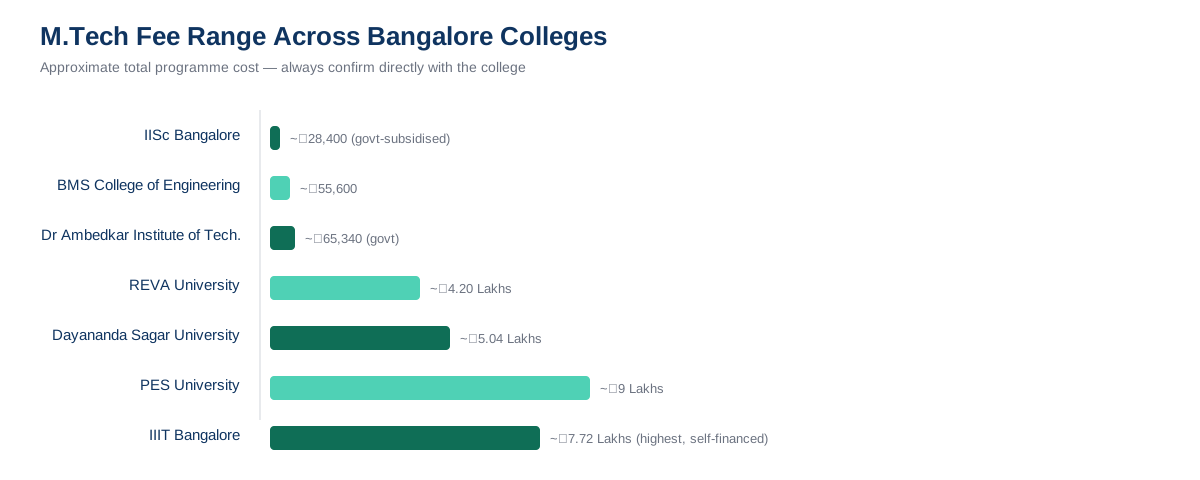
Beyond the seven profiled above, Bangalore's remaining private M.Tech colleges span a wide range of fees and specialisations – a similar naming-confusion pattern to what shows up among the city's B.Arch colleges also appears here, particularly around the Ramaiah and Dayananda Sagar trust names. Rather than thin out the depth on the profiles above, here's a straight comparison of more names worth knowing:
| College | Approx. Fee | Notable For |
|---|---|---|
| Dr Ambedkar Institute of Technology | ~₹65,340 | Government college, low fee, GATE-based admission |
| SJB Institute of Technology (SJBIT) | ~₹1.37 lakh | Affordable private option with a structural engineering specialisation track |
| Nitte Meenakshi Institute of Technology (NMIT) | ~₹2.56 lakh | NIRF 101-150 band; part of the wider Nitte education group |
| Atria Institute of Technology | ~₹1.55 lakh | Mid-affordability private option |
| Christ University | ~₹1.75 lakh | NIRF 101-150 band; broader university brand beyond pure engineering |
| BNM Institute of Technology (BNMIT) | ~₹2.50 lakh | VLSI Design and Embedded Systems specialisation focus |
| New Horizon College of Engineering (NHCE) | ~₹2.40 lakh | NIRF 151-200 band |
| Dayananda Sagar College of Engineering (DSCE) | ~₹2.08 lakh | NIRF 201-300 band; separate institution from Dayananda Sagar University |
| Dayananda Sagar University (DSU) | ~₹5.04 lakh | 7 M.Tech courses; PGCET-based admission; separate from DSCE above |
| MS Ramaiah University of Applied Sciences (MSRUAS) | ~₹4.26 lakh | Separate institution from MSRIT above, part of the same wider Ramaiah trust |
| REVA University | ~₹4.20 lakh | NIRF 201-300 band; 10 M.Tech courses; also offers part-time M.Tech, one of only three colleges in the city to do so |
| Jain University (Faculty of Engineering and Technology) | ~₹4.70 lakh | 13 M.Tech courses including a dedicated Artificial Intelligence track |
| Presidency University | Fee varies by course | NIRF 201-300 band; AI and Machine Learning specialisation track |
Step-by-Step: How M.Tech Admission Actually Works in Bangalore
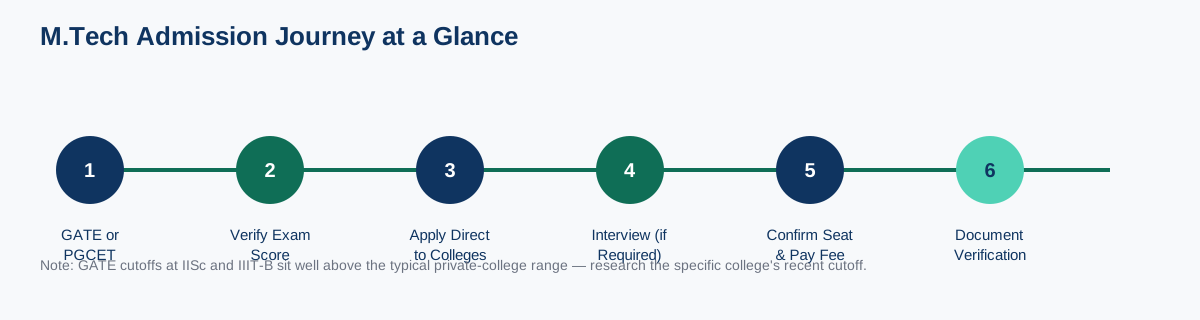
1. Decide between GATE and PGCET early
GATE opens doors to the government and top-tier institutes (IISc, IIIT-B, UVCE, and most established private colleges), while Karnataka PGCET is the state-level alternative several private colleges also accept. Some colleges take either; a few take only one. Confirm your target colleges' accepted routes before committing your preparation time to just one exam.
2. Understand that fee and prestige don't move together on this list
BMSCE's ₹55,600 fee alongside a reputed placement roster, versus IIIT-B's ₹7.72 lakh for its more specialised IT focus, shows this isn't a simple "you get what you pay for" market. Research the specific fee for your target specialisation at each college rather than assuming prestige and price scale together uniformly.
2a. Weigh the research-versus-industry orientation before shortlisting
Beyond fee and rank, ask directly what proportion of a programme's assessment is coursework versus independent project or thesis work – this varies substantially across this list and affects daily student life more than most rankings capture. A programme's placement statistics tell you about outcomes; this question tells you about the actual two years you'll spend getting there.
3. Confirm which specific M.Tech specialisation each college offers
Colleges on this list range from single-specialisation programmes to UVCE's 24 courses and MSRIT's 11 – the breadth varies enormously. If you have a specific specialisation in mind (VLSI, structural engineering, data science, AI), verify it's actually offered at your shortlisted college before assuming a "top" college automatically covers your interest area.
4. Register for GATE or PGCET well ahead of the cycle
AICTE-approval and NBA accreditation are worth checking for any shortlisted college before applying, alongside NAAC grade where available. GATE registration typically opens months before the exam itself, and a strong GATE score is the single biggest lever for admission to the more selective names on this list, particularly IISc and IIIT-B. Start preparation early rather than treating it as a formality after a B.Tech.
5. Gather your documents early
Bachelor's degree mark sheets and certificates, GATE or PGCET scorecard once available, category certificates if applicable, and standard identity documents. International applicants may face additional document requirements – confirm this directly with your shortlisted university's international admissions office.
6. Sit GATE or PGCET and track your score against college-specific cutoffs
Cutoffs vary considerably across this list – IISc and IIIT-B's effective cutoffs sit well above what most of the private colleges here require. Research the specific college and specialisation's recent cutoff trend rather than a generic "top Bangalore college" cutoff figure.
7. Apply directly to each shortlisted college
Unlike KCET's centralised counselling for undergraduate engineering, M.Tech admission in Bangalore runs largely through direct application to each institution, even where the underlying entrance exam (GATE) is shared. Apply to each college's own admission portal separately.
8. Apply across a realistic spread of institution types
Given the fee range on this list runs from roughly ₹28,400 to ₹7.72 lakh, and selectivity varies just as widely, include at least one government or subsidised option alongside your private university applications, rather than applying only to the most prestigious names.
9. Attend interview or counselling rounds where required
Some colleges, particularly the more research-oriented ones like IISc, add an interview stage beyond the GATE score itself. Confirm whether your shortlisted programme requires this and prepare accordingly – this is typically a research-interest and technical-background conversation rather than a general aptitude test.
10. Confirm your seat within the offer window
Most colleges give a limited confirmation window after an offer, requiring an initial payment. Given the wide fee range on this list, confirm the exact first-instalment amount before committing.
11. Submit original documents for verification
Every institution on this list requires in-person original-document verification before finalising enrolment – this cannot be completed with digital copies alone.
12. Complete fee payment and confirm instalment options
Private universities in the multi-lakh range typically offer semester-wise instalment plans. Ask specifically, since this isn't always prominently advertised on the fee page.
13. Confirm whether your programme is full-time, part-time, or research-heavy
Only three colleges in this city currently offer part-time M.Tech options (PES University, REVA University, and Reva Institute of Technology and Management) – relevant specifically for working professionals who can't commit to a full-time schedule. Most other colleges on this list are full-time only. If you're currently employed and considering this route, confirm with your employer whether the part-time schedule fits your work commitments before enrolling – the coursework load, even part-time, is substantial enough that treating it as a minor addition to a full-time job is a common and avoidable planning mistake.
14. Register for your first semester and clarify your research or project supervisor
M.Tech programmes are considerably more research- and project-driven than undergraduate engineering. Understanding your department's supervisor allocation process and research focus areas early helps you make the most of the specialisation you've chosen.
What Comes After an M.Tech Degree
A PhD is the natural academic continuation for M.Tech graduates from research-oriented institutes like IISc specifically, and several of the universities on this list (IIIT-B, MSRIT, RVCE) also run their own PhD programmes for students who want to continue at the same institution. For graduates oriented toward industry rather than academia, the M.Tech itself is typically treated as the terminal qualification, with career progression happening through work experience and, later, an MBA for those who want to move into technical leadership or management roles rather than staying purely technical. Professional certifications in cloud platforms, specific programming frameworks, or domain-specific tools (VLSI design software, structural analysis packages, depending on specialisation) are increasingly pursued alongside or shortly after the degree, particularly for graduates targeting the stronger-placement institutes on this list. A smaller but genuine share of graduates, particularly from IISc and IIIT-B, also pursue postdoctoral or international research fellowships straight after their M.Tech, using it as a direct bridge into a research career rather than an industry one – a path that's realistically only available at this list's more research-oriented institutions.
Career Paths and Jobs
M.Tech graduates from Bangalore's colleges typically enter roles like software development engineer, research and development engineer, systems engineer, or design engineer, depending on their specific specialisation, with placement percentages across this list's colleges commonly cited around 80-90% based on available data. Recruiters actively hiring from this list span the full range of Bangalore's tech and manufacturing ecosystem, and the city's broader status as India's largest technology employment hub means even mid-tier colleges on this list benefit from proximity to a deep local job market that graduates from equivalent programmes in smaller cities don't have automatic access to – IIIT-B's graduates go into Adobe, Intel, Google, and Salesforce; MSRIT's into Infosys, Capgemini, and HCL; PES University's into Mercedes-Benz, Netflix, and Cisco; and BMSCE's into Airtel, Nokia, and Philips. That range itself is worth noting: an M.Tech from this city doesn't funnel graduates into one narrow industry, and the specific institution and specialisation matter considerably more than the "M.Tech from Bangalore" label alone in determining which of these recruiter categories a graduate is likely to reach. Graduates from research-focused specialisations – particularly at IISc and IIIT-B – also increasingly move into applied research roles at global tech companies' India-based R&D centres, a category of employment that's grown substantially in Bangalore specifically over the past several years and didn't feature prominently in placement data even a decade ago.
Opportunities abroad for M.Tech graduates are more direct than for undergraduate degrees, since a master's-level engineering qualification carries more international recognition on its own – the US, Germany, and increasingly Southeast Asian tech hubs are common destinations, though graduates from research-heavy institutes like IISc more often pursue a PhD abroad rather than direct industry placement.
M.Tech vs. Related Degrees
An MCA is the closest adjacent option for students from a computer applications or non-core-engineering background who want to move into technical roles without an engineering bachelor's degree as a prerequisite – M.Tech requires a B.Tech/B.E., while MCA typically accepts a BCA or BSc Computer Science background. An MBA in a technology or operations specialisation suits graduates who've decided they want to move toward technical leadership and management rather than staying in a pure engineering or research role. A direct PhD (bypassing a separate M.Tech) is occasionally available at research institutes like IISc for exceptionally strong candidates, though this remains the less common route for most engineering graduates. A dual-degree option – an integrated M.Tech combined with an MBA, offered by a handful of institutions in this city – suits students who already know at the undergraduate stage that they want both a deep technical specialisation and a management credential, rather than choosing one path and adding the other later as a separate degree.
Mistakes Applicants Keep Making
The most common mistake is assuming a single GATE score works identically across every college on this list – cutoffs for IISc and IIIT-B sit meaningfully above the private-college range, and applying only to the most selective names without a realistic backup wastes an admission cycle. The second is not verifying which specific specialisation a "top" college actually offers before assuming it covers your interest area – UVCE's 24 courses and a single-specialisation college are not comparable shortlist entries. Third, applicants frequently confuse similarly-named institutions on this list, particularly MSRIT versus MSRUAS (both part of the Ramaiah trust but separate institutions) and DSCE versus DSU (both Dayananda Sagar-affiliated but separately accredited). Finally, don't assume the highest-fee option automatically delivers the strongest placements – BMSCE's fee-to-outcome ratio on this list is a clear counterexample worth weighing seriously before defaulting to the most expensive name you recognise. A fifth mistake worth flagging: underestimating how much the research-versus-industry orientation of a programme affects day-to-day experience. A student who wants a fast, coursework-driven path into an industry role can find IISc's research-heavy culture mismatched to their goals, just as a student hoping for deep research mentorship might find a coursework-heavy private programme less suited to that ambition – match the institution's actual academic culture to your goals, not just its name recognition. Talking to current students or recent graduates of your shortlisted programme, where possible, surfaces this kind of cultural fit information far more reliably than any published ranking or placement statistic ever will.
How We Help
With around 58 real M.E/M.Tech colleges in Bangalore spanning a fee range from ₹28,400 to over ₹7 lakh, working out which one fits your GATE score, budget, and specialisation interest is exactly the kind of decision we help Karnataka students work through every admission cycle. We help you get the best admission to your preferred colleges without hassle. For personalised guidance comparing real fee and placement data across these institutions, WhatsApp us at +91 6363 330 233.
About This Guide
OneCity Technologies Pvt. Ltd began in 2006 publishing an annual print education directory for Karnataka students and parents. As demand grew, OneCity launched an education portal in 2019 to bring that same directory information online, and in 2025 relaunched as CollegesInfo.org – a comprehensive Karnataka college directory covering 1,500+ institutions across engineering, medical, management, arts, commerce, and more. Founder L K Monu Borkala brings 20+ years of business experience and 19 years of work across various education-sector services. CollegesInfo.org's content is built from publicly available KEA, NMC, AICTE, and university data, cross-checked against official sources wherever possible. CollegesInfo.org's admission assistance service helps students secure admission to colleges they are eligible for under that college's actual published criteria. We help you get the best admission to your preferred colleges without hassle.
About the Author
L K Monu Borkala is the Founder of OneCity Technologies Pvt Ltd and CollegesInfo.org, with over two decades of business experience and 19 years working across Karnataka's education sector.
Frequently Asked Questions
How many M.Tech colleges are actually there in Bangalore?
Around 58 colleges offer M.E/M.Tech in Bangalore – 50 private and 8 government. This guide profiles the most differentiated 20 rather than treating all 58 as equally worth individual research.
What's the fee difference between government and private M.Tech colleges in Bangalore?
Government and heavily subsidised institutes (IISc, IIIT-B in its subsidised categorisation, Dr Ambedkar Institute of Technology) charge dramatically less than most private options, though IIIT-B specifically is actually one of the highest-fee names on this entire list despite being government-adjacent, since it operates on a self-financing model. Always check the specific institution's current fee rather than assuming government-linked automatically means low-cost.
Is GATE compulsory for M.Tech admission in Bangalore?
Not universally – GATE is the primary route for most colleges on this list, but Karnataka PGCET is a widely accepted state-level alternative at many private colleges. A few universities also run their own entrance test. Check each shortlisted college's specific accepted routes.
What's the difference between MSRIT and MSRUAS?
They are two separate institutions under the wider Ramaiah education trust – MSRIT (MS Ramaiah Institute of Technology) and MSRUAS (MS Ramaiah University of Applied Sciences) have different NIRF standings, fee structures, and course offerings. Don't assume they're interchangeable when researching either one.
Can I pursue M.Tech part-time while working in Bangalore?
Only three institutions in the city currently offer this: PES University, REVA University, and Reva Institute of Technology and Management. Every other college on this list runs full-time programmes only.
Which M.Tech college in Bangalore has the strongest tech-industry placements?
Based on published recruiter data, IIIT-B (Adobe, Intel, Google, Salesforce) and PES University (Mercedes-Benz, Netflix, Cisco, Facebook) show the strongest big-name tech placements on this list, though always request the most recent placement cycle's figures directly from your shortlisted college, since a single strong year can skew a headline average more than most published figures make clear.
Is an M.Tech from IISc worth pursuing over a more "practical" private college option?
It depends on your goals. IISc is the strongest choice for students oriented toward research, academia, or a PhD pathway, given its research-first institutional culture and remarkably subsidised fee. For students focused primarily on direct industry placement straight after the degree, several private options on this list (particularly PES University and IIIT-B) show equally strong or stronger direct-industry recruiter rosters.
Need help with admission?
CollegesInfo.org helps students secure admission to colleges they are eligible for under that college's actual published criteria. Chat with us on WhatsApp or explore admission assistance.