Last Updated: September 7, 2026
Quick Facts: B.Arch in Bangalore
| Detail | Overview |
|---|---|
| Duration | 5 years, full-time (10 semesters) |
| Admission route | NATA (National Aptitude Test in Architecture) primarily; some colleges also accept JEE Main Paper 2, KCET, COMEDK UGET, or PESSAT |
| Typical eligibility | 10+2 with Physics, Chemistry and Mathematics, minimum 50% aggregate |
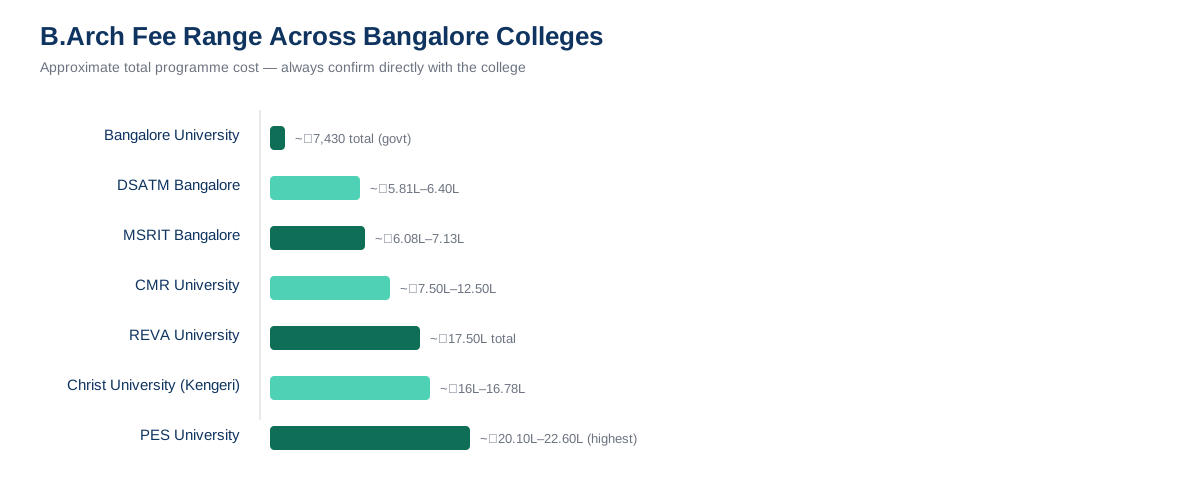
| Typical fee range | Approximately ₹7,430/year at government colleges to ₹20-23 lakh total at premium private universities |
| Colleges offering B.Arch in Bangalore | 30 total (28 private, 2 government) – this guide profiles the 20 most worth comparing |
Architecture is one of the few undergraduate degrees in Bangalore where the college name can mislead you. There are 30 real B.Arch colleges in the city, and a meaningful number of them share confusingly similar names with completely separate institutions – BMS College of Architecture, BMS School of Architecture, and BMS College of Engineering are three distinct entities under overlapping trusts, and getting this wrong before an application deadline is an avoidable mistake. This guide sorts the real 30 into what actually matters: which names run architecture as their core identity versus which are engineering universities that also happen to offer a B.Arch programme, what NATA and the alternative entrance routes actually require, and which of these colleges are worth the five-year commitment at each price point. It's also worth setting expectations early: architecture is a longer, costlier, and more studio-intensive commitment than most undergraduate degrees on this site, and the right college for you depends heavily on whether you want a dedicated architecture-only environment or the broader resources and campus life of a large multi-discipline university – both paths lead to the same COA-recognised degree, but the day-to-day experience differs considerably.
The Colleges: Bangalore's Most Differentiated B.Arch Options
BMS College of Architecture (BMSCA)
Start here because it's the single most important name to get right on this list. BMS College of Architecture is one of the oldest dedicated architecture institutions in Bangalore and holds NIRF Architecture rank 23 nationally – the strongest specific architecture ranking of any college in this city, ahead of every engineering-university-run B.Arch programme on this list. It is a separate institution from both BMS School of Architecture (a different college, also real, also in Bangalore) and BMS College of Engineering (which does not run a B.Arch programme at all despite the name similarity). If a source or a well-meaning relative tells you "BMS does architecture," always confirm which of the three BMS-branded institutions they actually mean before you apply. This isn't a minor administrative footnote – each of the three BMS institutions has its own separate admission process, fee structure, and campus, so an application mistake here isn't easily correctable after the fact.
MS Ramaiah Institute of Technology (MSRIT)
MSRIT, already known citywide for its engineering programmes, holds NIRF Architecture rank 75, making it the best-ranked B.Arch programme run inside a larger multi-discipline engineering university rather than a dedicated architecture school. Its B.Arch fees run around ₹6.08-7.13 lakh for the full programme, and it accepts NATA alongside KCET – an useful admission route for Karnataka-domicile students who've already prepared for KCET rather than starting NATA prep from scratch. Its published median salary package for architecture graduates sits around ₹2.16 lakh, which is on the lower end for this list, worth weighing against the brand recognition MSRIT carries in Bangalore's broader engineering ecosystem.
Christ University (Kengeri Campus)
This is worth calling out specifically because Christ's B.Arch runs on a different campus (Kengeri) from Christ's main city campus most people picture when they hear the name – an important commute consideration if you're a day-scholar assuming central-Bangalore access. Its NIRF Architecture rank sits in the 101-150 band, fees run approximately ₹16-16.78 lakh for the full programme, and it shows the strongest published median salary package on this list at roughly ₹4.83 lakh – nearly double MSRIT's figure. Admission is through NATA. For families weighing "which of these colleges actually gets its architecture graduates the best starting salaries," Christ Kengeri currently has the strongest public number. Worth noting, though: a single strong average can be pulled upward by a small number of exceptional placements in any given year, so ask the college directly for the full salary range and how many students that average is drawn from, not just the headline figure.
Bangalore University
The government option, and the fee difference is not subtle – Bangalore University's B.Arch runs around ₹7,430 total, compared to six or seven figures at the private names on this list. It accepts NATA, CUET UG, and KCET, giving it the widest set of entry routes of any college here. What you're trading for that price is a public-university pace and infrastructure rather than a private institution's design-studio investment, but for a rigorous, accredited five-year architecture degree at a fraction of private cost, this is the realistic option for families where the lakhs-per-year private tier simply isn't feasible.
University Visvesvaraya College of Engineering (UVCE)
UVCE is Bangalore's other government B.Arch option and one of the oldest technical institutions in the city, tracing back to 1917. It accepts NATA and KCET (check your likely rank with the KCET predictor if that's your route), and as a public institution under Bangalore University's umbrella, it carries a century-plus institutional history that none of the private names on this list can match. Placement and fee data for its B.Arch programme specifically is less publicly documented than the private universities on this list, which is itself worth knowing – confirm current figures directly with the college rather than assuming parity with its broader engineering reputation. As a public institution, its fee structure is expected to sit far closer to Bangalore University's affordable end than to the private-university lakh-plus range, though the exact current figure should be verified directly with the admissions office each cycle since public-university fee structures can be revised administratively.
RV College of Architecture
RV College of Architecture is a standalone architecture institution operating under the well-known Rashtreeya Vidyalaya trust – the same educational group behind RV College of Engineering – but it is its own separately accredited college, not a department inside the engineering campus. Admission runs through JEE Main and an additional accepted exam. For families who want the reassurance of an established, reputable Bangalore educational trust behind the institution, but a dedicated architecture-only campus rather than a B.Arch programme bolted onto an engineering university, RV College of Architecture is the clearest example of that combination on this list. The same trust-plus-standalone-school pattern shows up repeatedly across this city's architecture and engineering landscape – Dayananda Sagar, Sir MV, and SJB all follow a similar structure of a well-known parent educational group running a separately branded, separately accredited architecture institution rather than folding it into the main engineering campus.
Dayananda Sagar Academy of Technology and Management (DSATM)
DSATM's B.Arch runs at roughly ₹5.81-6.40 lakh for the full programme – the most affordable of the private-university-run (as opposed to government) options on this list – while still posting a median salary package around ₹3.78 lakh, the second-strongest placement figure after Christ Kengeri. Admission is through NATA. This combination of lower fees and solid published placement outcomes makes DSATM worth shortlisting specifically for families comparing value rather than brand name alone. It's part of the wider Dayananda Sagar education group, which also runs Dayananda Sagar College of Engineering and the separately accredited Dayananda Sagar College of Architecture – three different institutions under one trust, another naming cluster worth confirming carefully before applying.
The Next Tier: More Verified B.Arch Options in Bangalore
Beyond the seven profiled above – and worth comparing against other Bangalore degree options if you are still weighing architecture against a different field entirely – Bangalore has a genuine cluster of dedicated, standalone architecture schools – most operating under an established engineering or education trust but run as separate accredited institutions. Rather than thin out the depth on the profiles above, here's a straight comparison of the remaining names worth knowing:
| College | Type | Notable For |
|---|---|---|
| BMS School of Architecture | Private, standalone | A separate institution from BMS College of Architecture above – verify which one you're researching before applying |
| Dayananda Sagar College of Architecture | Private, standalone | Fees around ₹16.25 lakh; separate institution from DSATM and Dayananda Sagar College of Engineering |
| Sir MV School of Architecture | Private, standalone | Accepts COMEDK UGET alongside other routes; separate from Sir M Visvesvaraya Institute of Technology |
| SJB School of Architecture and Planning | Private, standalone | Accepts COMEDK UGET plus two additional exam routes, among the widest entry options in this tier |
| PES University | Private university | Highest fees on this list (₹20.10-22.60 lakh); NIRF 101-150 band; accepts JEE Main, PESSAT, KCET |
| CMR University | Private university | Fees around ₹7.50-12.50 lakh; accepts JEE Main, KCET and an additional route |
| REVA University | Private university | Fees around ₹17.50 lakh; NIRF 201-300 band; accepts JEE Main and one additional route |
| Nitte School of Architecture, Planning and Design | Private, standalone | Part of the wider Nitte education group, better known for its Mangalore campuses |
| Acharya's NRV School of Architecture | Private, standalone | Part of the Acharya Institutes group in north-west Bengaluru |
| Gopalan School of Architecture and Planning | Private, standalone | Part of the Gopalan education and real-estate group |
| BGS School of Architecture and Planning | Private, standalone | Part of the BGS education trust, separate from BGS medical and degree college campuses |
| RR School of Architecture | Private, standalone | Part of the RR education group |
| The Oxford College of Engineering | Private university | Runs B.Arch alongside its engineering programmes; part of the wider Oxford education group |
A pattern worth noticing across this next tier: the standalone "School of Architecture" names are overwhelmingly attached to trusts you'll recognise from Bangalore's engineering college landscape – Dayananda Sagar, Sir MV, SJB, RR, BGS, and Acharya's all run a separately branded architecture school alongside their better-known engineering campuses. That's generally a reassuring signal (an established trust with real institutional backing) rather than a red flag, but it does mean the architecture school's own specific reputation and outcomes can differ meaningfully from its more famous engineering sibling's, so research each one on its own merits rather than assuming the parent brand's engineering reputation transfers automatically.
Step-by-Step: How B.Arch Admission Actually Works in Bangalore
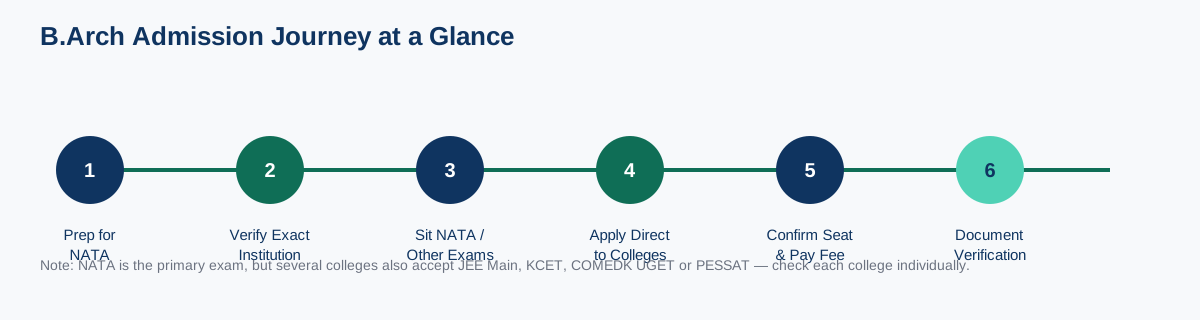
1. Start NATA preparation early – it's a different test than KCET or JEE
NATA tests drawing ability, observational skill, aesthetic sensitivity, and spatial reasoning – nothing like the physics-chemistry-maths format of KCET or JEE Main. If architecture is even a possibility for you, start NATA-specific preparation (sketching practice especially) well before 12th boards, since this can't be crammed the way subject-based exams can.
2. Confirm which entrance exams your shortlisted colleges actually accept
Coverage varies widely across this list – some colleges accept NATA only, others add JEE Main Paper 2, KCET, COMEDK UGET, PESSAT, or CUET UG in different combinations. Bangalore University alone accepts three different routes. Check each shortlisted college's specific accepted-exam list rather than assuming NATA alone covers everything.
3. Verify you have the correct institution, not a similarly-named one
This is the step most guides skip and the one this city requires: BMS College of Architecture, BMS School of Architecture, and BMS College of Engineering are three separate institutions. The same caution applies to Dayananda Sagar's several campuses (College of Architecture vs. Academy of Technology and Management vs. College of Engineering) and Sir MV's architecture school versus its engineering institute. Confirm the exact institution name and campus before registering for anything.
4. Register for NATA and any additional required exams
NATA is conducted by the Council of Architecture and typically offers multiple test sessions across the year – use a retake if your first attempt underperforms, since your best score is usually what counts toward admission.
5. Gather your documents early
10th and 12th mark sheets, transfer and migration certificates, passport photographs, category certificates if applicable, and your NATA/JEE scorecard once available. Physics-Chemistry-Mathematics in 12th grade is a hard eligibility requirement at every college on this list – confirm this before investing further time if your board combination differs.
6. Sit NATA and track your score against previous cutoffs
Cutoffs vary considerably between the top-ranked names (BMSCA, MSRIT) and the wider private tier – a score that clears one college comfortably may fall short at a more selective one. Research the specific college's recent cutoff trend rather than a citywide average.
7. Apply directly to your shortlisted colleges
Unlike KCET-driven engineering admissions, B.Arch admission in Bangalore runs largely through direct application to each college rather than a single centralised counselling system, even though the underlying entrance exam (NATA) is common. Apply to each shortlisted college's own admission portal separately.
8. Apply across a realistic spread of price tiers
Given the ₹7,430-to-₹23-lakh range across this list's 30 real colleges, include at least one government option (Bangalore University or UVCE) and one lower-cost private option (DSATM, for instance) alongside any premium private university on your list.
9. Attend counselling or interview rounds where required
Some colleges add a portfolio review or brief interview beyond the NATA score itself, particularly for management-quota seats. Confirm whether your shortlisted colleges require this and prepare a basic design portfolio if so, even at the undergraduate entry level.
10. Confirm your seat within the offer window
Most colleges give a limited window (often 7-10 days) to confirm an offer with an initial payment. Given how widely fees vary on this list, confirm the exact first-instalment amount before committing, since it can range from a few thousand rupees to several lakh depending on the institution.
11. Submit original documents for verification
Every institution on this list requires an in-person original-document check – this is standard across Bangalore's colleges and cannot be completed with digital copies alone.
12. Complete fee payment and confirm instalment options
Private universities charging in the double-digit-lakh range typically offer semester-wise or annual instalment plans rather than requiring the full five-year fee upfront – ask specifically, since this isn't always advertised prominently on the fee page.
13. Plan for studio time and material costs beyond tuition
Architecture programmes carry real costs beyond tuition – drafting equipment, model-making materials, printing for studio submissions, and software licences add up over five years. Budget for this separately from the headline fee figure when comparing colleges.
14. Sort out hostel or commute planning around your specific campus
Campus locations on this list vary considerably – Christ's architecture programme sits at Kengeri specifically, not Christ's main campus, while DSATM, MSRIT, and several standalone architecture schools sit in different parts of the city entirely. Confirm the actual campus address, not just the university's general city reputation, before planning your commute or hostel needs. Traffic patterns matter more for a five-year architecture commitment than they might for a shorter degree, particularly if your daily studio hours run later than a typical college day – factor realistic evening-commute time into your decision, not just the distance shown on a map.
15. Register for your first semester and understand the studio culture
Architecture education runs on a studio model rather than a standard lecture-and-exam structure – expect long in-studio hours, jury-style project reviews rather than only written exams, and a workload that's different from most other undergraduate degrees. Understanding this going in, rather than discovering it in week two, makes the adjustment considerably smoother.
What Comes After a B.Arch Degree
Registration with the Council of Architecture (COA) is the essential next step immediately after graduation – without COA registration, you cannot legally practise as an architect in India, regardless of how strong your degree is. From there, an M.Arch specialisation (Urban Design, Sustainable Architecture, Architectural Conservation, or Building Engineering and Management are commonly offered by colleges on this list) is the typical academic continuation for graduates who want to specialise further or move toward research and teaching. A growing number of graduates also pursue an MBA in real estate or construction management specifically, positioning themselves for project-management and developer-side roles rather than design-practice roles. Professional certifications in sustainable design (LEED, GRIHA) and BIM software credentials are increasingly treated as parallel additions during or shortly after the degree, since employers across this list's placement data show growing demand for graduates comfortable with digital design and sustainability standards from day one. A smaller number of graduates each year also pursue architecture programmes abroad for their master's specifically – the UK, Italy, and Singapore are common destinations – using the Bangalore B.Arch as a strong foundational qualification even though it requires a bridging postgraduate degree for professional recognition in most of those markets.
Career Paths and Jobs
Entry-level roles for B.Arch graduates from Bangalore's colleges include junior architect, architectural associate, site supervisor, and design intern-to-hire positions at architecture firms, with published median salary packages across this list's colleges ranging from roughly ₹2.16 lakh to ₹4.83 lakh depending on the specific institution. Recruiters actively hiring B.Arch graduates from Bangalore include established architecture and design practices – firms like Edifice Consultants, Morphogenesis, Sanjay Puri Architects, and Venkataramanan Associates recruit from this city's colleges – alongside construction companies and real estate developers building out in-house design teams. Bangalore's own construction and real estate boom is a genuine structural advantage for graduates from this list specifically: the city's ongoing infrastructure and commercial real estate expansion means local firms have steady project pipelines feeding entry-level hiring, more so than in cities with slower construction activity. Beyond traditional architecture-firm roles, a growing share of graduates from this list's colleges move into adjacent fields entirely – urban planning consultancies, heritage conservation bodies, and increasingly, technology roles at companies building architectural visualisation or building-information-modelling software, which value the spatial reasoning and CAD fluency a B.Arch develops even outside traditional practice.
Opportunities abroad for B.Arch graduates typically require an M.Arch or equivalent postgraduate qualification from the destination country first, since Indian B.Arch degrees, while COA-recognised domestically, don't carry automatic professional recognition in most international markets – the UK, Australia, and parts of the Middle East are the more commonly pursued destinations, usually via further study rather than direct placement.
B.Arch vs. Related Degrees
A B.Des (Bachelor of Design) is the closest adjacent option for students unsure between architecture and a broader design career – B.Des covers product, interior, or communication design more broadly, with considerably less structural engineering and building-code content than B.Arch. A B.Tech in Civil Engineering overlaps with B.Arch on structural fundamentals but stays firmly on the engineering and construction-management side rather than architectural design and aesthetics. Interior Design diploma or degree programmes, offered by a number of colleges in this city, suit students specifically interested in interior spaces rather than full building design, typically with a shorter, less expensive course than the five-year B.Arch commitment. A Bachelor of Planning (B.Plan), offered by a smaller number of institutions nationally, is the closer alternative for students more interested in city-scale urban planning than individual building design – worth researching separately if that's your genuine area of interest rather than assuming B.Arch is the only path into planning-adjacent careers.
Mistakes Applicants Keep Making
The single most common and most avoidable mistake on this specific list is confusing similarly-named institutions – BMS College of Architecture, BMS School of Architecture, and BMS College of Engineering are three different places, and the same confusion risk applies to Dayananda Sagar's and Sir MV's various campuses. Always verify the exact institution name, address, and COA approval status directly before applying. The second mistake is assuming NATA alone is sufficient preparation without checking whether a specific shortlisted college also requires JEE Main, KCET, or another exam – coverage varies college to college on this list. Third, applicants frequently underestimate studio and materials costs beyond the headline tuition fee, which can add a meaningful amount over five years, especially at the premium private universities. Finally, don't assume every college's published salary figure reflects current-year outcomes – Christ Kengeri's and DSATM's stronger published numbers are useful data points, but always ask for the most recent placement cycle's figures directly rather than relying on a number that may be a few years old. A fifth, subtler mistake: choosing a college purely on NIRF Architecture rank without weighing campus location and commute realistically. BMSCA's strong rank and Christ's strong placement number matter less if the actual daily commute to that specific campus makes five years of studio-heavy coursework exhausting – factor this in as seriously as the ranking table.
How We Help
With 30 real B.Arch colleges in Bangalore – several of them confusingly similarly named – getting the right shortlist and confirming you're applying to the institution you actually mean is exactly the kind of decision we help Karnataka students work through every admission cycle. We help you get the best admission to your preferred colleges without hassle. For personalised guidance verifying institutions and comparing real fee and placement data, WhatsApp us at +91 6363 330 233.
About This Guide
OneCity Technologies Pvt. Ltd began in 2006 publishing an annual print education directory for Karnataka students and parents. As demand grew, OneCity launched an education portal in 2019 to bring that same directory information online, and in 2025 relaunched as CollegesInfo.org – a comprehensive Karnataka college directory covering 1,500+ institutions across engineering, medical, management, arts, commerce, and more. Founder L K Monu Borkala brings 20+ years of business experience and 19 years of work across various education-sector services. CollegesInfo.org's content is built from publicly available KEA, NMC, AICTE, and university data, cross-checked against official sources wherever possible. CollegesInfo.org's admission assistance service helps students secure admission to colleges they are eligible for under that college's actual published criteria. We help you get the best admission to your preferred colleges without hassle.
About the Author
L K Monu Borkala is the Founder of OneCity Technologies Pvt Ltd and CollegesInfo.org, with over two decades of business experience and 19 years working across Karnataka's education sector.
Frequently Asked Questions
How many B.Arch colleges are actually there in Bangalore?
30 colleges offer B.Arch in Bangalore – 28 private and 2 government (Bangalore University and UVCE). This guide profiles the most differentiated 20 rather than treating all 30 as equally worth researching individually.
What is the difference between BMS College of Architecture and BMS School of Architecture?
They are two separate institutions with similarly overlapping names, both real and both offering B.Arch in Bangalore. Neither should be confused with BMS College of Engineering, which does not offer a B.Arch programme. Always confirm the exact institution name before applying.
Is NATA the only entrance exam needed for B.Arch in Bangalore?
No – while NATA is the primary and most widely accepted exam, several colleges on this list also accept JEE Main Paper 2, KCET, COMEDK UGET, or PESSAT, sometimes in combination. Check each specific college's accepted exam list rather than assuming NATA alone is sufficient everywhere.
What's the fee difference between government and private B.Arch colleges in Bangalore?
Government colleges (Bangalore University, UVCE) charge dramatically less – Bangalore University's fee is around ₹7,430 total – compared to private universities ranging from roughly ₹6 lakh to over ₹23 lakh for the full five-year programme.
Do I need Physics, Chemistry and Mathematics in 12th grade to apply for B.Arch?
Yes, this is a hard eligibility requirement across every college on this list, typically with a minimum 50% aggregate.
Can I practise as an architect in India immediately after completing B.Arch?
You need to register with the Council of Architecture (COA) after graduating before you can legally practise as an architect in India – this registration step is essential and shouldn't be treated as optional or automatic.
Which B.Arch college in Bangalore has the best placement outcomes?
Based on published data, Christ University's Kengeri Campus shows the strongest median salary package on this list at around ₹4.83 lakh, with DSATM Bangalore next at approximately ₹3.78 lakh. Always request the most recent placement cycle's figures directly from the college rather than relying on a possibly outdated published number.
Is a B.Arch from an engineering university (like MSRIT or PES) as good as one from a dedicated architecture school (like RV College of Architecture)?
Both types are COA-approved and lead to the same professional registration path. The genuine difference is institutional focus – a dedicated architecture school's entire faculty and infrastructure serves one discipline, while a multi-discipline university's B.Arch programme sits alongside its engineering and other departments. Neither is universally "better" – it depends on whether you value a specialised architecture-only environment or the broader campus resources of a larger university. Students who know early that architecture is their firm choice often lean toward the dedicated schools; students who want to keep some flexibility to explore adjacent fields during their degree sometimes prefer the wider resources a multi-discipline campus offers.
Need help with admission?
CollegesInfo.org helps students secure admission to colleges they are eligible for under that college's actual published criteria. Chat with us on WhatsApp or explore admission assistance.