Last Updated: September 7, 2026
Quick Facts: BCom in Bangalore
| Detail | Overview |
|---|---|
| Duration | 3 years, full-time (6 semesters) |
| Admission route | Merit on 10+2 marks at most colleges; entrance test plus interview at Christ and a handful of others |
| Typical eligibility | 10+2 pass, usually 45-50% aggregate (varies by college and category); Commerce stream preferred but not always mandatory |
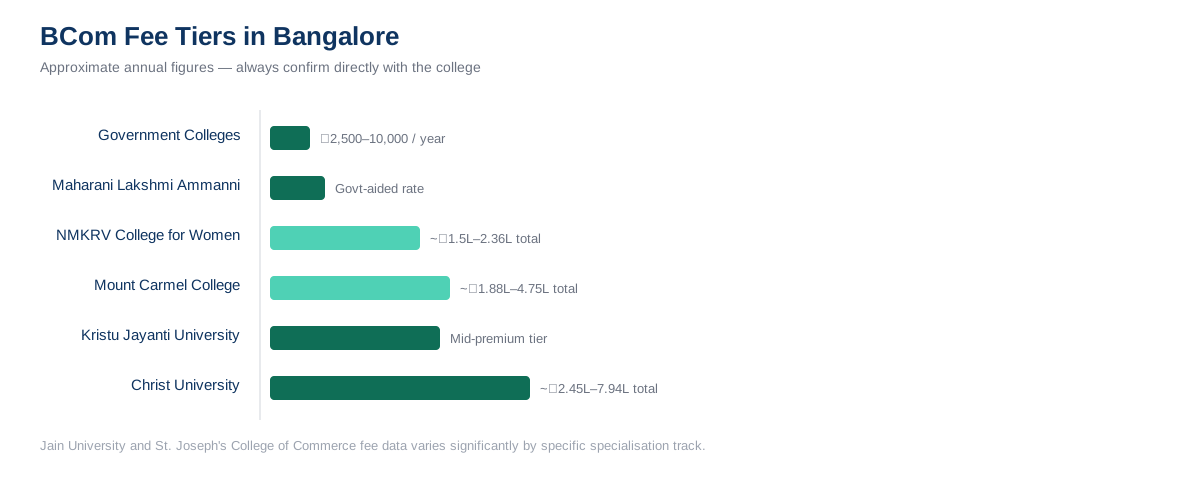
| Typical fee range | Approximately ₹2,500-10,000 per year at government colleges to ₹1.3-8 lakh per year at private universities |
| Colleges offering BCom in Bangalore | 248 total (19 government, 221 private) – this guide profiles the 20 most worth comparing |
Bangalore has 248 colleges offering a BCom degree, which is exactly why "best BCom college" is a hard question to answer – the real challenge isn't finding a college that teaches commerce, it's figuring out which of 248 options is actually worth your family's money and your three years. This guide doesn't try to rank all 248. Instead, it profiles the institutions that consistently show up across placement data, NAAC cycles, and NIRF bands as differentiated, then gives you a clean comparison view of the next tier so you can shortlist by what actually matters to you: budget, brand, campus culture, or a specific specialisation like Business Analytics or Computer Applications. It's also worth saying plainly that a BCom from Bangalore carries a specific kind of weight in the national job market that a commerce degree from a smaller city sometimes doesn't – the sheer density of banks, BPOs, audit firms, and now fintech companies headquartered or operating here means even a mid-tier college's placement cell has more corporate relationships to draw on than an equivalent college elsewhere in Karnataka. That's a genuine structural advantage worth weighing against fee differences when you compare a Bangalore college to an option closer to home.
The Colleges: Bangalore's Most Differentiated BCom Options
Christ University
Christ University is the name almost every Bangalore commerce aspirant hears first, and for good reason – it holds a NAAC A+ grade and runs one of the most selective BCom admission processes in the city, a four-round process covering an entrance test, a skill assessment, a micro-presentation, and a personal interview. That selectivity is the point: Christ's BCom fees run from roughly ₹2.45 lakh to ₹7.94 lakh across specialisations (general, honours, and professional tracks integrated with certifications like CIMA), reflecting a programme built around dense industry exposure rather than a standard lecture-hall commerce degree. Placement recruiters have included Deloitte, KPMG, and Goldman Sachs for its more specialised tracks. What you're paying the premium for is Christ's brand weight in campus interviews and its rigorous entrance filter, which means classmates are pre-selected for seriousness about the subject. The trade-off is real, though: a ₹7.94 lakh three-year commitment for the top-end specialised track is a meaningfully different financial decision than a ₹2.45 lakh general BCom at the same institution, and families should treat these as separate choices rather than "Christ vs. everyone else" as a single binary.
Jain (Deemed-to-be University)
Jain University holds a NAAC A grade and has climbed into the 60s nationally for Universities in the NIRF 2025 list, and its BCom programme leans hard into professional-certification integration – Honours and Honours-with-Research tracks combined with pathways like US CPA, EA, and Certified Management Accountant (CMA) preparation built into the core curriculum rather than offered as a bolt-on. That's a different positioning from Christ's interview-heavy selectivity: Jain is betting that stacking a globally recognised accounting credential onto the degree itself is worth more to employers than the university's general brand name. For students who already know they want to sit for CA, CMA, or CPA exams eventually, that head start matters. Jain's fee structure spans a wide band across its various BCom tracks, so it's worth requesting the exact figure for the specific specialisation you're considering rather than assuming a single headline number applies – the general BCom and the certification-integrated Honours-with-Research track are priced quite differently.
St. Joseph's College of Commerce (SJCC)
SJCC deserves to be treated as its own institution, not folded into "St. Joseph's" generally – it split off from St. Joseph's College as an independent, autonomous commerce college in 1972, and it's a different entity from St. Joseph's University despite sharing the same Jesuit trust (the Bangalore Jesuit Educational Society). That independence has paid off in specialisation: SJCC is ranked 55th nationally among all colleges by NIRF 2024, purely on the strength of a commerce-only academic identity built since 1949. Its Brigade Road campus sits in the heart of central Bangalore, and being commerce-exclusive means every resource on campus – faculty, labs, industry tie-ups – serves one subject area instead of being split across science, arts, and management faculties. For a family specifically hunting for the strongest possible commerce-only pedigree in the city, SJCC is the most direct answer. Its NAAC history is also worth knowing – the college has gone through four full accreditation cycles since 2000, starting with a five-star rating under NAAC's older grading scale, which reflects a sustained institutional quality record rather than a single good assessment cycle.
Kristu Jayanti (Deemed to be University)
Kristu Jayanti is the fastest-rising name on this list – founded in 1999 by the Carmelites of Mary Immaculate, it holds a NAAC A++ grade with a 3.78/4 CGPA, and in the NIRF 2025 college-category rankings it placed 34th nationally, which works out to rank 1 in Karnataka that year, ahead of long-established names like Mount Carmel and St. Joseph's College. Its BCom programme runs alongside a large multidisciplinary campus (50 acres, 16,000+ students, 788 staff), and the college has built in specifics that matter for commerce students directly: a Bloomberg Terminal Lab and integrated global accounting certification pathways within the commerce curriculum. For students weighing "established brand" against "fastest-improving outcomes," Kristu Jayanti is the strongest case for the second option. Its rapid climb through the NIRF rankings over the past few cycles also reflects a broader pattern worth noting: several of Bangalore's Christian-trust-run institutions have invested heavily in infrastructure and faculty recruitment over the last decade specifically to compete with the older, more established names, and Kristu Jayanti is currently the clearest example of that investment translating into measurable ranking movement.
Mount Carmel College (MCC)
Mount Carmel was founded in 1948 by the Carmelite Sisters of St. Teresa as a women's college and only began admitting men to undergraduate programmes from 2024 – a recent shift worth knowing about if campus culture matters to your decision. It holds a NAAC A+ grade, sits in the NIRF 151-200 band for degree colleges (2025), and its Department of Commerce and Management has Research Centre status from Bangalore University, which is a meaningfully different credential from a standard teaching department. MCC's BCom sits inside a large four-stream campus (Humanities, Sciences, Commerce & Management, Applied Sciences across 76 programmes), and its placement data – average package around ₹5.5 lakh, top recruiters including Accenture, Cognizant, Citibank, and TCS – reflects an institution with decades of corporate relationships behind it, not a newer campus still building those ties. MCC's Commerce department carrying Research Centre status is an uncommon credential at the undergraduate commerce level in this city, and it signals a faculty depth that goes beyond standard teaching duties into active research output, which can matter if you're weighing further postgraduate study at the same institution later.
NMKRV College for Women
NMKRV was established in 1973 (as a pre-university college from 1971) under the Rashtreeya Sikshana Samithi Trust – the same trust behind the well-known RV engineering group – and holds a NAAC A grade with UGC "College with Potential for Excellence" recognition. Its BCom fee structure (roughly ₹1.5-2.36 lakh for the full three years, varying by specialisation including a Data Analytics track) sits well below Christ or Jain while still delivering real placement outcomes: recruiters include Wipro, Infosys, HDFC, Axis Bank, and Northern Trust, with UG median packages reported around ₹2.5-5.5 lakh depending on the specific programme year. For an all-women's, government-recognised, mid-affordability option with a long placement track record, NMKRV is the strongest fit on this list.
Maharani Lakshmi Ammanni College for Women
This is the government-aided option worth knowing about specifically, established in 1978 and affiliated to Bengaluru City University. As a government-aided institution, its fee structure is regulated at rates dramatically lower than any private name on this list – commonly cited in the low thousands to low tens-of-thousands per year rather than lakhs – while still offering a genuine BCom programme with decades of Bangalore University and Bengaluru City University examination history behind its faculty. Its central Seshadri Road location has strong BMTC connectivity from across the city, and while its placement machinery isn't comparable to Christ's or Kristu Jayanti's corporate tie-ups, government sector recruitment (including civil services aspirants) and BPO/financial services roles for commerce graduates are a well-established outcome path here. For families for whom the ₹1-8 lakh range of the private names above simply isn't feasible, this is the realistic, quality-assured alternative.
The Next Tier: More Verified BCom Options in Bangalore
Beyond the seven profiled above, Bangalore's remaining 241 BCom colleges span a wide range – autonomous colleges with strong regional reputations, government first-grade colleges in every part of the city, and newer private universities still building their placement track record. Rather than thin out the profiles above to shallowly cover more names, here's a straight comparison of a few more names that consistently surface in student and placement data. A general pattern worth keeping in mind across this next tier: government first-grade colleges vary considerably campus to campus even within the same city, so a low fee at one government college doesn't automatically mean the same academic quality as another – always check the specific campus's own NAAC status and recent placement figures rather than assuming government-affiliated colleges are interchangeable.
| College | Type | Notable For |
|---|---|---|
| Jyoti Nivas College (Autonomous) | Private, women's, autonomous | Consistently named alongside SJCC and Mount Carmel in placement and infrastructure surveys; strong Commerce and Management reputation |
| Bangalore University (BU) – direct/constituent colleges | Government | Among the lowest BCom fees citywide (in the low thousands per year); the baseline most other colleges' affiliation is measured against |
| Sindhi College Bangalore | Private | Long-established commerce-focused college, mid-range fees, regularly listed among the city's established BCom options |
| Government First Grade Colleges (various, citywide) | Government | 19 government colleges across Bangalore offer BCom at the lowest fee tier in the city; quality varies by specific campus, so verify NAAC status individually |
Step-by-Step: How BCom Admission Actually Works in Bangalore
1. Decide which tier fits your budget first
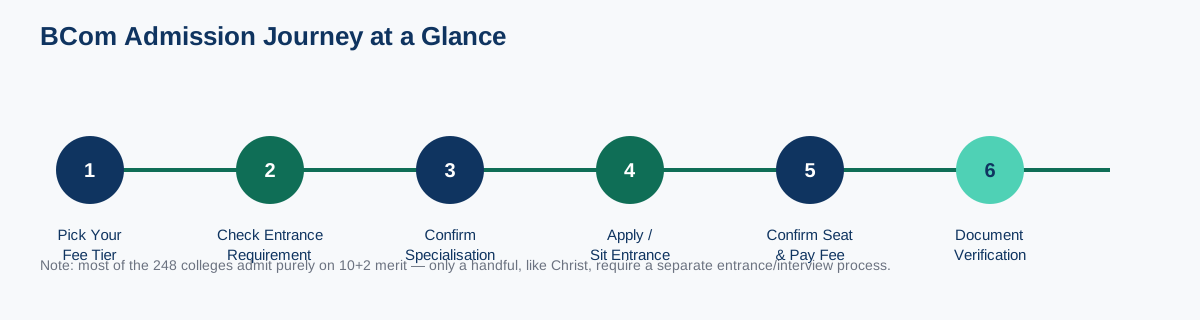
Before comparing individual colleges, be honest about which fee tier you're in: government (₹2,500-10,000/year), autonomous mid-range (₹1-2.5 lakh/year), or private premium (₹2.5-8 lakh/year). This single decision eliminates most of the 248 options immediately and makes the rest of your shortlisting far faster.
2. Check whether your target college requires an entrance test
Most of Bangalore's 248 BCom colleges admit purely on 10+2 merit – no separate test. Christ is the major exception, with its four-round selection process (entrance test, skill assessment, micro-presentation, interview). A handful of other private universities run their own shorter entrance or interview rounds. Confirm this early, since it changes your preparation timeline entirely.
3. Confirm the specific specialisation you want exists at that campus
"BCom" isn't one uniform product – General, Honours, Computer Applications, Business Analytics, Banking and Insurance, Taxation, and professional-certification-integrated tracks (CA/CMA/CPA-aligned) are all sold under the same "BCom" label but can differ enormously in curriculum and cost. Christ and Jain both offer certification-integrated tracks at a meaningfully higher fee than their general BCom; confirm you're comparing the same specific track across colleges, not a general BCom at one college against a specialised track at another.
4. Gather your documents early
10th and 12th mark sheets and certificates, transfer certificate, migration certificate, passport photographs, and category certificates if applicable – the same core set every college asks for. Government colleges may also require income certificates for fee-concession categories; check this specifically if you're applying to the ₹2,500-10,000/year tier.
5. Register for entrance tests or apply directly, per college
For Christ and similar entrance-based colleges, register and prepare separately – there's no shared commerce entrance exam across Bangalore's colleges the way KCET works for engineering. For merit-based colleges (the large majority), the "application" is often just submitting your 10+2 marksheet through the college's own portal.
6. Sit any required entrance test or interview round
If your shortlist includes Christ or another selective private university, budget real preparation time for this – the skill-assessment and interview rounds specifically screen for communication ability and commercial awareness, not just academic marks.
7. Track merit list releases and cutoff trends
Government and autonomous colleges publish merit lists in rounds; premium private universities publish results after their selection process concludes. Popular colleges' cutoffs shift year to year based on applicant volume – don't assume last year's published cutoff guarantees this year's seat.
8. Apply to a realistic spread across tiers
Given 248 real options, applying only to Christ, Jain, and two or three other premium names is a common and avoidable mistake. Include at least one autonomous mid-range college and one government college in your applications as a genuine backup, not an afterthought.
9. Confirm your seat within the college's window
Most colleges give a short confirmation window (often 5-10 days) after an offer, requiring an initial payment to hold the seat. Missing this typically forfeits the offer even if you intended to accept.
10. Submit original documents for physical verification
Every college on this list requires an in-person original-document check before finalising enrolment – photocopies and digital uploads alone don't complete admission.
11. Complete first-year fee payment
Government colleges are typically paid in full upfront given the low amounts involved; private universities in the lakh-plus range commonly offer instalment plans. Ask specifically about instalment options if the sticker price at a premium college is a stretch – most offer more flexibility than their published fee page suggests.
12. Sort out hostel or commute planning
Central-Bangalore campuses (SJCC on Brigade Road, Christ, Mount Carmel) favour day-scholars with a reasonable commute; Kristu Jayanti's Kothanur campus and some outer-Bangalore government colleges make hostel or PG accommodation a more serious consideration for outstation students. Factor this in before accepting a seat, not after.
13. Attend orientation and choose your specialisation track
Where a college offers multiple BCom tracks (General, Honours, Computer Applications, Business Analytics, certification-integrated), orientation is typically where you formally lock in your choice – research this in advance rather than deciding on the spot.
14. Register for your first semester and understand the exam pattern
Autonomous colleges (Christ, SJCC, Mount Carmel, Kristu Jayanti among them) run their own internal assessment and exam pattern rather than the affiliating university's standard structure, which often means more continuous assessment and fewer high-stakes single exams. Non-autonomous, affiliated colleges typically follow the university's semester exam pattern directly. Understanding which system your college uses in the first week saves considerable confusion later in the year.
What Comes After a BCom Degree
A BCom graduate's most common next step remains professional certification – CA, CMA, or CS, often started during the final year of the degree itself rather than after graduating, since several colleges on this list (Jain and Christ in particular) now build certification-prep directly into the BCom curriculum. An MCom is the direct academic continuation for students who want to stay in pure commerce academia or teaching, while an MBA remains the most common route for BCom graduates who want to pivot into a broader management career rather than staying purely in accounting or finance. A growing number of graduates also move into Business Analytics or Data Analytics postgraduate certifications specifically, reflecting how many BCom programmes on this list (NMKRV, Christ, Jain) now offer analytics-specific undergraduate tracks that make that transition a natural continuation rather than a cold start. For students specifically drawn to the technical side of finance, an MCA after a BCom Computer Applications specialisation is a less common but viable pivot, particularly for graduates who discover during their undergraduate years that they enjoyed the technical modules more than the pure accounting ones.
Career Paths and Jobs
Entry-level roles for BCom graduates in Bangalore typically fall under titles like accounts executive, junior auditor, financial analyst trainee, or business development associate, with starting packages that vary enormously by institution tier – commonly cited in the ₹3.5-7 lakh per annum range at the stronger-placement private colleges on this list, with median outcomes at more affordable institutions running lower, often in the ₹2.5-4 lakh band based on the placement data available. Sectors actively hiring BCom graduates in the city include banking and financial services, accounting and audit firms, BPO and shared-services centres, and increasingly, e-commerce and fintech companies building out finance and operations teams. Government sector recruitment, particularly through bank clerical and probationary officer exams, also remains a well-established path for BCom graduates from the more affordable colleges on this list, since these exams don't weight institutional brand the way private-sector campus placements do. What differentiates candidates at the entry level isn't the degree alone – proficiency in Tally and Excel, exposure to real accounting software, and at least one completed internship consistently separate BCom graduates who clear interview rounds quickly from those who don't, regardless of which of the 248 colleges they attended. Increasingly, basic familiarity with GST filing processes and at least one analytics tool (even at a beginner level) shows up as a screening filter at mid-size firms specifically, since many are digitising their finance functions and want graduates who won't need extensive retraining on tools the firm has already adopted.
Opportunities abroad for BCom graduates specifically tend to run through further study rather than direct placement – a master's in accounting, finance, or business analytics in the UK, Canada, or Australia is the common pathway, since a standalone Indian BCom rarely carries direct professional recognition overseas without a bridging qualification or further credential.
BCom vs. Related Degrees
A BBA is the closest adjacent option and the one families most often weigh against BCom – BBA leans toward management and business strategy broadly, while BCom stays grounded in accounting, taxation, and financial reporting specifically. Students who already know they want to become a Chartered Accountant should generally lean BCom, since it aligns more directly with CA's own syllabus; students who are unsure whether they want finance specifically versus a broader management career often find BBA the more flexible choice. A BCA is a completely different direction – computer applications rather than commerce – and only overlaps with BCom for the specific "BCom Computer Applications" specialisation track some colleges on this list offer. An integrated BCom-LLB, offered by a smaller number of institutions, suits students set on corporate law rather than pure accounting or general management.
Mistakes Applicants Keep Making
The most common mistake is applying almost exclusively to the handful of famous names (Christ, Jain, SJCC) without a realistic backup spread across tiers, given genuine competition for limited seats at these colleges. The second is not confirming which specific BCom specialisation a college's marketing material is actually describing – "BCom Honours" at one college and "BCom General" at another aren't the same product, and fee differences between them can be substantial even at the same institution. Third, students frequently underweight government and autonomous mid-range colleges purely on brand perception, when several (NMKRV, Maharani Lakshmi Ammanni) have solid, verifiable placement and academic track records at a fraction of the cost. Finally, don't assume every college's advertised "average package" reflects what a typical BCom graduate – as opposed to a BBA or BCA graduate from the same campus – actually earns; ask for BCom-specific placement data, not the institution's blended average across all its programmes. A sixth, subtler mistake: assuming autonomous status alone signals quality. Autonomy means a college sets its own curriculum and exam pattern, which can be a genuine advantage in a fast-moving field, but it says nothing on its own about NAAC grade, placement record, or faculty depth – always check those three separately rather than treating "autonomous" as a quality shortcut. A seventh: overlooking the affiliating university itself as a factor. Bangalore University and Bengaluru City University (which split from BU in 2017) have somewhat different examination calendars and syllabus update cycles, and a college's affiliation can occasionally affect semester scheduling in ways that matter if you're also juggling a professional certification exam calendar alongside your degree.
How We Help
With 248 real BCom options in Bangalore alone, narrowing this down to a shortlist that actually fits your marks, budget, and career direction is exactly the kind of decision we help Karnataka students work through every admission cycle. We help you get the best admission to your preferred colleges without hassle. For personalised guidance comparing real fee and placement data across these institutions, WhatsApp us at +91 6363 330 233.
About This Guide
OneCity Technologies Pvt. Ltd began in 2006 publishing an annual print education directory for Karnataka students and parents. As demand grew, OneCity launched an education portal in 2019 to bring that same directory information online, and in 2025 relaunched as CollegesInfo.org – a comprehensive Karnataka college directory covering 1,500+ institutions across engineering, medical, management, arts, commerce, and more. Founder L K Monu Borkala brings 20+ years of business experience and 19 years of work across various education-sector services. CollegesInfo.org's content is built from publicly available KEA, NMC, AICTE, and university data, cross-checked against official sources wherever possible. CollegesInfo.org's admission assistance service helps students secure admission to colleges they are eligible for under that college's actual published criteria. We help you get the best admission to your preferred colleges without hassle.
About the Author
L K Monu Borkala is the Founder of OneCity Technologies Pvt Ltd and CollegesInfo.org, with over two decades of business experience and 19 years working across Karnataka's education sector.
Frequently Asked Questions
How many BCom colleges are actually there in Bangalore?
248 colleges offer a BCom degree in Bangalore – 19 government and 221 private. This guide profiles the 20 most worth comparing in depth rather than listing all 248.
What's the fee difference between government and private BCom colleges in Bangalore?
Government colleges typically charge ₹2,500-10,000 per year, while private universities range from roughly ₹1.3 lakh to ₹8 lakh per year depending on the institution and specialisation. Autonomous mid-range colleges generally fall between these two extremes.
Is Christ University's BCom worth the higher fee compared to other options?
It depends on what you're optimising for. Christ's selective four-round admission process and industry-integrated tracks carry real brand weight in campus placements, but several more affordable colleges on this list (NMKRV, Mount Carmel) also show genuine, verifiable placement outcomes at a fraction of the cost – the "worth it" answer depends on your specific budget and career priorities.
Do I need to be from a Commerce background in 12th grade to apply for BCom?
Most colleges prefer but don't strictly require a Commerce stream background; some accept Science or Arts stream students, particularly at less selective institutions. Always confirm the specific eligibility criteria on the individual college's admission page, since this varies.
What's the difference between St. Joseph's College of Commerce and St. Joseph's University?
They are two separate, independently accredited institutions under the same Jesuit trust – the commerce college split off and became independent in 1972, while St. Joseph's University (formerly St. Joseph's College) is a separate campus offering a broader range of programmes. Don't assume they're interchangeable when researching either one.
Can I switch from BCom to an MBA later even without work experience?
Yes – many Indian MBA programmes accept fresh BCom graduates directly, though some competitive programmes and most international MBAs prefer or require a few years of work experience first. Check the specific programme's eligibility rather than assuming either path is universally required.
Which BCom specialisation has the best job prospects right now?
Business Analytics and Computer Applications specialisations are seeing the fastest-growing demand alongside traditional Accounting and Finance tracks, reflecting broader hiring trends toward data-literate finance graduates. That said, a well-placed General BCom from a strong-placement college often outperforms a niche specialisation from a weaker one – the institution's placement record matters as much as the specialisation name.
How do I compare placement data fairly across these colleges?
Ask each shortlisted college for placement figures specific to their BCom cohort, not a blended average across BBA, BCA, and other UG programmes on the same campus – a college's overall placement brand can significantly overstate or understate what a BCom graduate specifically should expect.
Are there BCom colleges in Bangalore with hostel facilities for outstation students?
Yes, though it varies by college and gender – several of the women's colleges on this list (NMKRV, Mount Carmel, Maharani Lakshmi Ammanni) offer on-campus or nearby hostel arrangements, while coed private universities like Christ and Jain typically have larger, more established hostel infrastructure given their scale. Confirm hostel availability and cost directly with the specific college rather than assuming it's included in the standard fee structure, since it usually isn't.
Is an autonomous BCom college's degree recognised the same way as an affiliated one?
Yes – autonomous colleges still award degrees through their affiliating university (Bangalore University or Bengaluru City University, depending on the college), so the degree's recognition is identical. What differs is the curriculum and exam pattern, which the autonomous college designs itself rather than following the university's standard syllabus.