A bachelor degree of science — commonly called BSc — is a 3-year undergraduate programme regulated by the UGC, covering pure and applied sciences from physics and mathematics to data science and biotechnology. Karnataka alone has 289 BSc colleges, with government institutions charging ₹5,000–₹20,000 per year and private universities reaching ₹2 lakh. Graduates earn ₹2.5–6 LPA at entry level, with data science and computer science specializations pushing past ₹15 LPA within five years.
What a BSc Degree Actually Is — And Who Benefits Most
BSc stands for Bachelor of Science. The degree runs six semesters over three years under the Choice-Based Credit System (CBCS), though the National Education Policy 2020 introduced a four-year honours track with a research component at select universities. Both formats are UGC-recognised.
The programme sits between a purely theoretical arts degree and the application-heavy engineering route. Students who chose PCMB or PCMC in their 10+2 have the widest range of bachelor of science courses open to them, but several specializations — psychology, environmental science, computer science — accept commerce-stream students with mathematics.
Three groups benefit the most from a BSc. First, students aiming at government competitive exams: UPSC, KPSC, and SSC CGL all accept BSc graduates, and the structured science curriculum builds the analytical rigour these exams test. Second, anyone planning a research or teaching career — BSc is the mandatory foundation before MSc, UGC NET, and doctoral programmes. Third, students who want science exposure without the four-year commitment or ₹4–10 lakh fee burden of a BTech.
Karnataka's 289 BSc colleges span government first-grade colleges in every district, aided private institutions run by religious trusts and education societies, and deemed universities like Christ and Jain that set their own syllabi and admission processes. The state's affiliating universities — Bangalore, Mysore, Mangalore, Karnataka (Dharwad), Gulbarga, and VSKU — each control the curriculum and exams for their affiliated colleges.
If you are deciding between degree colleges after PUC, the specialization you pick matters more than the college brand for most BSc career paths — with a few exceptions noted below.
12 BSc Specializations and What Each One Leads To
Not every BSc is the same degree in practice. A BSc in Data Science and a BSc in Chemistry share a title but diverge entirely in curriculum, fees, and earning potential. Here are the 12 specializations Karnataka colleges commonly offer, with what each prepares you for.
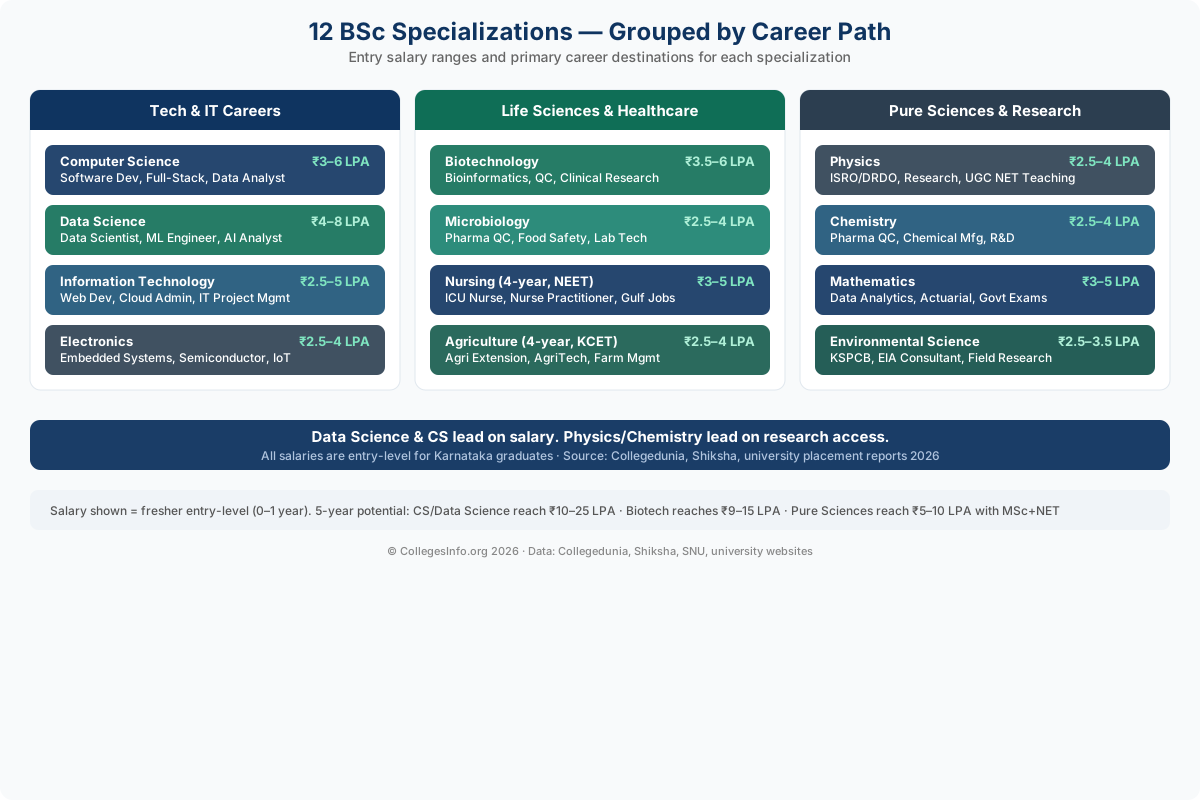
1. Physics — Covers classical mechanics, quantum physics, electrodynamics, and mathematical physics. Leads to MSc Physics, ISRO/DRDO research roles, or UGC NET for teaching. Entry salary in research assistant roles: ₹2.5–4 LPA.
2. Chemistry — Organic, inorganic, and physical chemistry with lab-heavy semesters. Feeds into pharmaceutical QC, chemical manufacturing, and MSc/PhD research. Entry salary: ₹2.5–4 LPA. Bangalore's pharma corridor (Biocon, Strides) recruits from Bangalore University-affiliated colleges.
3. Mathematics — Pure and applied math, statistics, and numerical methods. The most versatile feeder into competitive exams, actuarial science, and data analytics. Entry salary varies wildly by exit route: ₹3–5 LPA in analytics, ₹4.5–6 LPA through SSC CGL.
4. Computer Science — Programming (C, Java, Python), data structures, DBMS, and networking. The highest-demand BSc specialization. Freshers earn ₹3–6 LPA; with 3–5 years, ₹10–20 LPA is documented at mid-tier IT firms. BSc Data Science colleges in Bangalore offer a newer, more focused variant.
5. IT (Information Technology) — Overlaps with CS but adds web technologies, cloud computing, and IT project management. Similar career trajectory to CS, slightly lower starting salary at ₹2.5–5 LPA because fewer colleges have NAAC-accredited IT programmes.
6. Data Science — A post-2020 specialization covering Python, R, machine learning, and statistical modelling. Premium fees (₹80,000–₹1.5 lakh/year at private colleges) but premium outcomes: ₹4–8 LPA at entry, ₹12–25 LPA at the five-year mark. Offered by Christ University, Jain University, and select Bangalore institutions.
7. Biotechnology — Genetics, molecular biology, immunology, and bioinformatics. Bangalore is India's biotech capital, with Biocon, Syngene, and Strand Life Sciences hiring directly from Karnataka's BSc Biotechnology colleges. Entry salary: ₹3.5–6 LPA. Mid-level bioinformatics analysts reach ₹12–15 LPA.
8. Microbiology — Bacteriology, virology, food microbiology. Leads to QC roles in pharma and food processing. Narrower job market than biotech but steady demand. Entry salary: ₹2.5–4 LPA.
9. Electronics — Analog/digital circuits, microprocessors, embedded systems. Graduates compete for the same IT and semiconductor roles as BTech ECE holders, at lower entry salaries (₹2.5–4 LPA) but also lower education cost.
10. Environmental Science — Ecology, pollution control, environmental impact assessment. Government regulatory bodies (KSPCB, CPCB) and environmental consultancies hire BSc holders for field and lab roles. Entry salary: ₹2.5–3.5 LPA.
11. Agriculture — Soil science, crop production, horticulture, agricultural economics. A four-year programme at UAS Bangalore, UAS Dharwad, and affiliated agriculture colleges. KCET-based admission. Entry salary: ₹2.5–4 LPA in agri-extension; ₹4–7 LPA at agri-tech startups.
12. Nursing — A four-year professional BSc requiring NEET qualification. BSc Nursing colleges in Karnataka are regulated by the Indian Nursing Council, with government seats at ₹15,000–₹30,000/year and private seats reaching ₹1.5 lakh. Entry salary: ₹3–5 LPA in hospitals; ₹5–8 LPA in Gulf countries.
3 BSc Admission Routes in Karnataka
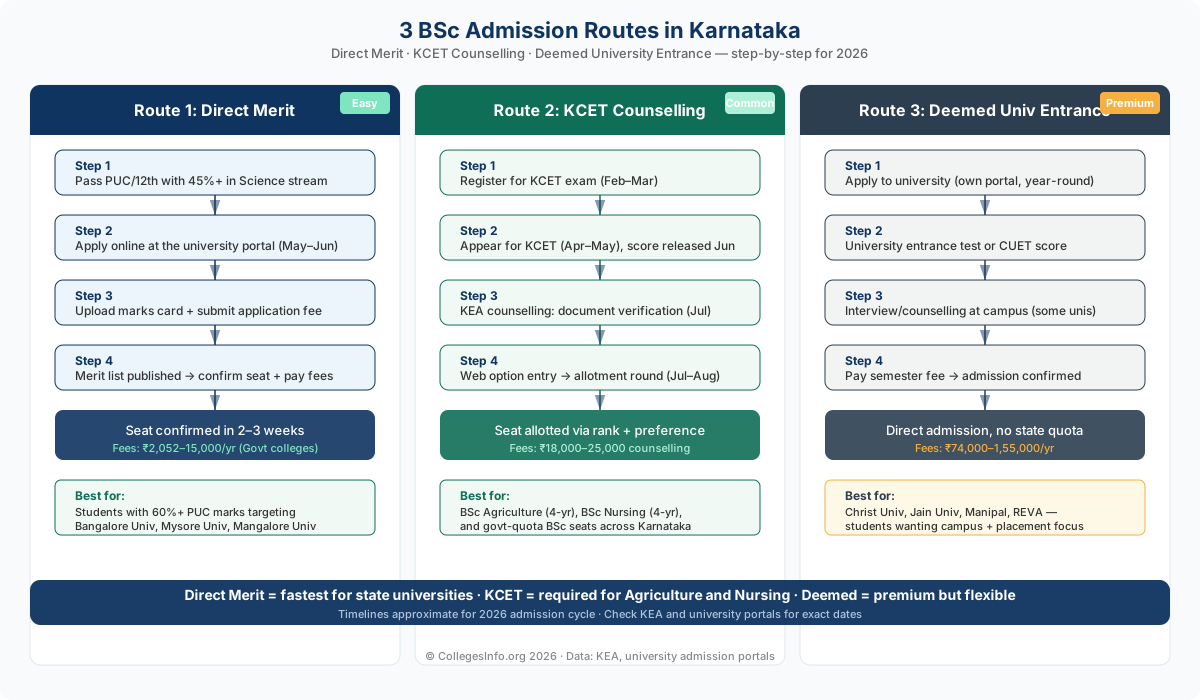
Unlike engineering (KCET single-window counselling) or medical (NEET), BSc admissions in Karnataka have no unified system. Three distinct routes operate simultaneously.
Route 1 — Direct Merit at State University Colleges
The route 80% of Karnataka BSc students use. Pass PUC/12th in science with 45–55% aggregate (varies by university and category), walk into the college with your marks card, and get a seat based on merit. No entrance test. Government and aided colleges fill most seats this way between June and July.
Documents required: PUC marks card, SSLC marks card, transfer certificate, caste/income certificate (if applicable), Aadhaar, four passport-size photos.
Fee: ₹2,052–₹5,000 per year at government colleges. Aided private colleges charge ₹5,000–₹15,000.
Route 2 — KCET for Select BSc Programmes
KCET covers a small number of BSc seats — primarily BSc Agriculture (at UAS campuses) and BSc Nursing. Most pure-science BSc programmes are not part of KEA counselling. Students who appeared for KCET should check whether their target specialization is covered before assuming KCET scores apply.
Route 3 — University-Specific Entrance for Deemed Universities
Christ University runs its own entrance (not to be confused with NTA's CUET), Jain University conducts JET, and Kristu Jayanti has its own aptitude test. These involve online applications (₹500–₹1,000 fee), an aptitude test, and often a personal interview. Registration opens January–March, with admissions confirmed by May. Fees range from ₹74,000 to ₹1.55 lakh per year.
5 BSc Fee Bands — Government to Deemed University
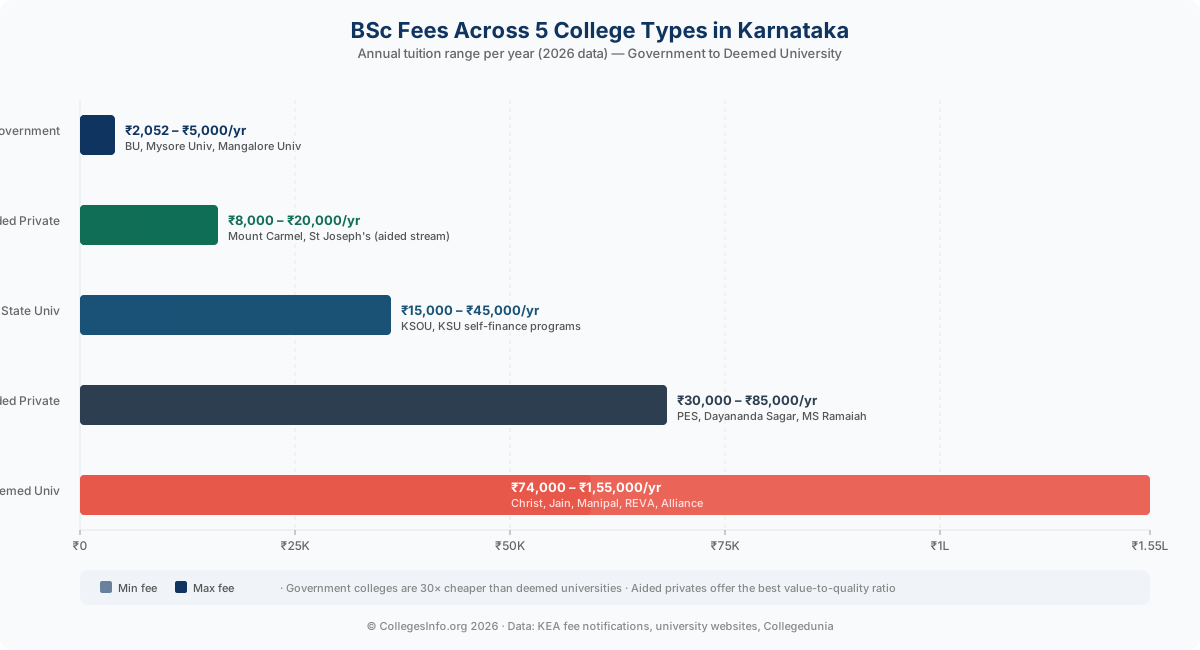
The cost of a BSc in Karnataka spans a 40x range. A government college student spends less on the entire three-year degree than one semester at a deemed university.
| College Type | Annual Fee Range | 3-Year Total | Example Institution |
|---|---|---|---|
| Government | ₹2,052–₹5,000 | ₹6,156–₹15,000 | Govt First Grade College, Bangalore |
| Government Autonomous (IISc) | ~₹19,000 | ~₹57,000 | Indian Institute of Science |
| Aided Private | ₹5,000–₹15,000 | ₹15,000–₹45,000 | St Aloysius College, Mangalore |
| Private Unaided | ₹30,000–₹2,00,000 | ₹90,000–₹6,00,000 | MS Ramaiah, Garden City University |
| Deemed University | ₹74,000–₹1,55,000 | ₹2,22,000–₹4,65,000 | Christ University, Jain University |
| Online/Distance (UGC-DEB) | ₹15,000–₹60,000 | ₹45,000–₹1,80,000 | IGNOU, Mysore University ODL |
Source: Collegedunia, CollegeDekho, university websites (September 2026)
What the fee does and doesn't include: Government college fees cover tuition, library, and exam charges — nothing else. Hostel, mess, and transport add ₹20,000–₹50,000 per year at government hostels. Private university fees typically bundle tuition, lab access, and some infrastructure charges, but hostel remains separate at ₹60,000–₹1,50,000 per year.
The real differentiator isn't the degree title. Both a ₹6,156 government BSc and a ₹4,65,000 deemed-university BSc read "Bachelor of Science" on the certificate. What differs is lab infrastructure, placement cell activity, peer cohort, and exposure to industry. For students targeting career paths after BSc in research or government exams, the fee premium of a private university rarely justifies itself. For placement-dependent paths like data science or biotech, the college's recruiter network matters — Christ University's highest BSc placement reached ₹12 LPA in 2025, compared to ₹3–4 LPA at most government colleges.
BSc vs BCA vs BTech — 7 Differences That Decide Your Path
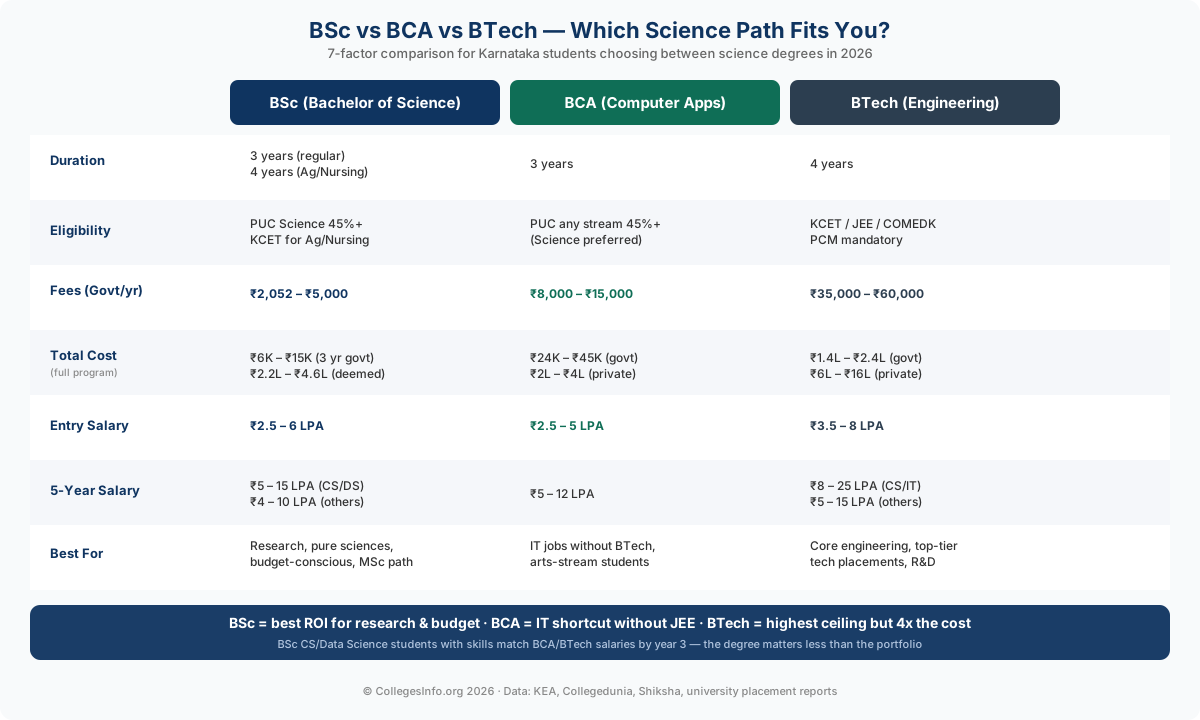
Students who picked science in 10+2 face a three-way fork. Each degree serves a different career logic.
| Factor | BSc | BCA | BTech |
|---|---|---|---|
| Duration | 3 years (4 with honours) | 3 years | 4 years |
| Eligibility | 10+2 Science (PCM/PCB) | 10+2 any stream with Maths | 10+2 PCM + KCET/JEE |
| Annual Fees (Karnataka) | ₹2,052–₹2,00,000 | ₹30,000–₹1,80,000 | ₹35,000–₹3,00,000 |
| Entrance Exam | Usually none | Usually none | KCET, JEE, COMEDK |
| Career Focus | Research, teaching, govt exams | Software development, IT | Engineering roles, core + IT |
| Fresher Salary (Median) | ₹2.5–5 LPA | ₹3–5 LPA | ₹3.5–8 LPA |
| Best For | Research, govt exams, cost-conscious | IT career without 4-yr commitment | Engineering-specific roles |
The honest assessment. BTech commands the highest average starting salary because of structured campus placements and the engineering brand. BCA and BSc CS graduates compete for many of the same IT jobs, but BSc CS holders need to demonstrate coding skills independently since fewer BSc colleges have active placement cells. BSc in non-CS specializations (physics, chemistry, biology) leads primarily to higher studies or government exams — choosing the best career option after 12th means understanding this distinction before enrolling.
For students who want software careers but cannot afford or qualify for BTech, BSc CS at a well-placed college (Christ, Jain, MCC Bangalore) delivers comparable outcomes at 60–70% of the cost. For those interested in engineering colleges in Bangalore, BTech remains the conventional route.

Career Scope and Salary After BSc — By Specialization
The question every BSc candidate asks — "what will I earn?" — has no single answer. It depends almost entirely on which specialization and which exit route.
6 BSc Specializations Ranked by 5-Year Earning Potential
| Specialization | Fresher Salary | 5-Year Salary | Top Exit Route | Top Karnataka Recruiter |
|---|---|---|---|---|
| Data Science | ₹4–8 LPA | ₹12–25 LPA | Data Scientist, ML Engineer | Flipkart, Mu Sigma, Accenture |
| Computer Science | ₹3–6 LPA | ₹10–20 LPA | Software Developer, Full-Stack | Infosys, Wipro, TCS |
| Biotechnology | ₹3.5–6 LPA | ₹9–15 LPA | Bioinformatics Analyst, QC Lead | Biocon, Syngene, Strand Life Sciences |
| Nursing | ₹3–5 LPA | ₹6–12 LPA | ICU Nurse, Nurse Practitioner | Manipal Hospitals, Narayana Health |
| Mathematics | ₹3–5 LPA | ₹6–12 LPA | Data Analyst, Actuarial Associate | Analytics firms, insurance cos |
| Physics/Chemistry | ₹2.5–4 LPA | ₹5–10 LPA | Researcher, Lab Manager, Lecturer | ISRO, DRDO, university labs |
Sources: Collegedunia salary data, Shiksha placement reports, SNU Biotechnology salary study (2026)
4 Higher-Study Paths That Multiply BSc Earnings
1. MSc + UGC NET — Required for university teaching. NET-qualified lecturers earn ₹57,700–₹1,82,200 per month under 7th CPC. Two-year investment.
2. MBA — BSc graduates who clear CAT/PGCET and enter a top MBA programme can expect ₹8–18 LPA. Three-year total investment (BSc) + two years = five years to MBA placement.
3. MCA — Open to BSc graduates with mathematics. Salary trajectory similar to BTech CS after MCA: ₹4–8 LPA at entry. Courses after BSc cover this route in detail.
4. GATE/JAM — For MSc/MTech admission at IITs and IISc. BSc Physics and Chemistry graduates with JAM scores get into IISc Bangalore's integrated PhD programme — among the most prestigious science research pathways in India.
Government Exam Routes for BSc Graduates
BSc qualifies you for Group A through Group C government positions:
- UPSC Civil Services — BSc graduates can choose science optionals; IAS/IPS starting salary: ₹56,100/month
- KPSC FDA/SDA — State-level Group B/C positions, starting at ₹27,650/month
- SSC CGL — Central government positions; BSc holders eligible for Inspector, Auditor, Tax Assistant roles at ₹44,900–₹1,42,400/month
- Banking (IBPS PO/Clerk) — BSc qualifies; starting ₹36,000–₹63,840/month

Frequently Asked Questions About BSc Degree
Is BSc a good degree for career growth in India?
BSc delivers strong career growth when paired with the right specialization and exit route. BSc CS and Data Science graduates in Bangalore earn ₹10–20 LPA within five years — comparable to many BTech holders. For non-CS specializations, growth depends on higher studies (MSc, MBA) or government exam success. The degree itself is a foundation, not a terminal qualification for most science careers.
What is the BSc full form and duration?
BSc stands for Bachelor of Science. The standard programme runs 3 years (6 semesters) under the CBCS framework. Under NEP 2020, a 4-year BSc Honours with a research component is available at select universities, with exit options at the end of year 1 (certificate), year 2 (diploma), or year 3 (regular degree).
Can commerce students join BSc?
Yes, for certain specializations. BSc Computer Science, BSc IT, BSc Psychology, and BSc Environmental Science at many universities accept 10+2 commerce students who studied mathematics. BSc Physics, Chemistry, and Biology typically require a science-stream 10+2.
What is the difference between BSc and BSc Honours?
BSc is a 3-year general degree with breadth across three subjects. BSc Honours is a 3- or 4-year programme with deep focus on one subject, additional papers, and often a research project or dissertation in the final year. Honours degrees are preferred for MSc admission at competitive universities.
Which BSc specialization has the highest salary?
BSc Data Science currently commands the highest entry salary (₹4–8 LPA) and the fastest growth trajectory (₹12–25 LPA at 5 years). BSc Computer Science follows closely. Among non-tech specializations, BSc Nursing offers the best returns when factoring in international placement opportunities.
Are BSc graduates eligible for government jobs?
Yes. BSc qualifies for UPSC, KPSC, SSC CGL, IBPS, and RBI exams. Several Group B and Group C positions specifically require or prefer science graduates — Inspector (Central Excise), Statistical Investigator, and Assistant Audit Officer are BSc-preferred roles in SSC CGL.
Is online BSc valid for government jobs?
Only if the university holds UGC-DEB (Distance Education Bureau) recognition. IGNOU, Mysore University's distance wing, and a handful of state open universities are approved. Verify at ugc.gov.in/deb before enrolling — online bachelor's degree options should always be cross-checked against the UGC-DEB list.
Need help choosing the right BSc college in Karnataka?
CollegesInfo.org's admission assistance team can help you find the right BSc programme based on your 10+2 marks, budget, and career goals. Chat with us on WhatsApp — we help you get the best admission to your preferred colleges without hassle.
This article is for informational purposes only. Consult the college directly before making admission decisions.