Written by L K Monu Borkala, Founder & Chief Strategist
The two-year PGP at the Indian Institute of Management Bangalore costs ₹26,00,000 in tuition for the 2026-28 batch, excluding taxes, as per IIMB’s fee page read on 13 October 2026. Entry runs through CAT, then a written ability test and interview. The General-category cut-offs are 80, 75, 75 and 85 percentile across VARC, DILR, QA and overall.
Of the 540 students admitted to IIMB’s PGP in 2026, 229 were women and 311 were men, according to the institute’s own class profile. A high CAT score gets you shortlisted and little more. At the final stage, the interview and the written test carry 50 of 100 points, and CAT carries 25. This guide reads IIMB’s published documents line by line: fees, aid, the scoring sheet, placements, and the routes worth taking if the call does not come. People searching for IIM MBA colleges in Bangalore are really asking about one campus.
The programmes at a glance
IIMB runs far more than the flagship MBA. Its admissions page lists a PhD, the PGP, the PGPBA (business analytics, 77 students in 2026), the EPGP, the PGPEM, a 14-month hybrid PGPPM, a four-year BSc Honours in Economics and Data Sciences, and a one-year pre-doctoral programme. Three of those matter to most MBA aspirants.
| Programme | Length and mode | 2026 intake | Tuition |
|---|---|---|---|
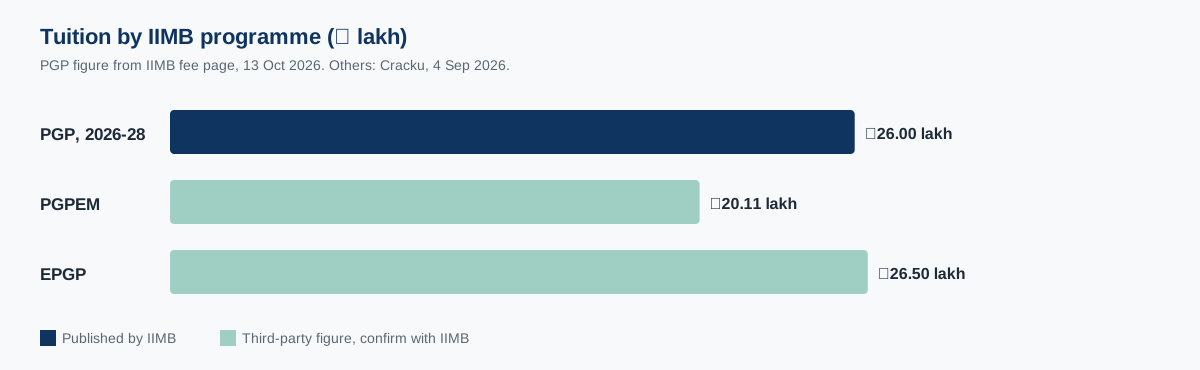
| PGP | 2 years, full-time, residential | 540 | ₹26,00,000 for 2026-28 (IIMB fee page, 13 Oct 2026) |
| PGPEM | 2 years, weekend classes on campus | 79 | ₹20,11,000 (Cracku, 4 Sep 2026) |
| EPGP | 1 year, full-time, 5+ years of work experience by 31 March 2027 | 74 | ₹26,50,000 (Cracku, 4 Sep 2026) |
Intake figures come from IIMB’s class profile pages, read on 13 October 2026. The EPGP count appears as 74 on one page and 75 in a news item.
What is the PGP, and how is it built?
The PGP is IIMB’s two-year, full-time, residential MBA-style programme, split into six trimesters with a summer project between the years. First year covers three terms and 51 credits of core courses. Second year is electives, 45 to 51 credits, allotted through a bidding system where students spend points on the courses they want.
There are no formal specialisations. IIMB groups electives under functional areas such as Decision Sciences, Finance and Accounting, and Marketing, and a student’s transcript simply shows what they bid for and won. If the specialisation question is on your mind, how MBA specialisations differ elsewhere is worth a read before you assume a track exists.
The summer internship is optional for students with at least 34 months of work experience.
Which programme fits a working professional?
Two routes exist, and they are not interchangeable. The EPGP is a one-year full-time programme for people with at least five years of experience before 31 March 2027. It asks for a GMAT or GRE score, sets no minimum, and does not consider CAT at all. For the 2026-27 batch, Round 1 applications ran from 15 June to 17 August 2026 and Round 2 from 19 August to 25 November 2026, with interviews on 5-6 September and 12-13 December 2026.
IIM Bangalore executive MBA fees are the number most people get wrong. Cracku’s fee page (4 September 2026) puts EPGP tuition at ₹26,50,000. Collegedunia (24 June 2026), citing iimb.ac.in, gives a total of ₹33,68,000 with hostel and ₹32,20,000 without, and that total includes a refundable deposit of ₹25,000 or ₹20,000. The gap is the immersion cost of ₹5,50,000, hostel at ₹80,000 and mess at ₹63,000. Read both before comparing the EPGP to anything.
The PGPEM is the weekend option, with a continuation fee of ₹25,000 per quarter beyond eight quarters. IIMB’s own pages disagree with each other on it: the body text asks for six years of experience, the meta description says four, and the programme page lists GMAT, CAT, GRE or an IIMB test while the admissions page says GMAT and GRE are not applicable for 2027. Confirm with the admissions office before you plan around either version. For professionals weighing a part-time degree instead, online MBA options for working professionals are a different tier of commitment altogether.
Indian Institute of Management Bangalore fees for the 2026-28 batch
The headline number is ₹26,00,000 for the two years of the PGP, for the 2026-28 domestic batch, excluding service tax and other taxes. IIMB’s fee page, read on 13 October 2026, does not print a combined total, and I found no PGP fee for the 2027 intake on the pages I read. Treat ₹26 lakh as the floor of what you will spend, not the sum.
| Item | Amount | Note (IIMB fee page, 13 Oct 2026) |
|---|---|---|
| PGP tuition, 2 years | ₹26,00,000 | 2026-28 domestic batch, excluding taxes |
| Caution deposit | ₹30,000 | One time |
| Mess advance | ₹30,000 per term | Charged separately from tuition |
Cracku’s 4 September 2026 estimate of about ₹27.5 lakh all-in assumes mess advance in four terms. The PGP runs six trimesters, so if the advance applies every term the same arithmetic gives ₹28.1 lakh. That is my calculation from IIMB’s per-term figure, not a number IIMB publishes, and it still excludes taxes.
What does the ₹26 lakh leave out?
Taxes, the caution deposit and the mess advance, as the table shows. Travel, books and personal spending are not on IIMB’s page at all and will vary by student. Budget a buffer of your own rather than trusting any all-in figure from an aggregator, because the aggregators themselves disagree by lakhs. If a loan is part of the plan, education loan basics for Karnataka students explains how banks treat a fee of this size.
Which scholarships and aid does IIMB list?
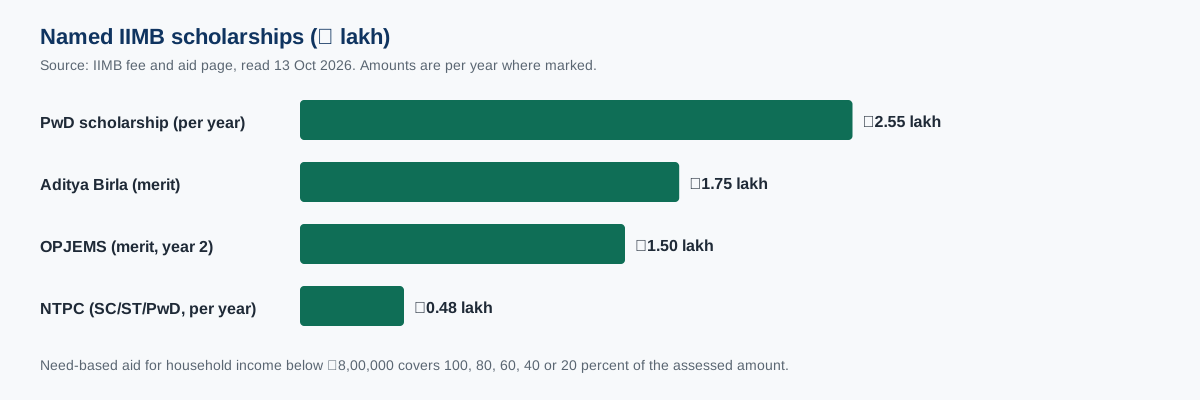
Need-based aid applies to households with income below ₹8,00,000, and it covers 100, 80, 60, 40 or 20 percent of the assessed amount. Named scholarships on IIMB’s page are smaller and more targeted.
| Scholarship | Amount | Who it is for |
|---|---|---|
| Aditya Birla | ₹1.75 lakh | Merit, years 1 and 2 |
| OPJEMS | ₹1.50 lakh | Merit, year 2 |
| NTPC | ₹48,000 per year | SC, ST and PwD students, year 2 |
| PwD scholarship (Ministry of Social Justice and Empowerment) | ₹2,55,000 per year | PwD students, means-based |
| Employment in Social Sector | One-third of fees reimbursed at the end of each of the first three years | As listed by IIMB |
SC and ST ministry scholarships cover tuition for eligible students, as IIMB’s fee page states.
How admission to the PGP works
IIMB’s PGP admissions-process document for the 2027 intake is a short PDF, and it answers most of what coaching sites charge to explain. The process has two stages. Stage I is a CAT-based shortlist. Stage II adds a personal interview and a written ability test. The document I read lists no application dates and no application fee, so check IIMB’s admissions page before you plan a timeline.
3 Eligibility Rules in IIMB’s 2027 Admissions Document
- A bachelor’s degree with at least 50% marks (45% for SC, ST and PwD candidates), or a completed CA, CS or ICWA qualification.
- Final-year students may apply, with a bonafide certificate from their institution.
- CAT is required, and it is the only entrance test the document names. No minimum work experience is listed, so freshers are eligible on paper.
What are the CAT cut-offs for shortlisting?
Stage I requires a positive raw score in every CAT section. On top of that sit percentile cut-offs, set using CAT 2025 for the 2026-28 batch. The first shortlist of the new cycle uses CAT 2026.
| Category | VARC | DILR | QA | Aggregate |
|---|---|---|---|---|
| General | 80 | 75 | 75 | 85 |
| NC-OBC and EWS | 70 | 65 | 65 | 75 |
| SC | 65 | 60 | 60 | 70 |
| ST | 55 | 55 | 55 | 65 |
| PwD | 50 | 50 | 50 | 60 |
Source: IIMB PGP admissions-process document for 2027, read 13 October 2026. These are percentiles from CAT 2025 and will move with each cycle.
Notice what is absent. There is no 99-percentile condition anywhere in the table, even though coaching material often implies one. A General candidate at 85 overall with 80 in verbal clears Stage I. Clearing it means you enter the scoring pool, nothing more.
How are applicants scored?
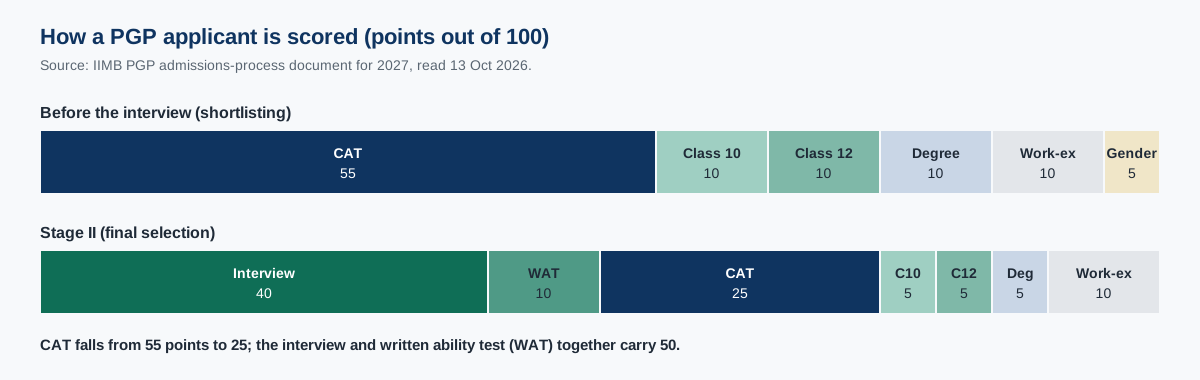
Points are out of 100 at both stages, but the weights change sharply once the interview is added.
| Component | Pre-interview shortlist | Stage II (final) |
|---|---|---|
| CAT | 55 (VARC 19, DILR 21, QA 15) | 25 (VARC 8.75, DILR 10, QA 6.25) |
| Personal interview | none | 40 |
| Written ability test | none | 10 |
| Class 10 board | 10 | 5 |
| Class 12 board | 10 | 5 |
| Bachelor’s degree | 10 | 5 |
| Work experience or professional course | 10 | 10 |
| Gender diversity | 5 | not used |
Source: IIMB PGP admissions-process document for 2027, read 13 October 2026.
Two things follow from this sheet. Academics carry 30 points before the interview, so a weak Class 10 or 12 result costs shortlisting points that a CAT percentile cannot always repay. And once the interview happens, CAT drops from 55 points to 25, while the interview and written test together carry 50. A candidate who is shortlisted with a middling profile and interviews well can finish ahead of a higher CAT scorer who does not.
The top ten applicants by CAT, adjusted bachelor’s score and professional score qualify for the interview automatically. The written ability test runs about 30 minutes, on the same day and at the same location as the interview.
Why does the same percentile end differently?
Work experience is the least visible lever. Before the interview, it is scored as 10 × x / 36 for x months under 36, and a flat 10 for 36 months or more, with months counted to July 2026 and internships excluded. A candidate with 18 months gets 5 points; one with 60 months gets the same 10 as someone with 36.
After the interview, the 10 points are scaled down to 5 and multiplied by the average quality-of-experience score from the panel. Each panel member rates the experience 0.25, 0.5, 1, 1.5 or 2. So a longer career stops earning points at 36 months, and after that only the panel’s reading of its quality moves your score. Two applicants with identical CAT results and identical tenure can land on different sides of the line for this reason alone.
Run the numbers once. After the interview, work experience can contribute anywhere from 1.25 points (5 × 0.25) to 10 points (5 × 2). That arithmetic is mine, built from IIMB’s published formula, not a figure IIMB states, but it shows the spread: a panel that rates your experience at the bottom of its scale takes nearly nine points off a candidate whose tenure looked identical on paper. That swing of 8.75 points is almost as large as Class 12 and the bachelor’s degree combined at that stage, which carry 10. Prepare to talk about what you actually did in your job, with outcomes, because that conversation is scored.
What happens on interview day?
The written ability test and the personal interview happen back to back at one location. Prepare for the test as a 30-minute timed exercise and for the interview as the stage that carries 40 points on its own. The shortlisting arithmetic is over by then; what remains is the panel’s judgement, including the experience rating described above. For help with the paperwork and planning side, how our admission assistance works lays out what we do and what we do not.
Placements: what IIMB publishes and what it leaves out
IIMB’s release dated 20 March 2026 covers the Class of 2024-26 (PGP and PGPBA). It reports 664 offers from 177 firms, with 596 students appearing for placement. By share, consulting took 45%, technology and product management 15%, and investment banking 11%. Its digest headline calls these “Final & Lateral Placements”, so the 664 combines two kinds of offers.
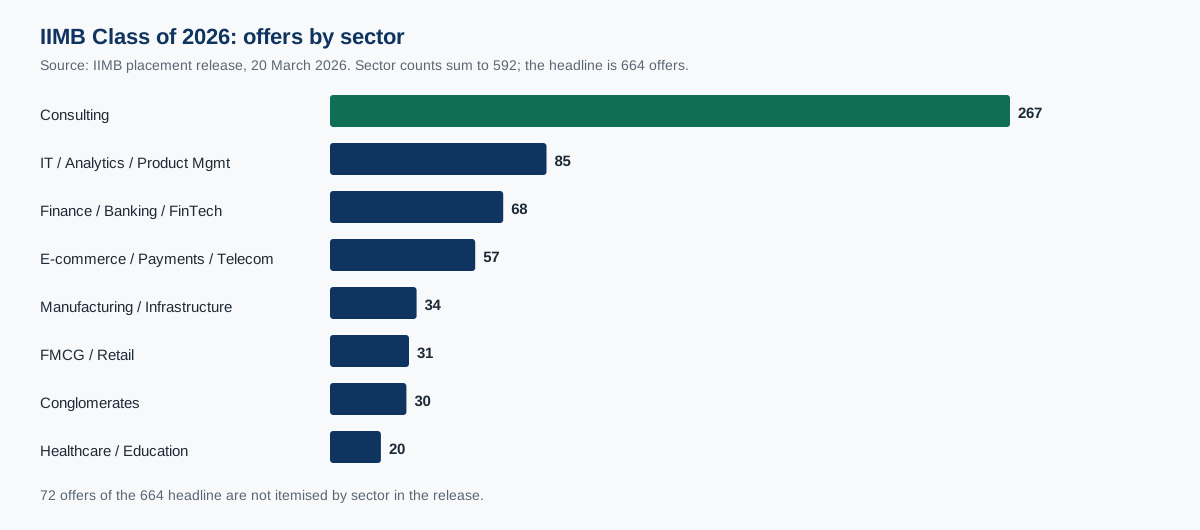
Here is the discrepancy most write-ups skip. IIMB’s own sector counts add up to 592, not 664: Consulting 267, IT/Analytics/Product Management 85, Finance/Banking/Investments/FinTech 68, E-commerce/Payments/Telecom/Logistics 57, Manufacturing/Construction/Energy/Infrastructure 34, FMCG/Retail 31, Conglomerates 30, and Healthcare/Education 20. The 72 offers in between are not itemised in the release. Offers are also not students: 664 offers against 596 students appearing works out to about 1.1 offers per student, but the headline includes lateral placements, so the ratio cannot be read as a per-student average. Ask IIMB’s placement office for the final-placement-only count before quoting any percentage of the batch placed.
Who recruited the Class of 2026?
| Recruiter | Offers |
|---|---|
| Accenture | 101 |
| BCG | 29 |
| Bain & Company | 23 |
| EY-Parthenon | 23 |
| American Express | 15 |
| Kearney | 13 |
| TCS | 11 |
Source: IIMB placement release, 20 March 2026, read 13 October 2026.
Accenture alone accounts for 101 offers, about 15% of the 664 headline. Anyone reading “consulting 45%” as a pipeline of pure strategy roles should check how much of that is a single large employer. For a method to do this on any college, see reading a placement record without being misled.
What do the salary figures look like?
IIMB’s release carries no average, median or highest pay. The figures below come from Careers360, updated 13 October 2026, and I could not match them to an IIMB document. Cracku’s 29 July 2025 post independently reports the same 2025 numbers.
| Year | Average CTC | Median CTC |
|---|---|---|
| 2026 | ₹35.35 lakh | ₹34.75 lakh |
| 2025 | ₹34.88 lakh | ₹32.61 lakh |
| 2024 | ₹35.92 lakh | ₹32.50 lakh |
Source: Careers360, updated 13 October 2026. Third-party figures; confirm against IIMB’s Placement Report.
The average has barely moved across three years, and the median has crept up by about ₹2 lakh since 2024. Claims of packages above ₹1 crore circulate online, but I found no official IIMB figure for a highest package, so I am leaving them out. For context on what graduates move into after the first job, see roles MBA graduates actually move into.
Where does IIMB rank?
In the NIRF India Rankings 2025 for Management, IIM Bangalore ranked 2 with a score of 81.56, behind IIM Ahmedabad at 1 and ahead of IIM Kozhikode at 3. I could not retrieve the 2026 list, so check the NIRF site for the latest. For a wider comparison, national MBA rankings and fee bands puts the IIMs next to other institutes.
If IIMB is out of reach, where next?
With 540 PGP seats and a CAT cut-off that screens out most test-takers, most applicants will not get in, and that is a normal outcome rather than a failure of preparation. The question is what to do with the score you have. A quick filter helps. If your CAT percentiles clear the Stage I table but your Class 10 and 12 marks are modest, your pre-interview score is the weak link, and a second CAT attempt will not fix it. If your marks are strong but one CAT section sits below its cut-off, a retake is the logical move. If neither applies, spend the year on work experience, because the first 36 months are the only months that earn points before the interview.
| Route | Who it suits | Where to read next |
|---|---|---|
| Other Bangalore MBA colleges | CAT, KMAT or PGCET scorers who want to stay in the city | Bangalore’s wider MBA field beyond IIMB |
| Return on fees | Candidates comparing payback, not prestige | which Bangalore MBAs repay their fees fastest |
| Government seats in Karnataka | PGCET candidates with a state rank | government MBA seats through PGCET |
| KMAT-accepting colleges | Applicants without a strong CAT score | colleges that accept KMAT scores |
| PGDM programmes | Applicants comparing degree and diploma routes | how a PGDM differs from an MBA |
| MBA abroad | Candidates with a GMAT or GRE score and a larger budget | studying an MBA in the USA |
For a state-quota route, how PGCET counselling runs walks through the process. If you want the whole picture of the degree first, how the MBA degree itself works covers it, and other management colleges in Karnataka lists more options by city. Bangalore alone has enough institutions to fill the full Bangalore MBA college directory, and students who prefer to look beyond management can see other postgraduate courses in Bangalore.
Our admissions desk handles admission support for other Bangalore MBA colleges, working strictly within each college’s published criteria. IIMB itself admits only through its own process, and no agency can change that.
Frequently asked questions
What is the IIM Bangalore PGP fee?
Tuition is ₹26,00,000 for the 2026-28 domestic batch, excluding taxes, with a one-time caution deposit of ₹30,000 and a mess advance of ₹30,000 per term, as per IIMB’s fee page read on 13 October 2026. I found no fee for the 2027 intake on the pages I read.
Does IIM Bangalore accept GMAT or CAT?
For the PGP, CAT is the only entrance test named in IIMB’s 2027 admissions document. For the one-year EPGP, GMAT or GRE is mandatory with no minimum score and CAT is not considered.
What CAT percentile is needed for IIM Bangalore?
General-category applicants need 80 in VARC, 75 in DILR, 75 in QA and 85 overall, based on CAT 2025 for the 2026-28 batch. Cut-offs for NC-OBC, EWS, SC, ST and PwD candidates are lower and listed in IIMB’s admissions document. The first shortlist of the new cycle uses CAT 2026.
Can freshers and final-year students apply to IIM Bangalore?
Yes. The 2027 admissions document sets no minimum work experience for the PGP and allows final-year students with a bonafide certificate. A bachelor’s degree with at least 50% marks (45% for SC, ST and PwD) or a completed CA, CS or ICWA qualification is required.
How many students does IIM Bangalore admit to the PGP?
The 2026 PGP batch has 540 students: 229 women and 311 men, per IIMB’s class profile read on 13 October 2026.
Does IIM Bangalore publish an average salary?
Not in its 20 March 2026 placement release, which reports 664 offers from 177 firms and sector shares but no pay figures. Careers360 (updated 13 October 2026) reports an average CTC of ₹35.35 lakh and a median of ₹34.75 lakh for 2026.
Your next step
Download IIMB’s PGP admissions-process PDF, mark your own scores against the Stage I table, and work out your pre-interview points using the weights above before you decide whether CAT 2026 is worth another attempt. If the arithmetic puts you short, shortlist three Bangalore programmes from the table in the previous section and check their own published criteria this week.
This article is for informational purposes only. Consult the college directly before making admission decisions.
We help you get the best admission to your preferred colleges without hassle.
Written by L K Monu Borkala.