Company Secretary (CS) is a 3-stage professional qualification run directly by ICSI — not a college degree — open to anyone from Class 12 onward, with graduates able to skip the first stage entirely. A real legal mandate (Section 203, Companies Act 2013) requires companies above a specific size to employ a whole-time CS, giving this credential genuine, structural demand in Bengaluru's dense corporate and startup ecosystem specifically.
| Course | Company Secretary (CS) |
|---|---|
| Governing Body | Institute of Company Secretaries of India (ICSI), statutory body under Ministry of Corporate Affairs |
| Stages | CSEET → CS Executive → CS Professional |
| Total Duration | 3-5 years, including mandatory 21-month practical training |
| Eligibility | Class 12 pass (any stream except fine arts) for CSEET; graduates can skip directly to CS Executive |
| Total Academic Fee | Roughly Rs 50,000-60,000 across all stages (excluding coaching) |
| Passing Requirement | 40% per paper, 50% aggregate |
| Final Designation | Associate Company Secretary (ACS), post-training and Professional exam |
🎯 Use the Free KCET Rank Predictor — Enter your rank and category to instantly see which commerce and management colleges you can get in 2026. No login required. Try KCET Predictor →
Is CS a College Course or Something Different?
This is worth understanding before you research any further, since it changes how you'd approach it. Unlike most fields covered on this site, CS isn't delivered through a college or university — it's a direct-registration professional qualification run by ICSI (Institute of Company Secretaries of India), a statutory body under the Ministry of Corporate Affairs. You register with ICSI directly, study through self-study material plus optional coaching institutes, and sit ICSI's own examinations. Some Bengaluru colleges (and coaching centres) offer CS-preparation classes alongside their regular degree programmes, but the actual qualification itself comes only from ICSI.
What Are the Three Real Stages?
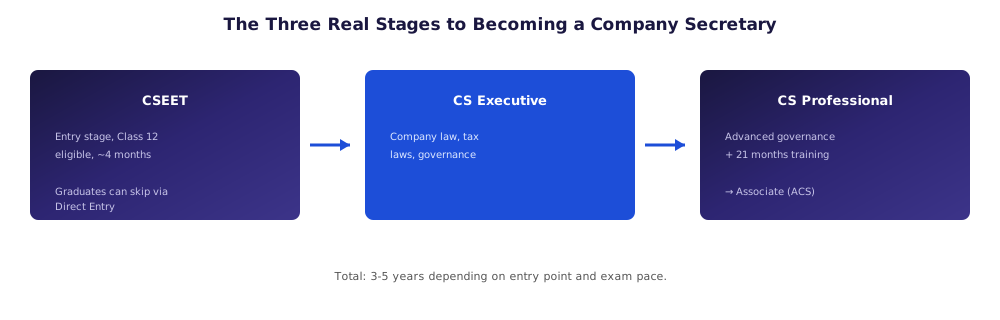
CSEET (Company Secretary Executive Entrance Test) is the entry stage, open to anyone who has passed Class 12 in any stream except fine arts, covering foundational business environment and legal concepts. CS Executive is the intermediate stage, going deeper into company law, tax laws, and corporate governance. CS Professional is the final stage, covering advanced governance, compliance, and specialised corporate law topics. After passing Professional and completing the required practical training, candidates become Associate Members of ICSI and can use "ACS" after their name.
Can Graduates Skip CSEET Entirely?
Yes, — this is a real, important shortcut most generic content glosses over. Commerce graduates or postgraduates with at least 55% aggregate marks can enrol directly into CS Executive via the Direct Entry Route, skipping CSEET completely. Non-commerce graduates can also use Direct Entry, typically with a somewhat higher marks requirement. Candidates who've already passed the CA (ICAI) Final or CMA (ICMAI) Final courses also qualify for Direct Entry with exemption fees. If you're already partway through a commerce degree, this route can meaningfully shorten your overall CS timeline.
Why Does This Career Have Genuine, Legally-Mandated Demand?
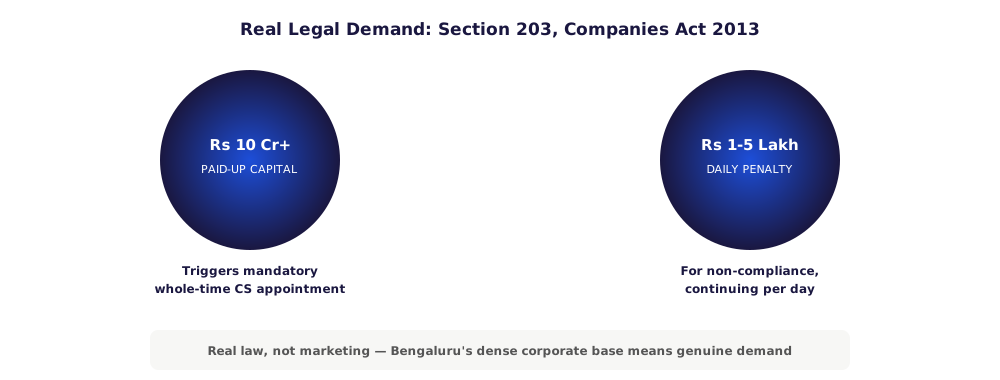
This is the single most important thing to understand about CS as a career choice, and it's not marketing language — it's actual law. Section 203 of the Companies Act, 2013, read with Rules 8 and 8A of the Companies (Appointment and Remuneration of Managerial Personnel) Rules, 2014, requires every listed company regardless of size, and every other public or private company with paid-up share capital of Rs 10 crore or more, to appoint a whole-time Company Secretary as Key Managerial Personnel. Only an ICSI member can legally hold this position — a Chartered Accountant or an internal CFO cannot substitute for it under the law. Non-compliance carries real penalties: Rs 1-5 lakh, continuing for every day the default persists. Given Bengaluru's exceptionally dense concentration of large companies, listed firms, and well-funded startups regularly crossing the Rs 10 crore paid-up capital threshold, this creates strong, structural local demand for qualified Company Secretaries specifically — not a vague "good career" claim, but a real legal requirement companies cannot avoid.
What Does the Full Course Actually Cost?
Total academic fees across all three stages run roughly Rs 50,000-60,000, excluding any coaching institute fees you choose to add. CSEET itself costs around Rs 7,500-9,000, CS Executive registration around Rs 10,600-18,900, and CS Professional around Rs 20,000. This is one of the more affordable professional qualifications covered on this site, reflecting ICSI's own direct-registration model rather than a private college's tuition structure.
What Does the Full Timeline Actually Look Like?
Total duration runs 3-5 years depending on your starting point (post-12th versus post-graduation) and how quickly you clear each stage's exams. an important, often-overlooked component: candidates must complete 21 months of Management Training in ICSI-sponsored companies or under a practising Company Secretary, in addition to passing all three examination stages. This training requirement is what actually produces qualified, practice-ready professionals — course completion and passing exams alone doesn't make you an Associate Company Secretary without it.
Career Scope and Salary — An Honest Range
Career destinations include compliance officer and legal advisor roles at corporate houses specifically required to appoint a CS under Section 203, roles at law firms and regulatory bodies, and independent Practising Company Secretary (PCS) work advising smaller companies on retainer. ICSI itself reports over 65,000 members and 250,000 students nationally, reflecting a large, established professional community. Salary reporting varies considerably by role and company size, so treat any specific figure cautiously — compliance roles at large, listed Bengaluru companies specifically tend to command stronger compensation than smaller-company or early-career PCS work, given the genuine legal weight and liability the CS role carries at that scale.
Who Should Pursue CS?
- Students interested in corporate law, governance, and compliance rather than pure accounting or finance
- Commerce graduates specifically, who can meaningfully shorten their path via Direct Entry
- Those comfortable with a self-study-driven qualification model rather than structured classroom teaching, though coaching institutes remain available
- Anyone drawn to Bengaluru's corporate and startup ecosystem specifically, given the genuine, legally-mandated demand described above
Comparing CS Against Related Fields
If you're weighing this against other commerce-adjacent professional qualifications, our courses directory covers the broader range of undergraduate commerce and management options available in Karnataka, including paths that could feed into CS via the Direct Entry route after graduation. If you're specifically comparing CS against CA or CMA as career paths, understanding each body's distinct governing structure and stages matters more than picking based on name recognition alone.
Funding Your CS Education
If you're SC, ST, OBC, or minority-category, our SSP scholarship guide covers Karnataka's post-matric scholarship system. Given CS's affordable total academic fee structure compared to many degree programmes, this remains one of the more accessible professional qualifications covered on this site even without additional financial support.
A Quick Verification Checklist Before You Register
Given ICSI updates its fee structure and specific requirements periodically, verify these directly before committing: current fees and registration deadlines at icsi.edu specifically, since these change periodically; whether you qualify for Direct Entry based on your specific academic background and marks; the actual coaching institute's track record if you're considering one, since ICSI itself doesn't require coaching; and the specific training-company placement process for your mandatory 21-month practical training component.
Frequently Asked Questions
Is Company Secretary a college degree or a separate qualification?
It's a separate, direct-registration professional qualification run by ICSI, not a university degree. Some colleges offer CS-preparation coaching alongside their regular programmes, but the actual credential comes only from ICSI.
Can I skip CSEET if I'm already a graduate?
Yes — commerce graduates or postgraduates with at least 55% aggregate can enrol directly into CS Executive via the Direct Entry Route, skipping CSEET entirely. Non-commerce graduates can also use this route, typically with a higher marks requirement.
Why is there genuine, legally-mandated demand for Company Secretaries?
Section 203 of the Companies Act, 2013 requires every listed company and every other public or private company with Rs 10 crore or more paid-up capital to appoint a whole-time Company Secretary as Key Managerial Personnel — a real legal requirement, not just industry demand.
What is the total cost of the CS course?
Roughly Rs 50,000-60,000 across all three stages (CSEET, Executive, Professional), excluding optional coaching institute fees.
How long does it take to become a qualified Company Secretary?
Typically 3-5 years total, including 21 months of mandatory Management Training that must be completed alongside the three examination stages.
What does ACS mean after someone's name?
Associate Company Secretary — the designation earned after passing the CS Professional examination and completing the required practical training, marking full ICSI membership.
Need help figuring out whether CS is the right path and how to plan around your current academic stage? WhatsApp +91 6363 330 233 and we'll help you think it through. We help you get the best admission to your preferred colleges without hassle.
Information on this page is compiled from publicly available ICSI and Ministry of Corporate Affairs sources, cross-checked across multiple sources given genuine variation in fee figures across reporting sites. Always confirm current fees and deadlines directly at icsi.edu. Published by L K Monu Borkala, founder of OneCity Technologies — publishing Karnataka education directories since 2006.