For a wider comparison, see all BSc Nursing colleges in Karnataka: Nursing Colleges in Karnataka.
Last Updated: August 26, 2026
BSc Nursing admission in Karnataka runs through KCET, not NEET. This is worth stating plainly upfront, since it's the single most confused point students run into when researching this online – national nursing-admission guides often mention NEET because several other states use it, but Karnataka specifically has run BSc Nursing through KCET (managed by the Karnataka Examinations Authority) since 2023, for both government and private college seats.
🎯 Use the Free KCET Rank Predictor – Enter your rank and category to instantly see which nursing colleges you can get in 2026. No login required. Try KCET Predictor →
Last Updated: September 9, 2026
Why Karnataka for BSc Nursing?
Karnataka is one of India's largest health-sciences education hubs, and most BSc Nursing colleges here are affiliated to Rajiv Gandhi University of Health Sciences (RGUHS) and recognised by the Indian Nursing Council, so the degree carries real, portable value. Students train at large multi-speciality hospitals in metro cities, teaching is largely in English, and – under government quota specifically – fees remain moderate compared to several other states. The Karnataka Examinations Authority runs centralised counselling for state-quota seats, which makes the admission process considerably more transparent than college-by-college private admission would be.
BSc Nursing Admission 2027 – Key Facts
| Parameter | Details |
|---|---|
| Entrance Exam | KCET (Karnataka CET), managed by KEA |
| Counselling Authority | KEA (Karnataka Examinations Authority) |
| Course Duration | 4 years + 1 year mandatory internship |
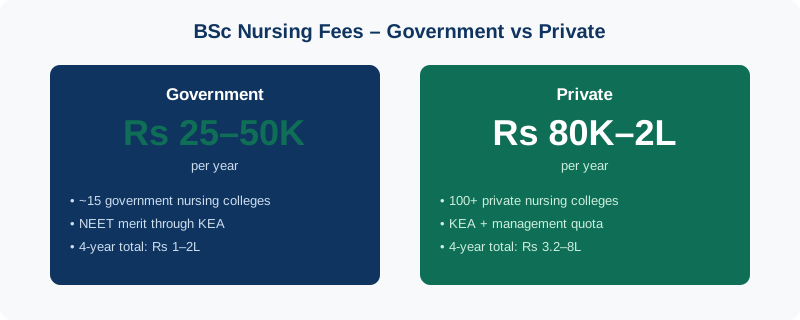
| Govt College Fee | ₹25,000–50,000/year |
| Private College Fee (Govt Quota) | ₹50,000–1,50,000/year |
| Private College Fee (Management Quota) | ₹1,50,000–3,00,000/year |
| Affiliating University | RGUHS (most colleges) |
A small but important caveat: a handful of nursing colleges attached to deemed universities (JSS, for instance, being part of JSSAHER) may run admission through their own separate process rather than the standard KEA/KCET route. If a specific deemed-university college is on your shortlist, confirm its exact admission route directly with that college rather than assuming the standard KCET process applies uniformly.
Important Dates for BSc Nursing Admission 2027
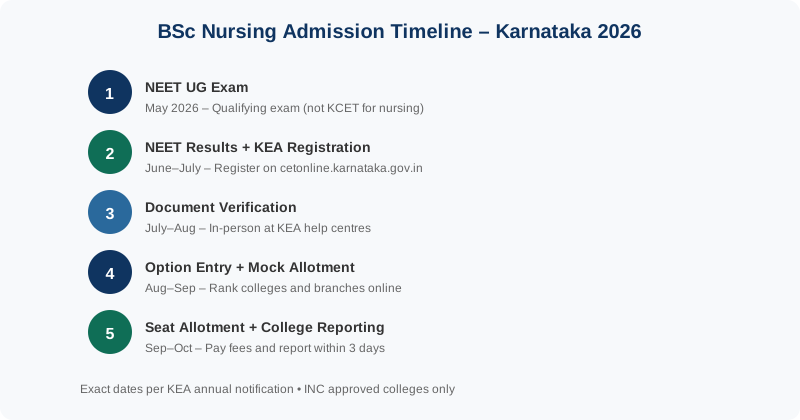
The BSc Nursing timeline follows the general KCET calendar. Based on this year's actual schedule:
- KCET online application: January–February 2026
- Application and fee payment deadline: Late February 2026
- Correction window: Late March 2026
- KCET exam dates: April 23–24, 2026 (with a separate Kannada language test on April 22 for candidates who need it)
- Admit card release: Early-to-mid April 2026
- Result and rank announcement: June 2026
- KEA counselling and option entry: Late June through August 2026
- Seat allotment and college reporting: Through September–October 2026, across multiple rounds
Always cross-check the current status directly on cetonline.karnataka.gov.in, since KEA has adjusted these dates without much advance notice in past cycles. Our complete KCET counselling schedule guide covers the full document-verification-through-reporting process in more depth than this nursing-specific page needs to repeat.
Eligibility Criteria for BSc Nursing 2027
Educational Qualification
- 10+2 or equivalent from a recognised board, with Physics, Chemistry, Biology, and English as subjects
- Minimum 45% aggregate in PCB for General category, 40% for SC/ST/OBC candidates
- Individual pass required in each subject at most colleges
- Karnataka domicile required for state-quota government seats specifically
Age Limit
Minimum age is 17 years on or before December 31 of the admission year. Official notifications generally don't specify a hard upper age limit for BSc Nursing, but it's worth checking the current year's KEA information bulletin for any updated rule before assuming this stays unchanged indefinitely.
Medical Fitness Requirement
Candidates must be certified medically fit to pursue nursing training by a registered medical practitioner, in the format the college or authority prescribes. This typically covers general physical and mental fitness, and normal vision (correction permitted) sufficient to handle clinical duties safely.
Reservation and Category Guidelines
Seats are reserved for SC, ST, OBC categories (1, 2A, 2B, 3A, 3B) per standard Karnataka government rules. Valid caste and income certificates, domicile/study certificates, and any special-category documentation need to be ready for upload and physical verification during counselling – missing or unclear documents at this stage is one of the most common, entirely avoidable reasons candidates lose time in the process.
Step-by-Step Application Process
Step 1 – Online Registration
Visit the KEA website and find the current year's KCET/UGCET link. Create a user ID with your name, mobile number, and email, and set a password. Save your application number carefully – you'll need it repeatedly through counselling.
Step 2 – Fill the Application Form
Log in and enter personal details, communication address, academic information from 10th and 12th, your study history in Karnataka (for domicile purposes), and category information. Select BSc Nursing among the course options where prompted.
Step 3 – Upload Documents
- Passport-size photo and signature
- SSLC and PUC/12th marks cards
- Caste and income certificate, if applicable
- Domicile/study certificate
- Disability or special-category certificate, if applicable
All documents must follow KEA's specified size and format guidelines – a common rejection cause is an upload that's technically present but doesn't meet the exact file specifications.
Step 4 – Pay the Application Fee
Pay online via net banking, card, or UPI. Keep the payment receipt and application printout as proof – you may need to produce this during document verification.
Step 5 – Download the Admit Card
Once KEA releases the hall ticket, log in and download it. Check your exam centre, date, and time, and verify every personal detail is correct before exam day.
Common mistakes worth avoiding: entering incorrect marks or category details, uploading unclear or oversized document scans, and waiting until the final day to apply, which routinely causes payment or server issues during the busiest submission window.
Merit List and Counselling Process
After the exam, KEA publishes provisional and final answer keys, then announces results and rank lists. Your BSc Nursing merit is based on KCET marks combined with qualifying-exam marks, per KEA's standard rank formula. Document verification follows – carried out in person or online at designated centres, requiring originals and photocopies of every certificate on your list. Candidates who skip verification cannot participate in option entry, regardless of rank.
After verification, you enter your college and course preferences in ranked order. Seat allotment happens round-wise based on your rank, category, seat availability, and choice order. Once allotted, you download the admission order, pay the prescribed fee within the deadline, and report to your allotted college with all documents and fee receipts. Multiple rounds typically follow (first, second, extended, and a mop-up round), and students seeking a better seat can participate in later rounds per KEA's guidelines.
Types of Seats Available
- Government quota seats in government nursing colleges – the lowest-cost option, filled entirely through KEA counselling.
- Government quota seats in private nursing colleges – moderate fees, still allotted through the centralised KEA process.
- Private/management quota in private colleges – higher fees, sometimes with more relaxed entry criteria, but still following the process approved by the relevant authority.
- NRI or institutional-preference quota at select colleges, with its own separate documentation and fee structure.
Which quotas apply to you depends on your domicile, category, and financial situation – it's worth mapping this out before you finalise your option-entry strategy, rather than discovering partway through counselling that a quota you assumed applied to you actually doesn't.
A Few Notable Nursing Colleges Across Karnataka
Karnataka's roughly 400+ nursing colleges span every major city. A representative, geographically spread sample worth knowing about: AJ Institute of Nursing Sciences in Mangaluru, Bapuji College of Nursing in Davangere, BGS College of Nursing in Bengaluru, and Basaveshwara Nursing College in Chitradurga. Our complete nursing colleges guide by city and pathway covers the fuller list in more depth, including government-versus-private fee and outcome comparisons across the state.
GNM, ANM, and Post Basic BSc Nursing – How These Differ
BSc Nursing isn't the only nursing pathway in Karnataka, and it's worth knowing the alternatives even if BSc is your primary target. GNM (General Nursing and Midwifery) is a 3.5-year diploma, generally with a lower entry bar than BSc Nursing, and is a solid option if your marks or KCET rank make BSc Nursing at your preferred college unrealistic. ANM (Auxiliary Nurse Midwifery) is a shorter, 2-year diploma focused on community and primary healthcare roles, typically the entry point for rural and public-health nursing positions. Post Basic BSc Nursing is a 2-year degree specifically for GNM diploma holders who want to upgrade to a full BSc qualification – a common and practical route for working nurses who started with GNM and want the broader career options a BSc opens up later. Our BSc Nursing vs GNM comparison goes into this decision in more depth if you're weighing the two.
Career Scope After BSc Nursing
Starting salaries vary by sector: private hospitals typically offer ₹2.5–4 LPA to begin, while government nursing positions (through state or central recruitment) often start around ₹3.5–5 LPA with meaningfully better job security and long-term benefits. Beyond direct clinical roles, BSc Nursing graduates in Karnataka have realistic paths into nursing education (teaching at nursing colleges after further qualification), hospital administration, and – significant for many students – international nursing careers in the UK, Australia, Canada, and Gulf countries, each requiring their own separate licensing or bridging exams rather than direct degree transfer. The UK's OSCE (Objective Structured Clinical Examination) and similar country-specific assessments typically take a year or more of preparation alongside your existing qualification, so students planning an international nursing career benefit from starting that research during their final BSc year rather than after graduating, when the natural momentum toward immediate employment can make an international-track decision feel like starting from scratch.
Funding Your Nursing Education
Given the meaningful gap between government-quota and management-quota fees, it's worth planning finances alongside your college shortlist rather than after allotment forces the question. If you're SC, ST, OBC, or minority-category, our SSP scholarship guide covers Karnataka's state scholarship system, which explicitly includes nursing among its covered post-matric courses.
Why the KCET vs NEET Confusion Exists Online
It's worth understanding where the widespread NEET confusion actually comes from, since it'll help you evaluate other sources you come across while researching. NEET UG became mandatory nationally for MBBS, BDS, and AYUSH programmes starting several years ago, and a lot of generic "nursing admission" content published across India – much of it written for a national audience rather than state-specific – extends that NEET requirement to nursing by association, since nursing sits in the broader medical-education category. In reality, nursing admission policy is set state-by-state, and several states do use NEET for nursing, which is exactly why national-level articles aren't wrong in a blanket sense – they're just not describing Karnataka's specific system. Karnataka made a deliberate government-order decision in 2023 to route BSc Nursing through its existing KCET infrastructure rather than adopting NEET, likely because KCET already had established counselling machinery for numerous other professional courses. If you're cross-referencing information from multiple sources, always check whether an article is describing the national picture or Karnataka specifically before trusting a claim about which exam applies to you.
What to Check Beyond Fees and Cutoffs
A few practical factors matter more to your actual nursing training than they might initially seem, and are worth confirming directly with any college on your shortlist:
- Attached hospital patient volume – more patients means more real clinical exposure during your training years, which matters enormously for your actual competence and confidence by graduation.
- Simulation lab quality – modern nursing education increasingly uses simulation manikins and scenario-based training before students handle real patients; colleges vary significantly in how much they've invested here.
- Hostel and safety infrastructure, particularly important given how many nursing students are young women studying away from home for the first time.
- Placement cell activity specifically for nursing graduates – ask for actual recent placement data (which hospitals, what starting roles) rather than a generic "100% placement" claim that many colleges advertise without specifics.
Government vs Private Nursing Colleges – Making the Actual Choice
Beyond the fee difference, government and private nursing colleges differ in ways worth weighing. Government colleges typically offer lower fees and a strong institutional reputation built over decades, but often with more constrained infrastructure and larger batch sizes than newer private colleges. Private colleges vary enormously – some invest in modern simulation labs, smaller clinical batches, and strong placement cells, while others are considerably thinner on infrastructure despite charging meaningfully higher fees. Our detailed government vs private nursing colleges comparison covers this trade-off across fees, training quality, and career outcomes in more depth than a brief summary can.
Building Your Own Timeline Around This Process
Beyond just knowing KEA's published dates, it helps to plan your own preparation calendar against them. In the months before applications open, gather your documents (SSLC, PUC marks cards, caste/income certificates if applicable) well in advance rather than scrambling once the window opens – certificate offices and Nadakacheri centres can have real waiting periods, especially during peak application season when thousands of students across streams are requesting the same documents simultaneously. During the application window itself, complete your registration early rather than in the final days, since server load increases as deadlines approach and a technical failure on the last day can cost you an entire admission cycle. Once results are out, use the weeks before counselling opens to research your realistic college options properly – checking government-quota versus management-quota costs, actual placement outcomes rather than marketing claims, and hostel or safety considerations if you're studying away from home – so your choice-filling reflects genuine research rather than a rushed decision made under counselling-week time pressure.
Frequently Asked Questions
Is KCET or NEET required for BSc Nursing in Karnataka?
KCET. Karnataka has run BSc Nursing admission through KCET, managed by KEA, since 2023 – for both government and private college seats. NEET applies to several other states' nursing admissions, which is where the confusion online often comes from, but it isn't the route for Karnataka specifically.
What is the minimum KCET score needed for BSc Nursing in Karnataka?
There's no single fixed score – closing ranks vary by college and category each year. Government colleges and well-regarded private colleges are more competitive; many other private colleges have relatively open government-quota seats. Use our KCET rank predictor for a realistic, personalised estimate.
What is the BSc Nursing fee in Karnataka government colleges?
Government college fees typically run ₹25,000–50,000 per year – significantly lower than private college government-quota fees (₹50,000–1,50,000) or management-quota fees (₹1,50,000–3,00,000).
What is the salary after BSc Nursing in Karnataka?
Starting salaries typically range ₹2.5–4 LPA in private hospitals and ₹3.5–5 LPA in government positions, with meaningfully better job security in government roles.
What's the difference between BSc Nursing and GNM?
BSc Nursing is a 4-year degree with generally broader long-term career options; GNM is a 3.5-year diploma with a typically lower entry bar. Post Basic BSc Nursing lets GNM graduates upgrade to a full degree in 2 additional years.
Can students from outside Karnataka apply for BSc Nursing here?
Non-Karnataka candidates can generally apply, but government-quota seats reserved for Karnataka-domicile students aren't accessible to them – non-domicile applicants typically compete for management-quota or general-category seats depending on the specific college's policy.
Do all Karnataka nursing colleges follow the same KCET admission process?
Most RGUHS-affiliated colleges do, but a handful of colleges attached to deemed universities may run their own separate admission process. Confirm directly with any specific deemed-university college on your shortlist rather than assuming the standard KCET route applies.
Need help figuring out which nursing colleges are realistic for your rank and category? WhatsApp +91 6363 330 233 and we'll help you build a realistic shortlist. We help you get the best admission to your preferred colleges without hassle.
Information on this page is compiled from official KEA sources and cross-checked against recent-cycle admission timelines. Dates and cutoffs change year to year – always verify current details directly on kea.kar.nic.in before making decisions based on any figure here. Published by L K Monu Borkala, founder of OneCity Technologies – publishing Karnataka education directories since 2006.
Need help with admission?
CollegesInfo.org helps students secure admission to colleges they are eligible for under that college's actual published criteria. Chat with us on WhatsApp or explore admission assistance.
About the author
OneCity Technologies Pvt. Ltd began in 2006 publishing an annual print education directory for Karnataka students and parents. As demand grew, OneCity launched an education portal in 2019 to bring that same directory information online, and in 2025 relaunched as CollegesInfo.org, a comprehensive Karnataka college directory covering 1,500+ institutions across engineering, medical, management, arts, commerce, and more. Founder L K Monu Borkala brings 20+ years of business experience and 19 years of work across various education-sector services. CollegesInfo.org's content is built from publicly available KEA, NMC, AICTE, and university data, cross-checked against official sources wherever possible. CollegesInfo.org's admission assistance service helps students secure admission to colleges they are eligible for under that college's actual published criteria. We help you get the best admission to your preferred colleges without hassle.