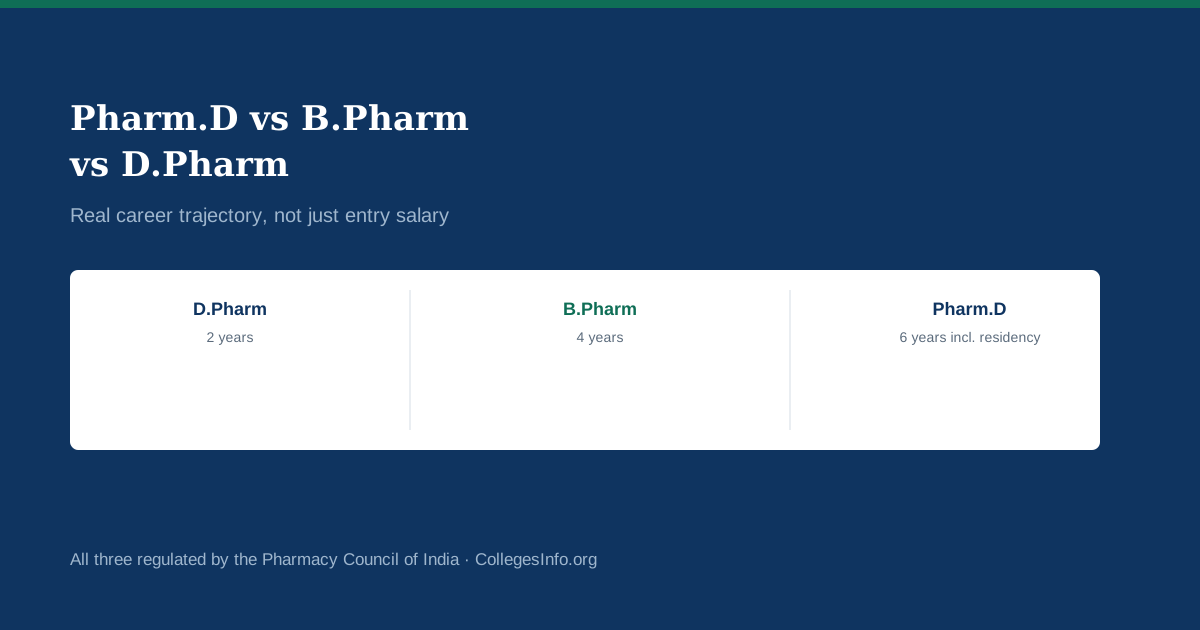
D.Pharm (2 years), B.Pharm (4 years) and Pharm.D (6 years) lead to fundamentally different careers, not just different lengths of the same education. D.Pharm opens retail pharmacy quickly. B.Pharm opens the widest range of industry, regulatory and research roles. Pharm.D is the only one built specifically for hospital-based clinical pharmacy and carries the clearest path to practising abroad, a distinction this comparison covers in real depth below.
Why Entry-Level Salary Alone Is a Misleading Comparison
Most comparisons between these three degrees stop at entry-level salary, and that number is actually the least useful figure for a 17-year-old choosing between a 2, 4, or 6-year commitment. Sources broadly agree that B.Pharm and Pharm.D graduates start at similar figures, commonly cited in the roughly Rs 3.5 to 6 lakh per annum range depending on the specific role and employer, with D.Pharm starting meaningfully lower, typically Rs 15,000 to 25,000 per month in retail or community pharmacy settings. What differs far more sharply is how each path's earning ceiling and career shape evolve over the following ten to fifteen years, which is the actual decision that matters here, far more than comparing a single entry-level number in isolation.
Candidates who want their specific pharmacy degree fit checked before applying anywhere can start from our MBA admission assistance page.
What Each Degree Actually Trains You For
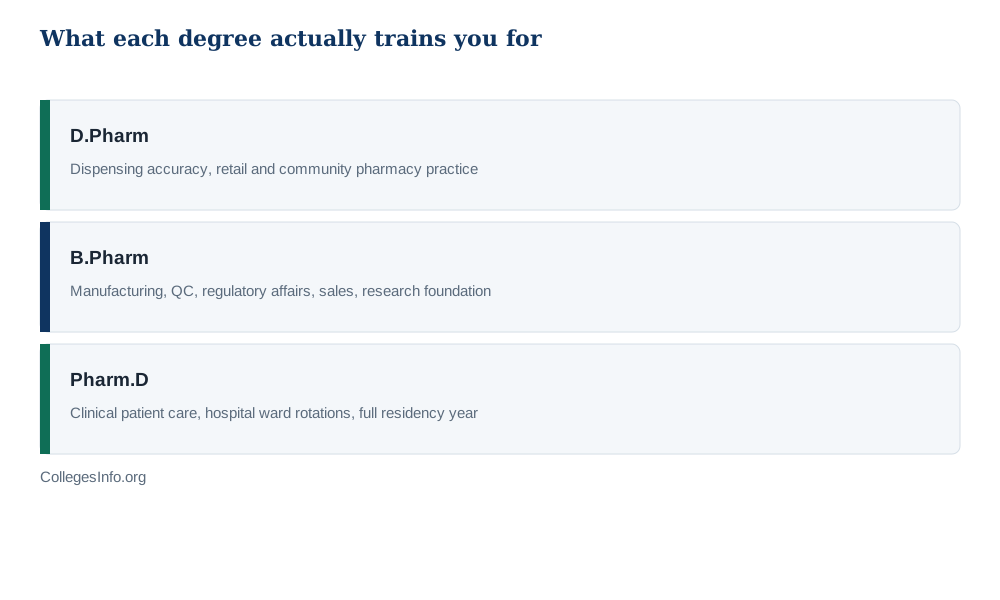
D.Pharm: Fast Entry Into Retail and Community Pharmacy
D.Pharm is a two-year diploma focused on practical, applied pharmaceutical knowledge, drug dispensing and direct patient interaction. It qualifies a graduate to register as a pharmacist and run or work in a retail pharmacy considerably faster than either other option, a real advantage for a candidate whose priority is entering paid employment as quickly as possible rather than maximising long-term career breadth. The career ceiling is real and worth stating plainly: D.Pharm alone does not open pharmaceutical industry, regulatory, or clinical hospital roles, and most D.Pharm holders who want those doors open eventually pursue B.Pharm through lateral entry, typically joining directly into the second year rather than restarting from scratch entirely.
B.Pharm: The Widest Range of Doors
B.Pharm is a four-year degree covering pharmaceutical sciences, drug formulation, pharmacology, quality control and regulatory fundamentals. It is the standard entry point into pharmaceutical manufacturing, quality assurance, regulatory affairs, pharmaceutical sales and marketing, and medical representative roles, while also keeping the door open to M.Pharm specialisation, Pharm.D Post-Baccalaureate, an MBA in healthcare management, or research routes including a PhD, a distinctly wide range of onward options that neither of the other two degrees matches on its own. This breadth is exactly why B.Pharm remains the default recommendation for a student who has not yet decided on a specific pharmacy-adjacent career: almost every other path in the field remains reachable from here.
Pharm.D: The Only Path Built for Hospital-Based Clinical Practice
Pharm.D is a six-year clinical pharmacy doctorate, introduced in India in 2008 by the Pharmacy Council of India specifically to create clinical pharmacists who work alongside doctors and nurses inside hospitals, not just in dispensing or manufacturing roles. The first four years cover largely the same pharmaceutical sciences foundation as B.Pharm, but years five and six shift into sustained clinical postings, drug therapy monitoring, and a full residency year with direct, supervised patient-care responsibility. This structure is why Pharm.D, not B.Pharm, is the degree that actually prepares a graduate to function as a clinical pharmacist inside a working hospital ward from day one of employment, rather than needing years of on-the-job clinical learning that a B.Pharm curriculum simply does not build in during the degree itself.
Quick Comparison
| Factor | D.Pharm | B.Pharm | Pharm.D |
|---|---|---|---|
| Duration | 2 years | 4 years | 6 years (incl. 1-year residency) |
| Core focus | Dispensing, retail practice | Pharmaceutical sciences, manufacturing | Clinical patient care in hospitals |
| Typical entry roles | Retail/community pharmacist | QC, regulatory, MR, production | Clinical pharmacist, hospital pharmacy |
| Higher-study route | Lateral entry to B.Pharm year 2 | M.Pharm, Pharm.D (PB), MBA | Residency, fellowship, PhD |
| International practice | Very limited | Needs further qualification | Clearest existing pathway |
The Lateral-Entry Pathways Connecting All Three
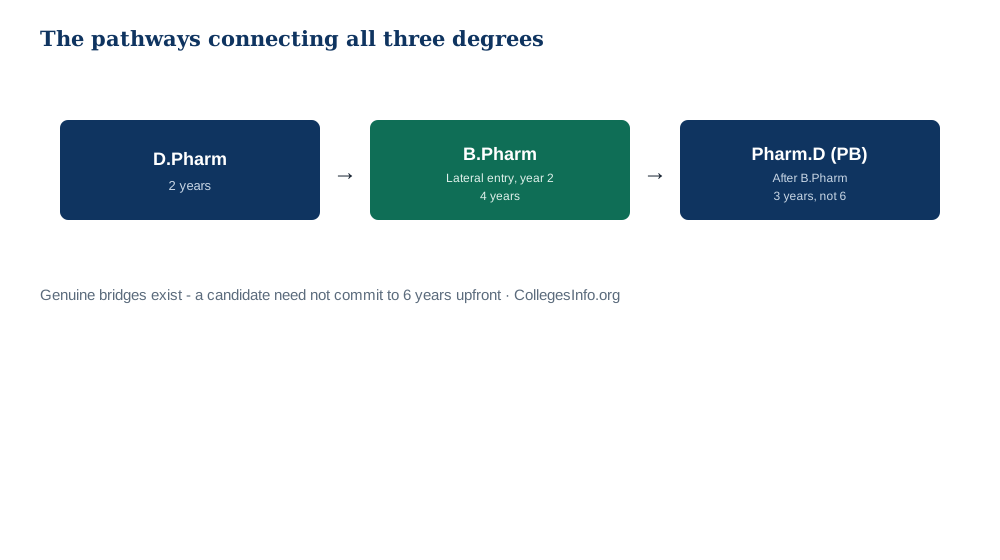
These three degrees are not fully separate tracks locked in from day one; Indian pharmacy education has built genuine bridges between them that a candidate should know about before committing. A D.Pharm graduate can move into B.Pharm through lateral entry, typically admitted directly into the second year rather than starting the four-year programme over, recovering much of the time already invested. A B.Pharm graduate can pursue Pharm.D as a Post-Baccalaureate route, commonly a three-year programme, two years academic plus one year residency, rather than the full six-year track required starting from 10+2. This means a candidate who is truly unsure at 17 whether they want the clinical-hospital track does not have to gamble the full six years upfront; starting with B.Pharm and moving into Pharm.D (PB) later, once career direction is clearer, is a legitimate and commonly used route. Candidates researching specific Bangalore pharmacy colleges offering these pathways can review our Bangalore pharmacy colleges guide for institution-specific detail alongside this comparison.
The same verification applies when comparing government-quota and management-quota admission routes, and our admission assistance service page covers that path.
How Salary Actually Diverges Over a Career, Not Just at Entry
Given how similar entry-level figures for B.Pharm and Pharm.D tend to be, the more useful question is how each path's earning trajectory actually diverges over five, ten, and fifteen years, since this is where the two degrees actually separate, far more meaningfully than any single entry-level comparison ever could. B.Pharm's highest ceiling tends to sit in specialised industry roles, senior regulatory affairs, pharmaceutical sales leadership, and formulation development, where experienced professionals in top roles are commonly cited well above Rs 50 lakh per annum, though reaching that ceiling typically requires additional qualifications, an MBA, an M.Pharm specialisation, or deep sector-specific experience, layered on top of the base B.Pharm degree over many years rather than arriving automatically with time served alone.
Pharm.D's strongest mid-career trajectory runs through clinical specialisation and international placement rather than domestic industry roles, with experienced clinical pharmacists in specialised hospital settings commonly cited in a considerably higher bracket than an equivalent-experience B.Pharm holder in a non-specialised industry role, and international clinical pharmacist placements, once additional country-specific licensing is cleared, opening a meaningfully different income bracket entirely, one that neither B.Pharm nor D.Pharm can access without first acquiring additional clinical qualifications of their own. D.Pharm's ceiling, without further qualification, remains the most constrained of the three, which is precisely why lateral entry into B.Pharm is such a commonly used route rather than an edge case, and why few D.Pharm graduates who aim for a long career in pharmacy treat the diploma as their final qualification.
International Recognition: Where Pharm.D Clearly Pulls Ahead
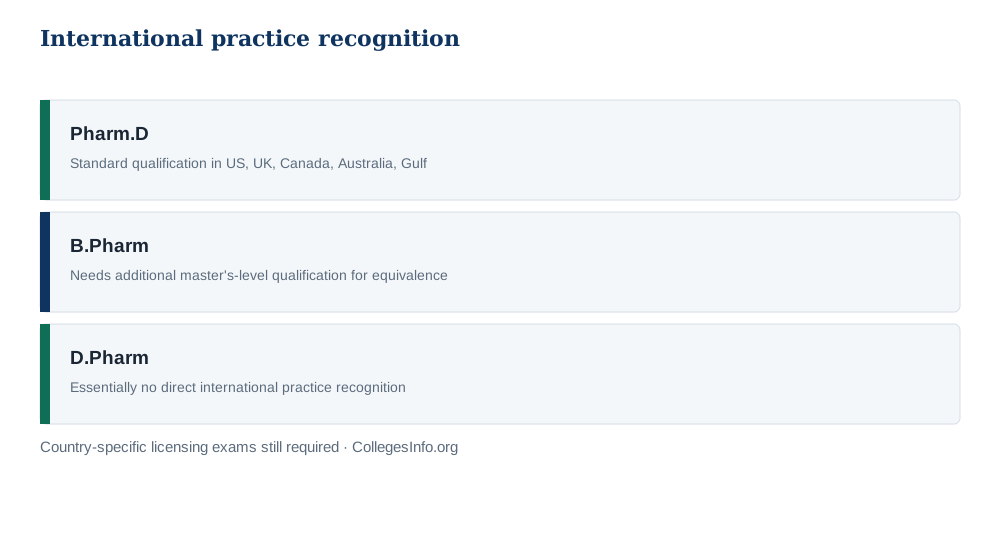
This is the area where the three degrees differ most sharply, and it deserves more attention than most comparisons give it. Pharm.D is internationally recognised as the standard clinical pharmacy qualification in the United States, United Kingdom, Canada, Australia and the Gulf region, and an Indian Pharm.D graduate from a PCI-recognised institution holds the correct base qualification to pursue licensing exams in these countries directly, the FPGEE and subsequent state licensing in the US, or the GPhC overseas pharmacist assessment route in the UK, among others.
B.Pharm graduates seeking equivalent international practice rights generally need to pursue additional qualifications first, commonly a master's-level programme or specific bridging coursework recognised by the destination country's pharmacy regulator, since a standalone four-year B.Pharm is not treated as directly equivalent to the six-year Pharm.D by most Western licensing bodies, a gap that surprises many B.Pharm graduates only after they have already begun exploring international opportunities. D.Pharm holds essentially no direct international practice recognition on its own. A candidate whose long-term goal specifically includes practising pharmacy abroad, rather than working in pharma industry roles abroad, should weigh this distinction heavily, since it is the single clearest structural advantage Pharm.D holds over the other two degrees.
Total Cost Across Six, Four and Two Years
Given Pharm.D runs six years against B.Pharm's four and D.Pharm's two, total investment differences track duration closely, but not perfectly, since Pharm.D's clinical infrastructure requirements, hospital tie-ups, additional faculty for clinical postings, tend to push per-year fees somewhat higher than an equivalent B.Pharm year at the same institution, particularly under management quota, a detail easy to overlook when comparing programmes on duration alone. A candidate comparing total cost across all three should request the full itemised breakdown for the entire programme duration from each shortlisted college, rather than multiplying a single year's fee by the programme length, since fee structures at several institutions step up in later, more clinically-intensive years rather than remaining flat throughout.
Government-quota seats narrow this cost gap considerably across all three degrees, since state-regulated fee structures apply regardless of programme length, making the actual out-of-pocket difference between government-quota D.Pharm, B.Pharm and Pharm.D considerably smaller than the management-quota comparison would suggest. A candidate with a strong KCET rank should factor this into the duration-versus-cost tradeoff directly, since a longer government-quota Pharm.D programme may end up costing less in total than a shorter management-quota B.Pharm at a different institution.
Scholarship Support Across All Three Degrees
Financial support schemes generally apply across D.Pharm, B.Pharm and Pharm.D alike rather than favouring one specific degree, though the absolute value of a scholarship matters proportionally more for Pharm.D's six-year commitment than for D.Pharm's two years. SC, ST and minority community candidates can access central government scholarship schemes covering tuition and maintenance costs at PCI-recognised institutions across all three programmes, applied through the national scholarships portal, while Karnataka's own state schemes support economically weaker general-category candidates specifically at government and aided institutions.
A candidate weighing Pharm.D's longer duration against B.Pharm's shorter one should factor in that scholarship eligibility windows and renewal requirements typically apply annually rather than as a single lump sum, meaning a six-year Pharm.D candidate needs to track and reapply for scholarship continuation considerably more times than a four-year B.Pharm candidate, a genuine administrative burden worth planning for rather than assuming a scholarship awarded in year one simply continues automatically through graduation. For help weighing a specific budget, rank and career goal against these three options, our admission guidance team can walk through the trade-offs directly.
Choosing Based on Career Goal, Not Just Duration
The honest framing that most comparisons skip is that duration is the least important variable here once a candidate has a genuine sense of their target career. A candidate who wants to start earning quickly and is comfortable with a retail or community pharmacy career should choose D.Pharm, with the lateral-entry door to B.Pharm staying open if goals shift later, a comparatively low-risk starting point given how directly and reliably that door connects to the longer degree without wasted time. A candidate whose interest lies broadly in the pharmaceutical industry, whether manufacturing, regulatory affairs, sales, or research, without a specific pull toward hospital-based clinical work, is generally better served by B.Pharm, given its breadth of onward options and comparatively shorter commitment than Pharm.D, especially if career direction may still shift over the next few years of study.
A candidate who already knows they want to work as a clinical pharmacist inside a hospital, manage patient drug therapy directly, or eventually practise internationally as a clinical pharmacist specifically, is the clearest fit for Pharm.D, accepting the additional two years and generally higher total course cost as the price of the only degree among the three specifically built for that career.
How Admission Actually Differs Across the Three
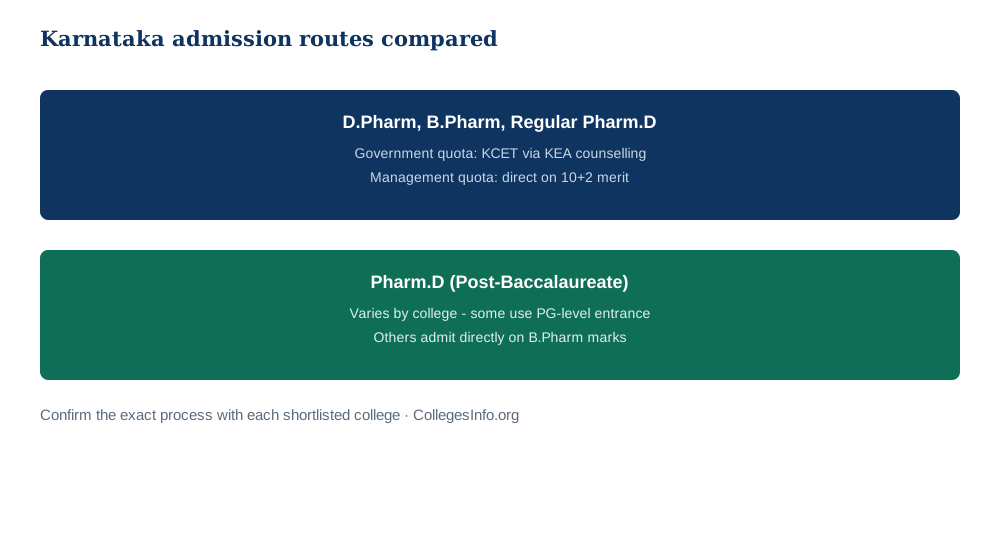
In Karnataka specifically, government-quota admission to D.Pharm, B.Pharm and Pharm.D (regular, direct-entry) all run through KCET via KEA counselling, a detail worth knowing since it differs from several other health-science streams that use different or no state-level entrance exam at all. Management-quota seats across all three are typically filled directly by the specific college, generally on 10+2 merit rather than requiring a KCET rank.
Pharm.D (Post-Baccalaureate) admission, for candidates who already hold a B.Pharm, runs differently: some colleges process this through a postgraduate-level entrance route, while others admit directly on B.Pharm aggregate marks without a fresh entrance exam. This variation is truly college-specific rather than following one uniform state-wide rule, so a candidate considering the PB route specifically should confirm the exact process directly with each shortlisted college rather than assuming it mirrors either the regular Pharm.D or M.Pharm admission pattern.
What the Curriculum Actually Covers, Year by Year
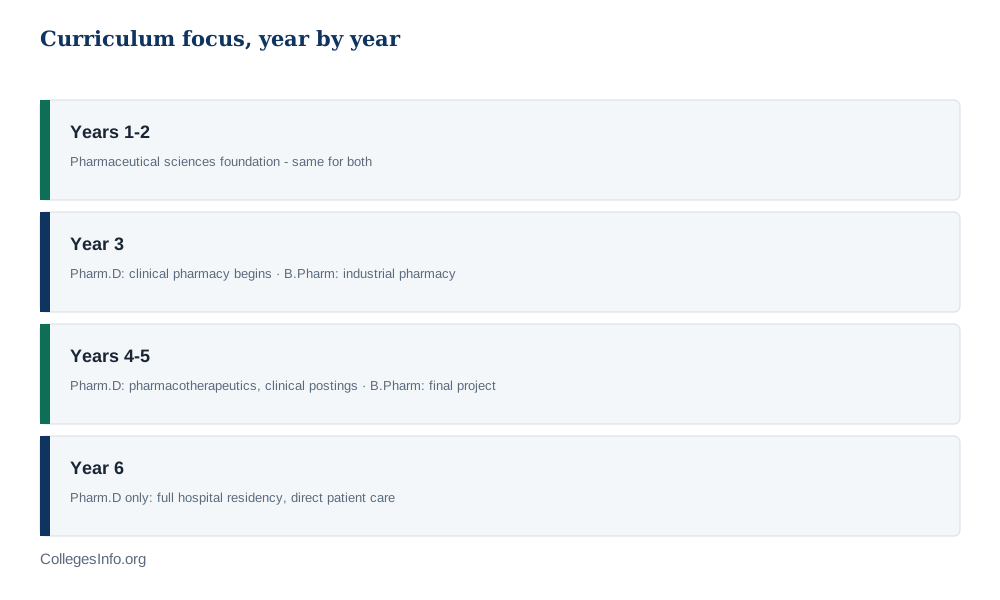
D.Pharm's two years concentrate almost entirely on applied, practical pharmaceutical knowledge: dispensing accuracy, basic pharmacology, community pharmacy practice and drug store management, with minimal exposure to research methodology or advanced pharmaceutical sciences. B.Pharm's four years build a considerably broader foundation, pharmaceutics, pharmaceutical chemistry, pharmacology, pharmacognosy, biopharmaceutics and industrial pharmacy, with a final-year project or industrial training component that gives graduates real exposure to manufacturing or research environments before entering the workforce.
Pharm.D's first three years cover largely the same pharmaceutical sciences foundation as B.Pharm, but from year three onward the curriculum shifts decisively toward clinical pharmacy, clinical pharmacokinetics, hospital and community pharmacy, and pharmacotherapeutics spanning eight units across major disease categories, before the sixth year's full residency. This structural difference, not just the extra two years, is what actually separates Pharm.D from B.Pharm: a B.Pharm graduate with strong grades has not necessarily had the sustained clinical ward exposure that a Pharm.D graduate's residency year specifically provides.
| Programme year | Pharm.D focus | B.Pharm equivalent |
|---|---|---|
| Years 1-2 | Pharmaceutical sciences foundation | Same foundation subjects |
| Year 3 | Clinical pharmacy begins | Industrial pharmacy, pharmacology |
| Years 4-5 | Pharmacotherapeutics, clinical postings | Final project, industrial training |
| Year 6 | Full hospital residency | Not applicable (degree complete) |
Candidates researching specific Bangalore pharmacy colleges across all three degree levels can browse our full Karnataka college directory, or compare specific institutions directly using the college comparison tool before shortlisting a specific programme and city.
Frequently Asked Questions
Which pays more, Pharm.D or B.Pharm?
Entry-level pay is broadly similar between the two across most sources. The meaningful difference emerges over a career: Pharm.D's strongest earning trajectory runs through clinical specialisation and international placement, while B.Pharm's highest ceiling typically requires additional qualifications like an MBA or M.Pharm layered on top over time.
Can I switch from D.Pharm to B.Pharm later?
Yes. D.Pharm graduates can move into B.Pharm through lateral entry, typically joining directly into the second year rather than restarting the full four-year programme, recovering much of the time already invested in the diploma.
Can I do Pharm.D after completing B.Pharm?
Yes, through Pharm.D (Post-Baccalaureate), commonly a three-year programme for B.Pharm graduates, two years academic plus one year residency, rather than the full six-year track required starting directly from 10+2.
Is Pharm.D recognised for practice outside India?
Yes, more directly than the other two degrees. Pharm.D is the standard clinical pharmacy qualification recognised in the US, UK, Canada, Australia and the Gulf region, though country-specific licensing exams are still required. B.Pharm graduates generally need additional qualifications to reach equivalent international recognition, and D.Pharm holds essentially no direct international practice recognition on its own.
Which degree is regulated by which body in India?
All three, D.Pharm, B.Pharm and Pharm.D, are regulated by the Pharmacy Council of India (PCI). Pharm.D specifically follows the PCI's Pharm.D Regulations, 2008, which introduced the degree to create clinical pharmacy specialists distinct from the existing B.Pharm framework, alongside oversight from bodies like AICTE for institutional approval where applicable.
Does the admission process differ between the three degrees in Karnataka?
Government-quota admission to D.Pharm, B.Pharm and regular Pharm.D all run through KCET via KEA counselling. Management-quota seats are typically filled directly by the college on 10+2 merit. Pharm.D (Post-Baccalaureate) admission varies by college, some use a postgraduate-level route, others admit directly on B.Pharm marks.
What does the Pharm.D residency year actually involve?
The sixth year is a full-time hospital clinical pharmacy residency with rotations through major departments including general medicine, surgery, paediatrics, ICU, and obstetrics and gynaecology, giving direct, supervised patient-care experience that B.Pharm's curriculum does not include at any stage.
Is D.Pharm worth it if I eventually want a pharmaceutical industry career?
D.Pharm alone does not typically open pharmaceutical industry, regulatory, or clinical hospital roles. Most D.Pharm holders with industry ambitions pursue B.Pharm through lateral entry rather than treating D.Pharm as a final qualification for that specific goal.
How much does each degree typically cost in total?
Total cost varies significantly by college and quota, government versus management, so this guide does not assert a single figure. Given Pharm.D runs six years against B.Pharm's four and D.Pharm's two, total cost differences track duration closely; candidates should confirm the current, itemised fee structure directly with each specific college before comparing total investment across the three options.
This article is for informational purposes only. Consult the specific college and regulatory body directly before making admission decisions.
About the author
OneCity Technologies Pvt. Ltd began in 2006 publishing an annual print education directory for Karnataka students and parents. As demand grew, OneCity launched an education portal in 2019 to bring that same directory information online, and in 2025 relaunched as CollegesInfo.org, a comprehensive Karnataka college directory covering 1,500+ institutions across engineering, medical, management, arts, commerce, and more. Founder L K Monu Borkala brings 20+ years of business experience and 19 years of work across various education-sector services. CollegesInfo.org's content is built from publicly available KEA, NMC, AICTE, and university data, cross-checked against official sources wherever possible. CollegesInfo.org's admission assistance service helps students secure admission to colleges they are eligible for under that college's actual published criteria. We help you get the best admission to your preferred colleges without hassle.
Not sure which pharmacy degree fits your goals and budget?
We help you get the best admission to your preferred colleges without hassle.
For a wider comparison, see government pharmacy colleges across Karnataka: Pharmacy Colleges in Karnataka.
Need help with admission?
CollegesInfo.org helps students secure admission to colleges they are eligible for under that college's actual published criteria. Chat with us on WhatsApp or explore admission assistance.