Last Updated: September 7, 2026
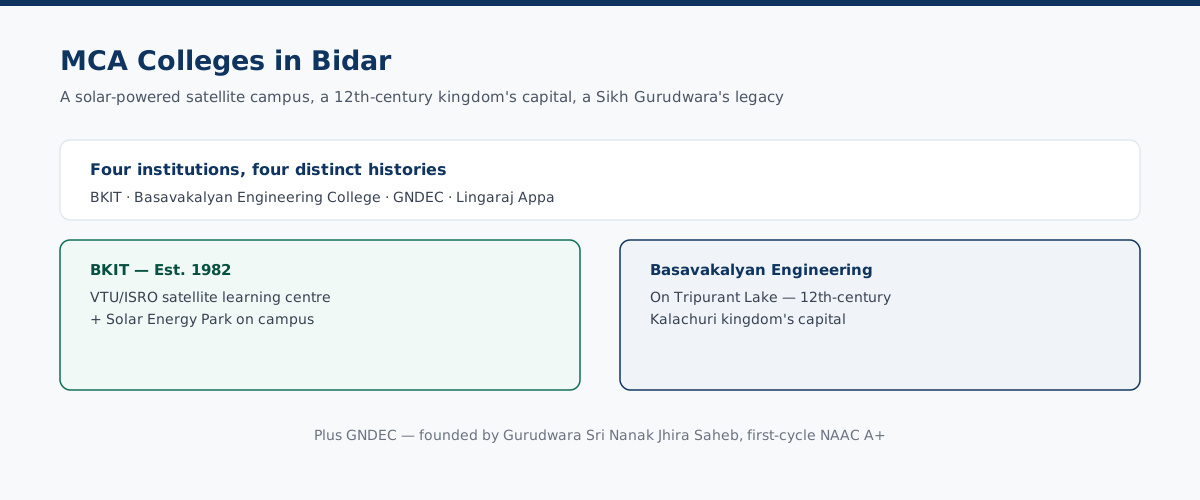
Bidar district's MCA cluster carries a remarkable concentration of history – an ISRO satellite learning centre with its own solar park, a college on the shores of a 12th-century kingdom's capital, and an institution founded by a Sikh Gurudwara. BKIT in Bhalki hosts VTU and ISRO's EDUSAT/VSAT satellite learning infrastructure alongside a Karnataka Renewable Energy Development-sanctioned Solar Energy Park. Basavakalyan Engineering College sits on the historic Tripurant Lake in the very town where the 12th-century social reformer Basaveshwara led an early movement against caste and gender discrimination. Guru Nanak Dev Engineering College, founded by a Sikh Gurudwara committee, claims a verifiable first-cycle NAAC A+ achievement. This piece covers all four institutions.
MCA in Bidar – Quick Facts
| Verified MCA institutions | 4 — BKIT, Basavakalyan Engineering College, Guru Nanak Dev Engineering College, Lingaraj Appa Engineering College |
|---|---|
| Oldest institution | BKIT, Bhalki (1982) — over 4 decades, 11,000+ alumni |
| unique infrastructure | BKIT hosts VTU/ISRO satellite learning centre + a Solar Energy Park on campus |
| Historical setting | Basavakalyan Engineering College sits in the 12th-century Kalachuri kingdom's capital, on Tripurant Lake |
| Community founding | Guru Nanak Dev Engineering College, founded by the Gurudwara Sri Nanak Jhira Saheb committee (1980) |
| Regional context | Bidar district, part of Kalyana Karnataka, near the Karnataka-Telangana-Maharashtra tri-junction |
| Admission route | Karnataka PGCET, management quota through each institution |
BKIT – A Satellite Campus With Its Own Solar Park
BKIT (Bheemanna Khandre Institute of Technology), Bhalki, established in 1982 under the Shanti Vardhak Education Society, originally operated as Rural Engineering College, Bhalki. It's named after Dr. Bheemanna Khandre – a genuine freedom fighter, former minister in the Government of Karnataka, and recipient of the National Integrity Award and the Suvarna Karnataka Rajyotsava Award. The institute has operated for over four decades in Bhalki, a taluk town in Bidar district positioned near the Karnataka-Telangana-Maharashtra tri-junction.
What distinguishes BKIT's infrastructure is documented and specific: it's chosen as a satellite education centre by VTU and ISRO for EDUSAT and VSAT-based learning, and hosts a Karnataka Renewable Energy Development-sanctioned Solar Energy Park directly on its 35-acre green campus – a combination of space-technology-linked distance education infrastructure and renewable energy investment that's uncommon among regional engineering colleges. With more than 11,000 alumni built up over its four-decade history, BKIT represents one of North Karnataka's more established private engineering institutions by any measure.
The naming connection to Dr. Bheemanna Khandre is also worth understanding as more than a formality – naming an engineering institution after a documented freedom fighter and government minister reflects a genuine regional tradition of connecting educational institutions to figures of established public service and historical significance, a pattern that recurs across several institutions in this specific piece, from BKIT's own namesake to Basavakalyan's connection to a 12th-century social reformer and GNDEC's foundation by a religious community institution.
Basavakalyan Engineering College – On the Shores of a 12th-Century Capital
Basavakalyan Engineering College (BKEC), established in 1999 under the Basavakalyan Educational Trust, sits on the banks of the historic Tripurant Lake in Basavakalyan – a town with genuine, documented historical significance as the 12th-century capital of King Bijjala's Kalachuri kingdom, and the place where the social reformer Lord Basaveshwara served as prime minister and led an early movement against caste and gender discrimination. The college takes its name directly from this historical setting.
This background matters for understanding the college beyond conventional metrics like NAAC grade or placement percentage: BKEC operates in a location carrying genuine social and historical weight within Karnataka's own history of reform movements, a detail that gives the institution a distinct regional identity compared to a college in a more historically neutral location. Students researching BKEC should weigh this genuine historical context as part of understanding the institution's place within the region, alongside its more standard academic and accreditation credentials.
Basaveshwara's own historical legacy specifically – leading a documented 12th-century movement against caste discrimination and advocating for women's participation in religious and social life centuries before such ideas gained broader traction – makes Basavakalyan a significant site within Karnataka's social history, not merely a footnote location. A college choosing to root its identity in this specific setting, as BKEC's own materials do, connects contemporary technical education directly to this documented reform legacy, offering students a distinct sense of place compared to studying at an engineering college with no comparable historical grounding.
Guru Nanak Dev Engineering College – A Verifiable First-Cycle NAAC A+ Claim
Guru Nanak Dev Engineering College (GNDEC), Bidar, established in August 1980 by the Prabandhak Committee of Gurudwara Sri Nanak Jhira Saheb under founder Sardar Joga Singh, makes a specific, verifiable institutional claim: it states it was the first private engineering college in the Kalyana Karnataka region to be accredited by NAAC with an A+ rating in its very first accreditation cycle – a concrete claim worth treating as real context rather than dismissing as generic marketing language, precisely because it's specific enough to be checked rather than a vague quality assertion.
GNDEC's affiliation history also reflects the region's own institutional evolution over time: affiliated to VTU since 1998, the college previously operated under Gulbarga University, and before that under Karnataka University Dharwad – three different affiliating bodies across its history, reflecting how Karnataka's technical education administrative structure itself has evolved since the college's 1980 founding.
The Gurudwara Sri Nanak Jhira Saheb connection also reflects a notable piece of regional religious history: this specific Gurudwara commemorates a documented visit by Guru Nanak, the founder of Sikhism, making Bidar a genuine pilgrimage site within Sikh religious tradition despite being geographically distant from Punjab, the religion's more commonly associated regional heartland. GNDEC's founding by this Gurudwara's committee reflects a genuine community institution investing in secular technical education alongside its religious and cultural role in the region, a pattern of community-driven educational investment that recurs across several institutions covered throughout this site's coverage of Karnataka's regional engineering colleges.
The Four Institutions, Compared
| Institution | Established | Genuine differentiator |
|---|---|---|
| BKIT | 1982 | VTU/ISRO satellite learning centre + Solar Energy Park; 11,000+ alumni |
| Basavakalyan Engineering College | 1999 | Sits on Tripurant Lake in the 12th-century Kalachuri capital |
| Guru Nanak Dev Engineering College | 1980 | Founded by Gurudwara Sri Nanak Jhira Saheb; claims first-cycle NAAC A+ |
| Lingaraj Appa Engineering College | — | Less-documented profile; verify current specifics directly |
What MCA Curriculum Covers Across These Institutions
Across BKIT, Basavakalyan Engineering College, and Guru Nanak Dev Engineering College, MCA follows the standard VTU-mandated curriculum, covering advanced programming, database management systems, data structures and algorithms, software engineering, and computer networks, alongside electives in emerging technology areas. Since all three institutions affiliate to the same VTU framework, core curriculum content tracks closely across them – the genuine differences lie in institutional infrastructure, faculty depth, and each college's own accumulated track record and specific character, rather than fundamentally different syllabus content.
BKIT's documented satellite-learning infrastructure specifically may offer genuine additional value for students interested in distance-education-adjacent technology skills, given its established VTU/ISRO EDUSAT and VSAT connection – a distinctive technical infrastructure exposure not every regional engineering college can offer its MCA students. Students specifically interested in renewable energy-adjacent computing applications might also find informal project or research opportunities connected to BKIT's on-campus Solar Energy Park, though this should be confirmed directly with the institution's current MCA department rather than assumed from the broader campus infrastructure alone.
Why This District's History Matters
Bidar district's confluence of a genuine freedom fighter's legacy at BKIT, a 12th-century social reform movement's historical setting at Basavakalyan, and a Sikh Gurudwara's educational mission at GNDEC reflects something worth naming directly: this isn't a district with a single, generic institutional story repeated across its colleges. Each institution here carries a distinct founding narrative rooted in real regional history, community identity, or documented achievement, rather than the more homogenous branding often found across newer private engineering colleges clustered in a single city.
This regional richness also connects to Bidar's position within the broader Kalyana Karnataka region, already covered in our separate piece on Kalaburagi's MCA cluster – both districts share the same historical development context as part of the formerly Hyderabad-Karnataka region, and both host engineering institutions committed to serving local students without requiring relocation to Bangalore or Mangaluru.
Beyond its engineering education landscape, Bidar itself carries a broader historical identity worth understanding: the district is home to Bidar Fort and the historic Bidriware metal-craft tradition, both reflecting the region's deep pre-colonial and medieval history predating British-era Karnataka entirely. Students choosing to study in this district are studying within a historically significant part of Karnataka, not simply a peripheral regional location defined only by its distance from Bangalore – a framing worth adopting deliberately when weighing the genuine value of studying somewhere with this depth of documented regional history and identity.
Admission Routes and Documents
| Route | Notes |
|---|---|
| Karnataka PGCET | Primary route across all four institutions for MCA admission |
| Management quota | Available at each institution's own published fee structure |
- Register for Karnataka PGCET (MBA/MCA stream) through KEA's official portal during the notification window.
- Shortlist based on your realistic PGCET rank, weighing BKIT's infrastructure and scale against GNDEC's documented accreditation achievement or Basavakalyan's specific regional setting.
- For Lingaraj Appa Engineering College specifically, verify current fees, seats, and programme details directly given its less complete published profile.
- Documents needed: bachelor's degree marks cards and certificate, PGCET scorecard, transfer and conduct certificates, category and income certificates if claiming reservation or scholarship support, Aadhaar, and photographs.
Scholarships and Fee Support
The Karnataka State Scholarship Portal (SSP) remains the primary channel for post-matric scholarships across all four institutions, offering fee reimbursement for SC/ST students and graded support for OBC and minority categories – apply in the opening weeks of the academic year with certificates ready. NAAC accreditation grades, including GNDEC's specific first-cycle A+ claim, can be independently verified through the National Assessment and Accreditation Council's official portal rather than relying solely on institutional claims. Education loans through the Vidya Lakshmi portal remain routinely available at nationalised banks across this fee range, with each institution's own established community backing – whether religious, historical, or civic – generally supporting simple loan documentation and approval regardless of which specific college a student ultimately chooses.
Career Math
MCA graduates from Bidar district's institutions enter the same broader Kalyana Karnataka regional job market documented in our Kalaburagi coverage, alongside Karnataka's wider technology sector for graduates willing to relocate. BKIT's substantial 11,000-plus alumni network, built over four decades, offers graduates a real professional network advantage over the newer institutions in this cluster, particularly given its documented satellite-learning and renewable-energy infrastructure investments that suggest sustained institutional development beyond a purely academic focus.
Students specifically drawn to GNDEC's community-institution model, or Basavakalyan's historically-rooted regional identity, should weigh these genuine institutional character differences against more conventional metrics like placement percentage alone – for many students, a college's specific community, cultural, or historical grounding within the region meaningfully shapes campus experience and post-graduation regional networks in ways that don't show up in a simple placement statistics comparison.
Bidar's own proximity to the Karnataka-Telangana-Maharashtra tri-junction, specifically relevant to BKIT's Bhalki location, also creates a distinct regional job-market consideration: graduates from this specific area may find themselves well-positioned for opportunities across all three neighbouring states, rather than being tied exclusively to Karnataka's own job market, a geographic flexibility worth factoring into longer-term career planning for students specifically based in or near this tri-state border region.
Mistakes Applicants Keep Making
- Treating BKIT's satellite-learning and solar-park infrastructure as marketing flourishes rather than genuine, verifiable institutional investments – these are specific, checkable facts about real campus infrastructure, not vague quality claims, and dismissing them overlooks genuine institutional substance.
- Overlooking Basavakalyan Engineering College's genuine historical setting as irrelevant to an admission decision, when a location's documented cultural and historical weight can shape campus identity and regional community connections in ways that matter for a student's overall college experience, not just academic outcomes.
- Dismissing GNDEC's first-cycle NAAC A+ claim as unverifiable marketing – it's a specific, checkable institutional claim rather than vague self-praise, and treating all such claims identically misses the genuine distinction between specific and generic institutional statements that a careful applicant should learn to recognise.
- Assuming Lingaraj Appa Engineering College mirrors the other three in documentation depth – verify its current specifics directly rather than assuming continuity with the richer profiles available for BKIT, Basavakalyan, or GNDEC, since thinner documentation doesn't necessarily mean a thinner institution, just less publicly available detail.
- Underestimating this cluster's genuine institutional diversity simply because it's a smaller regional district – Bidar's four institutions carry meaningfully distinct founding histories and community identities worth researching individually rather than treating as interchangeable regional options simply because they share a district.
- Choosing based on district reputation alone rather than each specific institution's own documented strengths – a student should weigh BKIT's infrastructure scale, Basavakalyan's historical setting, and GNDEC's specific accreditation achievement as distinct factors, not interchangeable variations of "a Bidar engineering college."
How We Help
Tell us your PGCET score and which institutional profile matters most to you – BKIT's infrastructure and alumni scale, Basavakalyan's regional history, or GNDEC's documented accreditation achievement – and we'll return honest guidance checked against our verified database. We help you get the best admission to your preferred colleges without hassle.
📱 Get honest guidance on Bidar's MCA institutions
Message +91 6363 330 233 with your PGCET score. We'll help you understand which institution fits.
This piece deliberately centred on what makes each of Bidar's institutions distinct rather than treating a smaller regional cluster as a lesser version of Bangalore's options: BKIT's documented satellite-learning infrastructure and solar park, Basavakalyan's genuine grounding in 12th-century social reform history, and GNDEC's specific, checkable first-cycle NAAC A+ claim. That's the same standard of specific, verified differentiation this site applies across every city and institution covered, rather than a generic regional list treating every district identically.
About This Guide
Written and maintained by L K Monu Borkala. OneCity Technologies began in 2006 publishing an annual print education directory for Karnataka students and parents. As demand grew, OneCity launched an education portal in 2019 to bring that same directory information online, and in 2025 relaunched as CollegesInfo.org – a comprehensive Karnataka college directory covering 1,500+ institutions across engineering, medical, management, arts, commerce, and more. Founder L K Monu Borkala brings 20+ years of business experience and 19 years of work across various education-sector services. CollegesInfo.org's content is built from publicly available KEA, NMC, AICTE, and university data, cross-checked against official sources wherever possible. CollegesInfo.org's admission assistance service helps students secure admission to colleges they are eligible for under that college's actual published criteria. We help you get the best admission to your preferred colleges without hassle.
Institutional establishment years, accreditation status, and structural details are drawn from CollegesInfo.org's own verified college database. BKIT's satellite-education and solar-park infrastructure, Basavakalyan's historical setting, and GNDEC's founding and accreditation history reflect information publicly documented regarding each institution. Fees, cutoffs and admission procedures change yearly – verify current figures directly with each institution before applying. Spot something outdated? WhatsApp us and we'll correct it.
MCA Colleges in Bidar – FAQs
Which colleges offer MCA in Bidar district?
Four institutions – BKIT, Basavakalyan Engineering College, Guru Nanak Dev Engineering College, and Lingaraj Appa Engineering College.
What makes BKIT's campus distinctive?
A VTU/ISRO satellite learning centre plus a Karnataka Renewable Energy Development-sanctioned Solar Energy Park on its 35-acre campus, with 11,000+ alumni over four decades.
What is Basavakalyan's historical significance?
The 12th-century capital of King Bijjala's Kalachuri kingdom, where social reformer Basaveshwara led an early anti-caste, anti-gender-discrimination movement – BKEC sits directly on the town's historic Tripurant Lake.
Who founded Guru Nanak Dev Engineering College?
The Prabandhak Committee of Gurudwara Sri Nanak Jhira Saheb, in 1980 – the college claims the first-cycle NAAC A+ rating among private engineering colleges in the Kalyana Karnataka region.
Does CollegesInfo charge for admission guidance?
Our admission assistance service helps students secure admission to colleges they're eligible for under that college's actual published criteria. WhatsApp us and we'll explain how we work before anything else.